
45C Inlets Just Killed the Chiller. Most People Haven't Noticed Yet
Walk the floor at a Supercomputing conference today and you could be forgiven for thinking you wandered into a plumbing trade show. Pipes, pumps, manifolds, quick-disconnects, and vendors who care far more about pressure drop than floating point. That was the scene at SC25 in St. Louis, and at SC26 in Chicago the pattern only intensified. The heat problem did not get smaller just because the building got bigger.
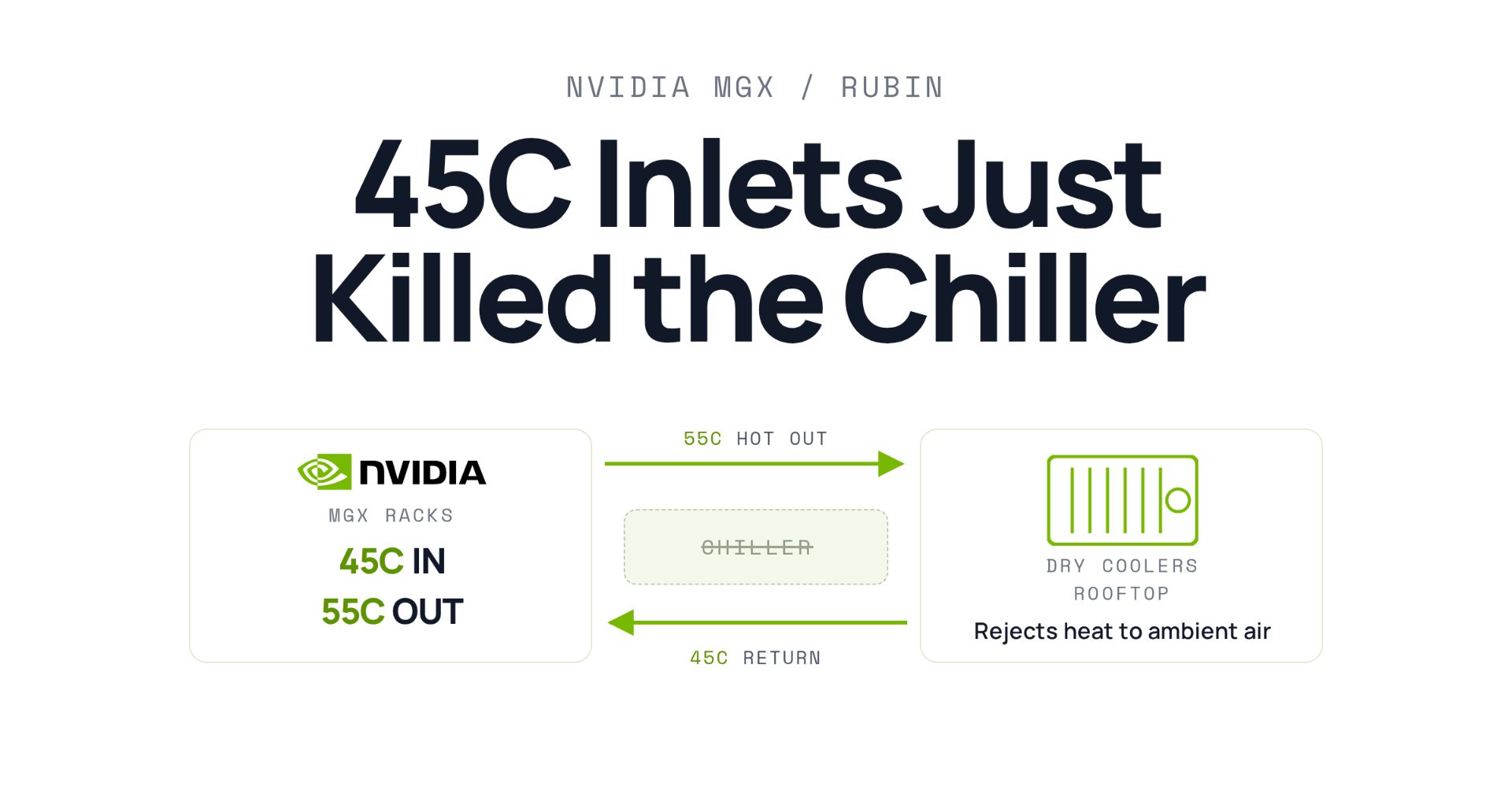
But the most consequential number of the year was not announced on a show floor. It came from NVIDIA, and it fits in a single sentence: its rack-scale systems, from GB200 NVL72 through GB300 and the Vera Rubin generation, are designed to operate with liquid coolant entering the racks at up to 45 degrees C (113 F). That number quietly rewrites the economics of data center cooling, and most of the industry has not fully registered what it means yet.
Why 45 degrees C flips the equation
Most liquid-cooled data centers have been engineered around coolant inlet temperatures of 30 to 35 degrees C. That was the practical limit chips would tolerate, and it is also the number around which mainstream direct liquid cooling designs had converged. The consequence of keeping water that cool is that most climates require mechanical chillers, essentially giant refrigerators that burn electricity to make cold water colder.
Raise the acceptable inlet to 45 degrees C and the math inverts. Coolant that only needs to be lukewarm can be rejected to ambient air in most places on Earth using rooftop dry coolers, which are large air-to-liquid heat exchangers with fans and finned coils. There are few locations where outdoor temperatures approach 113 F, and for the handful of hours each year when ambient spikes, adiabatic assist can bridge the gap by trickling water through a mesh around the dry coolers, dropping effective temperature another 10 to 20 percent.
The physics is not new. ASHRAE's thermal guidelines have accommodated warm water since 2011, and European supercomputing centers were running hot-water loops more than a decade ago. Leibniz Supercomputing Centre's SuperMUC ran coolant at up to 45 degrees C in 2012, and its successor pushes water to 50 degrees C while heating LRZ's offices with the waste heat. What is new is the default. The vendor whose racks anchor the AI buildout has made 45 degrees C the universal design point for its entire MGX rack line, and the facility ecosystem underneath now has to engineer to that number whether it was ready or not.
The new cooling architecture
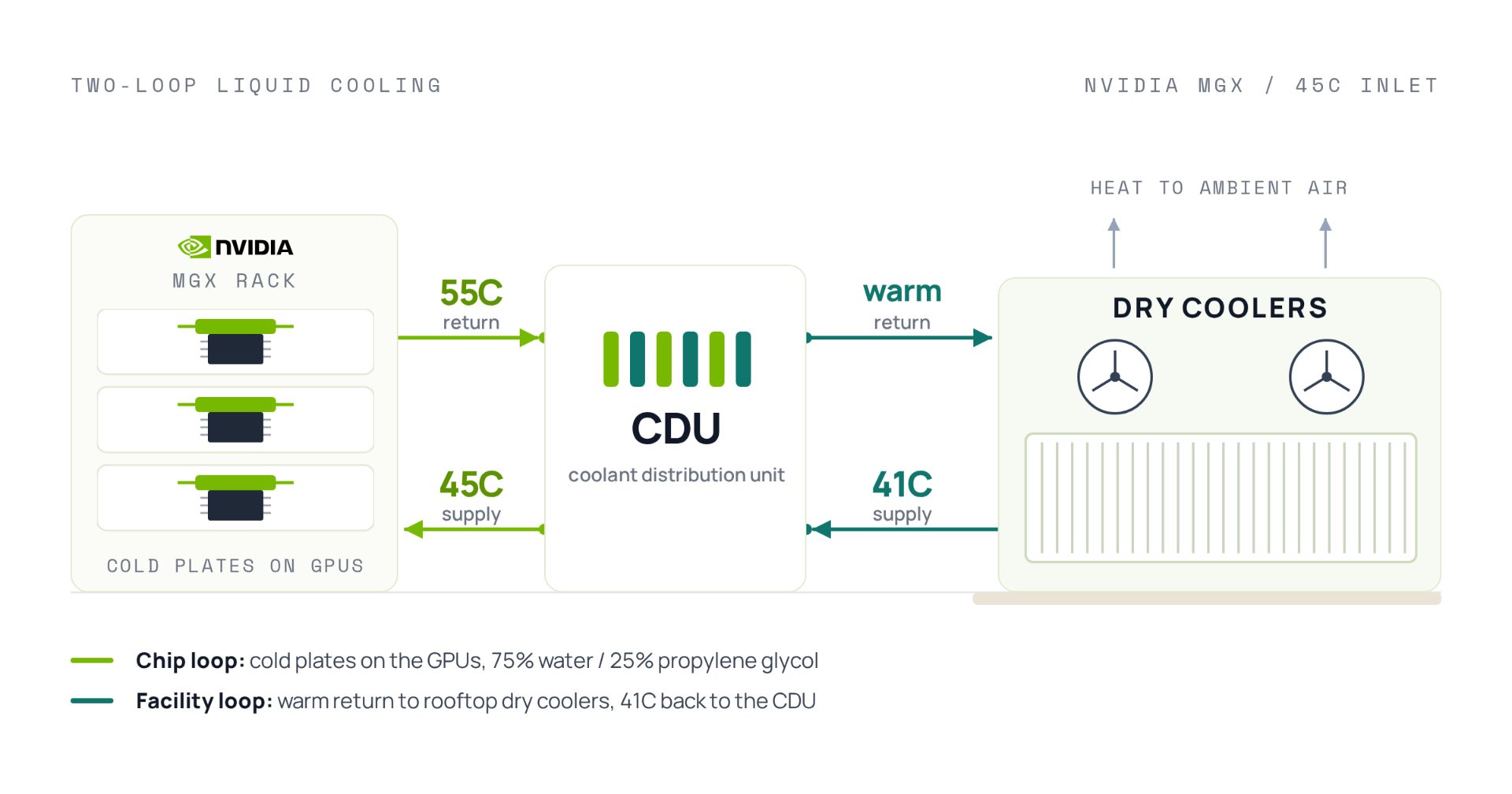
In the post-chiller world, the facility runs two closed loops. The technology cooling system loop carries coolant, typically a mix of 75 percent water and 25 percent propylene glycol, through cold plates directly onto the processors. In NVIDIA's published design, fluid enters the chips at up to 45 degrees C and exits at roughly 55 degrees C. That ten-degree rise is the heat leaving the silicon.
The second loop carries that hot water to the roof, where dry coolers reject it to ambient air, and returns it to the building. Rubin goes further than previous generations by committing completely: the design is fully liquid-cooled, with internal fans gone entirely, while GB200 and GB300 remain hybrid designs shedding roughly 10 to 15 percent of their heat to air.
The facility-level schematic matters too. NVIDIA's reference architecture feeds coolant distribution units at roughly 41 degrees C, and the CDUs supply 45 degrees C fluid to the racks. Four degrees sounds like a rounding error, but ASHRAE's W-classes are defined at the facility water supply, so an operator who reads 45 degrees C as a facility-loop number will size heat rejection against the wrong figure.
What disappears: the chiller plant
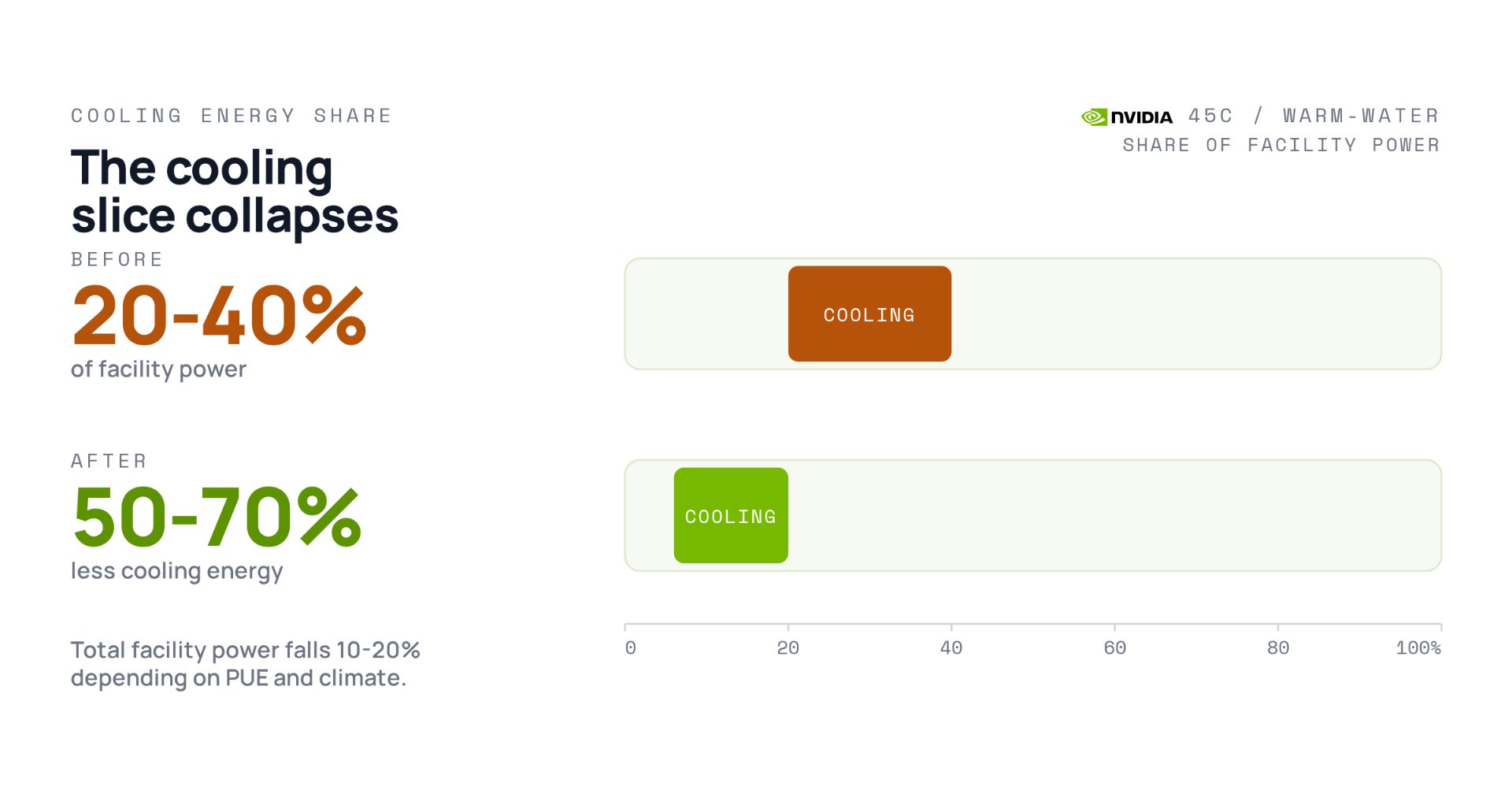
The thing missing from this picture is the chiller, and that is the point. Legacy designs that rely on chillers and open evaporative towers commonly put 20 to 40 percent of total facility energy into cooling, and a large share of that is the chiller plant itself: compressors, pumps, and cooling-tower fans. Compressors are the hungriest equipment in a conventional cooling chain.
Dry coolers running against a 45 degrees C inlet replace compressors with fans, which consume a fraction of the power. Vendor modeling and published estimates for high-temperature liquid loops put the reduction in cooling energy in the 50 to 70 percent range versus a conventional chiller-plus-tower plant, which translates into a 10 to 20 percent drop in total data center power depending on starting PUE and climate. One cooling vendor reports that every additional 1 degree C of inlet temperature cuts cooling energy cost by 3 to 4 percent, a figure that compounds meaningfully at scale.
The capital story is just as significant. A chiller plant is not only an operating cost; it is equipment that must be sized, installed, maintained, and eventually replaced. Dry coolers are simpler, cheaper to install, and have far fewer moving parts. When the chips accept 45 degrees C fluid, the business case for putting a mechanical refrigeration plant on the roof of a new build gets hard to defend in most climates.
Water: the number that matters even more
Water use falls harder than power. Conventional evaporative cooling towers consume on the order of 2.6 million gallons per megawatt per year, because they shed heat by evaporating water into the sky. A closed warm-water loop rejects heat sensibly through dry coolers and consumes essentially no outside water in normal operation. Adiabatic assist only wets the mesh during the hottest hours, cutting annual water consumption by 80 to 95 percent in most climates.
NVIDIA's projections put the figure at near zero under favorable conditions, with headline economics of more than 4 million dollars in annual cooling energy and water savings for a 50 MW facility. Those are marketing figures with no independent production measurements behind them yet, but the direction follows from the physics, and the water argument has consequences beyond the utility bill. Data centers face rising scrutiny over resource consumption, and a design that runs nearly water-free gives operators a far stronger position in permit hearings and community negotiations. For water-stressed regions, including Gulf states pairing abundant power with scarce water, this architecture reads as purpose-built.
The one percent problem
The chiller-free claim deserves its caveat, and NVIDIA's own director of data center cooling supplies it. Dry coolers can carry the load outside of maybe 1 percent of the year when chillers might be needed in some climates. One percent of a year is about 88 hours, and those hours arrive on the hottest afternoons, exactly when a dry cooler is weakest, because a dry cooler's capacity scales with the gap between water temperature and ambient air. With 45 degrees C water on a 35 degrees C afternoon, the system has only ten degrees to work with.
In practice, most designs still build or retain mechanical cooling sized for worst-case conditions. What the spec changes is how many hours a year it runs. In hotter climates where summer ambients exceed 40 degrees C, the gradient a dry cooler needs erases entirely, so year-round chiller-free operation is off the table and mechanical cooling remains a seasonal workhorse. There, the spec changes the water bill rather than eliminating the chiller.
Getting to 45C is not free
Designing around higher inlet temperatures takes real engineering. Loop sizing, dry cooler selection, flow rates, pressure drops, and control tuning all have to be validated at the new set points. Raising the inlet temperature also shrinks thermal margin, which relocates complexity upstream into the components where stability is actually determined: cold plates, coolant distribution units, and hydraulic controls.
Where cold facility water once masked minor hydraulic imbalances, warm-water conditions expose them as plate-to-plate variance, pump cycling, or oscillating control behavior. Flow imbalance across parallel branches, localized high heat flux, transient load changes, and pump and valve response all become first-order engineering constraints. Achieving reliability at 45 degrees C requires precision, not just capacity, and validation under real workload patterns, because thermal behavior depends strongly on transient power draw.
Retrofitting existing facilities is its own problem. Buildings designed around 20 to 30 degrees C chilled-water plants can serve the new racks, but they only collect the efficiency dividend if they rebuild heat rejection around dry coolers. Pipes, pumps, and heat exchangers sized for older, colder loops need to be rechecked, and rack-level electrical upgrades for high-density systems can run from 60,000 to 195,000 dollars per rack. The economics of the spec clearly favor greenfield AI factories designed around it from the slab up.
The ecosystem is already moving
The market response has been fast. Cooling has consolidated around industrial buyers: Ecolab closed its roughly 4.75 billion dollar acquisition of CoolIT Systems in July 2026, Trane completed its purchase of LiquidStack in March, and Schneider Electric owns Motivair. Meanwhile anyone with an angle is entering the market, from LITEON's 176 million dollar stake in DCX to a wave of independents like ZutaCore and Iceotope raising strategic capital. Every vendor on the SC26 floor had something to say about higher inlet temperatures, whether or not they had a real story behind it.
One open question is whether AMD, Intel, and Arm will match NVIDIA's number. Nothing public has emerged from those vendors, and cooling attendees at SC26 were closed-lipped. But the cooling vendor side is happy to comply, and there is real money riding on it. Note also that a separate OCP effort, including NVIDIA itself among its members, had previously converged on 30 degrees C as a minimum coolant temperature for durable multi-generation data center designs. The tension between that roadmap and the 45 degrees C rack spec is exactly the kind of inconsistency facility engineers will have to reconcile.
Why this hasn't sunk in yet
The temperature is not the news; the default is. Warm-water cooling has been technically viable for fifteen years. What changed is that the vendor anchoring the AI buildout wrote 45 degrees C into the product line across three generations of racks, roughly 15 degrees above where mainstream designs had converged, in a single product cycle. Dry cooler manufacturers, CDU vendors, colocation operators, and competing accelerator programs will now spend years being measured against that reference.
The changes reach beyond engineering. A facility that needs chillers only a tiny fraction of the year buys fewer of them, or none, shifting construction budgets away from heavy mechanical plant and toward piping, pumps, coolant distribution, and heat rejection surface. The arithmetic also matters to anyone working inside a fixed power envelope: with cooling energy recovered, NVIDIA's own modeling suggests enough headroom to allocate up to 10 percent additional racks in the same power budget.
The part that has not yet registered outside the cooling specialists is the compound effect. Power savings of 10 to 20 percent, water savings of 80 to 95 percent, and a smaller, simpler mechanical plant, all from one number printed in a rack specification. It also starts to answer some of the legitimate objections raised by communities facing new data center builds, at least the ones grounded in real engineering rather than inflated assumptions about water use. The chiller is not dead everywhere, and it will keep running its 88 hot hours a year in most places. But for new builds in most climates, the era of the big rooftop refrigerator is ending, and the industry is only beginning to do the accounting.
References
- 45C inlets just killed the chiller. Most people haven't noticed yet (The Register)
- NVIDIA's 45C Cooling Spec Isn't New Physics. It's a Forcing Function for the Supercomputing Data Center (Supercomputing.news)
- NVIDIA's Warm-Water Cooling Shift and Its Implications for AI Data Center Infrastructure (Advanced Cooling Technologies)