
On October 28, 2026, Google used its parent company's quarterly earnings call to make a quiet but consequential announcement: advertising inside AI Mode, the conversational layer of Search, is leaving the United States. Ads in AI Mode are now live in Australia, Canada, India, Kenya, Malaysia, New Zealand, Nigeria, Pakistan, the Philippines, and Singapore, with Brazil, Mexico, and the United Kingdom slated for the fourth quarter. In the US, Google is adding multiturn ads that can appear inside follow-up queries during an ongoing conversation. The timing is not accidental. Alphabet reported $127.6 billion in quarterly revenue, up 25% year over year, and crossed a half-trillion-dollar annual run rate. Yet Google Search and other advertising grew 12% to $63.35 billion, down from 17% growth in the second quarter and 19% in the first. The company's shares fell sharply after the print. The message from management was essentially that AI search is growing faster than Google can monetize it, and the fix is to sell ads in more places. A STRONG QUARTER WITH A SOFT SPOT IN THE MIDDLE The headline numbers looked healthy. Consolidated operating income rose 30% to $40.6 billion, operating margin reached 31.8%, and Google Cloud revenue more than doubled to $30.7 billion on demand for AI infrastructure. First-party model APIs were processing close to 32 billion tokens per minute, more than four times the volume of a year earlier, and the Gemini app passed one billion users. Advertising told a different story. Total Google advertising revenue reached $82.0 billion, up 10.6%, with YouTube ads contributing $11.2 billion and the Google Network $7.5 billion. Search, the engine that funds most of Alphabet's ambitions, decelerated for the third consecutive quarter. Chief Business Officer Philipp Schindler attributed part of the slowdown to foreign exchange movements, which he called the single largest drag. He also pointed to category-level shifts: some Asia-Pacific retail advertisers pulled back after the European Union removed its de minimis exemption, and media and entertainment spending normalized following the FIFA World Cup. Those are cyclical explanations. Then he offered a structural one. "The strong growth in AI Mode queries had an impact because of the lower monetization we were seeing in AI Mode," Schindler told analysts. In other words, the product Google is most eager to promote generates less revenue per query than the ten blue links it is gradually replacing. WHAT GOOGLE SHIPPED, AND WHERE The rollout is documented in a Google Ads post by Shashi Thakur, VP and GM of Search Ads. Ads will carry a clear "Sponsored" label, and the company says it will keep testing new formats. The geographic list is deliberate. Beyond the familiar English-language markets of Australia, Canada, and New Zealand, it includes India, Pakistan, the Philippines, Malaysia, Singapore, Kenya, and Nigeria, a mix of large, fast-growing mobile-first populations where conversational search may spread faster than desktop keyword search ever did. Multiturn ads are the more interesting product change. Traditional search advertising assumes a single query with a discrete intent. A conversation has a shape: someone asks about a category, reacts to an answer, narrows a shortlist, and then asks a follow-up. Multiturn ads let a sponsored placement follow the user into that follow-up rather than waiting for a new search box interaction. This builds on formats Google announced at Marketing Live in May 2026, including conversational discovery ads that respond to a user's specific question with creative assembled per query, and highlighted answers that place a sponsored recommendation inside a list of AI-generated suggestions. The through line is consistent: ads sit beside the AI answer, labeled and separate, and never alter the organic response itself. WHY LONGER QUERIES CHANGE THE MONETIZATION MATH The case for AI Mode advertising rests on query behavior. Google says queries in AI Mode run about three times longer than traditional searches. One in five AI Mode searches globally involves voice, images, or documents, and Google reports more than 50 billion visual searches per month. Longer queries carry more context. A person typing "running shoes" gives an auction a keyword. A person describing a half-marathon, a history of plantar fasciitis, a modest budget, and a preference for wide toe boxes gives an auction a brief. Schindler framed much of this as upper-funnel demand: users asking questions earlier in the purchase journey, before they have settled on a product, which Google describes as new high-value commercial intent rather than a replacement for existing intent. He added that the majority of AI Mode queries are incremental. Google also claims the formats are working. According to Schindler, click-through rates for sponsored product listings in AI Mode are already comparable to those for organic product listings, and internal research suggests users find the ads relevant. Both claims are directionally encouraging and notably imprecise. Google has not published the underlying click-through rates, has not compared them with conventional Search ads, and has not disclosed how much revenue AI Mode advertising generates. The gap between "users tolerate ads" and "advertisers get returns" is where this expansion will be judged. THE ADVERTISER SIDE OF A CONVERSATIONAL AUCTION For media buyers, the practical question is what to change. The answer is less about bidding tactics than about the inputs Google's models consume. Gemini now generates and assembles creative rather than serving a single static asset. Sparse product feeds produce weak conversational creative; complete feeds with accurate attributes, inventory, and descriptive product detail give the model better material. Landing pages matter more, not less, because a user arriving from a refined, exploratory conversation brings specific expectations that a generic page will fail to meet. And the campaign types Google points advertisers toward, AI Max and Performance Max, are the same ones that reach AI Overviews and AI Mode placements today. Google says the tools are already producing volume. Gemini models helped advertisers generate more than 1.5 billion campaign assets in the third quarter, over seven times the number a year earlier. The company also reported a 19% increase in user satisfaction after its largest update to product listing ads in a decade, with dissatisfaction falling by more than half. Telstra, cited on the call, saw a 52% increase in conversions and a 36% reduction in cost per order using AI Max to capture long-form and multilingual queries. Those numbers describe the tooling, not the new inventory. Scaling ads into ten markets is a distribution decision. Whether it produces durable revenue depends on whether advertisers can measure what a conversational placement is worth. THE COMPETITIVE CLOCK Google is not moving first. OpenAI introduced advertising in ChatGPT in India in late August 2026, partnering initially with WPP and Omnicom before opening a self-service Ads Manager, and disclosed a $1 billion annualized revenue run rate within roughly 200 days of launch, with tens of thousands of advertisers across more than 40 countries. It has since tested sponsored agents that let a user click an ad and begin a conversation with a business-sponsored assistant, and expanded visual formats and measurement partnerships. That puts a different kind of pressure on Google. Search advertising has been a keyword auction with two decades of attribution infrastructure behind it. Conversational advertising is a newer category where the pricing model, the measurement standard, and the user tolerance are all still being negotiated. Google's advantage is that its AI Mode placements plug into existing Google Ads accounts, so an advertiser already running Search campaigns can extend reach without rebuilding a measurement stack. Its disadvantage is that the same advertiser will ask why a longer, more expensive query produces less revenue than a short one. Google is also building toward agentic commerce, including the Universal Commerce Protocol that enables direct checkout across hundreds of thousands of brands. Schindler said the company is designing these experiences to preserve product discovery and consumer choice even when AI agents handle parts of the shopping process. If agents eventually complete purchases on a user's behalf, the sponsored recommendation may matter more than the click. WHAT THE EXPANSION DOES NOT SOLVE The announcement addresses coverage, not economics. Several open questions remain. First, Google has not quantified AI Mode revenue or its drag on the Search line. Analysts can see the deceleration but cannot isolate how much of it is AI Mode mix, how much is currency, and how much is category softness. That ambiguity is part of why the stock reaction was severe. Second, the near-term outlook is cautious. Finance chief Anat Ashkenazi said Google is absorbing roughly two percentage points of headwind in the fourth quarter from the base effect of accelerated Search growth in late 2025, alongside adverse currency movements. Both Search and YouTube advertising are likely to remain under year-over-year pressure. Third, the cost side is intensifying. Capital expenditure reached $51.4 billion in the quarter, and Alphabet maintained a 2026 outlook of $195 billion to $205 billion while warning that 2027 spending will rise significantly. Free cash flow turned negative at $9.07 billion, which management attributed largely to timing: TPU systems are built and stocked before revenue is recognized, and the cloud backlog now stands at $561 billion. Investors are being asked to accept a lag between spending and return. Fourth, trust remains the unresolved variable. Ads in AI-generated answers invite a specific skepticism that banner ads never faced: if a sponsored product appears inside an answer, users may wonder whether the answer itself was influenced. Google's design answer is separation and labeling. The Gemini-written explainer that accompanies the new formats is meant to make the reasoning visible. Whether that is enough to preserve confidence at scale is an empirical question, and the ten new markets are the test. WHAT TO WATCH NEXT The fourth quarter brings Brazil, Mexico, and the United Kingdom, which will say something about how the formats perform in larger, more mature ad markets with different competitive dynamics. The Q4 call should provide more detail on 2027 capital spending, and possibly the first real disclosure on how AI Mode inventory is priced and performing. For advertisers, the useful preparation is unglamorous: complete product feeds, diversified creative assets, landing pages that answer the question the user actually asked, clean first-party conversion signals, and campaigns structured to be eligible for AI surfaces rather than shielded from them. For Google, the wager is that a search experience people use more, with queries three times longer and increasingly multimodal, will eventually monetize at least as well as the one it is displacing. The company's own chief business officer has now said out loud that it does not yet. That is the honest shape of this moment. Google is not replacing search advertising with AI advertising so much as extending the same auction into a new interface and hoping the unit economics catch up before the patience of either advertisers or shareholders runs out. The expansion to ten markets is a bet that scale will do the catching up. The next two quarters will show whether the bet is working. REFERENCES * Google Ads: Ads in AI Mode Expand to New Markets * TechCrunch: Google Expands AI Search Ads Globally as Core Ad Growth Slows * Alphabet Announces Third Quarter 2026 Results
Startup news today
Latest news and SaaS launches and tech products
Even Healthcare has raised $50 million in an all-equity Series B round led by Khosla Ventures, with participation from Alpha Wave. The round values the Bengaluru-based managed-care startup at $300 million, triple its valuation 18 months ago, and brings its total capital raised to more than $120 million. The funding backs a bet against how Indian hospitals make money. Hospitals in India typically earn more when patients undergo additional tests, procedures, or longer stays, even when they may not need them. Even wants to change that by focusing on patient care rather than pushing unnecessary treatments that drive up medical bills. THE SHIFT TO OWNED HOSPITALS The startup was founded in 2021 by Mayank Banerjee, Matilde Giglio, and Alessandro Ialongo. It initially relied on partner hospitals to treat its members, but Banerjee said in an interview that the startup began questioning that model after finding that patients had undergone tests or been recommended surgeries it considered unnecessary. "We think patients are getting not only a bad experience, but insurers are getting a bad economic deal. And as a result, we decided to fix it by building our own hospitals," Banerjee told TechCrunch. Even has since opened two hospitals in Bengaluru, both of which reached operational profitability, excluding depreciation, within a year of opening, Banerjee said. The startup plans to open five more hospitals in the city over the next six months, funded by the latest round. It leases hospital buildings on 20-year agreements and spends on fitting them out and buying medical equipment. The compensation model is central to the approach. Even pays its doctors fixed salaries, not tying their pay to the number of tests or surgeries they perform, though doctors can earn bonuses based on patient-reported clinical outcomes. Hospital management compensation is likewise not linked to procedures. Every employee, including doctors and hospital staff, receives equity in Even. EARLY RESULTS Most of Even's revenue comes from patients paying for treatment. The startup also generates revenue through its relationships with insurers and is working with insurer partners on a model that could compensate it for hospitalizations it helps prevent. Even says its hospitals have an unplanned readmission rate of less than 1%, compared with an industry benchmark of 8% to 15%. It claims patients spend 40% less time in the hospital and that the approach has saved insurers more than 500 million rupees (about $5.27 million). Khosla Ventures has invested in Even since its seed round in 2021. Vinod Khosla, the firm's founder, said in a prepared statement that the goal is to reward better health outcomes rather than greater use of healthcare services. "The clinical and economic results so far give us conviction that this can become an important new model for healthcare in India and beyond," he said. Jai Sajnani, a partner at Khosla Ventures, told TechCrunch that the early performance of Even's hospitals was a key reason the firm led the round. The startup still loses money. Even posted a net loss of 902 million rupees (about $9.50 million) in fiscal 2025, nearly 25% more than the previous year, on revenue of 272 million rupees (about $2.86 million), regulatory filings show. In August, it laid off about 350 employees, according to Indian startup-news website Entrackr. Banerjee acknowledged the restructuring and called it a difficult decision, saying affected employees received severance, extended health insurance, and accelerated equity vesting. Even employs about 650 people, including around 300 doctors full-time. It has about 250,000 members and has recorded more than 750,000 patient interactions since its launch in 2021. Banerjee told TechCrunch that Even could turn profitable within months if it stopped spending on expansion, but the startup is choosing to grow instead. "Right now, we're investing in growth and serving more patients," he said.
The solo founder behind KiteDocs, a documentation hosting tool, posted on Indie Hackers this week that a changelog can do marketing for an indie product. The pitch is simple: write about your own progress, about what you know well, and readers will follow how the product grows. To prove it, the founder published their own changelog at kitedocs.com/docs/changelog, with screenshots of how it looks on desktop and mobile. The post, from October 17, frames the changelog as a low-effort content channel for founders who build in public. "It's always fascinating to read about how a product grows and develops, what founders do to make it better," wrote Aspiring Dev, the founder's name on Indie Hackers. They said they have not automated anything yet, but added that with KiteDocs it is easy to create content of almost any type: a diary, documentation, a user guide, an API reference. WHAT KITEDOCS IS KiteDocs is a platform for creating, managing, and publishing documentation online, built for product teams, startups, and enterprises. The founder says they started it because every new project brought the same problem: paid solutions were greedy, open-source tools were hard to use, and organizing docs under a folder was a nightmare. The tool handles knowledge bases, user manuals, product documentation, and playbooks. Custom domains work on every plan, and docs can be hosted on a subdomain or a subfolder. Pricing runs from a free plan with 20 pages, to Startup at $10 a month for 100 pages, Pro at $29 a month for 500 pages, and Business at $79 a month for unlimited pages. White-labeling and AI-powered search sit on the paid tiers, with AI searches described as coming soon. Non-technical users can publish through a visual editor, templates, and auto-generated navigation. A DOCUMENTATION SURVEY AS A LEAD MAGNET Three days earlier, on October 14, the same founder posted a second appeal on Indie Hackers: answer questions about how you handle documentation and get free lifetime access to the PRO plan, normally $29 a month with unlimited projects and 500 pages. The questions asked whether readers have documentation, whether it lives on a subdomain or a subfolder, which tool they use, and where they host their website. The subfolder question targets a known pain point. The founder argues that most founders put documentation on a subdomain rather than a subfolder, even though a subfolder looks more professional and helps with SEO, because subfolder setup is hard. They figured it out for Linux and shared the configuration steps, while acknowledging that not everyone runs Linux or has direct server access. The offer is a practical growth move for a solo project: free lifetime access in exchange for a detailed answer and an email address, which the founder needs to adjust account limits. The changelog post closes the loop by inviting readers to start posting their own progress and to request features KiteDocs does not have yet. Whether a changelog truly does marketing for a founder depends on whether anyone reads it. The founder's own changelog sits on the KiteDocs domain, which is also the product being marketed, so its audience is limited to people who already found the tool. Still, for a solo founder with no marketing budget, publishing progress in public is one of the few channels that costs nothing but writing time, and the tool now exists for exactly that purpose.
APPLE'S 14-INCH MACBOOK PRO GETS THE M6: FASTER SILICON, WI-FI 7, AND A FAMILIAR SHELL Apple announced a refreshed 14-inch MacBook Pro on October 27, 2026, built around its new M6 chip. The starting price is $1,999, preorders open October 28, and the laptop reaches stores on November 6 in space black and silver. Alongside it, Apple refreshed the 24-inch iMac with the same M6 silicon, continuing a busy week that started with a new iPad mini and ends with the company's "Pro and Tell" event. The headline is the chip. The enclosure, display, port layout, camera, and speaker system all carry over from the M5 generation. That makes this a spec-bump release in the traditional sense, with the interesting work happening underneath the aluminum rather than on the outside of it. WHAT THE M6 ACTUALLY CHANGES The M6 moves to a 2-nanometer manufacturing process, up from the third-generation 3nm node used for M5. Apple increased both core counts: the CPU goes from 10 cores to 12, and the GPU goes from 10 cores to 12. According to Macworld's breakdown of the chip, the 12-core CPU is split into two super cores, four performance cores, and six efficiency cores, a different arrangement than the M5's four super cores and six efficiency cores. The Neural Engine doubles from a single 16-core unit to a dual 16-core configuration. Apple claims that translates to up to 1.9 times the Neural Engine performance of M5. The GPU keeps Neural Accelerators in each core, along with hardware ray tracing and Dynamic Caching, which lets the chip allocate on-chip memory dynamically based on what a workload needs. Unified memory bandwidth rises from 153GB/s to 170GB/s. Capacity is unchanged: 16GB standard, with 24GB and 32GB available as upgrades. More bandwidth helps everywhere, but it matters most for GPU-heavy work and for running language models locally, where throughput between the chip and memory is often the limiting factor rather than raw compute. THE PERFORMANCE CLAIMS, AND WHAT THEY COMPARE AGAINST Apple's numbers fall into two groups, and it is worth keeping them separate. Against the M5, the gains are moderate but real. Apple claims up to 30 percent faster graphics, up to 25 percent faster AI workloads, and up to 1.3 times faster time to first token for LLM prompt processing. Blender ray-traced renders are quoted at up to 1.3 times faster, Affinity image processing at up to 1.2 times faster, and Xcode project builds at up to 1.3 times faster. Those are the kind of generational improvements you would expect from a process shrink plus two extra CPU and GPU cores. Against the M1, the gap is enormous. Apple compares the M6 machine to the 13-inch MacBook Pro with M1 and quotes up to 13 times faster LLM prompt processing, up to 11.7 times faster ray-traced rendering in Blender, up to 3.3 times faster Affinity image processing, and up to 2.5 times faster Xcode builds. These figures are doing most of the marketing work, and they are aimed squarely at the large installed base of people still running Apple's first-generation laptop silicon. As always, these are vendor benchmarks run under conditions Apple chose. Independent testing will show how the numbers hold up in real applications, particularly for sustained workloads where thermal behavior matters more than peak burst performance. WI-FI 7 AND BLUETOOTH 6 ARRIVE ON THE BASE MODEL The most tangible external change is wireless connectivity. The M6 MacBook Pro supports Wi-Fi 7 (802.11be) and Bluetooth 6, replacing the M5 model's Wi-Fi 6E and Bluetooth 5.3. The Verge notes that this comes through Apple's N1 wireless networking chip, which previously appeared only on MacBook Pro configurations with the M5 Pro and M5 Max. Wi-Fi 7 availability depends on your country and your router, so the upgrade only pays off if the rest of your network supports it. Bluetooth 6 is similarly forward-looking. Neither will change how the laptop feels on day one, but both extend the machine's useful life as access points and accessories catch up. Everything else on the connectivity side is unchanged: three Thunderbolt 4 ports that all support charging and DisplayPort output, MagSafe 3, full-size HDMI, an SDXC card slot, and a 3.5mm headphone jack with support for high-impedance headphones. BATTERY, DISPLAY, AND THE SMALL PRINT Apple rates the M6 MacBook Pro at up to 24 hours of video playback or up to 16 hours of wireless web browsing, with a 72.4Wh battery. Those are the same figures as the outgoing model, which is unsurprising given the identical chassis and battery capacity. Fast charging reaches 50 percent in 30 minutes, but only with a 96W or higher USB-C Power Delivery adapter. The 70W adapter included in the box in the U.S. does not meet that threshold, so buyers who want fast charging should plan on a separate higher-wattage brick. This is not new behavior for the line, but it is easy to miss. The display is the same 14.2-inch Liquid Retina XDR panel: 3024 x 1964, ProMotion up to 120Hz, 1,600 nits peak HDR brightness, and 1,000 nits sustained full-screen HDR. The nano-texture glass option, which cuts reflections, is now available on this model for a $150 upgrade. The 12MP Center Stage camera and six-speaker sound system also carry over. PRICING AND CONFIGURATIONS The base 14-inch MacBook Pro with M6 costs $1,999 and ships with 16GB of unified memory and 1TB of storage. Memory upgrades cost $200 for 24GB and $400 for 32GB. Storage upgrades cost $500 for 2TB and $1,500 for 4TB. A fully loaded 32GB/4TB configuration lands at $3,899. The pricing deserves a closer look. As Macworld points out, the M5 model launched at $1,599 in October 2025, and its current listing price had already risen to $1,999 before the M6 arrived. So the new machine matches the outgoing price but sits $400 above where the previous generation started a year ago. That increase lines up with the memory supply crunch that has pushed DRAM and LPDDR5X prices sharply higher through 2026 and forced price hikes across the PC industry. Apple is not alone here, but anyone upgrading from an older machine should budget with current pricing in mind rather than last year's. THE 16-INCH MODEL IS A DIFFERENT STORY One detail worth flagging: the 16-inch MacBook Pro is not part of this update. Buyers who want the larger machine are still limited to the M5 Pro and M5 Max chips introduced earlier in 2026, not M6 silicon. Apple has a history of staggering releases like this, splitting the base chip from the Pro and Max variants across different launch windows, and the current lineup reflects that pattern. The timing also matters. Apple's "Pro and Tell" event on October 28, the day after this announcement, is widely expected to focus on touchscreen OLED MacBook Pro models. Announcing the M6 refresh by press release a day before a hardware event suggests Apple wants to clear the spec-bump news out of the way so the event can focus on the redesigned machines. If you are considering the M6 model and a touchscreen or OLED panel would change your decision, waiting a day costs nothing. WHO SHOULD UPGRADE If you are still on an M1-era MacBook Pro, the case is straightforward. The performance gap in Apple's own figures is measured in multiples rather than percentages, and the battery, display, and connectivity improvements compound over five years of silicon development. The same applies to anyone coming from an Intel-based Mac, who additionally gets 16GB of starting memory, an extra Thunderbolt port, and the space black finish with an anodization seal that resists fingerprints. If you bought an M5 model in the past year, the upgrade calculus is much weaker. A 25 to 30 percent improvement in graphics and AI workloads is meaningful for people whose work is limited by those specific tasks, but it is not the kind of jump that justifies replacing a machine that is still under a year old. Independent benchmarks, particularly for sustained work like video export or long compile runs, are worth waiting for before deciding. If you are choosing between configurations, put the money into memory before storage. The 16GB base is fine for everyday productivity and most development work, but 24GB gives headroom for heavier multitasking and creative applications, and 32GB is the practical choice for local AI work or large projects. Storage can be managed with external drives; unified memory cannot be added later. The M6 MacBook Pro is not a redesign, and Apple is not pretending otherwise. It is a chip refresh that improves the parts of the laptop you cannot see, adds wireless standards that will matter more over time, and keeps everything else that made the previous model a solid machine. For a certain kind of buyer, particularly anyone arriving from M1, that is enough.
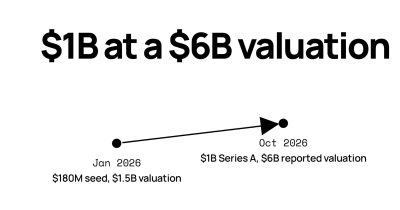
On Wednesday, Flapping Airplanes said it raised a $1 billion Series A round co-led by Index and Lux, reportedly at a $6 billion valuation. The company is a year old and has no product on sale. The round lands nine months after the San Francisco lab launched with a $180 million seed from GV, Sequoia and Index at a $1.5 billion valuation. The new price is four times that. Bloomberg, which first reported the valuation, counts $1.18 billion invested in the company in total. Sequoia, GV and Kleiner Perkins, all early backers, returned for the new round. Valor, Atreides, A* and Nvidia also appear on the investor list. Index partner Mark Xu joins the board, according to SiliconANGLE. A TEAM INVESTORS ALREADY KNEW The company was founded by Aidan Smith and brothers Asher and Ben Spector. Smith is a former founder and Thiel fellow who worked at the brain implant company Neuralink during college. Asher Spector was a statistics PhD at Stanford. Ben Spector was a computer science PhD student at Stanford and founded Prod, a student-run startup accelerator, while at MIT. Prod is five years old and has been described as something close to a secret society. Sequoia partner David Cahn, who invested in Flapping Airplanes, wrote earlier this year that Prod had "become one of the most powerful talent incubators in Silicon Valley." He said the founders "are building the 'young person's AGI lab.'" That reputation carried the round as much as the technical pitch did. The company is a couple of dozen people working in person in San Francisco, and investors are paying for the team before there is revenue to measure. ONE PROGRAM, SEVERAL JOBS The technical pitch centers on what the founders call a megakernel framework. A kernel is a program that runs on a GPU. A megakernel bundles many tasks into a single program so the chip spends less time switching between them. In the founders' words, it is "the world's most complete megakernel framework. It can perform entire training runs, serve inference, play video games, and even do all three simultaneously in a single kernel." They say it "can overlap memory-bound inference with compute-bound training," which pairs a task that mostly waits for data with one that mostly does arithmetic. The chip sits idle less often. The premise behind that work is that AI has barely scratched the surface of what GPUs can do. The founders argue intelligent systems can be built "without ingesting half the internet." The goal is models that cost less to train and run, which is where the data-efficiency mission comes in. "A model that's a million times more data efficient is probably a million times easier to put into the economy," Asher Spector told TechCrunch shortly after the startup launched. WHAT THE MONEY HAS TO PROVE None of those capabilities have been shown in a product or measured in independent benchmarks. They are the founders' own claims, and the $6 billion price rests on them. Asher Spector told TechCrunch in February that he could not give a timeline for commercialization, according to Tech Funding News. He told Bloomberg the lab intends to sell its technology eventually, so other companies can run AI more cheaply. The near-term test is narrower than the mission. A megakernel has to produce measurable speedups on hardware customers already own, before anyone can judge whether overlapping training and inference works outside a demo. Flapping Airplanes belongs to a small group of labs that raise at large valuations on research rather than products. Its first year went into low-level work on GPU primitives, and the company says that work makes new algorithms possible. The $1 billion buys time to show the rest of it.
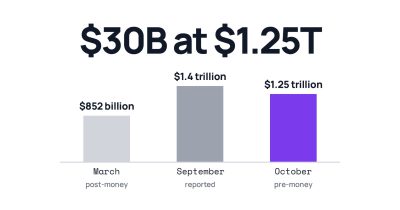
OpenAI is working on raising up to $30 billion at a $1.25 trillion pre-money valuation, with Coatue and investors from the United Arab Emirates leading the round, according to sources who spoke to CNBC. The company declined to comment. If it closes above $1 trillion, OpenAI becomes the most valuable private company on record. Its last round, closed in March, valued the ChatGPT maker at $852 billion post-money. The new figure is a step up of roughly 47% in seven months, and it excludes the new capital itself. CNBC reports the financing is being presented to investors as an "opportunistic" bridge ahead of a possible IPO. OpenAI told investors on Thursday it is aiming to have signatures by the end of next week, though the final size of the round is still being settled, according to people familiar with the deal. TWO PRICES, ONE MONTH APART A month ago Bloomberg reported OpenAI was working on $30 billion at a $1.4 trillion valuation. The number now circulating is lower. Terms are still under negotiation, and both outlets say the figures could change before anything is signed, so the gap is a measure of how live the talks are rather than a settled markdown. The valuation matters beyond the round. It sets a reference point for OpenAI's own listing and for the public debut of Anthropic, which is chasing a $1.5 trillion to $2 trillion valuation in its IPO, CNBC reports. Reuters reported that OpenAI wants commitments in hand before Anthropic's IPO disclosures invite direct comparisons between the two labs, according to Investing.com. CASH FOR COMPUTE The money is not only financial. CNBC reports the UAE investment could be paired with a commercial deal giving OpenAI more computing capacity from the country. OpenAI told investors in February that it is targeting roughly $600 billion in total compute spending by 2030. That spending is the reason the private rounds keep coming. OpenAI rents capacity across Microsoft, Oracle, AWS, CoreWeave and Google Cloud rather than owning data centers, and its March round was anchored by three suppliers, Amazon, Nvidia and SoftBank, with Microsoft also participating. THE LISTING STILL HAS NO DATE OpenAI filed confidential IPO paperwork with the SEC in June and has not said when it intends to debut. CFO Sarah Friar told employees in August that the company "will be a public company in 2027," CNBC reports. A month later, CEO Sam Altman said "right now would be an ill-advised moment to go public." Anthropic filed its own confidential paperwork in June, after raising $65 billion at a $965 billion valuation in May. Both companies are now raising or pricing against each other while still private, which is unusual: the benchmark for each IPO is being set in negotiated rounds that the public cannot see. The open question is whether investors will keep paying up. A $1.25 trillion pre-money figure commits new backers at a price roughly half again above March, before any public filing has shown audited revenue and losses. The earlier $1.4 trillion talk shows how quickly that appetite can move, in either direction, while the paperwork stays confidential.
Upwind closed a $400 million Series C on October 28, 2026, at a $3.8 billion valuation led by Bessemer Venture Partners. Canapi Ventures joined as a new investor, and every existing backer returned, including Greylock Partners, Craft Ventures, Cyberstarts, Salesforce Ventures, TCV, Alta Park, Penny Jar, Swish Ventures, Cerca Partners, Leaders Fund, and Picture Capital. The round brings cumulative funding past $800 million for a company that is four years old. The size of the check was not the most interesting part of the story. The deal that did not happen was. According to TechCrunch's reporting, Datadog spent months pursuing an acquisition of Upwind and ultimately came in at roughly the same $3.8 billion that venture investors had already agreed to pay. There was no premium above the private mark. Upwind declined and took the equity instead, choosing a cap table over a term sheet from a public company with a market capitalization near $90 billion. That choice is worth taking seriously, because it sits where three forces in enterprise software currently intersect: how cloud security products are priced, how AI has reshaped the perimeter those products are supposed to defend, and how few credible exit paths remain for a security company that wants to stay independent. WHAT UPWIND ACTUALLY SELLS It is easy to file Upwind under the generic label of cloud security, a category crowded with vendors whose pitch decks look interchangeable. The distinguishing claim is narrower and more technical than that. Upwind sells a cloud-native application protection platform built around runtime data. The conventional model in cloud security is to look at configuration. A tool pulls the state of an account through cloud provider APIs, compares it against a rule set, and produces a list of misconfigurations and vulnerabilities. That approach is useful and it scales, but it describes how an environment is configured rather than how it behaves. A resource can be flagged as publicly exposed and still be unreachable in practice. A vulnerability can score a 9.8 on CVSS and never be invoked in production. Security teams end up drowning in findings that are technically accurate and operationally meaningless. Upwind inverts the evidence chain. Greylock, which co-led the company's seed round and has backed every round since, described the approach at launch as combining previously unavailable runtime signals, including eBPF-based instrumentation and cloud infrastructure API telemetry, to build a real-time picture of what is executing inside the environment rather than what a periodic snapshot says about it. The practical consequence is prioritization: an exposure that is actually reachable, actually running, and actually touching sensitive data outranks one that exists only on paper. Upwind packages this as a consolidated CNAPP covering cloud security posture management, cloud workload protection, cloud detection and response, vulnerability management, identity security, container security, and API security. Consolidation matters here. Security leaders have spent several years trying to reduce tool counts, and a platform that answers posture, threat detection, and remediation questions from one dataset is easier to justify than four point products that each generate their own alerts. The company summarizes the philosophy as "inside-out" security, which is really an argument about evidence. Configuration snapshots are assumptions. Traffic, API calls, process behavior, and data flows inside a running workload are observations. Upwind's bet is that AI-era infrastructure, which is ephemeral by default, changes too fast for assumptions to hold. THE ROUND, THE RUMOR, AND THE REJECTION The fundraising itself follows a steep curve. Upwind raised $250 million at a $1.5 billion valuation in January 2026. Nine months later it closed $400 million at $3.8 billion, a valuation that more than doubled in less than a year and roughly eleven times its seed-era mark. The Datadog story requires some care, because the reporting is not unanimous. TechCrunch reported, citing a person familiar with Upwind, that Datadog attempted to buy the company and did not offer a premium above the $3.8 billion valuation set by venture investors, which is why Upwind stayed independent. Earlier reporting in The Information, relayed by Globes, described a roughly $4 billion approach that Upwind turned down. CTech subsequently reported that, based on its own reporting, the offer as described had not been made. Neither company commented publicly. What is not in dispute is more instructive than the discrepancy. Whether the bid was $3.8 billion, $4 billion, or something adjacent, the reported price sat at or barely above Upwind's freshly set private valuation. That is the detail that explains the decision. An acquisition at your last round price offers founders liquidity and certainty, but it offers almost no premium for the growth still ahead. For a company adding $20 million to $30 million in annualized recurring revenue every quarter, the forward-looking math favors staying private a while longer. It is also not the first time the two companies have circled each other. Upwind and Datadog reportedly discussed a deal worth around $1 billion the year before, which did not materialize either. The relationship reads less like a courtship that failed and more like a strategic interest that keeps getting re-priced as the target grows faster than the acquirer's willingness to pay. THE MATH BEHIND A 40X MULTIPLE Upwind's growth rate is the engine underneath the valuation. TechCrunch reported that the company has been adding $20 million to $30 million in ARR each quarter and is projected to finish 2026 at roughly $90 million. Earlier in the year, The Information reported that ARR had passed $50 million, up from about $20 million at the end of 2025. Upwind's own announcement framed the year as one in which revenue quadrupled. At $3.8 billion against roughly $90 million in projected ARR, the implied multiple is above 40x forward revenue. That sounds extreme until you place it against the rest of the category. Cyera, another fast-growing security company, was reported earlier in 2026 to be raising at around 80x ARR despite operating losses. Google's $32 billion acquisition of Wiz closed in March 2026 at roughly 32x the company's revenue, which for a business at that scale is an extraordinary outcome and a useful anchor for what strategic buyers will actually pay. Seen that way, 40x is aggressive but not unreasonable for a company compounding at this rate in a market with a structural tailwind. It is also the number that makes independence defensible. If the multiple compresses, or if growth decelerates faster than expected, the calculus changes quickly. Tomasz Tunguz of Theory Ventures has argued that cybersecurity is positioned to be the third major wave of AI software spending, following AI coding tools and customer support. The logic is straightforward: enterprises that deploy AI systems create new attack surface, and attack surface has to be defended. Whether or not that prediction holds exactly, it explains why capital is flowing into security at these multiples while other software categories have cooled. BUILDING FOR THE AGENTIC ERA Upwind's product roadmap over the past year reads like a company preparing for a threat model that most buyers have only started to articulate. In December 2025, the company launched an AI security suite inside its CNAPP. The components map onto a coherent set of problems. AI security posture management covers exposed inference endpoints, model versioning and governance, overly broad IAM roles, and leaked AI API keys. AI detection and response watches agents and LLM infrastructure for anomalous behavior and jailbreak attempts by analyzing process, network, and prompt payloads at layers 3, 4, and 7. An AI bill of materials inventories models, frameworks, SDKs, and agent systems across code, cloud inventory, and runtime evidence. Network visibility extends to AI-native protocols such as JSON-RPC and HTTP/2 streaming while flagging outbound calls to OpenAI, AWS Bedrock, Azure OpenAI, and Vertex AI. There is dedicated coverage for the Model Context Protocol, tracing the sequence from a prompt through downstream function calls, file operations, and resulting system changes. And AI security testing validates systems against adversarial techniques including the OWASP Top 10 for LLMs, prompt injection, jailbreaks, and unsafe tool bindings. The through-line is that AI risk cannot be assessed in isolation from cloud context. A model endpoint is not a separate universe from the workload that calls it, the identity that authorizes the call, or the data it reaches. Upwind's CEO Amiram Shachar framed it plainly: AI security should not be a stand-alone component, because it benefits from everything the CNAPP already knows. In January 2026, Upwind shipped Choppy AI, a natural-language layer across the platform. Users describe what they want in plain language, and the system translates that intent into structured, visible logic: query builder expressions for inventory search, editable rules for policy creation, and conversational investigation inside the vulnerability module. The design choice that matters is transparency. Most AI features in security tooling behave like black boxes, producing an answer without exposing how it was derived. For a rule that will be enforced in production, that is a hard sell to a security team that needs to defend the logic in an audit. Choppy AI keeps every generated query visible and editable, which is a statement about what security buyers will actually accept from AI. The company also introduced three named agents. A Blue Agent correlates across log sources to assemble a single attack narrative and handles exploitation attempts at runtime. A Red Agent safely tests whether exposures are genuinely exploitable in the customer's own environment, so teams can deprioritize theoretical findings. A Green Agent looks for the leverage points that can remediate thousands of findings at once. The framing is deliberate: the volume of AI-assisted attack activity is not something human triage can absorb, so response has to happen at machine speed with human judgment reserved for the decisions that need it. On the distribution side, Upwind integrated its CNAPP into the Extended plan of AWS Security Hub in February 2026, letting customers purchase through AWS with a single contract and consolidated billing and access Upwind from within the AWS console. That is unglamorous work, but it is how a security vendor becomes part of an enterprise's standard operating model rather than a separate procurement battle. The reference list has grown to include Siemens, Roku, Carvana, Nubank, Supabase, ClickUp, and Waste Management, whose CISO has publicly described a significant reduction in alerts and fewer irrelevant CVEs after rolling the platform across AWS and the broader cloud estate. A REPEAT FOUNDER WITH A FAMILIAR PLAYBOOK Shachar has done this before. He founded Spot.io, formerly Spotinst, which used machine learning to optimize cloud compute spend and was acquired by NetApp for $450 million in 2020. The founding team around him at Upwind, including Liran Polak, Lavi Ferdman, and Tal Zur, came from the same company. That history matters for reading the Datadog decision. A founder who has already sold a company, watched it scale inside a larger acquirer, and then started again has a different relationship with liquidity than a first-timer. The first exit answered the question of whether the outcome was possible. The second company is where the question becomes how large the outcome can get. The repeat-founder pattern also explains Upwind's operating tempo. The company went from stealth in September 2023 to a $1.5 billion valuation in January 2026 to a $3.8 billion valuation nine months later, and it acquired the Israeli AI security startup Aegis in a stock deal reported to be worth tens of millions of dollars along the way. It also established Upwind AI Labs, focused on AI security, agentic security, frontier models and benchmarks, and advanced AI systems. Those are not the moves of a company optimizing for a clean acquisition story. WHAT INDEPENDENCE COSTS Choosing the round over the acquisition is a bet with a clear downside. The most likely eventual outcome for a venture-backed security company remains an acquisition, and TechCrunch noted that very few cybersecurity companies have gone public in recent years. An IPO window that has been effectively shut for the category means the realistic path to liquidity runs back through the same strategic buyers who are now bidding at private-round prices. There is also a structural question about who those buyers can be. Google's acquisition of Wiz removed the largest independent cloud security company from the board and placed it inside a hyperscaler. For enterprises that run multi-cloud environments, having a significant portion of their security posture owned by one of the cloud providers they are trying to secure is an uncomfortable position, and it creates an opening for vendors that can credibly claim neutrality. It also narrows the field of independent acquirers, since the most natural strategic buyer for a cloud security platform is often a cloud or observability company that already has adjacent relationships. Datadog fits that profile precisely. It sells observability, and observability sits next to security in the same telemetry. Buying Upwind would have given it a runtime security franchise built on data it already partly sees. Not paying a premium for it was a rational choice on Datadog's side and a clear signal to Upwind about how the acquirer valued the growth still ahead. The other risk is timing. A 40x forward multiple assumes continued compounding at something close to the current rate. Anything that slows ARR growth, whether competitive pressure, a shift in buyer budgets, or the natural deceleration that comes with scale, makes the next round harder to price and the acquisition conversation easier to reopen. Upwind continues to draw acquisition interest, according to TechCrunch's source, which is a polite way of saying the option remains live. What the company has bought itself is time and a war chest. More than $800 million raised means it can fund product expansion into identity, data, and AI without returning to market on someone else's schedule. For a security vendor competing against companies with far larger distribution, that is not a luxury. It is the precondition for staying in the category at all. THE TAKEAWAY The headline is a $400 million round at a $3.8 billion valuation. The substance is a company that looked at an offer from a $90 billion public buyer, judged it to be roughly equivalent to the private mark it had already achieved, and decided that the next twelve months were worth more than the certainty of a signature. That is a defensible position only because the underlying business is growing fast enough to justify it, and because the technology thesis, that runtime evidence beats configuration snapshots in a world where AI agents change infrastructure continuously, has found real enterprise buyers. Whether Upwind is right will be settled by the multiple it commands at its next financing or its eventual exit. For now, the company has made the more interesting choice, and it has done so with enough capital to live with the consequences. REFERENCES * TechCrunch: Upwind raises $400M after walking away from Datadog acquisition offer * Greylock: Runtime Cloud Security * Upwind: The Next Wave Is Here - Upwind's $400M Series C to Build The Cloud & AI Security Platform
Stay informed as a product watcher.
Market insights that help you start and grow your business.