
Anthropic Expected to Get a High Junk Rating After Its IPO. Here Is What That Actually Changes
Anthropic filed its Form S-1 on October 26, 2026, and for four days the debate was about valuation, revenue growth, and the size of an $80.7 billion headline loss. Then the Financial Times reported something more consequential for how the company will fund itself: Blackstone, the anchor investor in the $63 billion deal financing Anthropic's chips, has told investors in that deal that it expects the AI lab to receive a "high" junk rating from credit rating agencies after its IPO.
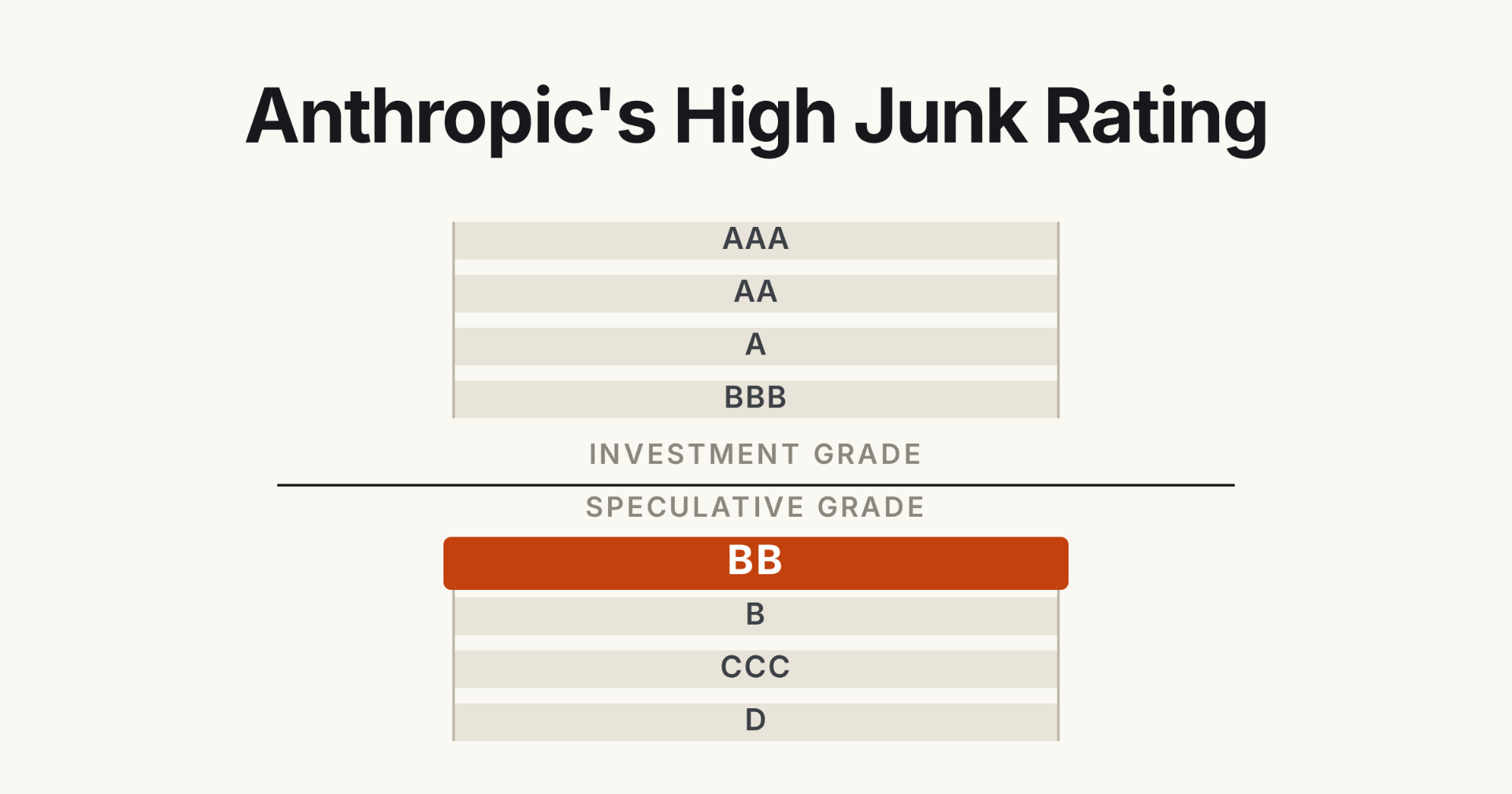
That is a reversal. According to the FT's reporting, Blackstone had previously told investors it expected Anthropic to secure an investment-grade rating before 2027 began. It now expects a rating in the double-B range, which is the top tier of speculative grade. Anthropic and Blackstone both declined to comment to TechCrunch. The forecast is a prediction, not a decision by Moody's, S&P, or Fitch, and nothing about it is final. But predictions from the institution underwriting the debt tend to travel, and this one tells you something about how the people closest to the deal are pricing Anthropic's risk.
The forecast that reversed
The sequence matters more than the headline. Bankers working with Anthropic and with OpenAI have spent months trying to persuade the major agencies to hand the two AI developers investment-grade ratings once they are public, according to the FT's sources. Blackstone itself had been telling investment partners that Anthropic would get there before the end of the year. The company has since revised that view, based on preliminary guidance from the agencies, toward a BB or higher outcome within speculative grade.
The shift did not happen in a vacuum. Anthropic has been signing compute deals at a pace that has made investors nervous, and its prospectus describes a plan to spend more than $800 billion on computing infrastructure through 2045. A company that commits to hundreds of billions in future payments is not a company whose credit looks like a mature software business, regardless of how fast revenue is growing. The agencies appear to be saying that out loud, at least in preliminary conversations.
What "double B" actually means
Credit ratings split the corporate world in two. Ratings from AAA down to BBB minus are investment grade: the issuer is judged likely to service its debt through a normal cycle. Ratings from BB plus down to D are speculative grade, commonly called high yield or junk. The boundary is not cosmetic. It decides which institutions are allowed to buy the bonds.
| Band | Category | Typical issuer profile |
|---|---|---|
| AAA to A | Investment grade | Large, profitable, low leverage, long track record |
| BBB plus to BBB minus | Investment grade | Stable cash flow, moderate leverage, some cyclicality |
| BB plus to BB minus | Speculative grade, top tier | Growing, leveraged, limited through-cycle history |
| B plus to B minus | Speculative grade | High leverage, thin margins, elevated default risk |
| CCC and below | Speculative grade | Distressed or near default |
A double-B issuer can borrow. It just borrows differently. The pool of buyers shrinks to high-yield funds, hedge funds, private credit vehicles, and a slice of crossover investors. Many insurance companies and pension funds operate under mandates that restrict or forbid meaningful exposure to speculative-grade debt, which is exactly the constraint the FT flagged: a missing investment-grade rating narrows Anthropic's lender base as well as raising its cost of capital.
There is a second-order effect that matters just as much. Ratings are public signals. A BB rating on Anthropic debt becomes a benchmark that counterparties cite in lease negotiations, in supplier contracts, and in the internal risk models of every company that has extended the lab credit backstops or capacity commitments.
Inside the $63 billion deal that made the rating a public question
The rating question became urgent because of how the chip financing was built. On October 26, Bank of America, Blackstone, Citi, and Morgan Stanley announced a $63 billion financing structure to buy Broadcom AI accelerators and networking equipment for lease to Anthropic, executed through a newly formed special purpose vehicle. Deliveries are expected to start in 2027 under a previously announced compute capacity agreement involving Broadcom. The FT later described the transaction as Project North Star, covering Anthropic's lease of 1.5 gigawatts of Google-designed chip capacity.
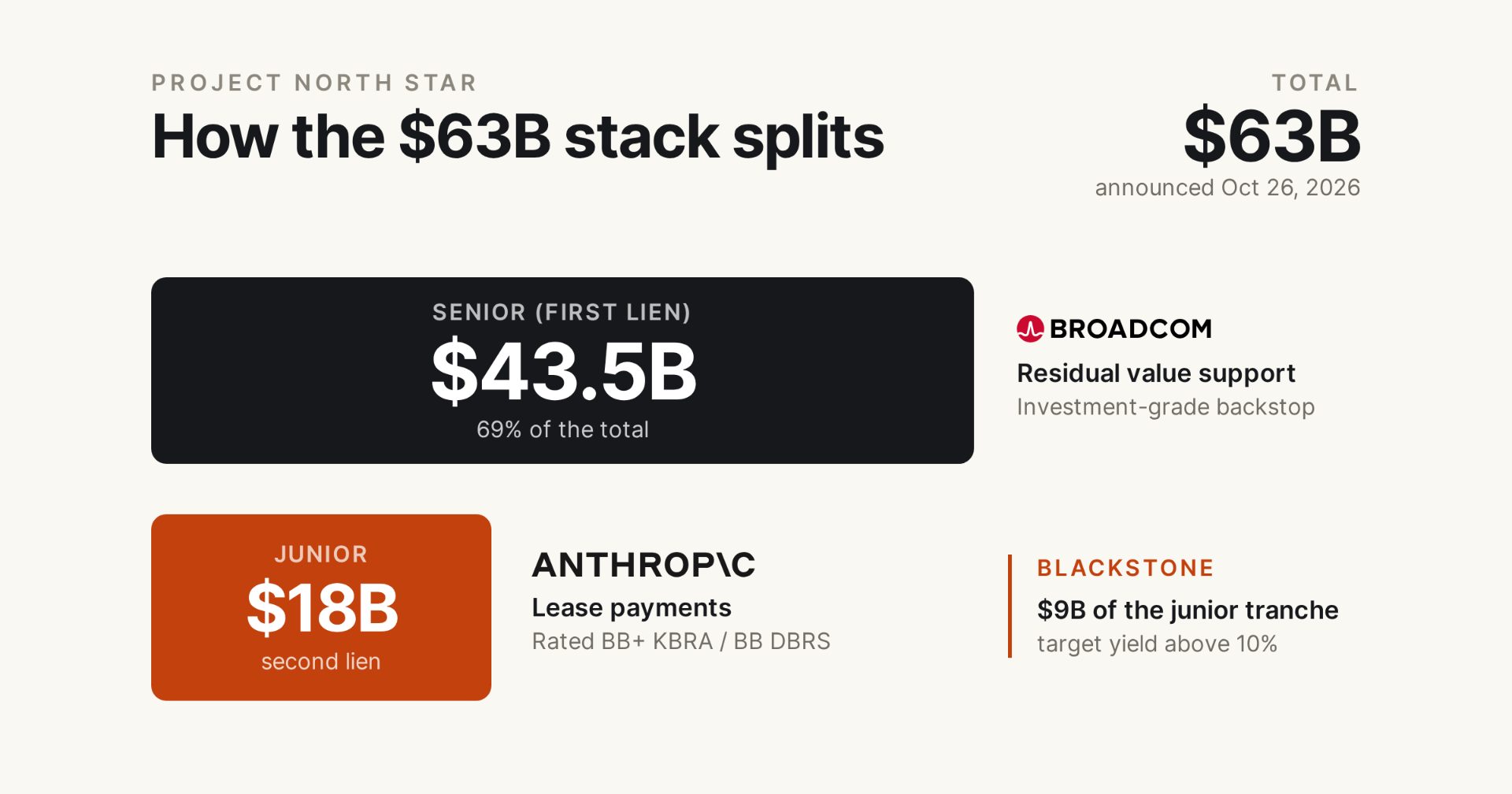
The stack is layered, and each layer carries a different rating.
| Layer | Size | Backing | Rating signal |
|---|---|---|---|
| Senior (first lien) debt | About $43.5 billion, roughly 69% of the total | Broadcom residual value support, absorbing declines in asset value | Supported by Broadcom's investment-grade profile |
| Junior (second lien) debt | About $18 billion | Anthropic lease payments | BB plus with positive outlook from KBRA; BB from Morningstar DBRS |
| Blackstone commitment | $9 billion of the junior tranche | Same | Targeted yield above 10% |
Broadcom's role is the part most readers skip. Its residual value guarantee means the senior lenders are not simply betting on Anthropic. They are betting on a chipmaker with an investment-grade rating standing behind the collateral. That structure is why a company with an operating loss could raise $63 billion at all. The senior tranche looks closer to a Broadcom credit than an Anthropic credit. The junior tranche does not, and that is where Blackstone put its money, at a yield that reflects the difference.
KBRA's BB plus with a positive outlook on the junior debt is a small but real improvement over the stable outlook it assigned to a similar arrangement, Project Big Sky, four months earlier. Read that alongside Blackstone's revised corporate-level forecast and the picture is consistent: the agencies see improvement, but not enough to cross into investment grade.
Why a rating is a financing input, not a report card
It is tempting to treat the rating as commentary on Anthropic's business. It is better understood as an input to a fairly mechanical calculation about how the company funds the next several years.
The arithmetic runs like this. Anthropic reported $16.29 billion of revenue in the first half of 2026, up from $1.16 billion a year earlier, alongside an operating loss of $693 million and $8.95 billion of compute and infrastructure expense. The $80.7 billion net loss is mostly an accounting event: about $72.4 billion of it came from non-cash fair value changes on convertible notes, derivative liabilities, and similar instruments. As the company's private valuation climbed, the accounting value of those liabilities rose, and accounting rules pushed that increase through the income statement.
So the operating business is improving while the balance sheet is committing to enormous future payments. Anthropic holds more than $112 billion in cash and cash equivalents, according to the FT, and investors expect it to raise roughly another $100 billion in the IPO. Its S-1 discloses named compute contracts with Google, Amazon, Microsoft, SpaceXAI, Broadcom, Nscale, and Lambda that add up to roughly $637 billion, and the $800 billion infrastructure plan extends to 2045.
Capital of that size cannot come from equity alone. Equity raises dilute, and public shareholders are less forgiving than private ones about dilution at scale. Debt is the alternative, and the price of that debt is set by the rating. An investment-grade issuer might borrow at a spread that a double-B issuer pays a multiple of. On a balance sheet carrying tens of billions in lease obligations, a couple of hundred basis points of spread is not a rounding error; it is the difference between funding the next tranche comfortably and funding it reluctantly.
The bull case the agencies are weighing
It would be wrong to read the junk forecast as a verdict that Anthropic's business is weak. The case for investment grade rests on numbers that are genuinely unusual.
Revenue grew roughly 1,300% year over year in the first half. Anthropic reported $974 million of operating income in the second quarter of 2026, its first profitable operating quarter in the six periods disclosed in the S-1. It generated positive operating cash flow of roughly $3.9 billion in the first half. Customers spending $100,000 or more on a trailing twelve-month basis grew from over 950 to over 11,900 in a year, and net revenue retention was approximately 900% as of September 30, 2026. A business with that retention profile has a plausible path to covering fixed commitments.
That is the argument bankers have been making to the agencies, and it is not frivolous. But it runs into a structural objection that rating committees tend to take seriously: there is no through-cycle history. Investment grade has historically meant a demonstrated ability to service debt during a downturn. Anthropic was founded in 2021. It has never operated through a demand collapse, a pricing war that compressed margins, or a technology shift that made its assets less valuable.
Moody's made a related point about the broader financing pattern, describing Broadcom as one of the strongest large technology companies while warning that risk would rise if multiple transactions were structured in a short period to meet the sizable funding needs of frontier AI labs. The concern is not any single deal. It is the aggregate.
Who is left holding the structure
There is a distributional question buried in the rating. When a deal is investment grade, risk lands on insurers, pension funds, and bond funds operating under conservative mandates. When it is speculative grade, risk lands on high-yield specialists and private credit funds, which demand higher yields and, in a stress scenario, are quicker to sell.
Blackstone's $9 billion commitment in the junior tranche, seeking a yield above 10%, is a clear illustration of how the market prices this. The yield is the compensation for taking Anthropic lease risk without Broadcom's guarantee underneath. If Anthropic's corporate rating comes in at double-B, that junior paper looks appropriately priced. If the corporate rating surprised to the upside, that yield would have been a bargain.
Broadcom carries the other side of the trade. Its residual value support transfers part of the collateral risk off the lenders and onto a chipmaker with a strong rating. The FT's reporting on Project North Star notes that Broadcom's A-range rating was an important factor in getting the financing done at all. That is a reminder that AI infrastructure debt is rarely a pure bet on one company. It is a web of guarantees in which the strongest balance sheet in the room sets the terms for everyone else.
Credit investors outside this deal have been flagging the same set of hazards for months: data center and chip financing structured through special purpose vehicles, so that leverage does not appear cleanly on any single balance sheet; a potential mismatch between the useful life of AI hardware and the maturity of the debt used to buy it; and the possibility that efficiency gains reduce demand for raw compute faster than the contracts assume. None of those risks is unique to Anthropic. But Anthropic is now the largest single test case for whether the market can absorb them.
What to watch between now and pricing
The rating agencies have not spoken. What exists today is preliminary guidance relayed by an anchor investor, and preliminary guidance can move in either direction once audited financials, a price range, and a share count are on the table. A completed IPO that raises close to the reported $100 billion would materially change the liquidity picture the agencies are modeling, and a large equity cushion is exactly the kind of thing that pushes a borderline credit upward.
Three data points will settle the question faster than any commentary.
- The actual rating and outlook from each agency that covers the new debt, including whether any of them assigns a higher rating to the secured tranches than to Anthropic's unsecured obligations.
- The payment schedule behind the compute commitments. A $637 billion contract total says little without knowing how much is due in each year, how much is cancellable, and whether obligations are conditioned on delivery milestones.
- The spread at which Anthropic's first unsecured or lightly secured borrowing prices after listing. That number is the market's own rating, and it will be visible immediately.
The signal inside the forecast
A junk rating is not a judgment that Anthropic is failing. The company grew revenue by more than a factor of fourteen year over year, turned an operating profit in the second quarter, and sits on a cash pile larger than the entire revenue base of most public software companies. Plenty of excellent businesses have spent years in high yield while they built durable cash flow.
What the Blackstone reversal signals is narrower and more useful. The credit market is separating the question of whether Anthropic will be a huge business from the question of whether its obligations should be held by conservative institutions. The answer to the first is increasingly yes. The answer to the second, at least for now, is: not yet, and not at investment-grade prices.
For anyone watching the AI buildout, that distinction is the real story coming out of the IPO. Anthropic's valuation will be set by people buying a growth story. Its borrowing costs will be set by people asking who pays if the growth arrives late. The gap between those two groups, and how it narrows over the next few quarters, will shape how much computing capacity the company can actually commit to. The FT's report is the first clear reading of how wide that gap currently is.
References
- TechCrunch: Anthropic expected to receive high 'junk' rating from credit agencies following IPO, FT report says
- Oninvest: Blackstone has told investors that Anthropic may not receive an investment-grade credit rating immediately after its IPO
- Reuters via Investing.com: Wall Street banks, Blackstone line up $63 billion to finance Broadcom AI chips for Anthropic