
Jio's 21% Debut: What the IPO Numbers Reveal
Jio's 21% Debut: What the IPO Numbers Reveal
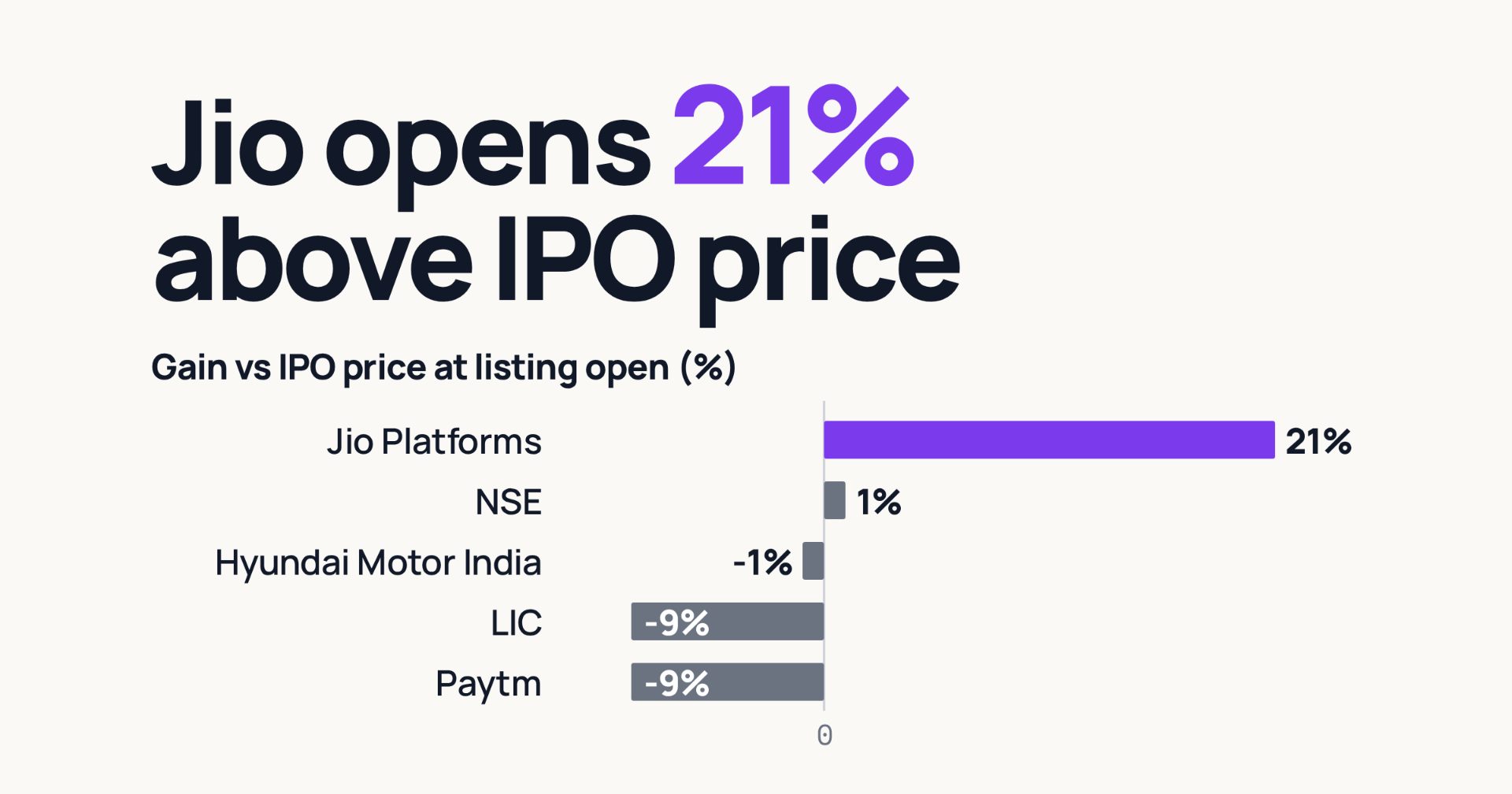
Jio Platforms opened at Rs 1,358 on October 28, 21.36% above its IPO price of Rs 1,119. The print valued the company at about Rs 12.5 trillion ($131.9 billion), second only to parent Reliance Industries among listed Indian companies, and capped a $3.2 billion offering that drew more investor bids than any Indian IPO before it.
The opening pop is the headline. The rest of the story is in the structure of the deal, the valuation it implies, and the operating numbers Jio will have to improve to justify it. By the end of the first session, the stock had given up most of the opening gain and closed about 4.5% above the issue price. A listing print is a starting auction, not a verdict.
A record offering measured by participation, not just multiple
Jio sold 270 million new shares in a price band of Rs 1,065 to Rs 1,119. The issue was entirely fresh, meaning the company received the proceeds and no existing shareholder sold into the IPO. At the top end, the raise was Rs 30,213 crore, or about $3.2 billion, and diluted existing owners by roughly 2.9%. The offer opened on October 21 and closed on October 23.
The book was oversubscribed 22.19 times. Qualified institutional buyers bid 70.55 times their portion, non-institutional investors 14 times, and retail 2.72 times. More than 13.8 million applications came in, and the issue was fully covered within 100 minutes of opening. Total demand, including the anchor book, was reported at more than $77 billion.
| Category | Subscription |
|---|---|
| Qualified institutional buyers | 70.55x |
| Non-institutional investors | 14x |
| Retail | 2.72x |
| Employees | 2.93x |
| Reliance shareholders | 7.63x |
| Overall | 22.19x |
The 22.19 times figure is not the highest subscription multiple an Indian IPO has seen. The record is about scale and participation: the largest issue size, the largest total bid value, and the largest number of individual applications. That distinction matters because a high multiple on a small float can be moved by a few large orders. A high multiple on a Rs 30,000 crore issue requires broad demand.
What the market is paying for
At the IPO price, Jio was valued at roughly 32 to 34 times forward earnings, depending on the estimate, and about 15 times FY26 EV/EBITDA. At the opening price, those multiples rose by a fifth. The comparison with Bharti Airtel is the one that matters, because Airtel is the closest listed peer and the only other Indian operator with a national 4G and 5G footprint at scale.
The comparison is not flattering on every line. Jio has more subscribers, but Airtel reported higher revenue and EBITDA in the June quarter: Rs 58,539 crore versus Jio's Rs 39,173 crore, and Rs 33,057 crore versus Rs 19,840 crore. Jio's ARPU was Rs 215.6, about 18% below Airtel's Rs 264. Its operating margin, excluding other income, was 50.6%, below Airtel's 56.5% and Vodafone Idea's 56.8%. Return on capital employed was 10.2% in the June quarter, roughly half of Airtel's 20%-plus.
That gap is the central investment question. Jio won the market with price. It now has to prove it can monetize the base without losing it, and that the next layer of growth, broadband, enterprise, cloud, and AI, can carry a valuation that already assumes a lot.
The growth case analysts are underwriting
Nomura, Motilal Oswal, and Elara all initiated coverage with Buy ratings. Their targets, Rs 1,340, Rs 1,350, and Rs 1,367, are clustered around the listing price, and two of the three sit below it. That is not a contradiction. A target is usually derived from a valuation at the issue price. A Buy rating at Rs 1,119 can coexist with a target that offers little upside from Rs 1,358.
The bull case rests on four things.
First, market position. Nomura estimates Jio carries 42% of India's wireless subscribers, 60% of data traffic, and 43% of home broadband. Scale gives it pricing power, and the industry has already shown it will follow Jio's tariff moves.
Second, ARPU recovery. Jio's ARPU growth has lagged peers, but 57% of its mobile subscribers are already on 5G. Nomura expects industry-wide tariff increases of about 15% in late 2026 and models a 13.5% EBITDA CAGR through FY29.
Third, broadband. Jio serves 28.6 million homes, nearly twice Airtel's base, and accounted for 62% of industry net additions in the June quarter. Fixed broadband reaches only about 21% of Indian households, and each connection generates roughly 2.5 times mobile ARPU.
Fourth, capital intensity. Capex fell from 49% of revenue in FY24 to 23% in FY26 as the 5G buildout moved into the rear-view mirror. Lower capex plus EBITDA growth is the classic recipe for free cash flow. Elara expects digital services, currently about 12% of revenue, to grow at a 23% CAGR through FY29.
Where the money goes
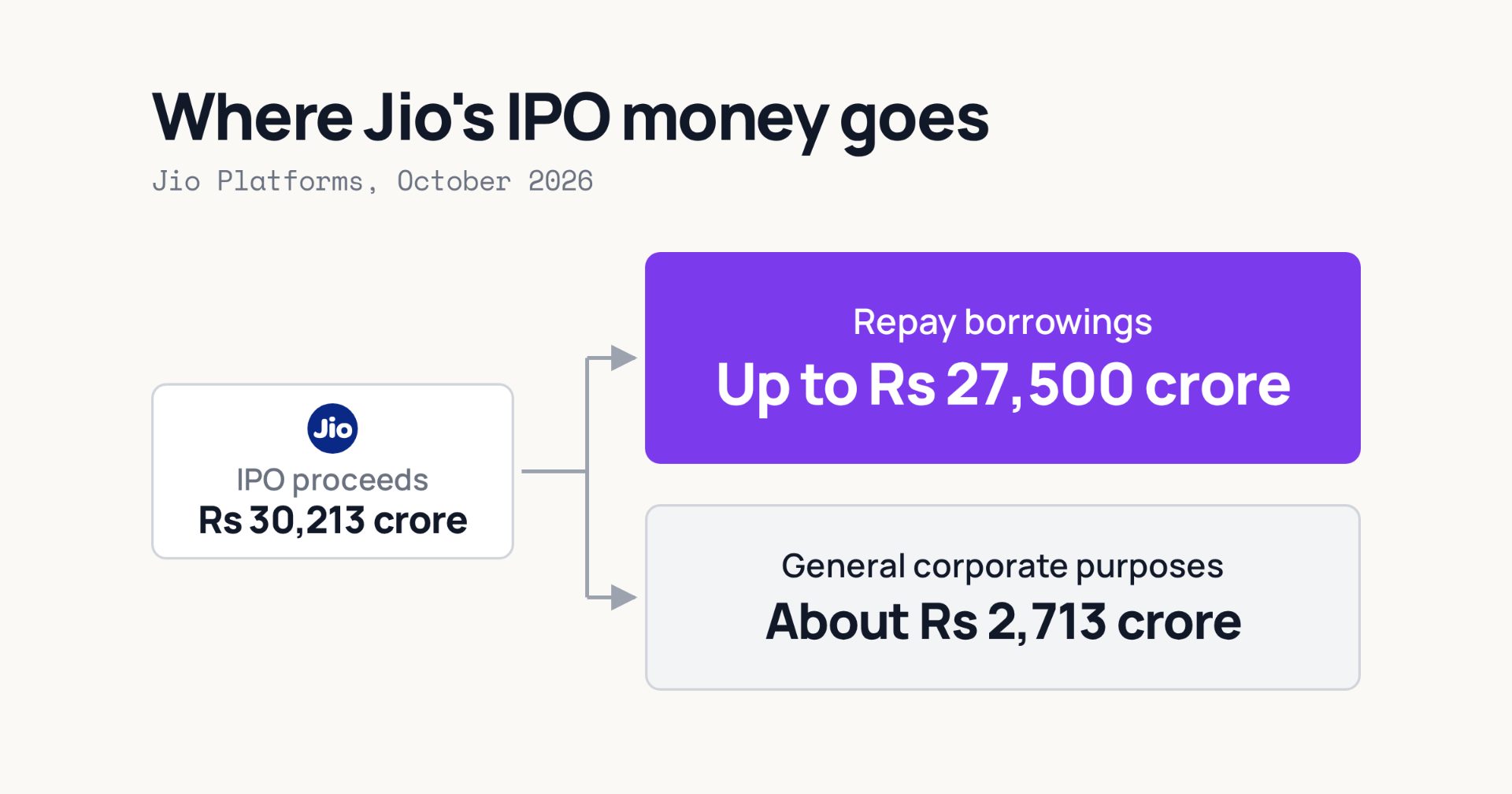
Jio plans to use up to Rs 27,500 crore of the proceeds to repay or prepay borrowings at Reliance Jio Infocomm, its telecom subsidiary, with the remainder for general corporate purposes. Total borrowings stood at Rs 613.7 billion as of June 30. The company also carries a spectrum liability of about Rs 1.04 lakh crore, which is a long-dated but real claim on future cash.
The debt repayment improves the capital structure and reduces interest cost, but it does not make the balance sheet self-funding. Spectrum payments, network investment, and the next technology cycle will require more capital. One pre-IPO analysis argued that the debt retirement is temporary for that reason. That is a fair caution, even if the proceeds still improve near-term ratios.
Risks the opening print does not price
The first risk is monetization. Jio's ARPU grew 3% year on year in the June quarter, slower than Airtel's 5% and Vodafone Idea's 7%. The 2G-to-4G and 4G-to-5G upgrade engine is partly spent: 57% of the base is already on 5G. Further gains depend on tariff increases and on selling more services per user, not just on adding subscribers.
The second is the lock-in overhang. Meta, Google, General Atlantic, Silver Lake, Vista, and other investors hold a combined 33.6% stake, acquired at Rs 488 to Rs 549 per share in 2020. None sold in the IPO. When the six-month lock-in expires, the market will have to absorb whatever portion of that stake chooses to exit. A large overhang does not have to sink the stock, but it changes the supply-demand balance.
The third is competition and regulation. Airtel is close on wireless share and ahead on ARPU and margins. Vodafone Idea remains a distant third but can follow price. Satellite broadband adds another front: Jio and Airtel both have distribution deals with SpaceX's Starlink, subject to approvals, while Elon Musk has publicly attacked Ambani over the pace of Starlink's India launch. The regulatory outcome is unresolved.
The fourth is execution beyond telecom. Cloud, AI, enterprise services, and technology exports are real opportunities, but they are still small relative to connectivity. Jio's own prospectus opens by calling the company a technology platform, not a telco. The market will eventually grade it on that claim.
The succession subplot
Akash Ambani, Mukesh Ambani's eldest son, is the managing director of Jio Platforms and chaired Reliance Jio Infocomm before that. He led the 5G rollout and has been the family's point person for Silicon Valley relationships, including Meta. At the listing ceremony he said: "My dream is that one day, when the world counts its great technology companies, one of them will be from India, and that company will be called Jio Platforms Limited." Isha Ambani, who sits on the board, framed the listing as a continuation of Reliance's decades-long relationship with public shareholders.
The governance point is straightforward. The IPO formalizes a transition that was already underway. Mukesh Ambani remains chairman of Jio Platforms and controls Reliance Industries, but the operating and capital-markets story is increasingly Akash's. Investors are not just buying a telecom cash flow. They are buying the first public test of the next generation's ability to allocate capital.
What to watch
Three numbers will tell most of the story over the next year: ARPU, capex as a share of revenue, and the pace of home broadband additions. ARPU shows whether Jio can close the monetization gap. Capex shows whether the free cash flow thesis is real. Broadband shows whether the company can build a second growth engine before mobile growth slows.
The listing answered the demand question. It did not answer the valuation question. At the opening price, Jio traded close to where independent analysts had set their 12-month targets. The 21% pop was a statement about scarcity, the first chance for public investors to own India's largest telecom operator, not a verdict on the business. The next few quarters will decide whether the debut was the start of a re-rating or the peak of the IPO premium.
This is an analysis of publicly disclosed figures, not investment advice.