
The Icepick Leak: Why 41,000 DHS Directory Records Are More Dangerous Than They Look
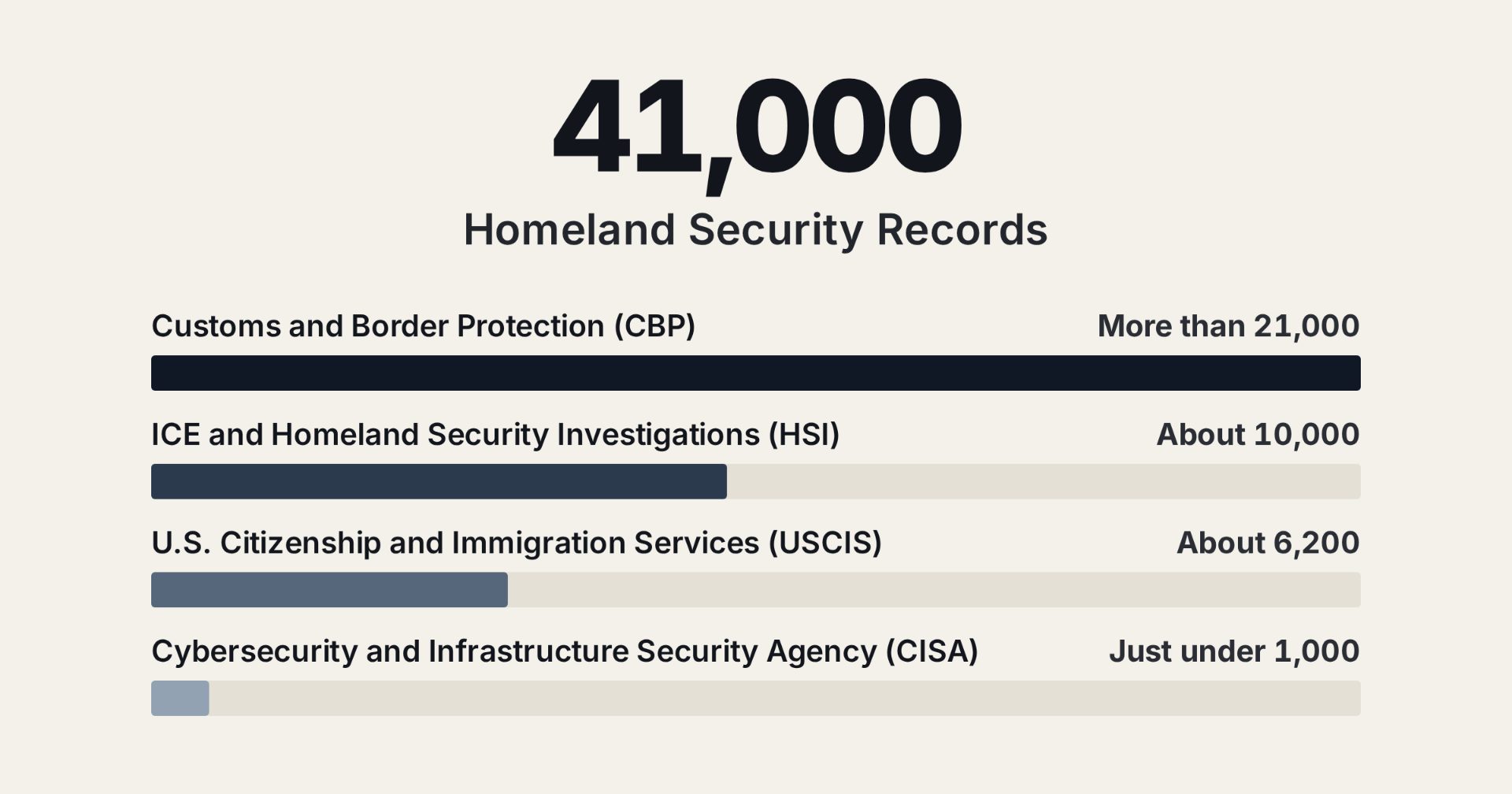
On October 28, 2026, the transparency nonprofit Distributed Denial of Secrets published a searchable archive it calls Icepick. The files describe more than 41,000 current and former employees and contractors of the U.S. Department of Homeland Security: names, job titles, work email addresses, work phone numbers, office locations, and, in many records, the internal access groups each person belongs to.
The leak is not a password dump, and by all public accounts it contains no case files. That is exactly why it deserves careful technical attention. What leaked is the directory layer, the identity plumbing that every large organization treats as low-sensitivity infrastructure. Icepick shows how much operational meaning that layer carries once someone exports it in bulk.
What Was Actually Published
The reporting converges on the shape of the data and diverges on the exact counts. TechCrunch, which reviewed a copy of the dataset, describes names, job titles, work contact information, and records of which systems and internal applications each employee is permitted to use. WIRED, which previewed the archive before publication, adds that the records were last updated on August 19, 2026, and that they reference more than 55,000 internal permission groups.
| Component | Records reported | Notes |
|---|---|---|
| Customs and Border Protection | More than 21,000 | More than half the dataset; staff at airports and ports of entry |
| ICE and Homeland Security Investigations | About 10,000 (TechCrunch); nearly 6,600 for ICE alone (BBC) | The gap likely reflects how HSI is counted |
| U.S. Citizenship and Immigration Services | About 6,200 | Reported by WIRED |
| CISA | Just under 1,000 | More than half described as contractors |
| DHS headquarters and other components | Not broken out | Includes the Federal Protective Service and others |
Two cautions belong next to that table. First, a record count is not a headcount. Directories accumulate stale entries, duplicate accounts, shared mailboxes, and contractor identities that have outlived their contracts. Nextgov/FCW found names of CISA staff who had already left the agency. Second, the component figures do not neatly add up to the headline total, which suggests that other offices and contractor pools sit in the remainder. None of that reduces the impact; it just means the headline number is a file size, not a verified roster.
Provider Versus Tenant: Reading the Okta Claim Correctly
A group calling itself the Department of Peace claimed it obtained the data from an Okta single sign-on system used across DHS. Okta's response was narrow and precise: "Okta is secure, and we have no evidence our data or systems were compromised."
Both statements can be true at once, and the distinction matters for anyone who operates an identity provider.
A provider compromise means the vendor's own infrastructure was breached, which would put every customer at risk simultaneously. A tenant compromise means that one customer's configuration, integrations, tokens, or administrator accounts were abused. Okta's statement addresses the first scenario. It says nothing about the second, and the Department of Peace has not publicly described which one it means.
Identity providers are attractive targets precisely because they sit at the center of everything. An Okta org or an Entra ID tenant holds a profile object for every person who signs in, along with group objects, application assignments, and audit history. Most of that data is readable through APIs by design, because provisioning systems, help desks, and collaboration tools all need it. The realistic paths by which a directory leaves an organization look like this:
- An OAuth application or integration granted a directory read scope broader than its function requires, paired with a long-lived token.
- A stolen session cookie or refresh token that bypasses password and multi-factor checks entirely.
- An over-privileged service account used by a reporting or synchronization job.
- A bulk export performed by an administrator or insider who already holds legitimate read access.
- A misconfigured application that exposes user attributes to unauthenticated callers.
The fields described in Icepick, names, titles, mail addresses, phone numbers, office locations, and group memberships, are exactly the attributes those paths yield. That is an inference from the reported contents rather than forensic evidence, but it is the inference a defender should test first.
The Group Names Are the Payload
If the leak had stopped at names and phone numbers, it would be a large doxxing incident. The group memberships move it into a different category.
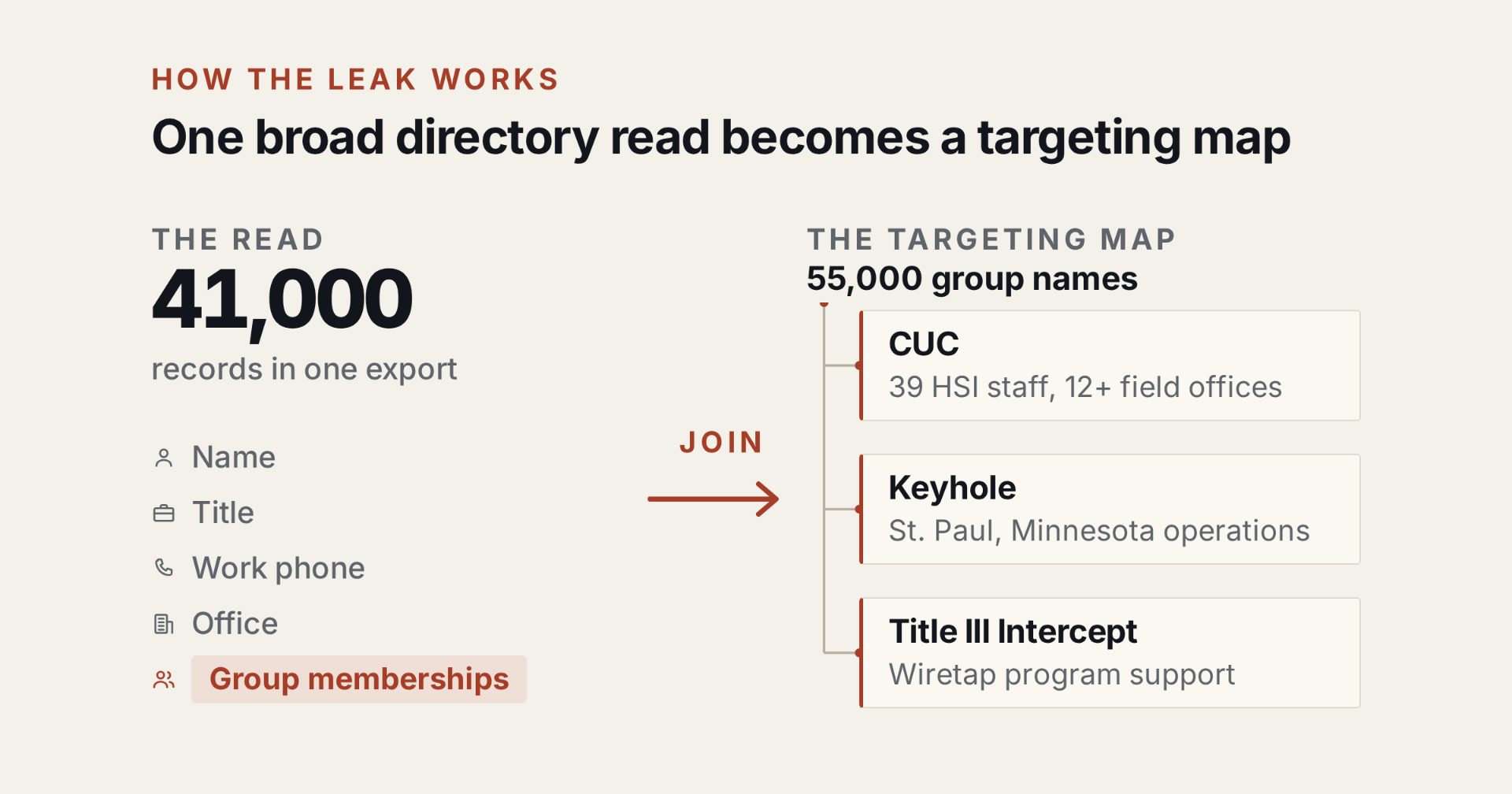
According to WIRED's analysis, the archive lists over 55,000 permission groups, and the names encode function. Thirty-nine HSI employees across more than a dozen field offices appear in groups containing "CUC," which federal court filings describe as certified undercover operation. Another group tied to HSI's St. Paul, Minnesota area of operations references "Keyhole," described in court filings as a certified undercover operation that recently funded surveillance of Minneapolis protest groups. Other group names reference a Communications Intercept Center TechOps program, a Title III Intercept Program for wiretaps, and an Illicit Sensor Intercept Program. Additional names point to commercial tools, including Palantir's Falcon investigative platform and PenLink, which analyzes phone records and social media.
At the top of the hierarchy, two groups called "Executive Leadership" and "AI Access" appear to list the same 13 people granted exceptions to the department's web filter. The names reported in those groups include former DHS secretary Kristi Noem, recently departed chief information officer Antoine McCord, Philip Hegseth, listed as a senior adviser to the secretary, and policy adviser Jayce Krachenfels.
This is the part of the story that security teams outside government should study. Group names are documentation. They exist so that administrators can tell a wiretap support group from a procurement group without opening a ticket. But once exported alongside a person's name, they stop being internal shorthand and become an org chart of sensitive programs, complete with the people who run them.
Gary Barlet, public sector CTO at Illumio, put the operational consequence plainly: "If an attacker knows which employees have access to which systems and applications, they've essentially been handed a roadmap for where to go next and who to target to get there."
Why Directory Data Resists Conventional Controls
Most data loss prevention programs are built around content: documents, databases, mail. Directory attributes do not look like sensitive content. They look like the global address list, which every employee can open.
That creates a structural tension. Directory data has to be broadly readable inside the organization or collaboration collapses; people need to find colleagues, check titles, and confirm team assignments. The control surface is therefore narrow and mostly procedural: which applications hold read scopes, how long tokens live, who can run exports, and how often group membership is reviewed.
Three properties make this class of data harder to protect than it appears.
Aggregation comes first. A name alone is public. A name plus a title plus a work cell number plus an office plus a program group is a dossier that supports a credible pretext in minutes. The risk lives in the join, not in any single field, which is why per-field classification schemes usually miss it.
Second, directory data decays slowly and asymmetrically. A departed employee's record may persist for months, and a stale work address still receives mail. Attackers do not need current employees to run a convincing phishing campaign; they need a plausible name and a real domain.
Third, the sensitive signal often sits in metadata that nobody classifies. A group named for an intercept program is not a document, so no content scanner flags it. It is a string in a database column, and it is doing work that its author never intended.
A Practical Playbook for Identity Teams
The lessons transfer to any organization running single sign-on at scale, not just federal agencies.
Start by treating the identity provider as a data store rather than only as an authentication gate. Inventory what can be exported from it and by whom. Enumerate every application integration with directory read scope, record which attributes each one actually consumes, and revoke the rest. Long-lived tokens issued to reporting tools are a common blind spot.
Then instrument the directory itself. Bulk enumeration and export patterns are detectable: a single principal listing thousands of user objects in a short window, a first-time call to a reporting endpoint, an unusual volume of group membership queries from one address. Most identity providers log these events. The usual failure is that nobody builds a rule against them, or that the rule fires into a queue nobody reads.
Group hygiene deserves the same attention as account hygiene. Recertify membership on a schedule, retire groups that no longer grant anything, and consider whether the naming convention itself is a liability. A group with a neutral name, whose real purpose is documented in a ticket instead of a label, leaks far less when it is exported. For genuinely sensitive programs, consider separate identity stores or scoped attribute visibility rather than one flat directory readable by the whole workforce.
Finally, plan for the export to succeed. Assume that at some point an attacker will hold your directory and use it for phishing and impersonation. That makes phishing-resistant authentication, call-back verification procedures for help desk requests, and training that names the specific pretexts, such as a call from a colleague in a program you actually work on, worth more than another layer of perimeter control.
The Pattern Behind the Pattern
Icepick is the third major exposure of U.S. federal personnel data in a matter of weeks, and the comparisons are instructive.
| Incident | Reported scale | Data involved |
|---|---|---|
| DMDC / Pentagon, disclosed September 2026 | 2.76 million living people and 294,000 deceased | Unencrypted PII including Social Security numbers, dates of birth, and service details, exposed over roughly nine months |
| FBI, September 2026, claimed by ShinyHunters | Thousands of agents and applicants | Personal and work contact data; the group later said it would not publish |
| DHS / Icepick, October 2026 | More than 41,000 | Directory attributes and internal group memberships |
The DMDC case is the closest analogue to the 2015 Office of Personnel Management breach, which affected more than 22 million people and is broadly attributed to China. Icepick is different in kind. It is smaller, it contains no Social Security numbers by all public accounts, and it was published deliberately by people who describe their motive as accountability rather than profit. Emma Best, a co-founder of DDoSecrets, framed the release as identifying "many of the architects and drivers of DHS policy and operations" rather than compiling an indiscriminate staff directory. The Department of Peace left a note with the files: "They have our information, so it's only fair that we have theirs."
Motives do not change the mechanics. A dataset published for one purpose is copied, mirrored, and reused for others. The archive is searchable, structured, and small enough to circulate freely. Whatever the intent behind its release, the practical legacy is a ready-made target list that will outlive the news cycle.
For DHS, the open questions are the ones that matter most: whether the access path has been closed, whether affected employees will be notified, and whether the department's own detection capability is adequate. Nextgov/FCW reported earlier in 2026 that personnel twice dismissed signs of intrusion inside the Homeland Security Information Network before confirming a breach. That history is more troubling than any single leaked file.
Conclusion
The Icepick leak will be remembered as a doxxing story, and the human consequences for border agents, immigration officers, and undercover investigators are real. But the technically significant lesson is about identity infrastructure. Single sign-on systems are not just doors; they are inventories of who works where, what they are allowed to touch, and which programs they support. Organizations spend heavily on locking the door and comparatively little on deciding who may read the inventory behind it.
That imbalance is fixable with tools most teams already own: narrower scopes, shorter token lifetimes, monitored exports, and group names that describe less than they know. None of it is glamorous, and none of it would have closed every path into a directory. But it would have made the haul less valuable, and value is what determines whether an archive like Icepick gets copied, mirrored, and reused for years.
References
- Hacker stole personnel data about thousands of Homeland Security employees, including CBP and ICE agents
- Massive Leak Exposes 41,000 Homeland Security Workers, Including Undercover ICE Agents
- DHS personnel leak exposes contact details and sensitive job information
- DHS Data Breach Exposes 41,000 Staff in Icepick Leak