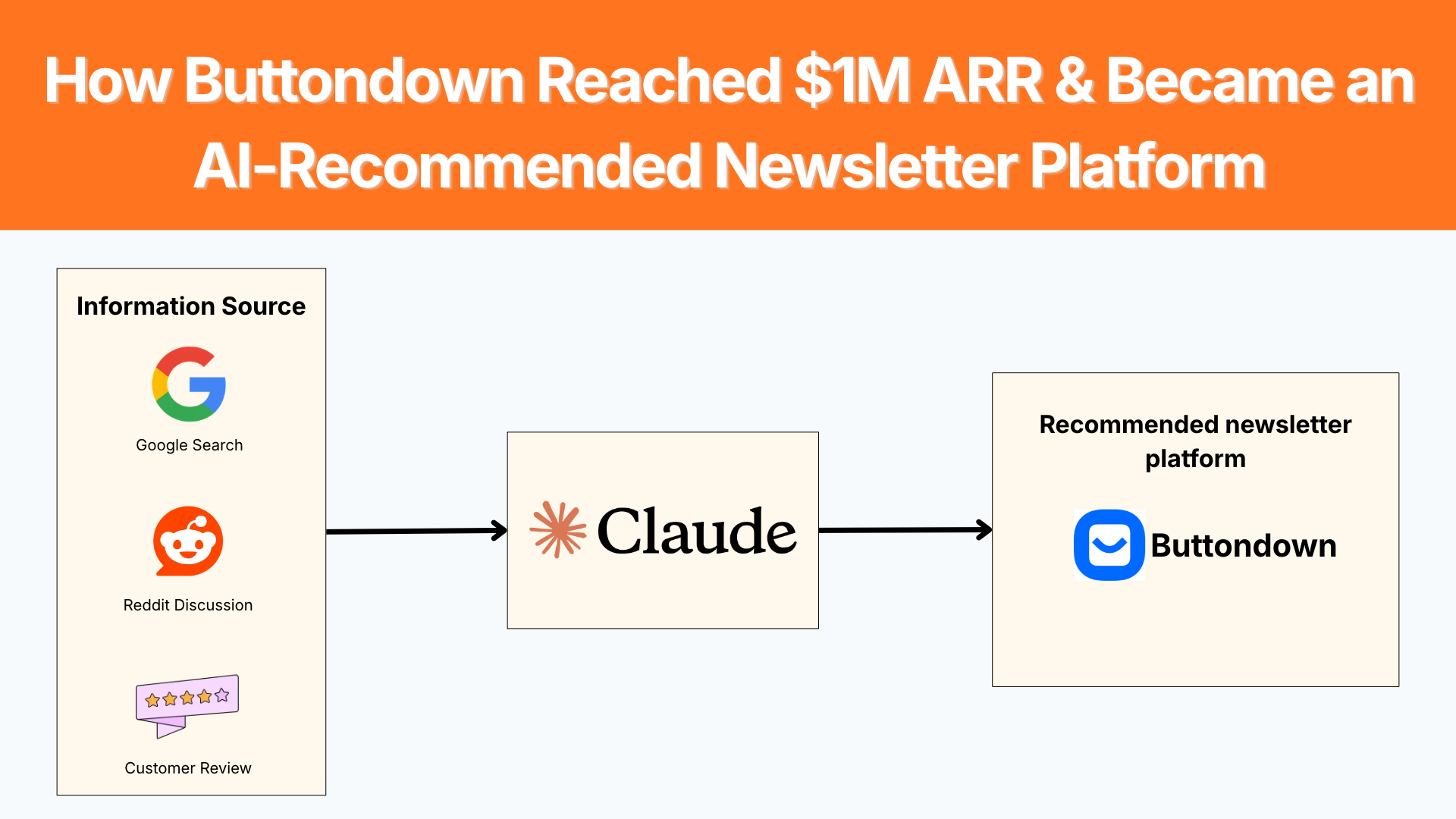
Getting a SaaS product recommended by Claude, ChatGPT, Gemini or Perplexity is becoming an important part of product discovery. But AI recommendations do not appear just because a company simply adds a few keywords to its website.
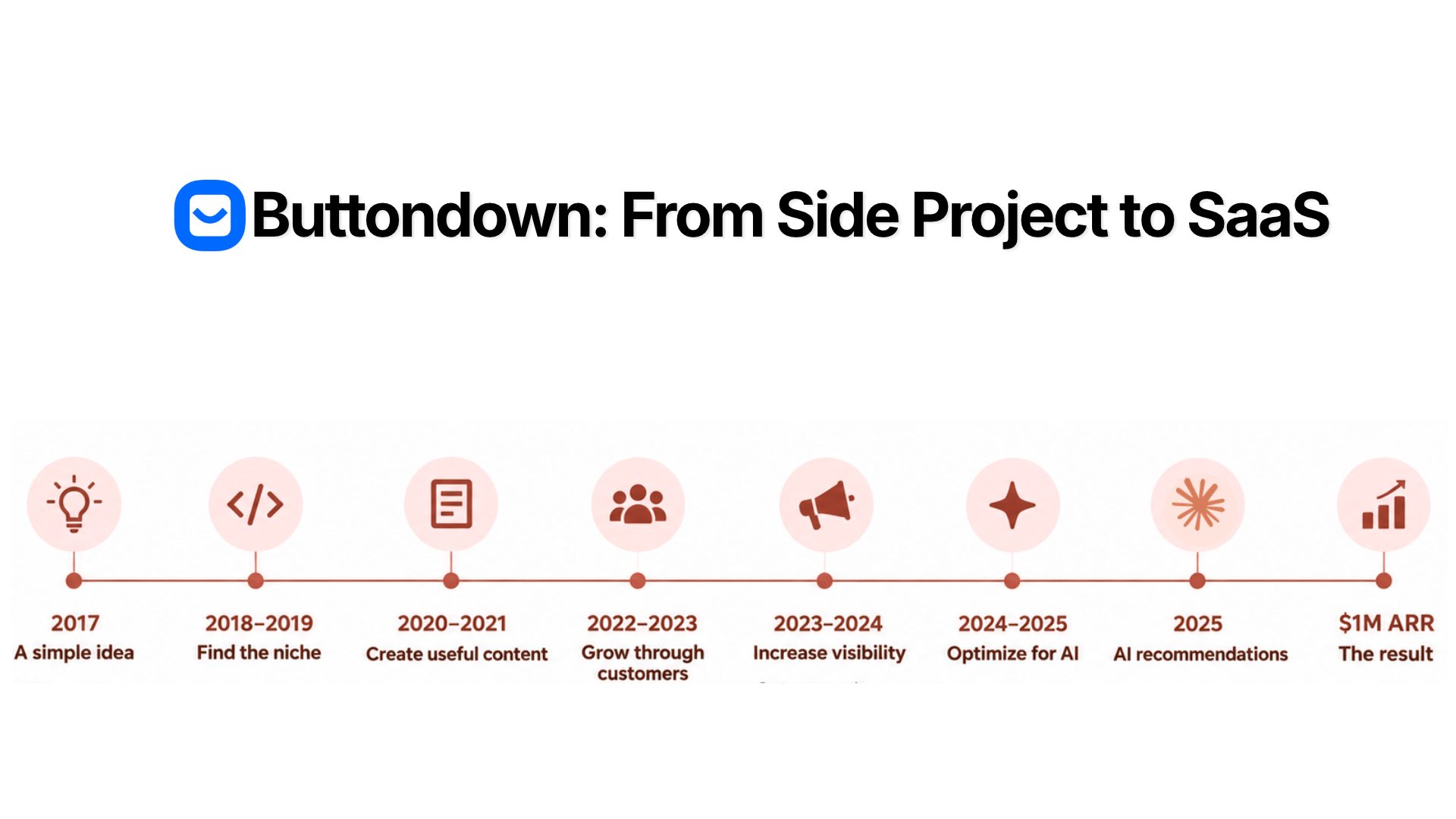
Buttondown is a useful example. The newsletter platform entered a crowded market, grew without a viral launch or major funding round, and eventually passed a $1M ARR run rate. In its September 2026 Indie Hackers case study, founder Justin Duke said that LLM-based acquisition had started increasing and wrote: “Claude loves us.”
The interesting question is not only how Buttondown reached $1M ARR. It is how years of product positioning, public writing, customer support, word of mouth, searchable content, and product visibility created the information footprint that now helps AI systems understand and recommend the company.
Quick Summary
- Solve one clear problem: Buttondown began in 2017 because Justin Duke wanted a simpler newsletter tool for his own use, rather than trying to compete with every email platform.
- Own a specific niche: It focused on Markdown-based newsletters, technical writers, developers, and independent publishers.
- Publish useful content: Founder-led writing and documentation built searchable information around the product.
- Turn customers into distribution: Good support and product experience drove recommendations and word of mouth.
- Build third-party visibility: Customer mentions, communities, reviews, and articles gave search engines and AI systems more evidence about the product.
- Optimize for AI discovery: Clear connections between product → audience → problem → use case help AI systems understand when Buttondown is relevant.
- Track AI recommendations: Duke says LLM-based acquisition is increasing and that Claude recommends Buttondown.
- Measure and improve: Use tools such as Lumirank.ai, Semrush, Profound, or OtterlyAI to track AI mentions, citations, competitors, and prompts.
Buttondown is a newsletter publishing platform designed around a simpler workflow than large marketing automation systems. Its positioning centers on newsletters, Markdown, technical publishing, APIs, automation, and a relatively minimal writing experience.
The product was created by Justin Duke, a software engineer who worked at Stripe and Amazon before and during the early period of Buttondown. The idea came from his own frustration with newsletter software. He had been using TinyLetter and felt that existing alternatives were either too heavy or tried to take control of more of the publishing experience than he wanted.
Buttondown's development started in April 2017, became functional enough to send emails by the end of May, and officially launched by the end of June 2017. Duke's December 2017 review says the product already had paying customers by July.
The original product was intentionally narrow. Duke wanted a tool that could handle the basic newsletter workflow without forcing writers into a large marketing platform. That positioning remains important because Buttondown is now associated with a specific type of user rather than trying to compete for every email-marketing use case.
The September 2026 Indie Hackers article reports that Buttondown now powers newsletters for tens of thousands of writers, from small personal newsletters to publications reaching hundreds of thousands of subscribers. The company is fully bootstrapped, profitable, and generating more than $83K per month, according to the case study.
Absolutely. The content and writing style are kept the same, but the 15 points have been condensed into 10 points by combining closely related sections. The original ideas and terminology are preserved. Pasted text
Buttondown did not begin by trying to serve every possible email marketer.
The initial customer was much easier to understand: someone who wanted to publish a newsletter without dealing with the complexity and marketing-heavy design of larger platforms.
Duke's advice is direct: build for a specific person, ideally yourself, and resist generalizing before there is a reason to do so.
Buttondown's identity is relatively easy to describe:
newsletter software for people who want a simple, technical, Markdown-friendly publishing workflow.
That is more useful for search and AI discovery than broad positioning such as:
“An all-in-one marketing platform for modern businesses.”
A product should have clear answers to:
What does it do?
Who is it for?
What problem does it solve?
What makes it different?
When should someone choose it instead of an alternative?
The connection becomes:
Product → audience → problem → use case
That relationship should remain consistent across the website, documentation, customer stories, directories, reviews, and third-party articles.
One of Buttondown's most important growth channels was writing.
Duke says he wrote extensively in public about building the product, product decisions, and the less interesting parts of running a software business. This writing did not always convert through a measurable funnel, but it built trust with people who were likely to become customers.
This is relevant to GEO because AI systems need information to build an understanding of a company.
A product page can explain what a product does. But independent articles, technical posts, documentation, reviews, customer stories, and community discussions provide additional context.
Buttondown also did not have one launch that suddenly changed the business. Duke explicitly says most growth came from a good product and customers telling their friends.
A satisfied customer may:
The company therefore gains information sources that it does not completely control.
Duke identifies customer support as another major part of Buttondown's growth.
When customers reported problems, a real person responded and tried to solve them quickly.
Good support increases the chance that customers stay. It also increases the chance that customers recommend the product.
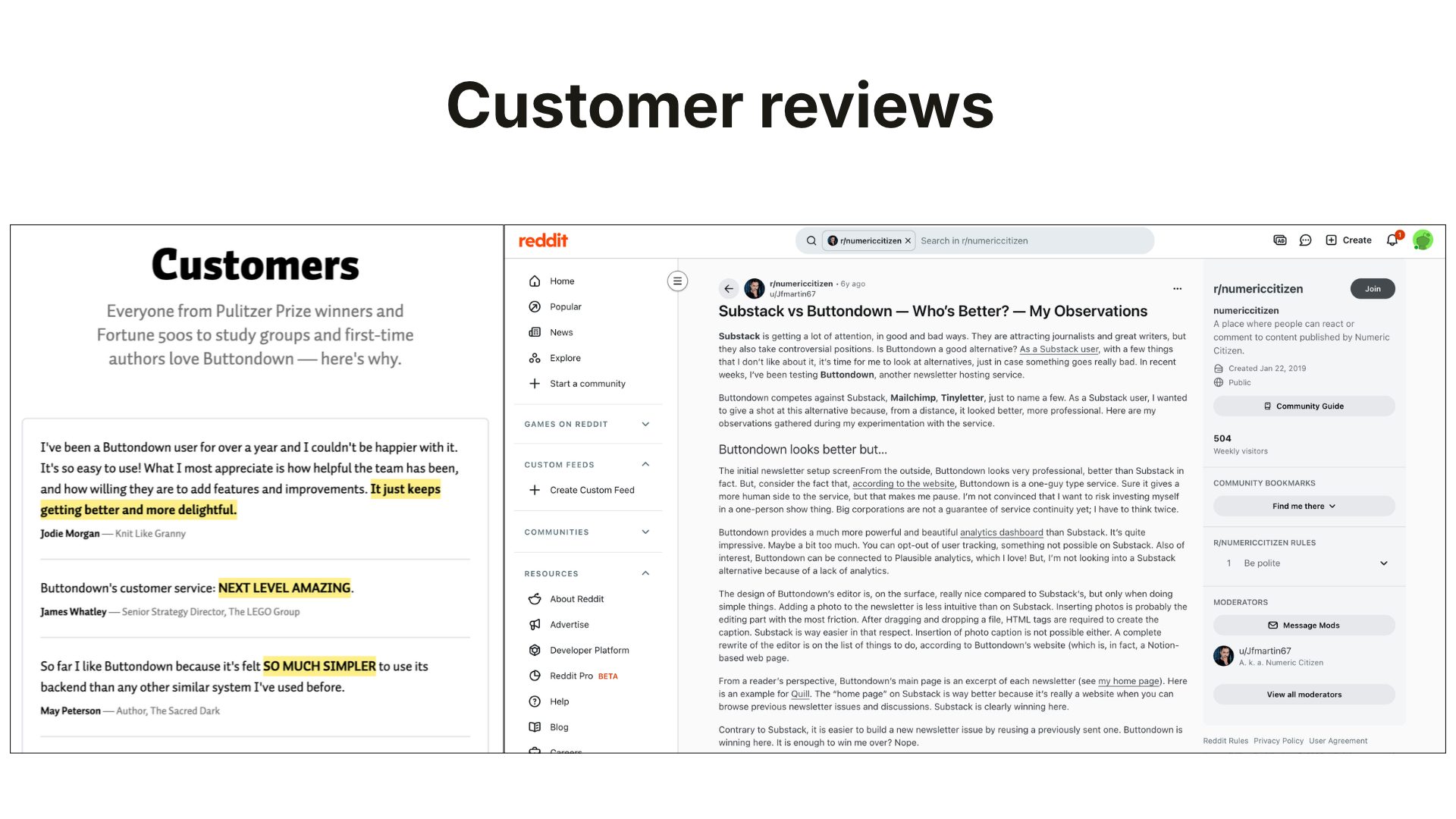
That creates a simple loop:
Good support → satisfied customers → recommendations → more discovery
No AI visibility tool can manufacture this loop.
GEO can increase the chances that existing reputation is discovered, but the underlying reputation still needs to exist.
Buttondown has another advantage that many SaaS products do not have: its customers publish newsletters.
Duke points out that Buttondown's emails carry the company's identity and that public newsletter archives create additional exposure. Every customer publishing through the platform can potentially introduce another person to Buttondown.
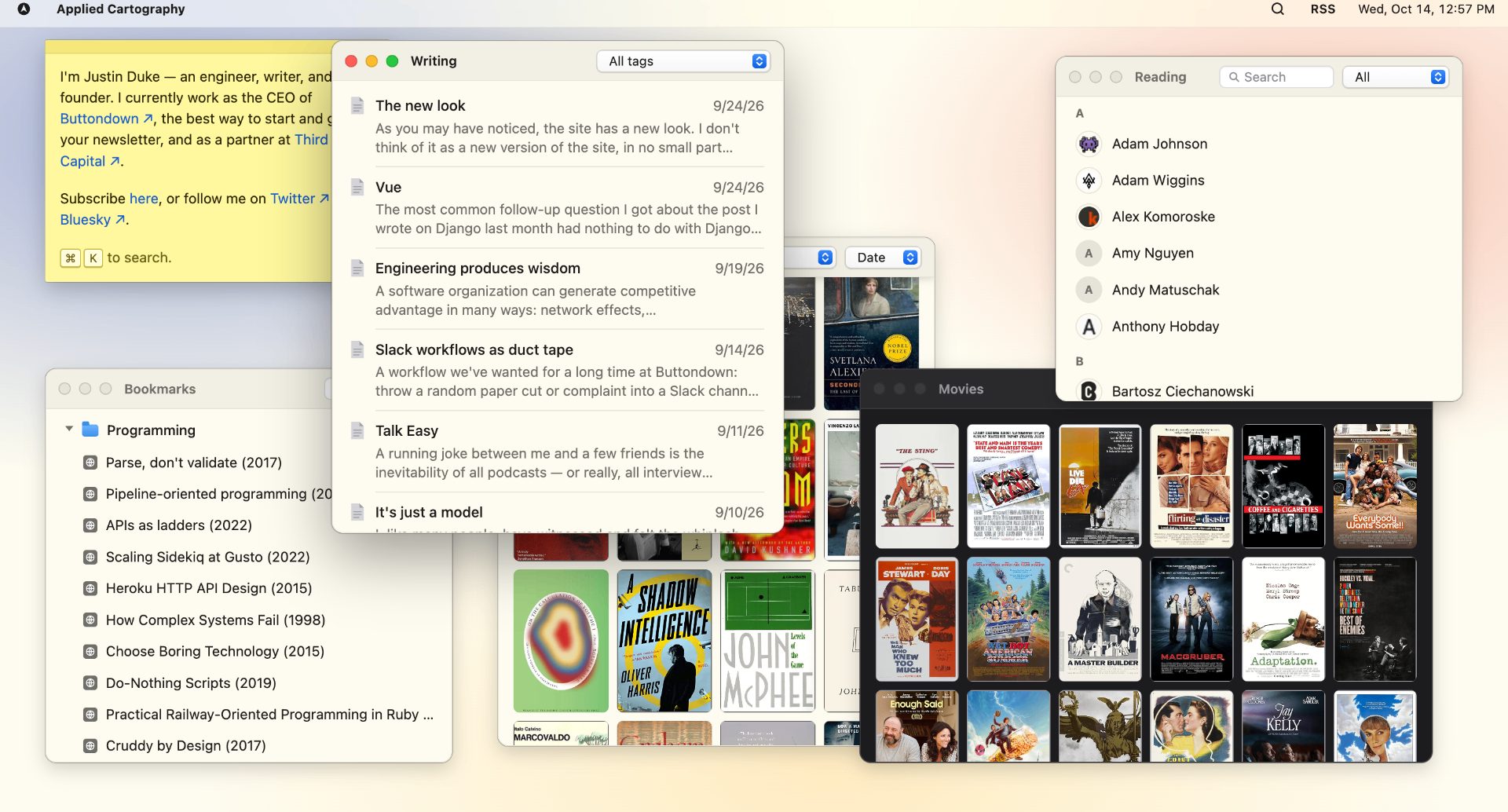
This is a form of product-led distribution.
The product is not simply used to create value. Its normal operation creates additional opportunities for discovery.
Other SaaS products can look for similar mechanisms.
For example:
A form builder can create public forms.
A website builder can create public sites.
A documentation tool can create public documentation.
A scheduling tool can create shareable booking pages.
A design tool can create public projects.
The strongest examples turn product usage into legitimate distribution without forcing promotional content into the customer's experience.
The most interesting part of the new Indie Hackers case study is the statement:
“LLM-based acquisition has bent the curve up a bit too. Claude loves us.”
This indicates that AI assistants have become another discovery channel for Buttondown.
The user may instead ask:
“What is the best newsletter platform for a developer who wants Markdown and an API?”
The answer engine decides which products to mention.
That changes the competition.
Traditional SEO is largely about ranking pages for queries.
AEO/GEO is about making sure the company, product, use case, evidence, and relevant sources are available to answer engines when they construct an answer.
There is no single “AI ranking.” A brand needs to monitor multiple answer engines and multiple prompts.
AEO starts with understanding the questions.
For a newsletter SaaS, useful prompts might include:
What is the best newsletter platform for developers?
What are good alternatives to Substack for technical writers?
Which newsletter tools support Markdown?
What newsletter platforms offer an API?
What is a simple alternative to Mailchimp for a small newsletter?
The content strategy should answer those questions directly.
Do not create a page simply because a keyword has search volume.
Create a useful answer that explains:
The problem → available options → differences → who each option is for → evidence → recommendation criteria.
Being mentioned by AI is useful. Being cited as a source is even more useful.
Useful citation targets include:
Original research, Product documentation, Detailed comparison pages, Technical guides, Pricing explanations, Industry statistics, Customer case studies, Definitions and explanations
Avoid creating pages that contain only promotional claims.
Instead of:
“The fastest and best AI prospecting platform.”
Publish:
“How to identify companies hiring SDRs, which data points to collect, and how to turn those signals into a prospecting workflow.”
The second page contains information an AI system can use.
A SaaS brand needs more than a homepage.
AI systems may encounter information about a company through:
Official website → documentation → reviews → directories → customer websites → communities → comparison articles → social profiles → founder content → news → third-party research
The objective is consistency.
If the company's website says it is an AI sales research platform, its documentation says the same thing, customers describe it that way, and third-party articles classify it similarly, an AI system has several independent signals connecting the company to that category.
If every page uses a different description, the model has a harder classification problem.
This is why entity consistency is an important part of GEO.
You cannot improve AI visibility if you do not know where the company currently appears.
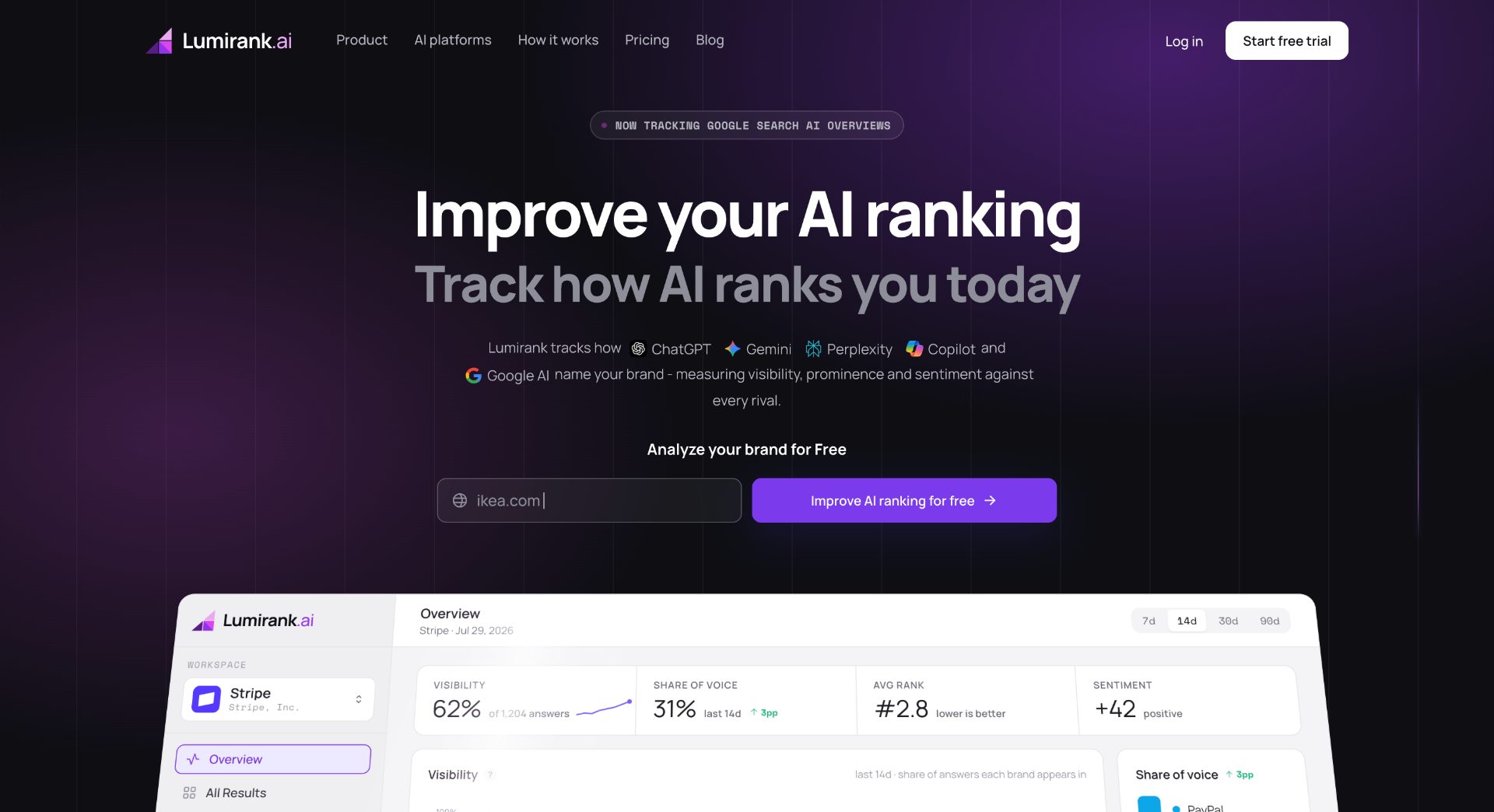
Lumirank.ai helps brands understand how they appear in AI search. It tracks how ChatGPT, Gemini, Perplexity, Copilot, and Google AI mention a brand, including visibility, sentiment, competitors, and cited sources.
Other useful tools include:
The workflow is simple:
Run prompts → record recommendations → identify competitors → inspect citations → find content gaps → publish or improve content → run the prompts again.
Do not assume that strong Google rankings mean strong AI visibility.
Create a list of 20–50 questions potential customers might ask.
Then test those questions across Claude, ChatGPT, Gemini, and Perplexity.
Record:
Was the brand mentioned?
What position did it receive?
How was the product described?
Which competitors appeared?
Which websites were cited?
Was the description accurate?
Which use cases triggered the recommendation?
Suppose Claude recommends a competitor whenever someone asks:
“What are the best AI sales tools for small SaaS companies?”
Look at the sources behind those answers.
Maybe the competitor is repeatedly mentioned in:
Those sources provide a roadmap.
The objective is not to copy the competitor's content. It is to understand what information ecosystem is influencing the category.
GEO should not become a campaign of publishing hundreds of pages that mention a brand repeatedly.
Instead, build information that deserves to be referenced.
For example, a cybersecurity company could publish original research about phishing attacks.
An analytics platform could publish benchmark data.
An SEO tool could publish a study of search behavior.
A developer tool could publish technical documentation and benchmarks.
A SaaS company can also create detailed comparisons and customer case studies based on real data.
Original information gives other websites and AI systems something concrete to reference.
One of the strongest lessons from Buttondown is that many of its acquisition channels compound slowly.
Duke says starting the company while he had a full-time salary gave him the financial stability to make patient decisions. He specifically connects patience with channels such as SEO and word of mouth.
That is also true for GEO.
A company cannot create years of customer recommendations, independent mentions, documentation, and useful content overnight.
But it can start building those assets now.
The process is:
Clear positioning → useful product → useful content → customer satisfaction → recommendations → third-party references → stronger entity recognition → AI visibility Pasted text
A SaaS marketing team can turn the Buttondown example into a repeatable process.
Write one clear sentence explaining what the product does and who it serves.
Collect questions customers might ask ChatGPT, Claude, Gemini, Perplexity, and Google AI.
Run those prompts and record brand mentions, competitors, rankings, descriptions, and citations.
Find the products appearing most often and identify the sources cited around them.
Make product pages, documentation, comparison pages, pricing, use cases, and FAQs clear and factually consistent.
Create original research, technical guides, customer stories, comparisons, and pages that directly answer important buyer questions.
Earn relevant mentions through customers, communities, publications, directories, reviews, partnerships, and industry content.
Use Lumirank.ai, Semrush, Profound, or OtterlyAI to monitor mentions, citations, competitors, and prompt-level changes.
If competitors appear for a valuable prompt and your product does not, investigate why. The missing piece may be content, positioning, authority, citations, or simply a better explanation of the product.
AI search changes continuously. Run the same prompts regularly and compare the results over time.
Buttondown's $1M ARR story is not primarily about one marketing tactic.
It is about building a product for a clearly defined user, keeping the product focused, supporting customers directly, publishing useful information, and allowing word of mouth to compound over years.
The new part of the story is AI discovery.
Justin Duke says LLM-based acquisition has increased and specifically notes that Claude recommends Buttondown.
That outcome makes sense when viewed through an AEO/GEO lens. Buttondown has a clear product identity, years of public writing, customer recommendations, documentation, public archives, and third-party references. Those sources give search engines and AI systems enough context to connect the product with specific newsletter use cases.
The lesson for SaaS companies is straightforward:
Do not optimize only to rank a page. Build the information, reputation, and evidence needed for an AI system to confidently understand when your product is the right answer.
Then measure whether that actually happens.
That is where tools such as Lumirank.ai, Semrush, Profound, and OtterlyAI become useful: they turn AI visibility from something a company occasionally checks into something the marketing team can monitor, compare, and improve.
