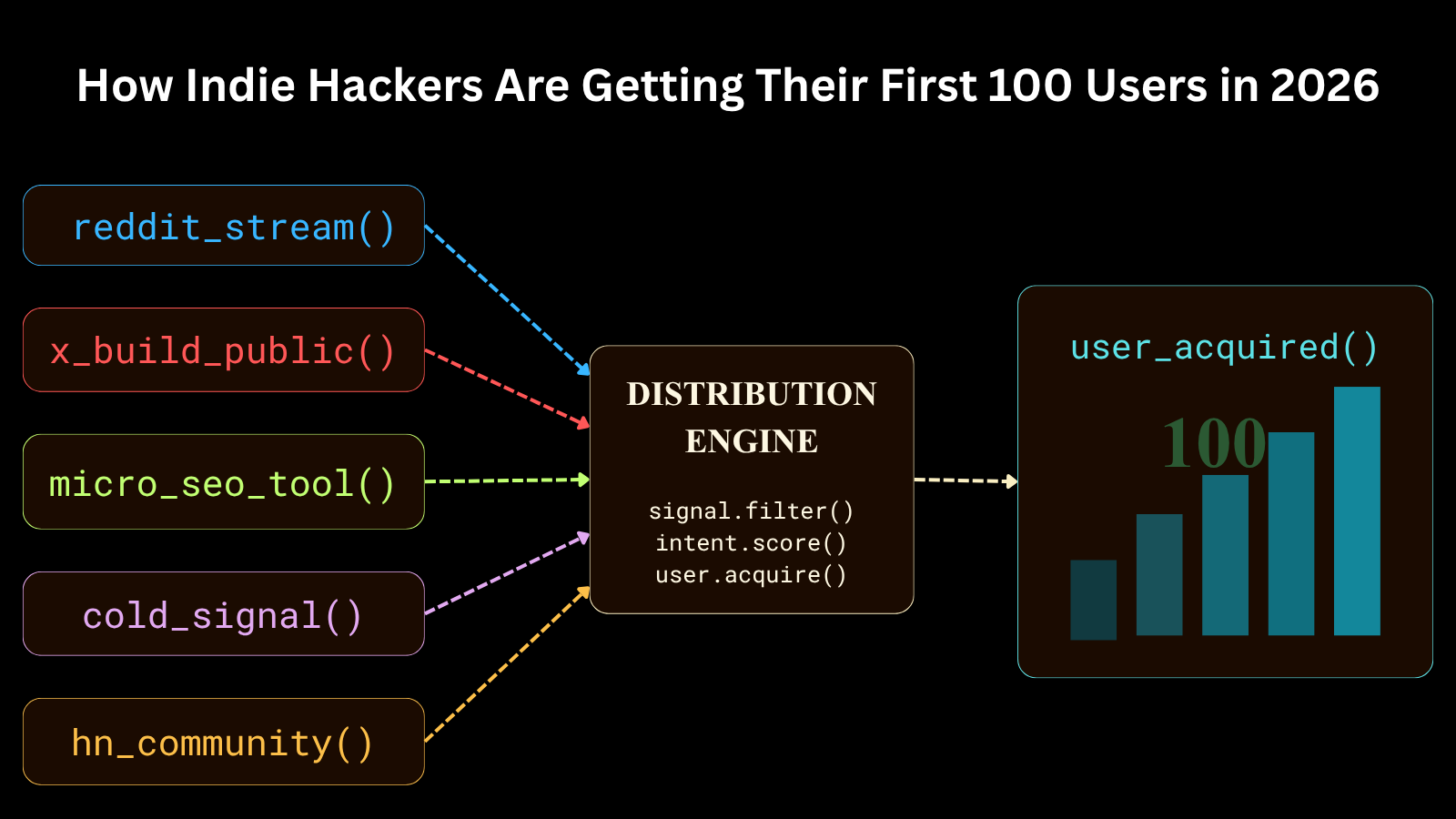
The standard playbook for launching a software product - drop it on Product Hunt, schedule ten tweets, spam a few subreddits, and wait for the Stripe webhooks to roll in - is completely broken. In 2026, programmatic SEO spam and LLM-generated wrapper noise have completely saturated traditional aggregate feeds. Buyers are fatigued, and filter algorithms are aggressive.
To get your first 100 users right now, you need un-scalable, highly targeted programmatic and manual distribution layers. We analyzed data from 42 successful SaaS micro-launches tracked on ProductWatch.io over the last two quarters. The metrics show a distinct shift: distribution has moved away from broad broadcast channels toward high-intent, hyper-niche communities and hard-engineered discovery loops. Here is the exact breakdown of what works, what fails, and how to execute the technical mechanics of 2026 user acquisition.
| Channel | Share of Initial Signups |
|---|
| Reddit & Niche Forums | 34% |
| Programmatic SEO & Micro-Tools | 24% |
| Targeted Cold Outbound | 18% |
| Directories & Launch Frameworks | 12% |
| Twitter/X Build in Public | 10% |
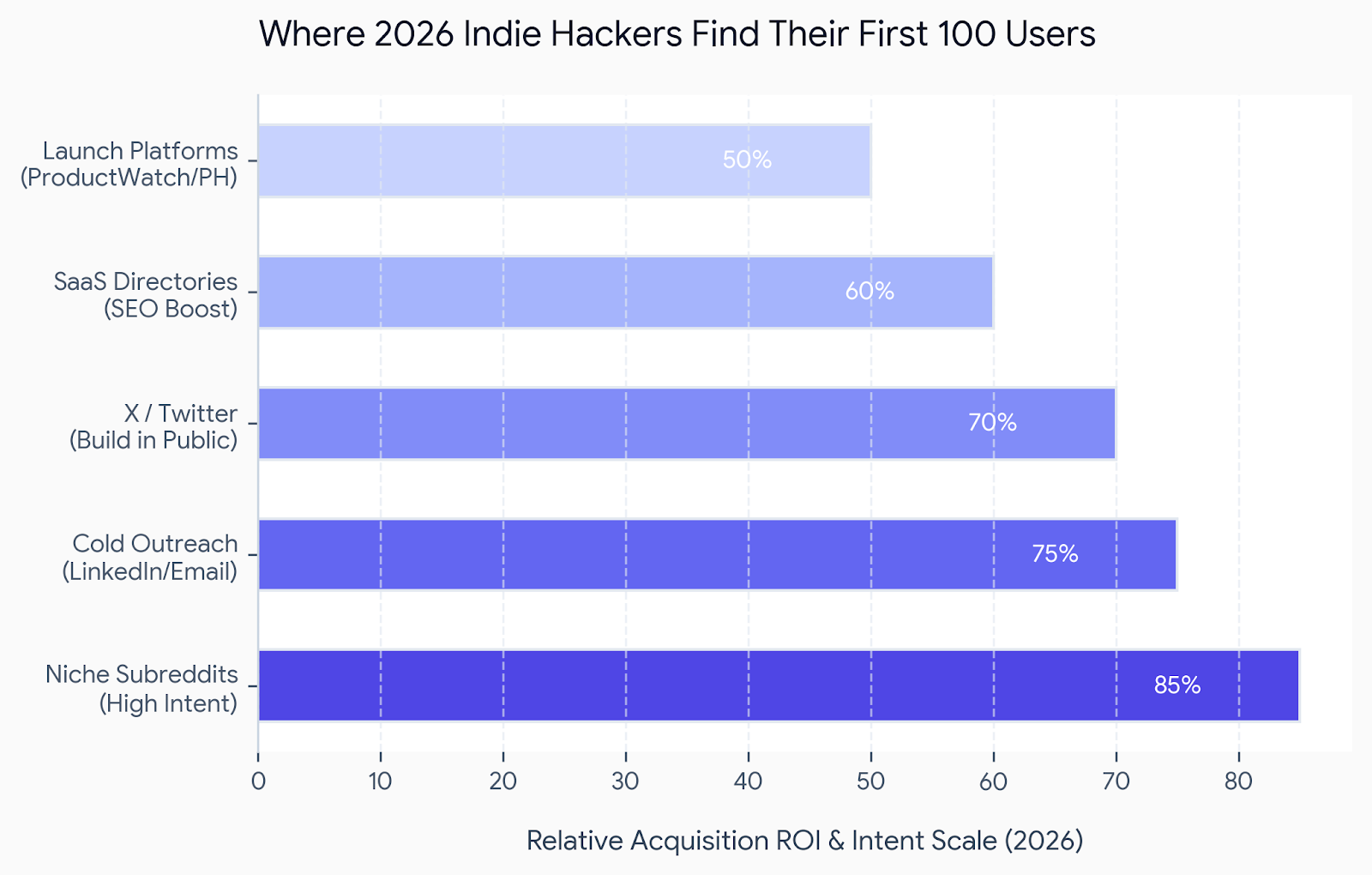
Reddit remains the single highest-converting channel for early users, but drop-shipping links into subreddits will get your domain blacklisted by AutoModerator within seconds. The 2026 approach requires monitoring high-intent, low-volume subreddits for structural friction points where your software provides an immediate fix.
Instead of manually browsing, developers are setting up listeners against the Reddit API streams. You want to query for problem-indicative strings like "how can I automate", "is there a tool for", or "alternative to [expensive incumbent]". Here is a bare-bones Node.js listener structure that pipes filtered keyword mentions straight into a Discord webhook for real-time triage:
When you respond to a flagged post, do not pitch your product directly in the top-level comment. Write a short, highly technical explanation of how to solve the user's issue manually. At the bottom, add a brief sign-off:
"I got tired of doing this manually, so I wrote an open-source parser to handle it at
yourlink.com- let me know if it breaks on your data." This establishes baseline competence first.
The era of getting traction by posting clean Tailwind screenshots or vague indie hacker platitudes is over. The algorithm on X heavily suppresses external outbound links unless the tweet secures intense initial engagement. The founders succeeding on X right now are shipping raw engineering retrospectives. Post about system failures, database scaling bottlenecks, or exactly how an unoptimized SQL query ran up a $400 database bill overnight. Use explicit snippets. Show the bad code alongside the fix:
When you give away the technical solution directly inside the platform without forcing a click-through, the algorithm amplifies it. Place your product link exclusively in the auto-DM or as a secondary reply thread once the initial code teardown catches velocity.
Traditional long-form blog posts take months to index and rarely rank for competitive commercial keywords anymore. Successful developers are instead launching dedicated, single-purpose micro-tools that target hyper-specific long-tail search queries.
If you are building a database migration SaaS, do not just write articles about database migration. Build a free, zero-auth, client-side browser tool like a "Raw SQL to Prisma Schema Converter" hosted at prisma-converter.yourdomain.com. Ensure it:
These micro-utilities rank quickly because they carry strong engagement signals and earn organic backlinks from developer resource lists. The compounding effect of a dozen such tools is significant.
The technical architecture matters for SEO too. Serve the tool on a subdomain so it inherits your root domain authority while keeping the slug clean. Implement proper <meta> tags, a canonical URL, and a sitemap.xml that pings Google Search Console on deploy via a CI hook:
Launch platforms no longer guarantee immediate sustainable business, but they are highly efficient for initial regression testing and getting your first 30 to 40 sandbox users. The key is structural timing. Do not launch on Product Hunt, Peerlist, and BetaList simultaneously.
Cold emails work only if the context is so specific it feels impossible to automate. Generic sequences sent at scale yield near-zero conversion and put your sending domain at risk of being flagged by major inbox providers. Instead, look for public technical triggers. If your product optimizes heavy media assets, monitor public repositories or websites with automated scripts to check for uncompressed images. When you find an unoptimized target, programmatically generate a specific optimized asset and email the engineering lead directly:
The response rate on this approach is high for one reason: it bypasses conventional marketing frameworks entirely and delivers quantifiable value before asking for anything. You have already done the work. The ask is a footnote. You can build the scraper with a straightforward Playwright or Puppeteer script:
Getting traction in Discord servers, Slack communities, and Hacker News requires respecting strict cultural boundaries. On Hacker News, the tolerance for marketing copy is zero. A post that reads like an ad will be downvoted into oblivion within minutes.
To succeed on Hacker News, tell the story of your technical architecture. Explain exactly why you chose SQLite over PostgreSQL for a multi-tenant platform, or how you cut Docker layer rebuild time from 4 minutes to 22 seconds by restructuring your COPY ordering
Open-source the core infrastructure or the underlying engine of your product if possible. The Hacker News audience explores landing pages from genuinely interesting technical posts, but only if the technical core earns it. On Discord and Slack, lurk in the channels relevant to your niche for at least two weeks before posting anything. Answer questions genuinely. Provide value without expectation. When you eventually mention your tool, it lands as a recommendation from a known contributor, not a cold drop.
Getting your first 100 users in 2026 is an exercise in engineering distribution with the exact same precision you apply to your codebase. Broadcasting to massive groups is a waste of time. Instead, focus your energy on setting up programmatic listeners, launching hyper-focused micro-utilities, and delivering highly individualized cold outreach that leads with concrete engineering value. Once you secure those initial 100 high-touch users, your primary product feedback loops will stabilize, giving you the real-world validation data required to build out scalable programmatic acquisition funnels.
Getting your first 100 users in 2026 is an exercise in engineering distribution with the exact same precision you apply to your codebase. Broadcasting to massive audiences is a waste of time and budget. Instead, focus on:
Once you secure those first 100 high-touch users, your feedback loops stabilize. You get a real-world signal. And then, only then, you have the data required to build scalable programmatic acquisition on top of a foundation that actually holds.