
Blogs in indiehacker
stay updated with the latest news, insights, and guides on indiehacker from ProductWatch.
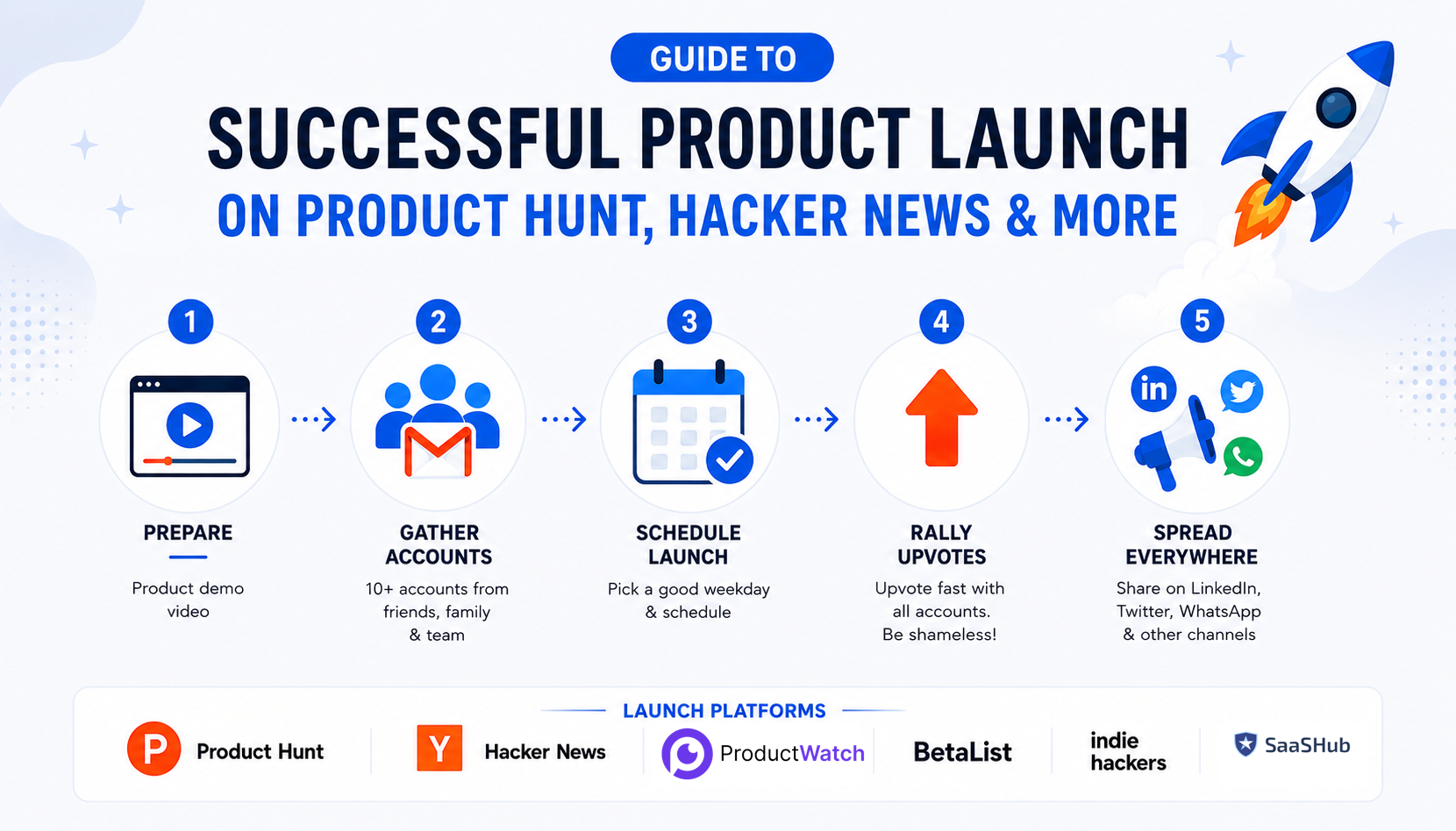
How to Successfully Launch a Product on Product Hunt, Hacker News, and Other Launch Platforms
Launching a SaaS product is easy. Getting the right people to notice it is the difficult part. For indie hackers, solo-founders, and SaaS developers, launch platforms such as Product Hunt, Hacker News, Indie Hackers, Reddit, LinkedIn, and X can create a powerful burst of visibility. But simply publishing a product page does not guarantee users, customers, or even meaningful attention. A successful launch starts well before launch day. The product needs a clear demo, the launch page needs to communicate its value quickly, the team needs to choose an appropriate launch time, and the founder needs a plan for distributing the launch across existing networks. This guide focuses on the practical launch process, particularly preparing a demo, building a genuine Product Hunt presence, choosing launch timing, generating legitimate launch-day momentum, distributing the launch through social and personal networks, and understanding why buying or manipulating votes is not a sustainable strategy. > QUICK SUMMARY > > * Product Hunt: Record a short demo before launch, complete the launch page, prepare your screenshots and description, schedule the launch when your team can be available, and ask your real network for feedback and sharing rather than creating fake accounts or buying votes. > * Hacker News: Launch when the product has something genuinely useful or technically interesting for developers. Write a clear post explaining what was built and why it matters, then stay available to answer technical questions. > * Indie Hackers: Share the actual building journey, including the problem, product decisions, launch experience, early users, mistakes, and results. Start participating in discussions before promoting the product. > * Reddit: Find subreddits where your target users already discuss the problem your product solves. Check each community's rules, contribute useful information, and share the launch only where self-promotion is allowed. > * Startup directories: Submit the product to relevant directories such as Product Watch to create additional discovery opportunities, referral traffic, and long-term SEO value. Do not expect every directory to generate immediate launch-day traffic. > * LinkedIn & X : Turn the launch into several posts instead of sharing the same announcement repeatedly. Publish the demo, explain the problem, show the product in action, share the founder story, and post early results > * WhatsApp and personal networks: Send the launch to friends, colleagues, existing users, and relevant professional contacts who may genuinely be interested. Ask them to try the product and share honest feedback rather than simply asking everyone to upvote. > * After launch: Do not stop when the Product Hunt ranking settles. Follow up with people who tried the product, collect feedback, fix the biggest problems, share the results, and continue promoting the product through content, communities, directories, and social media. USEFUL TOOLS FOR THE LAUNCH PROCESS | Launch task | Tool | Primary use | | | | | | Product graphics and video | Canva | Screenshots, launch graphics, thumbnails and video | | Screen recording | Loom | Product demos and technical walkthroughs | | AI/UGC video | HeyGen | AI presenter and UGC-style videos | | Social scheduling | Buffer | Preparing and scheduling launch posts | | Product launch | Product Hunt | Product discovery and launch | | Technical launch | Hacker News | Developer-focused launches | | Founder distribution | Indie Hackers | SaaS stories and founder discussions | | Community distribution | Reddit | Niche communities | | Professional distribution | LinkedIn | B2B and founder audiences | | Developer/founder distribution | X | Threads, product updates and build-in-public content | 1. PREPARE A PRODUCT DEMO BEFORE LAUNCHING The first thing to prepare is a short product demo. A common mistake among SaaS founders is spending weeks preparing the product and then trying to record a demo a few hours before launch. The demo should make the product understandable without requiring the visitor to read a long description. Ideally, someone should be able to watch it and understand what the product does, who it is for, and why it is useful within a minute or two. > For example, imagine an indie hacker launching an AI tool that converts GitHub commits into social media posts. Instead of explaining every feature, the demo could show a GitHub repository, select a commit, generate the post, make a small edit, and publish the result. The entire value proposition becomes visible through the workflow. A simple structure works well: show the problem, introduce the product, demonstrate the core workflow, and finish with the result.* For visual assets and lightweight video editing, Canva can be used to create product screenshots, launch graphics, thumbnails, captions, and short videos. For straightforward screen recording, Loom is particularly useful for SaaS and developer products because the founder can simply record the actual product in action. The goal should not be to make the video look like a large company's advertisement. The goal is to make the product immediately understandable. Product Hunt itself includes product media and launch preparation guidance for makers preparing their pages. 2. BUILD YOUR PRODUCT HUNT PRESENCE BEFORE LAUNCH One of the most common Product Hunt launch tactics found in older growth guides is to create multiple accounts through friends and family and use them to generate a large number of votes immediately after launch. That is not a strategy worth following. Product Hunt explicitly says makers should not ask friends or family to upvote their products. It expects people to vote because they genuinely like or find the product interesting, and coordinated requests can result in ranking drops or removal from the homepage. Product Hunt also works to detect fake accounts, voting rings, and other forms of vote manipulation, and suspicious votes can be removed. The useful idea behind the old strategy is actually starting early. Instead of creating accounts solely for voting, founders and team members should create genuine Product Hunt profiles well before launch and participate in the community. Product Hunt recommends joining the community before launching and says newly created accounts must wait at least one week before posting a product. It also recommends becoming familiar with the community considerably earlier than launch. For an indie hacker, this means the founder can start following other makers, discovering products, leaving useful comments, and understanding how successful launches are presented. If there is a team, genuine team members can also participate. The important distinction is that every account should represent a real person rather than an account created simply to manipulate launch rankings. 3. SCHEDULE THE LAUNCH AT THE RIGHT TIME Launch timing matters, but there is no magical weekday that guarantees a Product Hunt win. Product Hunt itself says there is no universal "golden-ticket" day because launch performance depends on several factors, including competing launches, events, audience behavior, and the maker's ability to participate during the launch. Product Hunt currently recommends 12:01 a.m. Pacific Time as the default launch time when makers do not have another timing constraint. This gives the product a full 24-hour launch cycle. Product Hunt also allows makers to schedule launches up to one month in advance. For a SaaS founder, the practical question is therefore not simply "Which day gets the most votes?" It is "When can the team give the launch its full attention?" If the founder launches at midnight but goes to sleep immediately, a theoretically perfect launch window becomes much less useful. Someone should be available to respond to comments, answer questions, monitor the application, investigate bugs, and talk to early users. Before scheduling, the Product Hunt page, demo video, screenshots, launch description, first comment, website, analytics, social posts, and support process should all be ready. 4. LAUNCH DAY: CREATE MOMENTUM WITHOUT MANIPULATING VOTES This is where the traditional "get 10 accounts and upvote immediately" strategy should be replaced with something much more effective. When the product goes live, activate the people who already know about the product. That could include beta users, newsletter subscribers, existing customers, genuine community members, friends who are actually interested in the product, previous collaborators, and the founder's professional network. The message should not be: > "Go upvote this Product Hunt launch." Instead, it can be: > The launch is live 🚀 Would love to get your honest feedback on the product. If you have a few minutes, check it out and let us know what you think. That small change matters. It invites genuine engagement rather than attempting to manufacture votes. Product Hunt recommends asking people to visit, comment, provide feedback, and share rather than directly asking them for upvotes. A person who genuinely likes the product can decide whether to upvote it themselves. This approach also produces something more valuable than a vote. Someone may become a customer, report a bug, introduce another founder, write a review, share the product, or provide feedback that improves the product. Product Hunt says its ranking system considers multiple signals, including votes, comments, time since submission, and other factors, while keeping the exact algorithm private to prevent manipulation. The objective should therefore be real engagement, not a particular vote number. 5. TELL YOUR NETWORK ABOUT THE LAUNCH Once the product is live, do not simply wait for Product Hunt's internal traffic. Use the channels where the founder already has relationships. LinkedIn can be particularly effective for B2B SaaS. Instead of publishing a generic "We are live on Product Hunt" announcement, explain the problem that led to the product. For example: > After months of building, [Product Name] is finally live. > The problem was simple: developers were spending too much time switching between tools to debug API requests. > The new workflow puts the entire process into one place. > Here's a 45-second demo. > Feedback from developers and SaaS founders would be especially useful. That type of post gives the audience a reason to care before asking them to visit the launch. The same principle applies to X. A founder can turn the launch into a short story showing what was built, why it was built, what changed during development, and what the product does now. For visual content, Canva can turn the same product screenshots into LinkedIn graphics, X images, carousels, thumbnails, and short videos. 6. USE WHATSAPP AND PERSONAL NETWORKS CAREFULLY WhatsApp can be useful for early-stage launches because founders often have personal and professional relationships there. However, blasting dozens of groups with "Please upvote this" can quickly become spammy and can also produce low-quality engagement. A better approach is to contact people who are actually relevant. For example, if a founder has built a developer tool, a personal message to developer friends can say: > The product is finally live. Since you work with APIs, would love your honest opinion after trying it. If the person likes the product, they can share it naturally. The same principle applies to Slack groups, Discord communities, Telegram groups, email lists, and private communities. The launch should be relevant to the audience rather than simply distributed everywhere. Product Hunt specifically recommends sharing launches through email, LinkedIn, in-app notifications, and communities where the maker has already established a presence. It also warns against suddenly spamming communities such as Reddit or Indie Hackers on launch day. 7. PREPARE SOCIAL POSTS BEFORE LAUNCH DAY Launch day can become surprisingly chaotic. A founder may need to answer Product Hunt comments, solve bugs, respond to customers, monitor infrastructure, speak with potential users, and track traffic at the same time. Social content should therefore be prepared before launch. Buffer can help schedule posts across social platforms so the founder does not have to manually publish every update during the launch. Instead of publishing the same announcement repeatedly, create different angles around the same product. The first post can announce the launch. A later post can show the product demo. Another can explain the problem that inspired the product. Another can highlight a feature. A later post can share what users discovered during launch day. This makes the launch feel like an ongoing story rather than a single promotional message repeated five times. 8. TURN ONE PRODUCT DEMO INTO MULTIPLE LAUNCH ASSETS The demo video created before launch should not be used only on Product Hunt. A 60-second product demo can be transformed into several pieces of content. The full version can appear on the Product Hunt page. A shorter version can be posted on LinkedIn and X. Individual scenes can become screenshots. A particularly interesting workflow can become a GIF. A technical section can become an X thread or developer-focused post. Canva is useful for creating these variations, while Loom can be used when additional technical walkthroughs are needed. For founders experimenting with different hooks, HeyGen can also create different AI-presenter or UGC-style versions. For example, the same SaaS product can have one video starting with: > "Still doing this manually?" Another can start with: > "This used to take 20 minutes. Now it takes 30 seconds." Another can start with: > "Here's how this developer workflow works." The product remains the same. The positioning changes according to the audience. 9. USE REDDIT TO REACH THE RIGHT AUDIENCE Reddit can be a strong launch channel for SaaS products, indie projects, and developer tools, but the approach should be different from Product Hunt. Instead of posting the same promotional message everywhere, find subreddits where potential users already discuss the problem the product solves. Some useful communities to research include r/SaaS, r/SideProject, r/indiehackers, r/buildinpublic, r/microsaas, r/startups, r/EntrepreneurRideAlong, and r/RoastMyStartup. For example, rather than saying "Our SaaS is live, check it out," share the problem, development journey, results, or ask for genuine feedback. Always check the current subreddit rules before posting because many communities restrict self-promotion or provide dedicated launch threads. The goal is not to post on the most subreddits. It is to find the communities where the product genuinely belongs. 10. STAY ACTIVE AFTER THE PRODUCT GOES LIVE Launching is not the end of the process. The first few hours can generate questions that reveal exactly what potential customers do not understand. If multiple people ask how pricing works, the pricing page may need improvement. If people repeatedly ask whether a certain integration exists, that integration may be worth considering. If visitors watch the demo but do not sign up, the onboarding or landing page may have friction. If developers love the technical idea but struggle to install the product, the documentation may need work. Product Hunt recommends being available and responding to comments as quickly as possible during launch day. For a small SaaS team, this can be one of the most valuable parts of the launch because the founder is suddenly receiving concentrated feedback from people who discovered the product without being personally recruited. 11. DON'T OBSESS OVER THE PRODUCT HUNT LEADERBOARD It is tempting to refresh the Product Hunt ranking every few minutes. But ranking is only one part of the outcome. Suppose a launch receives 5,000 visitors but only two customers. Another source sends 500 visitors and produces ten paying customers. The second channel may be much more valuable. Product Hunt itself identifies goals such as website traffic, sales and leads, early adopters, feedback, networking, social buzz, and brand recognition as potential launch outcomes. For an early-stage SaaS, track what happens after the click. Website visitors matter. Signups matter more. Activated users matter more than signups. Paying customers matter more than activated users. Retention matters more than one-time purchases. The launch should therefore be evaluated as a funnel rather than simply as a leaderboard position. 12. WHAT ABOUT BUYING UPVOTES? The original six-step strategy includes buying upvotes if there is enough budget. That should not be part of a legitimate Product Hunt launch strategy. Product Hunt explicitly warns against artificial engagement, vote manipulation, paid hunters, and incentivized voting. It states that products involved in rule-breaking can be unfeatured or removed and that makers may face permanent bans. There is a major difference between paying for distribution and paying for votes. A founder can legitimately spend money on a video, design, advertising, sponsorships, creator partnerships, or other marketing activities. But paying people specifically to create artificial Product Hunt engagement can put the launch and account at risk. For a limited SaaS marketing budget, money is generally better spent improving the assets that create genuine demand. A better $100 can be spent on a better demo, landing-page improvements, customer interviews, or content that continues generating traffic after launch. PRODUCT HUNT LAUNCH WORKFLOW FOR SAAS FOUNDERS The entire process can be reduced to a straightforward workflow. Before launch: Build the product, prepare the demo, create a genuine Product Hunt profile, participate in the community, prepare the launch page, and schedule the launch. One week before: Prepare LinkedIn, X, email, and personal-network content. Make sure analytics and support are ready. Launch day: Publish the product, notify the existing audience, share the demo, ask for feedback, respond to comments, and monitor the product. During the first 24 hours: Continue genuine distribution instead of repeatedly asking for votes. Talk to users, answer questions, identify friction, and monitor signups. After launch: Share what was learned, improve the product, follow up with interested users, and turn the launch into additional content. CONCLUSION A successful Product Hunt launch is not about creating ten accounts, asking everyone to upvote, or purchasing votes. The real advantage comes from preparation and distribution. Prepare a product demo that makes the SaaS immediately understandable. Build a genuine Product Hunt presence before launch instead of creating accounts solely for voting. Schedule the launch when the team can actually participate. On launch day, activate the people who genuinely care about the product and ask for feedback rather than manufactured engagement. Then take the launch outside Product Hunt. Share the story on LinkedIn. Turn the development journey into an X thread. Reach relevant people through personal networks and email. Use communities where the founder already participates. Repurpose the demo into multiple pieces of content. Tools such as Canva, Loom, HeyGen, and Buffer can make this process significantly easier for a small team. Most importantly, do not confuse votes with traction. The strongest launch is not necessarily the one with the highest leaderboard position. It is the one that brings the right people into the product, creates meaningful conversations, generates customers, reveals product weaknesses, and gives the founder enough momentum to keep growing after launch day. Launch day gets attention. What happens after launch determines whether that attention becomes a business.
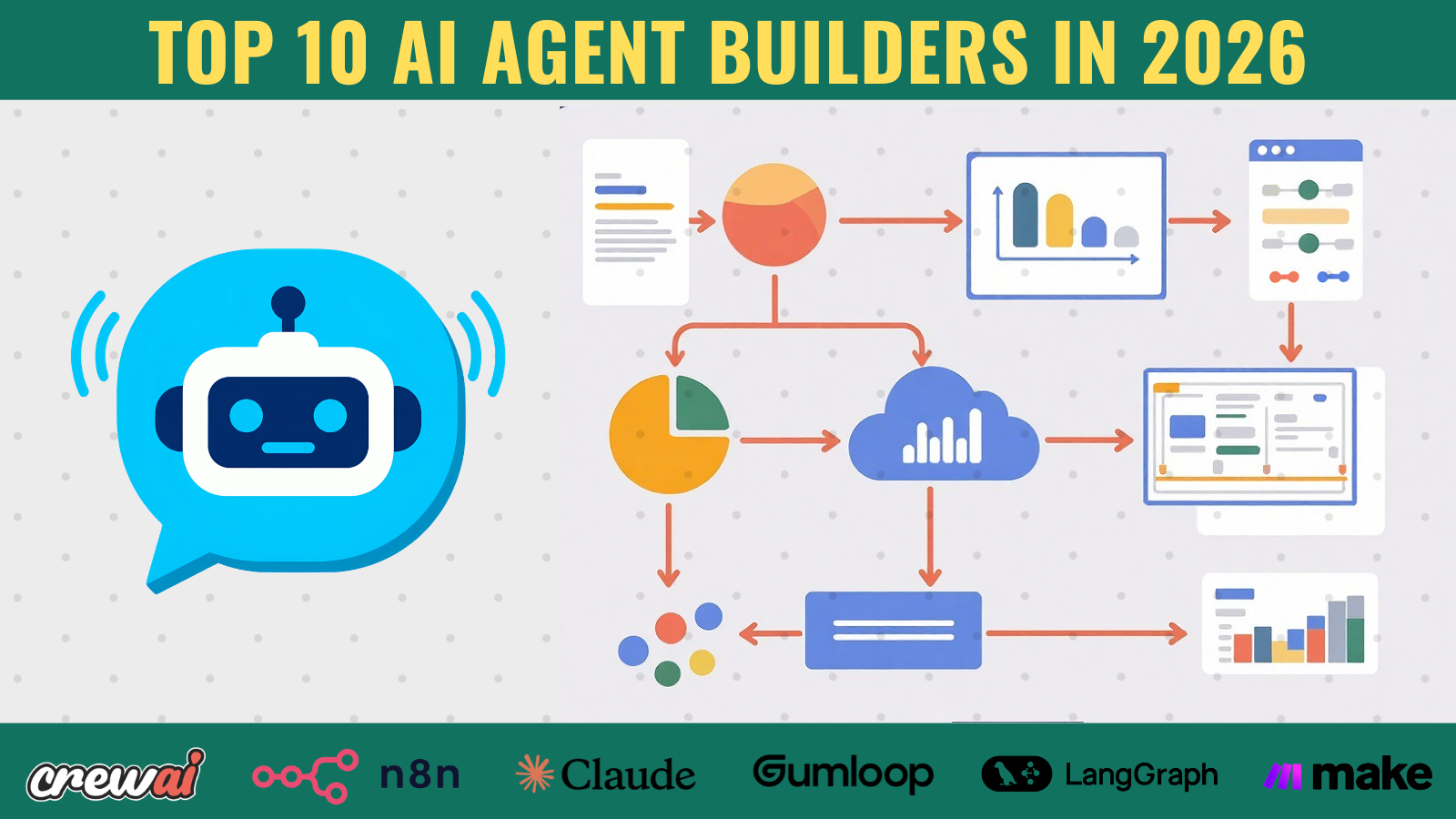
Top 10 AI Agent Builders in 2026
A three-person startup shipped a customer support agent on a Friday afternoon using a $24-a-month workflow tool, and by Monday it had resolved 40 percent of incoming tickets without a human touching them. Meanwhile, a mid-size fintech spent six weeks and two engineers wiring the same kind of agent by hand with raw API calls, retries, and a homemade state machine, because their compliance team would not accept a black-box no-code platform. Both approaches produced working agents. Neither approach was wrong. That gap is the entire story of AI agent builders in 2026: the category has split into tools that get you to a working agent in an afternoon and frameworks that get you to a defensible, auditable one in a few weeks, and picking the wrong lane wastes real time. The market backs this up. Gartner projects that 40 percent of enterprise applications will include task-specific AI agents by the end of 2026, up from under 5 percent in 2025. McKinsey's 2025 Global Survey found that 62 percent of organizations are already experimenting with or actively scaling agents. That growth has pulled dozens of vendors into a category that barely existed two years ago, and most comparison articles online just repeat vendor marketing copy. This one is built from actual product documentation, pricing pages, and release notes, cross-checked as of July 2026. > QUICK OVERVIEW > > An AI agent builder is a platform or framework that lets you define a goal for an AI system and have it plan steps, call tools or APIs, and act with limited human input, rather than following a fixed script. Some builders are no-code, visual, and aimed at business teams; others are code-first frameworks meant for engineers who need control over state, retries, and observability. In short: > > * n8n – open-source, self-hostable workflow and agent builder with full code-level control when needed. > * LangGraph – the most production-tested framework for stateful, branching agent workflows with checkpointing. > * CrewAI – the fastest way to get a role-based multi-agent prototype running. > * Claude Agent SDK – Anthropic's toolkit for building production agents natively on Claude models. > * Gumloop – a no-code, AI-first automation platform built around natural-language agent creation. > > AI agent builders include Microsoft Agent Framework, StackAI, Lindy, Make, and Google ADK, offering enterprise, no-code, automation, and Gemini-powered AI agent development. WHAT "AI AGENT BUILDER" ACTUALLY MEANS IN 2026 The term gets thrown around loosely enough that it is worth defining before comparing tools. A chatbot that answers questions from a script is not an agent. An agent observes context, decides what to do next, calls real tools such as APIs, databases, or browsers, and adjusts based on what happens, often across multiple steps without a human approving each one. The distinction that matters for buyers is between automation and judgment: automation tools follow "if this happens, do that" rules set in advance, while agent builders let teams define a goal and let the system work out the steps. Two things changed the landscape heading into 2026. First, the Model Context Protocol (MCP), originally released by Anthropic, became a common way for agents to connect to external tools without custom integration code for each one, and most serious platforms now support it. Second, multi-agent orchestration moved from a research curiosity to a standard requirement because single agents handling long, branching workflows tend to lose track of state or make cascading mistakes. That is why several tools on this list, including LangGraph and CrewAI, exist specifically to coordinate teams of specialized agents rather than one agent trying to do everything. HOW TO EVALUATE AN AI AGENT BUILDER Before getting into the ten tools, it helps to know what actually separates a good choice from a bad one, because feature lists on vendor pages tend to look identical. The factors worth weighing are model flexibility (can a team swap between Claude, GPT, and Gemini without rewriting logic), integration depth (does the tool actually complete real tasks reliably, not just connect to an app in theory), multi-agent support (can specialized agents hand off work to each other), and governance (SOC 2, HIPAA, audit logs, and role-based access if the agent touches sensitive data). Pricing model matters just as much: some tools bill per "execution" or workflow run, others bill per step or task, and that difference can make a 10-step workflow cost ten times more on one platform than another. | AI Agent Builder | Best For | Open Source | No-Code | Self-Host | Multi-Agent | Model Support | Starting Price | | | |: :|: :|: :|: :| | | | n8n | Workflow automation, AI agents, and API orchestration | ✓ | ✓ | ✓ | Partial | OpenAI, Anthropic, Gemini, Ollama, MCP, 500+ integrations | Free (Self-host), Cloud from $24/month | | LangGraph | Production-grade stateful AI agents with memory and checkpointing | ✓ | ✗ | ✓ | ✓ | Any LLM via LangChain | Free | | CrewAI | Role-based multi-agent applications | ✓ | ✗ | ✓ | ✓ | OpenAI, Anthropic, Gemini, Ollama, Groq, and more | Free | | Claude Agent SDK | Native AI agent development for Claude models | ✓ | ✗ | ✓ | ✓ | Claude | Free SDK (API usage billed separately) | | Gumloop | No-code AI workflow and agent builder | ✗ | ✓ | ✗ | Partial | OpenAI, Anthropic, Gemini, and others | Free plan, Paid from $97/month | | Microsoft Agent Framework | Enterprise AI agents and orchestration on Azure | ✓ | ✗ | ✓ | ✓ | Azure AI, OpenAI, Semantic Kernel | Free SDK (Azure services billed separately) | | StackAI | Enterprise AI agents and internal copilots | ✗ | ✓ | ✓ | ✓ | OpenAI, Anthropic, Gemini, Azure OpenAI | Free plan, Paid plans available | | Lindy | AI executive assistant and business workflow automation | ✗ | ✓ | ✗ | Partial | Multiple LLMs | Free plan, Paid from $49/month | | Make | Visual AI workflow automation with 3,000+ integrations | ✗ | ✓ | ✗ | Partial | OpenAI, Anthropic, Gemini, Mistral, and more | Free plan, Paid from $10.59/month | | Google ADK | Gemini-native AI agent development framework | ✓ | ✗ | ✓ | ✓ | Gemini | Free SDK (Gemini API billed separately) | THE 5 BEST AI AGENT BUILDERS IN 2026 1. N8N: BEST FOR DEVELOPERS WHO WANT FULL CONTROL n8n is an open-source workflow automation platform that added native AI agent nodes, LangChain integration, and MCP tool support on top of its existing 400-plus integrations. The core appeal for technical teams is the Community Edition: it is completely free to self-host under a fair-code license, with unlimited workflows and unlimited executions, and the only real cost is a small VPS, typically $5 to $10 a month. For teams that would rather not manage infrastructure, n8n Cloud starts at roughly $20 to $24 a month for the Starter plan (2,500 executions), with Pro at about $50 to $60 a month for 10,000 executions, and a Business tier around $800 a month that adds SSO, Git-based version control, and log streaming. What makes n8n stand out from typical automation tools is that it bills per execution, meaning one run of an entire workflow counts as a single execution regardless of how many steps or nodes it contains. That is a meaningfully different economic model from tools like Zapier, which charge per task inside a workflow. For an agent that calls five or six tools per run, that difference adds up fast at scale. A basic agent node in n8n can be wired to call an LLM, reason over a tool list, and act, without leaving the visual canvas, but developers can also drop into JavaScript or Python code nodes for anything the drag-and-drop interface cannot express. The tradeoff is a steeper learning curve than fully no-code tools like Gumloop or Relay, and the interface still assumes some comfort with automation logic. For a solo developer or small technical team that wants to self-host, keep data in-house, and avoid per-seat pricing, n8n remains one of the more cost-effective options available in 2026. 2. LANGGRAPH: BEST FOR PRODUCTION-GRADE, STATEFUL AGENTS LangGraph, built by the LangChain team, models an agent workflow as a directed graph where nodes represent steps like an LLM call, a tool call, or a human-approval checkpoint, and edges define how control moves between them, including conditional branching. LangGraph reached general availability in October 2025, and by mid-2026 it had absorbed features like per-node timeouts, durable streaming, and a Postgres-backed checkpointer that lets long-running agents persist their state and resume after a failure. It pulls tens of millions of monthly downloads on PyPI, more than any competing agent framework, largely because enterprises value the audit trail and rollback points that a graph structure provides. The honest tradeoff is verbosity. Even a simple two-agent workflow requires defining a state schema, nodes, and edges explicitly, which is more setup work than a framework like CrewAI. Teams that start with a simpler tool for prototyping frequently migrate to LangGraph once they need production-grade state management, human-in-the-loop approval steps, or precise control over retries and error recovery. It is model-agnostic, so different nodes in the same graph can call Claude, GPT, or a locally hosted model, and it pairs with LangSmith for tracing and evaluation across the full application lifecycle. For teams building anything long-running, branching, or subject to compliance review, LangGraph is close to the default choice for production work in 2026. 3. CREWAI: BEST FOR FAST, ROLE-BASED MULTI-AGENT PROTOTYPES CrewAI takes a different approach: instead of an explicit graph, it models multi-agent collaboration as a "crew" of role-playing agents, each defined with a role, a goal, and a backstory, then assembled into a team with a shared set of tasks. That metaphor maps closely to how people already think about delegating work, which is why developers consistently report getting a working multi-agent prototype running faster with CrewAI than with any comparable framework. CrewAI reports over 5 million monthly downloads and supports three coordination modes: sequential, hierarchical (a manager agent delegates to workers), and consensual (agents vote on decisions). The framework is open source and free to use, with cost limited to whatever LLM API calls the agents make. It genuinely shines for content pipelines, research assistants, and business analysis workflows where the task naturally splits into specialist roles, such as a researcher agent, a writer agent, and an editor agent working in sequence. The limitation shows up at scale: CrewAI has no built-in checkpointing for long-running workflows, agent-to-agent communication is mediated through task outputs rather than direct messaging, and error handling is comparatively coarse. Independent benchmarks in 2026 found roughly 18 percent more token overhead in a CrewAI ticket-triage setup compared to an equivalent LangGraph implementation. The common pattern, acknowledged even in CrewAI's own documentation, is to prototype in CrewAI to validate whether an agent architecture makes sense, then migrate the production-critical paths to LangGraph once checkpointing and fine-grained control become necessary. 4. CLAUDE AGENT SDK: BEST FOR BUILDING NATIVELY ON CLAUDE The Claude Agent SDK, renamed from the earlier Claude Code SDK in early 2026, is Anthropic's toolkit for building production agents directly on Claude models, including Claude Sonnet 5 and Claude Opus 4.8. As of June 2026, it added hierarchical subagent spawning and fallback model chains, letting a primary agent delegate subtasks to specialized subagents and automatically fall back to a different model if one becomes unavailable. It ships tool use, memory management, and tracing by default, which several 2026 framework comparisons flagged as a faster path than a general-purpose framework like LangGraph or CrewAI for teams that only need a single agent calling one or two tools rather than full multi-agent orchestration. The obvious tradeoff is that it is model-locked to Claude, so teams that need to swap between OpenAI, Google, and Anthropic models inside the same agent will find LangGraph's model-agnostic design more flexible. For developers who have already settled on Claude as their model provider, whether for coding tasks through Claude Code, general reasoning, or long-context workflows, the Agent SDK removes a layer of framework abstraction that would otherwise need to be built by hand. It works well alongside MCP connectors, since Anthropic maintains the Model Context Protocol as an open standard that most other tools on this list now also support. 5. GUMLOOP: BEST NO-CODE OPTION FOR NON-ENGINEERS Gumloop is a no-code, AI-first automation platform built around two core concepts: Flows, which are workflows built by dragging nodes representing apps and LLMs onto a visual canvas, and an in-platform assistant called Gummie that can build a workflow from a plain-language description rather than requiring manual node placement. It connects to MCP servers, a large library of built-in integrations, and multiple LLM providers without requiring separate API keys or subscriptions for each model. Pricing starts with a free plan, with paid tiers beginning around $37 a month, and the platform reports usage by companies including Shopify, Instacart, and Webflow across marketing, sales, and operations teams. Gumloop's appeal is speed to a working result: a non-technical team member can describe a task like "summarize new support tickets and post a daily digest to Slack" and get a functioning agent without touching code. That accessibility is also its ceiling. Teams that need precise control over retries, complex conditional branching, or on-premise deployment will hit the edges of what a visual, no-code canvas can express, and at that point, a code-first framework becomes the better fit. For solo operators, marketing teams, and founders who want to automate real workflows without hiring an engineer, Gumloop remains one of the more capable entries in the no-code segment. OTHER AI AGENT BUILDERS WORTH KNOWING Microsoft Agent Framework unifies AutoGen and Semantic Kernel into a single 1.0 release (April 2026) with graph-based workflows and Python plus .NET runtimes, making it the practical default for teams already standardized on Azure. StackAI is a low-code builder positioned for regulated industries, offering SOC 2, HIPAA, and GDPR compliance along with on-premises and VPC deployment options for teams that cannot use a fully cloud-hosted agent platform. Lindy functions less like a general builder and more like a pre-built AI executive assistant that manages inbox triage, calendar scheduling, and meeting follow-ups, including integration via iMessage. Make offers a visual Scenario Builder with more than 3,000 app connectors, aimed at mid-market operations and marketing teams that want to ship agentic workflows without waiting on an engineering backlog. Google ADK (Agent Development Kit) gives teams already invested in Google Cloud a native path to building agents optimized for Gemini models, with session-based state management and pluggable backend support. NO-CODE VS. CODE-FIRST: WHICH PATH FITS YOUR TEAM The honest answer to "which AI agent builder is best" depends entirely on who is building and what happens if the agent gets something wrong. A no-code platform like Gumloop, Relay, or Lindy gets a non-technical founder or marketer to a working agent in under an hour, and for tasks like summarizing tickets, drafting outreach, or managing a calendar, that speed is the whole point. A code-first framework like LangGraph, CrewAI, or the Claude Agent SDK asks for more setup time upfront in exchange for the ability to see exactly what prompt is being sent to the model, add a retry policy when a tool call fails, and pass a compliance audit that requires knowing precisely how a decision was made. A reasonable rule of thumb: if the agent is customer-facing, touches money, or operates in a regulated industry, lean toward a framework with explicit state management and observability, such as LangGraph, or a compliance-focused platform like StackAI. If the agent is an internal productivity tool with low stakes, if it makes an occasional mistake, a no-code platform will get there faster and with less engineering overhead. COMMON PITFALLS WHEN BUILDING AN AGENT A recurring mistake is treating an agent builder as a chatbot builder and expecting reliability without giving it real tool access, meaningful error handling, or a way to escalate to a human when it is uncertain. Another is picking a fully no-code platform for a workflow that will eventually need custom logic, then rebuilding the entire thing in a code-first framework six months later, a migration pattern that shows up often enough in CrewAI-to-LangGraph transitions that CrewAI's own documentation acknowledges it. A third is underestimating token cost: multi-agent setups with several specialized agents can burn noticeably more tokens than a single well-designed agent, so it is worth prototyping with a smaller model before committing to an expensive one in production. CONCLUSION The best AI agent builder in 2026 is not a single winner so much as a matter of matching the tool to the job and the team. Developers who want free, self-hosted control should start with n8n. Teams building anything long-running or subject to compliance review should default to LangGraph. Anyone who wants a multi-agent prototype running in an afternoon should try CrewAI before anything more complex. Teams already committed to Claude should look at the Claude Agent SDK before reaching for a heavier framework. Founders and non-technical operators who just need something working today should start with Gumloop or a similar no-code platform and only move to a framework once the workflow outgrows the visual canvas. Whichever path gets chosen, the same principle holds across every tool on this list: an agent is only as good as the tools it can call and the guardrails placed around it, so start narrow, watch what actually breaks in production, and expand from there rather than trying to build the perfect agent on day one.
Best AI Business Copilot Tools to Run Your Startup in 2026
Startup founders rarely struggle with ideas. The real challenge is keeping everything moving at the same time. Product development, customer support, fundraising, hiring, sales, engineering, documentation, marketing, finance, and operations all compete for attention. A typical workday involves jumping between Slack, Notion, GitHub, Linear, Jira, HubSpot, Google Drive, calendars, investor emails, analytics dashboards, and countless browser tabs. Valuable information ends up scattered across multiple platforms, making it difficult to stay focused on building the business. That challenge has created an entirely new category of software: AI business copilots. Unlike traditional AI assistants that simply answer questions or generate content, AI business copilots understand how a company operates. They connect with internal knowledge, project management platforms, customer data, financial systems, communication tools, and business workflows to provide meaningful context instead of isolated responses. Some function as AI-powered chiefs of staff, helping founders organize priorities and prepare for important decisions. Others operate as startup command centers that coordinate projects, monitor execution, automate repetitive work, and even manage autonomous AI agents capable of completing complex business tasks. For developers, founders, indie hackers, and startup teams, these platforms reduce operational overhead while improving visibility across the organization. Instead of spending hours collecting information, leaders can focus on product development, customer feedback, and business growth. This guide compares the best AI business copilot tools available in 2026, highlighting what each platform does best and which startups will benefit most from using them. > QUICK OVERVIEW > > Looking for an AI assistant that can do more than answer questions? Modern AI business copilots help founders manage operations, automate repetitive work, coordinate teams, organize company knowledge, and make faster decisions from a single workspace. > > In this guide, you'll discover: > > * Mission Control: AI operating system that helps founders manage projects, priorities, and company operations. > * BurnRateOS: Virtual AI executive team with AI CEO, CFO, CTO, CMO, and other business advisors. > * FounderOS: AI-powered workspace for startup planning, execution, and business management. > * CEO Workspace: Strategic planning platform for business growth, investor updates, and executive decision-making. > * GoTogether AI: AI collaboration platform that keeps teams, projects, and knowledge connected. > * Nautis: Startup operating system for managing operations, planning, and organizational workflows. > * xyroCore: AI CEO assistant that helps founders organize priorities and business execution. > * MetaTechAI FounderOS: AI-powered company operating system with intelligent agents and centralized business knowledge. > * Flowith: Visual AI workspace for research, strategic planning, brainstorming, and complex problem-solving. > * Lutra AI: AI workflow automation platform that eliminates repetitive business tasks. > * Relay.app: AI-powered workflow automation for coordinating multi-step business processes. > * Zapier AI Agents: Autonomous AI agents that automate work across thousands of business applications. > > The guide also includes a detailed comparison table, pricing, ideal use cases, and practical recommendations to help founders, developers, startup teams, and growing businesses choose the right AI business copilot in 2026. WHAT IS AN AI BUSINESS COPILOT? An AI business copilot is an intelligent software platform designed to help founders and startup teams manage everyday operations. Rather than acting as a standalone chatbot, it connects with the applications already used across the business, understands company context, retrieves relevant information, and assists with planning, coordination, and execution. Unlike traditional automation tools that rely on predefined rules, modern business copilots combine large language models, company knowledge, workflow automation, and AI agents to complete meaningful work. They can summarize meetings, monitor projects, retrieve documentation, organize priorities, prepare investor updates, automate repetitive workflows, and answer business questions using information spread across multiple systems. Many of these platforms are evolving into startup operating systems, providing a unified workspace where founders can manage projects, customer relationships, documentation, financial planning, and team collaboration from a single interface. WHY EVERY STARTUP NEEDS AN AI BUSINESS COPILOT Building a startup means making hundreds of decisions every week. Unfortunately, the information required to make those decisions is often scattered across different applications. Engineering updates might live inside GitHub or Linear. Customer feedback sits in Slack or Intercom. Sales data remains inside a CRM, while financial reports exist elsewhere. Even simple questions frequently require opening several applications before arriving at an answer. AI business copilots eliminate much of that friction by connecting these systems. Instead of searching for information manually, founders can ask natural-language questions, receive summarized insights, identify blockers, prepare meetings, automate routine work, and monitor company progress without switching between dozens of browser tabs. As startups scale, these capabilities become increasingly valuable because operational complexity usually grows faster than team size. HOW TO CHOOSE THE RIGHT AI BUSINESS COPILOT Every startup operates differently, so the ideal business copilot depends on existing workflows and long-term goals. Founders looking for a centralized operating system should prioritize platforms that combine company knowledge, project management, AI agents, and executive dashboards. Teams focused on automation may benefit more from workflow orchestration tools capable of connecting hundreds of business applications. Companies handling sensitive customer information should also evaluate security, permissions, compliance, and integration capabilities before selecting a platform. Scalability is another important consideration. While some tools are designed primarily for founders and early-stage startups, others support enterprise-grade workflows involving multiple departments, thousands of documents, and complex operational processes. The best AI business copilot should reduce administrative work without forcing teams to replace software that already works well. AI BUSINESS COPILOT COMPARISON | Tool | Primary Use Case | AI Agents | Multi-Agent Support | Workflow Automation | Integrations | Starting Price | | | | : : | : : | : : | : : | : | | Mission Control | AI operating system for founders | Yes | Yes | Yes | Limited | £9/month | | BurnRateOS | AI executive team (CEO, CFO, CTO & more) | Yes | Yes | Yes | Yes | Contact Sales | | FounderOS | Startup planning and execution | Yes | No | Yes | Limited | Contact Sales | | CEO Workspace | Business strategy and investor management | No | No | Limited | Limited | Custom Pricing | | GoTogether AI | Startup collaboration and operations | Yes | Yes | Yes | Yes | Contact Sales | | Nautis | Startup operating system | Yes | Yes | Yes | Yes | Free, Paid from $49/month | | xyroCore | AI CEO assistant | Yes | No | Limited | Limited | Contact Sales | | MetaTechAI FounderOS | AI company operating system | Yes | Yes | Yes | Yes | Custom Pricing | | Flowith | AI research and strategic planning | Yes | No | Limited | Yes | Free, Paid from $19/month | | Lutra AI | AI workflow automation | Yes | No | Yes | Yes | Free, Paid from $23/month | | Relay.app | AI-powered workflow automation | Yes | No | Yes | Yes | From $11/month | | Zapier AI Agents | Cross-platform business automation | Yes | No | Yes | Yes | Free, Paid from $19.99/month | THE BEST AI BUSINESS COPILOT TOOLS IN 2026 The platforms below represent the most innovative AI business copilots currently available. Each approaches business operations differently, ranging from AI executive assistants and startup operating systems to autonomous workflow platforms capable of coordinating entire business processes. The following sections compare each tool in detail, explaining where it excels, how it fits into modern startup workflows, and which teams are most likely to benefit from adopting it. 1. MISSION CONTROL Website: https://missioncontrolhq.ai/ Running a startup often means juggling product development, fundraising, hiring, customer feedback, engineering, and operations at the same time. Important updates quickly become scattered across project boards, documents, calendars, chats, and dashboards, making it difficult to maintain a clear picture of the business. Mission Control addresses this challenge by providing an AI-powered operating system built specifically for startup founders and leadership teams. Rather than functioning as another conversational AI assistant, Mission Control connects business knowledge, projects, strategic goals, and team activities into a unified workspace. Founders can quickly understand what requires attention, review ongoing initiatives, prepare for meetings, monitor company progress, and retrieve information without manually searching through multiple applications. This centralized approach helps reduce context switching while improving visibility across the organization. As startups grow, coordination often becomes more challenging than execution. Mission Control helps leadership teams stay aligned by organizing company priorities, surfacing important updates, and providing the context needed to make informed decisions. Instead of spending valuable time gathering information, founders can focus on building products, talking with customers, and executing growth strategies. Best For: Startup founders, CEOs, executive teams, and fast-growing companies looking for an AI-powered business operating system. 2. BURNRATEOS Website: https://burnrateos.com/ Most AI assistants support individual tasks, but BurnRateOS approaches business management from an executive perspective. The platform introduces an AI leadership team that includes specialized virtual executives such as an AI CEO, CFO, CTO, CMO, CRO, and other business roles. Each AI agent focuses on a different aspect of company operations, allowing founders to receive specialized recommendations across finance, engineering, marketing, sales, and strategic planning. Instead of relying on a single AI assistant for every decision, BurnRateOS distributes responsibilities across multiple AI executives who collaborate using shared business context. Financial planning, product strategy, operational improvements, customer acquisition, and technical decision-making can all be supported through dedicated AI advisors, helping founders evaluate opportunities from different business perspectives before making important decisions. This approach is especially valuable for early-stage startups where one founder often performs the responsibilities of several executives. By organizing strategic planning, operational insights, and business recommendations into one platform, BurnRateOS helps founders identify priorities while reducing the administrative workload associated with running a growing company. Best For: Startup founders, solo entrepreneurs, and leadership teams looking for AI-powered executive guidance across multiple business functions. 3. FOUNDEROS Website: https://founderos.me/ Building a startup requires constant planning, rapid execution, and the ability to adapt quickly when priorities change. FounderOS is designed to help founders manage those moving parts from a single workspace, bringing together strategy, goals, projects, documentation, and business planning into one AI-powered environment. Instead of replacing existing tools, it acts as an intelligent layer that helps organize information and keeps important work moving forward. The platform assists with everything from defining company objectives and tracking milestones to preparing product roadmaps and organizing operational knowledge. Rather than spending time updating multiple spreadsheets, notes, and project boards, founders can use FounderOS to maintain a structured overview of their startup while allowing AI to surface priorities, summarize progress, and recommend the next actions based on ongoing work. FounderOS is particularly useful during the early stages of a startup when small teams are responsible for every aspect of the business. Product planning, fundraising, customer discovery, hiring, and execution often happen simultaneously, and the platform helps reduce the operational complexity that comes with wearing multiple hats. Its focus on startup execution makes it more than a productivity tool, offering a structured system for turning ideas into measurable progress. Best For: Early-stage startups, solo founders, and small teams that need a centralized workspace for planning and execution. 4. CEO WORKSPACE Website: https://ceoworkspace.com/ Strategic planning often gets pushed aside while founders deal with everyday operational challenges. CEO Workspace focuses on the executive side of running a business by helping leaders organize strategic initiatives, prepare investor communications, monitor company performance, and maintain a clear view of long-term objectives. Rather than emphasizing task management, the platform supports higher-level decision-making through AI-assisted planning and business analysis. Founders can use the platform to develop business plans, create investor updates, organize board meeting materials, draft company strategies, and maintain documentation related to fundraising or business growth. By centralizing executive information, CEO Workspace reduces the effort required to prepare reports and communicate progress with investors, advisors, and stakeholders. As companies scale, leadership teams often spend significant time coordinating information before making strategic decisions. CEO Workspace simplifies this process by bringing planning, reporting, and company knowledge together in one environment, allowing executives to focus more on growth opportunities and less on administrative preparation. Best For: Startup founders, CEOs, executive teams, and businesses preparing for fundraising or long-term strategic planning. 5. GOTOGETHER AI Website: https://gotogether.ai/ Successful startups depend on effective collaboration between product, engineering, operations, marketing, and customer-facing teams. GoTogether AI is designed to improve that coordination by providing a shared workspace where projects, discussions, documentation, and business activities remain connected through AI. Instead of operating as a standalone assistant, it becomes part of the company's daily workflow, helping teams stay aligned while reducing unnecessary communication overhead. The platform connects information across departments, making it easier to understand project status, assign responsibilities, monitor execution, and identify blockers before they delay delivery. AI-generated summaries, contextual search, and intelligent recommendations help team members find relevant information without navigating multiple tools or long discussion threads. This creates a smoother experience for distributed teams working across different time zones and functions. GoTogether AI is particularly valuable for startups experiencing rapid growth, where communication often becomes fragmented as new employees join and responsibilities expand. By centralizing collaboration and providing AI-assisted coordination, the platform helps maintain transparency across the organization while supporting faster execution. Best For: Remote startups, cross-functional teams, and growing companies that want better collaboration and operational visibility. 6. NAUTIS Website: https://getnautis.com/ Managing a startup usually involves far more than building a product. Founders must balance hiring, finance, legal tasks, fundraising, customer acquisition, operational planning, and team coordination, often without dedicated specialists in each area. Nautis brings these responsibilities into a single AI-powered operating environment that helps organize business activities while reducing the need to jump between disconnected software. Instead of focusing on one department, Nautis supports multiple aspects of startup management, allowing founders to monitor operations, manage internal processes, coordinate business documentation, and track strategic objectives from one place. The platform encourages structured execution while providing AI assistance that helps teams stay organized as the business grows. Its broad approach makes Nautis particularly appealing to startups that want a centralized business workspace rather than separate applications for every operational task. By combining planning, collaboration, and AI-driven organization, the platform gives founders greater visibility into company activities while helping reduce routine administrative work. Best For: Startups and growing businesses looking for an all-in-one AI platform to manage operations, planning, and organizational workflows. 7. XYROCORE Website: https://xyrocore.com/ Every startup reaches a point where founders spend more time managing the business than actually building it. xyroCore is designed to reduce that burden by acting as an AI CEO that helps organize priorities, coordinate business activities, and support everyday decision-making. Rather than focusing on a single department, the platform provides assistance across operations, planning, customer management, and business execution through a unified AI workspace. The platform helps founders monitor ongoing initiatives, organize company knowledge, track important objectives, and receive AI-driven recommendations based on current business activities. Instead of manually collecting information from different systems, leadership teams can quickly access business insights and identify where attention is needed most. This approach makes routine management less reactive and allows founders to spend more time focusing on product development and customer growth. xyroCore is particularly well suited for startups that want executive-level AI assistance without building complex automation workflows. Its emphasis on operational visibility and strategic guidance makes it a practical choice for founders looking to simplify daily business management. Best For: Startup founders, small business owners, and leadership teams seeking an AI-powered executive assistant. 8. METATECHAI FOUNDEROS Website: https://metatechai.com/ Managing a growing startup requires more than tracking tasks. Teams need quick access to company knowledge, coordinated workflows, and reliable systems that keep every department aligned. MetaTechAI FounderOS approaches this challenge by positioning itself as a complete operating system for startups, combining AI agents, organizational memory, business workflows, and collaborative planning within a single platform. The platform connects information across different business functions, enabling founders to retrieve documents, coordinate projects, automate internal processes, and manage operational knowledge without relying on multiple disconnected applications. AI agents assist with planning, execution, reporting, and everyday business coordination while maintaining awareness of company context. This reduces repetitive work and allows teams to make decisions using up-to-date information rather than manually compiled reports. MetaTechAI FounderOS is especially valuable for technology startups experiencing rapid growth. As new employees, customers, and projects increase, maintaining consistent knowledge becomes more difficult. The platform helps preserve organizational context while improving collaboration across engineering, product, operations, and leadership teams. Best For: Technology startups, AI-first companies, and organizations looking for an intelligent business operating system. 9. FLOWITH Website: https://flowith.io/ Many AI tools rely on traditional chat interfaces that become difficult to manage during complex projects. Flowith introduces a visual workspace where ideas, research, planning, and AI conversations remain connected, making it easier to explore complicated business problems without losing context. This approach is particularly useful for founders who regularly evaluate markets, validate product ideas, prepare business strategies, or conduct competitive research. Instead of treating every prompt as an isolated conversation, Flowith allows users to build interconnected knowledge structures that grow as projects evolve. Product strategies, customer research, competitor analysis, fundraising preparation, and technical planning can all exist within the same visual workspace, giving founders a more organized way to think through important decisions. Developers, researchers, and startup teams working on long-term projects often benefit from this structured approach because it encourages deeper analysis instead of fragmented AI interactions. Flowith becomes more than a writing assistant by serving as an environment for strategic thinking and collaborative problem-solving. Best For: Founders, product managers, researchers, and strategy teams working on complex planning and decision-making. 10. LUTRA AI Website: https://lutra.ai/ As startups grow, repetitive administrative work begins consuming valuable engineering and operational time. Updating spreadsheets, processing customer requests, moving information between applications, generating reports, and handling routine workflows quickly become everyday responsibilities that slow business growth. Lutra AI focuses on eliminating these repetitive tasks through intelligent workflow automation powered by AI. The platform connects with popular business applications and enables teams to automate complex processes using natural language instead of writing scripts or configuring lengthy automation rules. Reports can be generated automatically, customer information synchronized across systems, repetitive data processing eliminated, and business workflows executed with minimal manual intervention. This allows teams to dedicate more time to product development and customer success rather than operational maintenance. Unlike startup operating systems that emphasize executive planning, Lutra AI specializes in execution. Its automation capabilities make it particularly attractive for startups that already have established workflows but want AI to perform routine operational tasks more efficiently. Best For: Operations teams, startups, and businesses looking to automate repetitive workflows across multiple business applications. CONCLUSION The way startups operate is changing rapidly, and AI business copilots are becoming an essential part of that transformation. Instead of relying on disconnected tools for planning, collaboration, automation, customer management, and decision-making, founders can now use AI to connect every aspect of their business through a unified workflow. The platforms featured in this guide represent different approaches to solving the same challenge. Some, such as Mission Control, FounderOS, and MetaTechAI FounderOS, are designed to serve as startup operating systems that centralize company knowledge, projects, and strategic execution. Others, including BurnRateOS and xyroCore, provide AI-powered executive support that helps founders make informed decisions across finance, marketing, engineering, and operations. Workflow-focused platforms like Lutra AI, Relay.app, and Zapier AI Agents excel at automating repetitive business processes, while tools such as Flowith and CEO Workspace help founders with research, strategic planning, and investor communication. The best AI business copilot ultimately depends on how a startup operates. Early-stage founders often benefit from platforms that organize ideas, goals, and execution in one place. Growing startups may prioritize automation, cross-functional collaboration, and AI agents that reduce manual work across multiple departments. Teams already using specialized software should also consider how well a platform integrates with their existing technology stack before making a decision. As AI continues to evolve, business copilots are becoming more than productivity tools. They are developing into intelligent operating systems that help founders spend less time managing software and more time building products, serving customers, and growing their businesses. Choosing the right platform today can create a more efficient, scalable, and data-driven foundation for the years ahead. Whether launching a new SaaS product, managing a remote engineering team, preparing for fundraising, or scaling an established startup, adopting the right AI business copilot can simplify operations, improve decision-making, and give founders more time to focus on what matters most: building a successful company.
Best AI Database Tools For Startups in 2026
Every AI application eventually reaches the same architectural question: Where should vector embeddings live? Many teams begin with PostgreSQL and add pgvector because it is quick to adopt. As applications grow, requirements such as semantic search, metadata filtering, hybrid search, distributed indexing, and Retrieval Augmented Generation (RAG) has become increasingly important. The database selected during the MVP stage can influence infrastructure costs, query latency, and future scalability. Today, startups can choose from dedicated vector databases like Pinecone, Qdrant, Weaviate, and Milvus, or extend familiar databases such as PostgreSQL, Redis, MongoDB, and Elasticsearch with vector search capabilities. This guide explains what each tool offers, where it fits best, and its pricing model, limitations, and practical use cases. > KEY TAKEAWAYS > > * Start with pgvector if PostgreSQL already powers the application. > * Choose Qdrant for an open-source, production-ready vector database. > * Choose Pinecone for a fully managed experience. > * Evaluate Milvus for very large datasets. > * Consider Weaviate for hybrid search and rich integrations. > * Benchmark with your own workload before committing. COMPARISON TABLE | Tool | Best For | Open Source | Starting Price* | | | | | | | Pinecone | Production RAG | No | Free, paid from ~$20/month | | Weaviate | Hybrid search | Yes | Free, cloud from ~$45/month | | Qdrant | Startup production apps | Yes | Self-host free | | Milvus | Large-scale vector search | Yes | Self-host free | | Chroma | Local development | Yes | Free | | pgvector | PostgreSQL users | Yes | Free extension | | LanceDB | Local analytics | Yes | Free | | Redis Stack | Low latency search | Yes | Free Community Edition | | Elasticsearch | Hybrid keyword + vector | Yes | Free self-host | | MongoDB Atlas | Existing MongoDB apps | No | Atlas cluster pricing | | Azure AI Search | Azure ecosystem | No | Usage-based | TOP VECTOR DATABASES FOR AI APPLICATIONS PINECONE Website: https://www.pinecone.io/ Pinecone has become one of the most widely adopted vector databases for production AI applications because it removes much of the operational complexity involved in managing large-scale vector search infrastructure. Built specifically for semantic search, recommendation systems, and Retrieval-Augmented Generation (RAG), it can store billions of vector embeddings while delivering fast and accurate similarity searches. Since the service is fully managed, engineering teams can concentrate on building AI products instead of handling database scaling, replication, backups, or infrastructure maintenance. The platform integrates with popular AI frameworks such as LangChain, LlamaIndex, OpenAI, Cohere, and Hugging Face, making it easy to connect modern language models with production data. Features like real-time vector updates, metadata filtering, namespace isolation, and serverless scaling allow applications to grow without significant architectural changes. Its reliability, mature documentation, and enterprise-ready infrastructure make Pinecone a leading choice for organizations building customer-facing AI systems. However, the managed service comes with less flexibility than self-hosted alternatives, and operating costs can increase noticeably as datasets and query volumes grow. Best For: Production AI applications, enterprise RAG systems, recommendation engines, and SaaS platforms that prioritize reliability over infrastructure management. WEAVIATE Website: https://weaviate.io/ Weaviate combines vector search with traditional database functionality, offering a flexible foundation for AI-powered applications that require more than simple similarity search. As an open-source platform, it supports semantic search, hybrid search, metadata filtering, GraphQL queries, and REST APIs while integrating with embedding providers such as OpenAI, Cohere, Hugging Face, and Google Vertex AI. Automatic vectorization further simplifies data ingestion by generating embeddings during import. Deployment options range from self-hosted installations to a managed cloud service, allowing organizations to choose the level of operational control that fits their requirements. The modular architecture makes it adaptable for a wide variety of AI workloads, from knowledge retrieval systems to recommendation engines. While its flexibility is one of its greatest strengths, managing self-hosted deployments requires additional infrastructure expertise, and some enterprise-focused capabilities are available only through managed plans. Best For: Teams looking for an open-source vector database with flexible deployment options and strong support for hybrid search. QDRANT Website: https://qdrant.tech/ Qdrant focuses on delivering high-performance vector search while maintaining a developer-friendly experience. Designed for AI applications that rely on semantic understanding, it combines fast similarity search with powerful payload filtering, allowing vector queries to be refined using structured metadata. This capability makes the database particularly effective for recommendation systems, personalized search, and Retrieval-Augmented Generation workflows where contextual filtering plays an important role. Developers can move from local experimentation to production using REST APIs, gRPC support, official SDKs, Docker images, Kubernetes deployments, or the managed cloud service. The straightforward setup process and well-written documentation help reduce development time, making Qdrant popular among startups and growing AI teams. Although its ecosystem is smaller than some long-established competitors, it provides an excellent balance between performance, flexibility, and ease of deployment. Best For: Developers, startups, and AI products that need fast vector search with advanced metadata filtering. MILVUS Website: https://milvus.io/ Milvus is designed for organizations that need to search massive collections of vector embeddings without sacrificing speed or accuracy. Its distributed architecture supports datasets containing hundreds of millions or even billions of vectors, making it well suited for enterprise AI platforms, multimodal search, recommendation engines, and large-scale research projects. Support for multiple indexing algorithms, including HNSW, IVF, DiskANN, and GPU acceleration, allows performance to be optimized for different workloads. The platform integrates well with cloud-native infrastructure and distributed storage systems, making it capable of handling demanding production environments. This scalability comes at the cost of increased operational complexity, as deploying and maintaining Milvus often requires experienced infrastructure teams. For organizations managing very large AI workloads, however, its performance and scalability make the additional effort worthwhile. Best For: Large enterprises, research organizations, and AI platforms managing extremely large vector datasets. CHROMA Website: https://www.trychroma.com/ Chroma is built for developers who want to experiment with vector search without spending time configuring complex infrastructure. Its lightweight design makes it easy to integrate into notebooks, local AI assistants, prototypes, and proof-of-concept Retrieval-Augmented Generation projects. With only a few lines of code, developers can begin storing embeddings and performing semantic searches while integrating with frameworks such as LangChain, LlamaIndex, OpenAI, and local language models. The emphasis on simplicity makes Chroma one of the easiest databases for testing AI ideas and validating new workflows before moving to larger production systems. Although it performs exceptionally well during development and experimentation, it is not intended for massive enterprise deployments where scalability, distributed infrastructure, and advanced operational features become essential. Best For: AI prototypes, local development, research projects, notebooks, and early-stage startups. PGVECTOR Website: https://github.com/pgvector/pgvector pgvector extends PostgreSQL with native vector similarity search, allowing developers to store embeddings alongside traditional relational data without introducing a separate vector database. Existing SQL queries, transactions, indexing, joins, and PostgreSQL tooling continue to work as expected, making adoption straightforward for teams already running PostgreSQL in production. Support for cosine similarity, Euclidean distance, and inner product search covers many common semantic search use cases. Keeping structured business data and vector embeddings inside a single database simplifies application architecture while reducing operational overhead. This approach is especially attractive for startups and SaaS products that want to add AI capabilities without maintaining another database system. Dedicated vector databases generally provide better performance at very large scales, but pgvector offers an excellent balance between simplicity and functionality for many production applications. Best For: Startups and SaaS companies already using PostgreSQL that want to introduce vector search with minimal architectural changes. LANCEDB Website: https://lancedb.com/ LanceDB takes a different approach from many vector databases by focusing on local AI development, analytical workloads, and multimodal data instead of cloud-first deployments. Built on the Lance storage format, it stores large datasets efficiently on disk while delivering fast vector search performance. This design makes it particularly appealing for data scientists and developers working with machine learning pipelines, desktop AI applications, and offline environments where cloud infrastructure is not always necessary. Its integration with Python, Pandas, Apache Arrow, and modern AI frameworks allows developers to build semantic search applications without introducing unnecessary complexity. The lightweight architecture also makes experimentation and data analysis straightforward, especially for projects that process images, text, and structured datasets together. While LanceDB delivers excellent local performance, it offers fewer managed deployment options and has a smaller ecosystem than more established cloud-native vector databases. Best For: Data scientists, local AI applications, analytical workloads, and offline machine learning projects. REDIS STACK Website: https://redis.io/ Redis Stack extends the familiar Redis database with vector similarity search, allowing developers to combine caching, real-time data processing, and semantic search within a single platform. Since Redis operates primarily in memory, vector queries can be executed with extremely low latency, making it well suited for applications where response time is critical. Existing Redis users can introduce AI-powered search without redesigning their infrastructure or maintaining an additional vector database. Beyond fast similarity search, Redis Stack supports hybrid queries that combine vector embeddings with structured metadata, making it useful for recommendation engines, conversational AI, personalization, and real-time search experiences. Its mature ecosystem, broad language support, and extensive client libraries simplify adoption across different development environments. The primary limitation comes from memory requirements, which can increase infrastructure costs for applications managing very large vector collections. Best For: Real-time AI applications, recommendation engines, chatbots, personalization systems, and high-speed semantic search. ELASTICSEARCH Website: https://www.elastic.co/elasticsearch Elasticsearch has evolved from a traditional search engine into a platform capable of combining keyword search with semantic vector search. This hybrid approach enables applications to deliver more accurate search results by considering both lexical matching and semantic meaning, making it valuable for enterprise search, ecommerce, document retrieval, and AI-powered knowledge systems. Organizations already using Elasticsearch can introduce vector search without migrating to an entirely new database. Its mature ecosystem includes advanced filtering, analytics, security, monitoring, and ranking capabilities that extend well beyond search alone. These features make Elasticsearch particularly attractive for large organizations that require centralized search infrastructure across multiple applications. Although vector search has become an important part of the platform, configuring and optimizing Elasticsearch remains more complex than many dedicated vector databases, especially for teams new to the Elastic ecosystem. Best For: Enterprise search platforms, document management systems, ecommerce search, observability, and hybrid search applications. MONGODB ATLAS VECTOR SEARCH Website: https://www.mongodb.com/products/platform/atlas-vector-search MongoDB Atlas Vector Search brings semantic search directly into MongoDB Atlas, allowing structured documents and vector embeddings to coexist within the same database. This eliminates the need to synchronize information across multiple storage systems, simplifying both application architecture and ongoing maintenance. Developers already familiar with MongoDB can introduce AI-powered search while continuing to use existing queries, collections, and development workflows. Support for vector indexing, metadata filtering, and hybrid search enables applications to combine traditional database operations with semantic retrieval. This approach works particularly well for AI features added to existing MongoDB applications, reducing migration effort while maintaining a familiar developer experience. Although dedicated vector databases often provide more advanced optimization for large-scale workloads, Atlas Vector Search offers an accessible solution for teams that have already standardized on MongoDB. Best For: Teams using MongoDB Atlas that want to add semantic search without introducing a separate vector database. AZURE AI SEARCH Website: https://azure.microsoft.com/products/ai-services/ai-search Azure AI Search combines traditional search, semantic ranking, hybrid search, and vector search within a fully managed Microsoft cloud service. Deep integration with Azure OpenAI Service, Azure Machine Learning, Azure Storage, and other Azure services makes it a natural choice for organizations building AI applications on Microsoft's cloud platform. Enterprise-grade security, compliance features, monitoring, and AI enrichment pipelines further strengthen its position for production deployments. The platform is widely used to power internal knowledge bases, enterprise document search, customer support systems, and Retrieval-Augmented Generation applications that require both scalability and strong governance. Its managed infrastructure reduces operational overhead while allowing organizations to scale as search workloads grow. The service is most effective for businesses already invested in Azure, although long-term costs and platform dependency may be considerations for teams seeking greater flexibility or cloud portability. Best For: Enterprises using Microsoft Azure for AI-powered search, knowledge management, document retrieval, and production RAG systems. CONCLUSION Startups should optimize for simplicity during the MVP stage and introduce specialized infrastructure only when it delivers measurable value. Before making a final decision, benchmark indexing speed, query latency, metadata filtering, operational costs, and backup strategy using real production-like data.
Best AI Automation Tools for Businesses in 2026
Every business has the same hidden problem: talented people burning hours on work a machine could handle. A customer support team drowning in 400 identical questions per week. A sales team copy-pasting lead data between systems like it's 2005. Developers babysitting scripts that shouldn't exist. The common thread? Repetitive digital work that follows the exact same pattern every time: 1. Receive an event 2. Extract information 3. Make a decision 4. Update another system 5. Notify a person AI automation tools now handle this entire chain - no custom scripts, no manual handoffs, no wasted talent. But here's the problem nobody talks about: thousands of tools claim to automate your business. Most don't fit your workflow, your data, or your team. This guide cuts through the noise. Below you'll find the best AI automation tools for 2025, how each one actually works, where they shine, where they fail, and exactly how to choose the right one. Modern AI automation platforms connect hundreds of business applications into a single, manageable workflow. QUICK SUMMARY (TL;DR) * AI automation tools eliminate repetitive manual work by connecting apps, APIs, and AI models into automated workflows * The best tool depends on workflow complexity, technical skill, existing software, and security needs * No-code platforms (Zapier, Make) work best for teams that need quick automation without developers * Microsoft Power Automate is the obvious choice for organizations already in the Microsoft ecosystem * Developer tools (n8n, LangChain, OpenAI API) give engineering teams full control over custom AI systems * AI automation works best for structured, predictable tasks: document processing, ticket classification, reporting, data sync, and internal workflows * Successful automation requires clean data, monitoring, human review loops, and ongoing testing * Start with a specific workflow problem - never with a tool WHAT ARE AI AUTOMATION TOOLS? (AND HOW THEY'RE DIFFERENT FROM TRADITIONAL AUTOMATION) Traditional automation follows hard-coded rules. If this happens, do that. No exceptions. AI-powered automation handles messier inputs - the kind where the exact wording changes every time, but the intent stays the same: Modern AI automation platforms typically combine: * Large language models (LLMs) for understanding and generating text * APIs for connecting external services * Workflow builders for defining logic and sequence * Data connectors for pulling from databases and business apps * Automation triggers for starting workflows based on events Real examples of what these systems handle today: * Summarizing customer conversations before a support agent replies * Categorizing incoming support tickets by issue type and urgency * Extracting structured data from unstructured documents (contracts, invoices, forms) * Auto-generating weekly performance reports * Updating CRM fields without manual data entry * Building internal knowledge assistants that answer employee questions * Processing and routing invoices through approval workflows WHY BUSINESSES ARE RACING TO ADOPT AI AUTOMATION Most business processes aren't intellectually difficult. They're just time-consuming - because they involve the same small decisions, repeated hundreds of times. A marketing team's typical week: * Collect leads from multiple form sources * Enrich company data for each prospect * Categorize prospects by fit and intent * Draft personalized follow-up emails * Update 12 different CRM fields per lead A finance team's typical week: * Review incoming invoices * Extract payment amounts, dates, and vendor details * Match invoices against purchase orders * Flag transactions that look unusual * Route approvals to the right people None of these steps requires deep human judgment. All of them consume serious time. AI automation connects these systems and handles the repetitive decisions - freeing people for work that actually requires a human. One important note: automation doesn't remove the need for oversight. Legal decisions, financial approvals, sensitive customer situations, and strategic calls still need human review. The goal is to eliminate the low-value repetition, not replacing judgment. HOW AI AUTOMATION ACTUALLY WORKS: THE 4-LAYER ARCHITECTURE Most business automation systems - regardless of the platform - follow the same underlying structure. LAYER 1: TRIGGER Every workflow starts when something happens. Common triggers: * New customer signup * Incoming email or message * New database record created * Document uploaded * Scheduled time (daily, weekly, monthly) Example trigger: New support ticket created in Zendesk LAYER 2: DATA PROCESSING The system gathers and prepares all relevant information. Customer email ↓ Text extracted ↓ Language detected ↓ Customer history retrieved from CRM LAYER 3: AI DECISION LAYER An AI model analyzes the prepared information and takes action. What AI can do at this layer: * Determine message category or urgency * Generate a draft response * Extract key fields from unstructured text * Summarize long documents * Recommend a next action LAYER 4: OUTPUT ACTION The workflow executes the result. Possible actions: * Send email or Slack message * Update CRM record * Create task or ticket * Store data in a database * Trigger another downstream workflow THE 8 BEST AI AUTOMATION TOOLS FOR BUSINESS IN 2026 Different tools solve different problems. Here's an honest breakdown of each. 1. ZAPIER AI - BEST FOR BUSINESS WORKFLOW AUTOMATION WITHOUT CODE Website: zapier.com Zapier connects over 7,000 applications. For teams that need to automate business processes without writing a single line of code, it's still the fastest path from problem to working solution. Zapier workflows run on a simple model: * Triggers start the workflow * Actions do things in other apps * Filters apply conditional logic * AI steps add intelligence to any point in the flow What Zapier excels at: Lead Management Automatically capture leads from any source, score customer intent using AI, push records into CRM, and alert the right sales rep - all without a developer. Content Operations Generate content briefs, draft social media posts, route approvals, and publish - with AI handling the creation steps. Customer Support Classify incoming tickets, generate response suggestions, and route complex cases to human agents. Advantages: * Largest app ecosystem of any automation platform * Fastest setup for non-technical users * Native AI workflow steps built in Limitations: * Complex multi-branch workflows become difficult to maintain at scale * Per-task pricing adds up quickly at high volume * Advanced conditional logic pushes against the platform's limits Best for: Small businesses, marketing teams, operations teams, and startups that need working automation without infrastructure investment. 2. MAKE - BEST VISUAL WORKFLOW AUTOMATION PLATFORM Website: make.com Make (formerly Integromat) takes a different approach: a canvas-based visual builder where workflows are built by connecting modules, not filling in form fields. This gives teams much more control over: * How data is transformed between steps * Complex conditional branching * Multiple parallel workflow paths * Direct API connections with custom configuration What Make excels at: * E-commerce order processing and fulfillment automation - Internal reporting pipelines that aggregate data from multiple sources * Bidirectional data synchronization between systems * Customer onboarding workflows with multiple decision branches Advantages: * Visual canvas makes complex workflows easier to understand and debug * More flexible data transformation than most no-code tools * Strong API-based automation without requiring code Limitations: * Higher learning curve than simpler tools * Large workflows require careful documentation to stay maintainable Best for: Operations teams and technically-minded users managing multi-step processes with complex logic. 3. MICROSOFT POWER AUTOMATE - BEST FOR MICROSOFT-ECOSYSTEM BUSINESSES Website: powerautomate.microsoft.com If the business already runs on Microsoft Teams, SharePoint, Dynamics 365, Outlook, Microsoft 365, Power Automate is the automation layer that fits without friction. It handles automation across: * All Microsoft 365 applications * Cloud and on-premises services * Desktop applications (via Power Automate Desktop) * Enterprise systems and legacy software Advantages: * Deep native integration with every Microsoft product * Desktop automation for legacy applications with no APIs * Strong enterprise security and compliance controls Limitations: * Best value only realized inside the Microsoft ecosystem * Licensing structure can get complicated for large organizations Best for: Mid-size to large organizations already invested in Microsoft infrastructure. CHOOSING BETWEEN THE THREE NO-CODE PLATFORMS | Tool | Best For | Technical Level | Ecosystem | | | | | | | Zapier | Quick business workflows | Beginner | 7,000+ apps | | Make | Complex visual automation | Intermediate | Strong API flexibility | | Power Automate | Enterprise Microsoft workflows | Intermediate | Microsoft-first | The right choice usually comes down to the existing software stack. If the team is non-technical and needs fast results, Zapier wins. If workflows are complex with multiple branches, Make is more capable. If the organization runs on Microsoft, Power Automate is the obvious fit. 4. N8N - BEST OPEN-SOURCE AI AUTOMATION PLATFORM FOR DEVELOPERS Website: n8n.io n8n is what technical teams reach for when they need the power of workflow automation but can't hand data to a third-party SaaS platform. Unlike Zapier or Make, n8n can be self-hosted on your own infrastructure - which changes everything for data privacy, security, and customization. Self-hosting gives control over: * Where data is stored and processed * Infrastructure scaling and reliability * Custom integrations not available on managed platforms * Authentication and access control What n8n excels at: Internal AI Assistants Teams can build assistants that connect directly to company documentation, internal databases, proprietary APIs, and internal tools - without sending data to third-party servers. Example: An employee asks, "Show all pending customer issues from last week." The workflow searches support data, summarizes open tickets, and generates a formatted report - entirely on internal infrastructure. Data Processing Pipelines n8n handles: * Scheduled data collection from multiple sources * API synchronization between systems * Automated report generation * Database updates and record maintenance CRM data export ↓ n8n processing workflow ↓ AI trend analysis ↓ Weekly sales report delivered to Slack Advantages: * Open-source with active community * Self-hosting option for data-sensitive organizations * Flexible API connections with full control over logic * Strong fit for custom AI workflow development Limitations: * Requires meaningful technical knowledge to set up and maintain * Self-hosted deployments require ongoing infrastructure maintenance * Workflow reliability depends on proper error handling and monitoring Best for: Developers, data-sensitive startups, and technical teams that need ownership of their automation stack. 5. OPENAI API - BEST FOR CUSTOM AI AUTOMATION SYSTEMS Website: platform.openai.com The OpenAI API isn't a workflow builder - it's the AI layer that powers custom-built automation systems. Instead of using a visual interface, engineering teams integrate AI capabilities directly into business applications. A basic API integration: from openai import OpenAI client = OpenAI() response = client.responses.create( model="gpt-4o-mini", input="Summarize this customer feedback and identify the primary complaint." ) print(response.output_text) A complete custom AI automation system might: 1. Receive customer data from an internal source 2. Send the data to an AI model for analysis 3. Process and validate the AI output 4. Store structured results in a database 5. Trigger a downstream business action What OpenAI API excels at: Document Processing Contract uploaded ↓ AI extracts key clauses and obligations ↓ Structured data saved to database ↓ Legal team notified with summary Customer Support Automation Engineering teams build systems that: * Classify incoming tickets by category and urgency * Suggest draft responses based on historical resolutions * Search internal documentation for relevant answers * Route complex or sensitive issues to human agents Advantages: * Complete control over the AI integration * Works within any existing software architecture * Ideal for building AI features into products Limitations: * Requires dedicated engineering resources to build and maintain * API costs require careful management at scale * AI outputs need validation logic - errors do occur Best for: Companies building custom software products or internal AI systems where off-the-shelf workflow tools don't fit. 6. LANGCHAIN - BEST FRAMEWORK FOR AI APPLICATION DEVELOPMENT Website: langchain.com LangChain is a development framework for building sophisticated AI-powered applications. It abstracts away the complexity of connecting language models with external tools, memory systems, and data sources. Common architecture: User Request ↓ LangChain Application Layer ↓ AI Model (GPT-4, Claude, etc.) ↓ External Tools (search, calculator, APIs) ↓ Business Data Sources What LangChain excels at: Knowledge Assistants Organizations upload internal documentation, product manuals, or knowledge bases. The system: 1. Searches relevant documents using vector similarity 2. Retrieves the most relevant content 3. Generates an accurate, grounded answer AI Agents That Complete Multi-Step Tasks Example: A user asks, "Prepare a quarterly sales report." The AI agent: 1. Retrieves sales data from the CRM 2. Pulls comparison data from the previous quarter 3. Analyzes trends and anomalies 4. Generates a formatted summary report Advantages: * Purpose-built for AI application development * Supports tool-using AI agents with complex decision flows * Large developer community with extensive documentation Limitations: * Requires solid programming knowledge * AI applications need careful testing before production deployment * Architectural decisions compound in complexity as systems grow Best for: Developers building production-grade AI applications with retrieval, memory, or multi-step agent capabilities. 7. UIPATH - BEST FOR ENTERPRISE ROBOTIC PROCESS AUTOMATION Website: uipath.com UiPath specializes in Robotic Process Automation (RPA) - automating tasks by interacting with application user interfaces the same way a human would, rather than through APIs. This matters for one critical reason: legacy software often has no API. UiPath can automate systems that no modern tool can touch. What UiPath excels at: * Finance operations in organizations running older ERP systems * Insurance claims processing with complex legacy interfaces * High-volume data entry into systems without API access * Enterprise application workflows that span multiple systems Advantages: * Reaches legacy software that no API-based tool can touch * Strong enterprise adoption with proven track record * Handles UI-based tasks at scale Limitations: * UI changes in target applications break automations - requires maintenance * Large deployments need dedicated governance and monitoring * Not every process justifies the complexity of RPA deployment Best for: Large enterprises with significant legacy software investments and high-volume operational processes. 8. CLAUDE API - BEST FOR LONG-CONTEXT, DOCUMENT-HEAVY WORKFLOWS Website: anthropic.com Anthropic's Claude models are particularly well-suited for workflows that involve large documents, nuanced analysis, or careful business writing. Claude's context window handles documents that other models struggle with - making it a strong choice for document-centric automation. What Claude API excels at: * Legal and contract document review * Research synthesis across long reports * Internal knowledge management systems * Policy analysis and comparison * Business writing assistance with consistent tone Advantages: * Strong performance on long documents and complex analysis tasks * Developer API available for custom integration * Works across a wide range of business applications Limitations: * Requires application development for custom workflow integration * AI outputs require human review for high-stakes decisions * Costs scale with usage volume Best for: Organizations handling large volumes of text-based information where document understanding is the core workflow requirement. FULL AI AUTOMATION TOOLS COMPARISON | Tool | Main Purpose | Best User | Self-Hosted | Technical Level | | | | | | | | Zapier | App workflow automation | Business teams | No | Beginner | | Make | Visual automation | Operations teams | No | Intermediate | | Power Automate | Enterprise Microsoft workflows | Microsoft users | Limited | Intermediate | | n8n | Custom automation | Developers | Yes | Advanced | | OpenAI API | Custom AI applications | Developers | Depends | Advanced | | LangChain | AI system development | Developers | Yes | Advanced | | UiPath | RPA / legacy systems | Enterprise ops teams | Enterprise | Advanced | | Claude API | Document-heavy workflows | Developers & businesses | No | Advanced | HOW TO CHOOSE THE RIGHT AI AUTOMATION TOOL: A DECISION FRAMEWORK The biggest mistake teams make: choosing a tool before defining the problem. Here's the right sequence. STEP 1: IDENTIFY THE RIGHT WORKFLOW TO AUTOMATE Strong automation candidates share these characteristics: * Clear, consistent inputs * Steps that follow the same pattern every time * Outcomes that don't require deep human judgment Good automation candidates: * Data entry and record updates * Report generation on a schedule * Email and ticket classification * Document data extraction * Customer notification workflows Poor automation candidates: * Strategic decisions with significant consequences * Sensitive approvals requiring accountability * Tasks where the right answer changes based on unstructured context * Situations requiring empathy and relationship management STEP 2: AUDIT EXISTING SYSTEMS Before selecting any tool, answer: * Which software systems does this workflow touch? * Do those systems have APIs, or only user interfaces? * What data governance and security requirements apply? * Can the automation tool access the required data? A workflow that can't connect to the required systems provides zero value, regardless of how capable the tool is. STEP 3: MATCH TECHNICAL REQUIREMENTS TO TEAM SKILLS Choose no-code tools when: * Teams need working automation quickly * Processes are relatively simple * Developer resources are limited or unavailable * The business needs to iterate rapidly Choose developer-focused tools when: * Custom business logic is required * Security and data sovereignty matter * Automation needs to become part of a product * The organization wants full ownership of the stack COMMON MISTAKES THAT KILL AI AUTOMATION PROJECTS AUTOMATING A BROKEN PROCESS Automation amplifies what already exists - including inefficiency. A manual process with unnecessary steps becomes a faster, harder-to-change, inefficient automated process. Fix the workflow logic before automating it. IGNORING DATA QUALITY AI systems are only as good as their inputs. Common data problems that derail automation: * Outdated documentation the AI is trained on * Inconsistent customer records across systems * Missing fields that break downstream logic Garbage in, garbage out - applies to AI more than anywhere. REMOVING HUMAN REVIEW TOO EARLY AI-generated outputs can contain: * Incorrect assumptions based on ambiguous input * Missing context that a human would catch * Misclassifications that compound over time Critical business workflows should always include human approval steps - at least initially. Remove oversight only after monitoring proves reliability. BUILDING WITHOUT MONITORING Production automation without observability is a liability. Every automated workflow needs: * Error tracking and alerting * Execution logs for debugging * Usage and volume monitoring * Human feedback loops for quality improvement This combines automation with human oversight - reducing manual work without removing accountability. The key insight: the goal isn't to replace the entire process. It's to eliminate the low-value steps so people focus where human judgment actually matters. WHICH AI AUTOMATION TOOL SHOULD YOU USE? | Situation | Best Choice | | | | | Non-technical team, quick automation needed | Zapier | | Complex multi-branch workflows, visual builder preferred | Make | | Already using Microsoft 365 / Dynamics | Power Automate | | Need self-hosted, data-sensitive automation | n8n | | Building a custom AI product or internal system | OpenAI API | | Building AI agents or knowledge retrieval apps | LangChain | | Legacy enterprise systems with no API access | UiPath | | Document-heavy workflows requiring deep text understanding | Claude API | No single platform wins every scenario. The right tool is the one that fits the specific workflow, the existing software stack, the team's technical capability, and the organization's data requirements. Start with the problem. The tool choice follows naturally. CONCLUSION The numbers around AI automation are compelling - fewer errors, faster turnaround, lower operational cost. But the most underrated benefit is something harder to measure: where human attention goes instead. When a support team stops manually triaging 400 tickets a week, those hours don't disappear. They flow toward harder problems - the edge cases, the frustrated customers, the issues that actually need a person. When a finance team stops manually matching invoices, they have time to analyze spend patterns, catch vendor irregularities, and contribute to decisions that move the business forward. That's the real return on AI automation. Not just efficiency - but a reallocation of the most valuable resource in any organization. A few principles to carry forward: * Automate the repeatable. Protect the irreplaceable. * Start with one workflow, prove it works, then expand. * Monitor everything. AI systems drift, data changes, and integrations break. * Keep humans in the loop for anything that has real consequences. * Revisit tool choices as the team and stack evolve - the right platform today may not be right at 10x scale. The businesses winning with AI automation in 2026 aren't the ones that automated the most. They're the ones that automated the right things - and freed their teams to do the work only humans can do. Pick one workflow. Build one automation. See what becomes possible when repetition stops being the enemy of progress.
The Best Free Tools for Solo Founders in 2026
Every tool tested across three side projects over 18 months. Here's what actually earned its place in the stack - and a few that sounded good but weren't worth the tab. KEY TAKEAWAYS * A complete startup stack can run for around $1/month before revenue. * Vercel, Supabase, Railway, AWS Activate and Cloudflare cover most infrastructure needs. * Zoho mail, Resend and Brevo solve transactional and marketing emails separately. * Umami and PostHog provide privacy-friendly analytics and product insights. * Notion, Linear, Tally, and Cal.com simplify operations and user management. * AI tools like Antigravity, ChatGPT, Claude, and GitHub Copilot are useful even on free plans. * Some popular tools are no longer worth using due to restrictive free tiers. At $0 MRR you need to be careful what you pay for. But the free tiers across infrastructure, tooling, and SaaS have genuinely improved over the last few years. You can build, ship, and market a real product today without a credit card - at least until you have users who justify the cost. This post covers the stack that held up across three side projects over 18 months - actual usage, not speculation. Two of those projects are still running, and one now pays for its own hosting. INFRASTRUCTURE: HOST, SHIP, ITERATE VERCEL Pricing: Free up to 100GB bandwidth/month The Hobby plan is genuinely good. You get automatic deploys on push, preview URLs per branch, serverless functions, and Edge Config. For a solo founder running a Next.js or SvelteKit app, this handles 90% of prod deployments without configuration. The unexpected upside: how much faster iteration gets when every PR has a preview URL. Share it with a beta user in Slack. They test. They reply. No staging server to manage. Free tier limit: 100GB bandwidth and 6,000 function-hours per month. You'll hit these with real traffic - which is fine, because at that point you should have paying customers. * Works great for: Next.js, SvelteKit, Nuxt, static sites * Watch out for: long-running background jobs (use Railway instead) SUPABASE Pricing: Free for individuals Postgres with a dashboard, row-level security, auth (including OAuth and magic links out of the box), and a storage layer - all free to start. The DX is better than you'd expect from a hosted database. The SQL editor works, the table view is usable, and supabase gen types typescript keeps client types in sync with the schema. Auth alone makes it worth it. Setting up email/password + Google + GitHub OAuth takes about 20 minutes, including the callback routes. That's time previously spent reinventing the same plumbing on every project. Free tier limit: Projects pause after 1 week of inactivity. Fine for dev; pin your prod project to avoid cold starts for real users. * Works great for: apps that need auth + db + storage together * Watch out for: paused projects surprising early users at 2am RAILWAY Pricing: $5 monthly usage credit Where Vercel handles the frontend, Railway handles the stuff that needs to run longer than a serverless function - background queues, cron jobs, a separate Python service for ML inference. Everything deploys from a GitHub repo with environment variables and a Dockerfile or Nixpacks auto-detection. The $5/month free credit covers low-traffic services comfortably. A Node worker + Redis queue processing a few hundred jobs per day can run free for months before hitting the credit ceiling. AWS ACTIVATE Pricing: Free ( program, eligible startups can receive up to $ 100,000 to $ 200,000 in promotional credits to offset cloud infrastructure costs, including compute, storage, and machine learning models like Amazon Bedrock) If you're building something that eventually outgrows free tiers, AWS Activate can significantly extend your runway. Eligible startups can receive cloud credits that offset infrastructure costs across services like EC2, S3, RDS, Lambda, and more. The program is particularly valuable for founders working on AI, data, or infrastructure-heavy products that need more flexibility than typical free plans provide. * Works great for: startups planning to scale on AWS * Best benefit: cloud credits that reduce early infrastructure costs CLOUDFLARE Pricing: DNS + CDN + DDoS protection + Pages hosting: Free Cloudflare offers one of the most generous free tiers for builders. Beyond free DNS, SSL certificates, CDN, and DDoS protection, it also includes Cloudflare Pages for hosting landing pages, blogs, documentation sites, and portfolios at no cost. Cloudflare Workers further extends the platform with up to 100,000 free requests per day, making it useful for lightweight APIs, rate limiting, redirects, and edge applications. For many side projects and early-stage startups, Cloudflare can handle DNS, security, performance optimization, and static hosting from a single platform. * Best for: DNS, CDN, security, static websites, and edge functions * Includes: Cloudflare Pages, SSL certificates, and global CDN * Standout feature: 100,000 free Worker requests per day GITHUB PAGES Pricing: Free static website hosting GitHub Pages is a simple way to publish websites directly from a GitHub repository. It works particularly well for documentation, project websites, open-source projects, and personal portfolios where a lightweight deployment workflow is preferred. * Best for: documentation, project sites, open-source projects * Standout feature: deploy directly from a GitHub repository DESIGN AND PAYMENTS CANVA Pricing: Free graphics, presentations, and video editing Canva has become the default design tool for many founders who aren't professional designers. The free plan covers social media graphics, posters, presentations, YouTube thumbnails, short videos, pitch decks, and marketing assets. For early-stage projects, Canva often replaces multiple tools. A product launch graphic, investor deck, feature announcement, and demo video can all be created from the same workspace. * Works great for: social media posts, launch graphics, pitch decks, short videos * Watch out for: some premium templates and assets require a paid plan FIGMA Pricing: Free - 3 projects Three projects cover a lot of ground for a solo founder. Keep one file per product with everything: screens, component library, and the occasional architecture diagram for your own reference. Dev mode inspection is free now - previously a paid feature - and it's genuinely useful for getting spacing right. If you're technical, don't skip Figma just because you "don't need design tools." Having a single source of truth for what the app looks like - even a rough one - prevents you from redesigning the same modal for times in code. STRIPE Pricing: Free to use - 2.9% + 30¢ per transaction No monthly fee. You pay per transaction. For a SaaS doing subscriptions, the Billing and Checkout products handle almost everything: dunning, invoice emails, proration on plan changes, and the tax bits if you turn on Stripe Tax. The Stripe CLI is worth knowing about: stripe listen --forward-to localhost:3000/webhooks This routes webhook events to your local server. Test a subscription upgrade flow in 10 minutes without touching ngrok. EMAIL - TWO DIFFERENT PROBLEMS > Transactional vs. marketing email: these are separate problems and you want separate tools. Mixing them causes deliverability issues for both. A password reset landing in the Promotions tab is a support ticket waiting to happen. ZOHO MAIL Pricing: Free business email Having a professional email address helps establish credibility from day one. Zoho Mail offers a free plan that supports custom domains, allowing emails like [email protected] without paying for Google Workspace. For bootstrapped founders, it is one of the easiest ways to get business email running before revenue starts coming in. * Works great for: business email on custom domains * Watch out for: fewer collaboration features than Google Workspace RESEND Pricing: Free - 3,000 emails/mo, 100/day Transactional email that doesn't require a PhD to set up. Verify your domain, grab the API key, drop in the SDK. The React Email integration is the best part - write templates as React components, preview them in a browser, and render them server-side before sending. No more testing email HTML in Outlook. // send a welcome email in 8 lines import { Resend } from 'resend'; import { WelcomeEmail } from './emails/welcome'; const resend = new Resend(process.env.RESEND_API_KEY); await resend.emails.send({ from: '[email protected]', to: user.email, subject: 'Welcome to ProductWatch', react: <WelcomeEmail name={user.name} />, }); BREVO Pricing: Free - 300 emails/day, unlimited contacts Unlimited contacts on the free plan is the differentiator. Mailchimp caps you at 500 contacts free. If you're collecting a waitlist, Brevo lets you grow without paying until you're actually sending campaigns at volume. The automation builder is serviceable for a 4-email onboarding sequence triggered on signup - nothing fancy, but it works. The interface is a bit dated compared to newer tools, but that doesn't matter much when you're writing copy, not CSS. * Watch out for: the daily send limit on free means batching your launches. Not ideal for a 2,000-person waitlist email. ANALYTICS WITHOUT THE SURVEILLANCE BAGGAGE UMAMI Pricing: Free - self-hostable or free cloud tier Privacy-first analytics that doesn't need a cookie banner. Umami tracks page views, referrers, and custom events without fingerprinting users. The dashboard is clean enough that you'll actually check it instead of just assuming Google Analytics is running somewhere. The cloud free tier gives you 10,000 events per month. Deploy it yourself on Railway and you get unlimited events for ~$1/month in compute: # self-host in 20 minutes git clone https://github.com/umami-software/umami # add DATABASE_URL, APP_SECRET to Railway # deploy - done POSTHOG Pricing: Free - 1M events/mo Where Umami handles traffic, PostHog handles product analytics: funnels, session recordings, feature flags, A/B testing. One million events per month free is enough for early-stage products to get real insight into where users drop off. Feature flags alone justify adding it. You can ship half-rolled-out features to 10% of users in production, measure the activation rate, and toggle the flag off without a deploy. That's normally a paid feature. * Best use: funnel analysis for a signup or activation flow where you need to find the exact drop-off step MANAGING YOURSELF NOTION Pricing: Free - unlimited pages, 10 guests Notion works well for everything that's not code: user research notes, the product roadmap, a CRM with one table, launch checklists, blog drafts. The free plan is generous enough to run an entire early-stage operation inside it. One pattern that holds up: a "weekly review" page as a Notion template. Duplicate it weekly, fill in what shipped, what's stuck, and what the single most important thing is next week. Keeps the project from drifting in the wrong direction for a month without noticing. LINEAR Pricing: Free - unlimited issues, 1 workspace Linear is Jira if Jira were designed for people who have to actually use it. Free for a solo project. Tracking bugs, features, and user-reported issues in Linear - rather than in Notion - helps because keeping a separate space for "things to fix" vs "things to think about" reduces context-switching. The GitHub integration is good: reference an issue in a commit message and it closes automatically on merge. Keeps the issue list clean without extra bookkeeping. CAL.COM Pricing: Free - unlimited issues, 1 workspace Open-source Calendly. Self-hostable, or use the cloud version free. Embed it in the product for user onboarding calls. The shared link is a lot less awkward than emailing back and forth about times, and the free tier doesn't watermark your booking page the way some alternatives do. TALLY Pricing: Free - unlimited forms and submissions Typeform-style forms with unlimited everything free. Good for user research surveys, feature request forms embedded in the app, and feedback collection after onboarding calls. The Notion integration sends responses straight to a database without Zapier in the middle. AI TOOLS WORTH THE FREE TIER ANTIGRAVITY Pricing: Free AI access Many AI tools provide limited daily usage on free plans. AntiGravity stands out by offering a more generous free experience, making it practical for coding assistance, content generation, research, brainstorming, and day-to-day startup work. For founders trying to minimize software spending, a generous AI free tier often delivers more value than access to a specific model. * Best for: coding help, content generation, idea validation, research * Advantage: higher usable free-tier limits for regular workflows Other useful options include ChatGPT and Claude, though their free plans tend to have tighter daily limits depending on usage. GITHUB COPILOT Pricing: Free for individuals GitHub rolled out a free Copilot tier - 2,000 completions per month and 50 chat messages. Enough for coding sessions where you want autocomplete without paying $10/month until the product is actually making money. * Best for: boilerplate, tests, and filling in the obvious 5 lines you were about to type anyway * Skip for: anything security-sensitive - review what it suggests before committing WHAT TO SKIP Not everything with a free tier earns its place in the stack. Some tools tested and removed: | Tool | Tested for | Why it got cut | | | | | | Airtable | User CRM | Free tier caps at 1,000 records. Notion does the same job at any scale for free. | | Heroku | Backend deploys | Killed their free tier in 2022. Railway is better anyway. | | Mailchimp free | Newsletter | 500-contact cap is painfully low. Brevo's unlimited contacts wins immediately. | | Zendesk free | Support tickets | Overkill. Crisp's free chat + a shared inbox in Gmail works fine at <100 users. | | PlanetScale | MySQL alternative to Supabase | Killed their free tier in 2024. Supabase and Neon are better options now. | > Watch out for free tier cliffs. PlanetScale, Heroku, and Render have all reduced or removed free tiers in the last two years. Before building on a free tier, check the pricing page carefully for what happens when the bill arrives. THE WHOLE STACK, PRICED OUT Here's the full stack running on an active side project, and what it actually costs per month before there are paying users: | Tool | What it does | Monthly cost at $0 MRR | | | | | | Vercel (Hobby) | Frontend hosting, deploys | $0 | | Supabase (Free) | DB + auth + storage | $0 | | Railway | Background workers | $0 (under $5 credit) | | Cloudflare | DNS, CDN, Security, Pages, Workers | $0 | | GitHub Pages | Static website hosting | $0 | | AWS Activate | Startup cloud credits | $0 (eligible startups) | | Zoho Mail | Business email | $0 | | Resend | Transactional email | $0 | | Brevo | Marketing email | $0 | | Umami(self-hosted) | Analytics | ~$1 (Railway compute) | | PostHog | Product analytics | $0 | | Canva | Graphics, presentations, videos | $0 | | Figma | Design & UI mockups | $0 | | Antigravity | AI assistant | $0 | | GitHub Copilot (Free) | AI coding assistance | $0 | | Notion + Linear | Planning & project management | $0 | | Stripe | Payments | $0 (pay per transaction) | | Total | | ~$1/mo | The domain name ($12/year from Cloudflare Registrar) is the actual biggest expense before revenue. When a project starts earning, the first paid upgrades usually go in this order: Vercel Pro for faster builds, PostHog Scale for more events, then Resend's paid plan for higher send limits. The infrastructure grows with revenue instead of preceding it. > The goal isn't the cheapest stack. It's delaying cash outflow until there's cash in. These tools make that possible without meaningful tradeoffs on quality. CONCLUSION Building a product no longer requires a large software budget. The current generation of free tiers is capable enough to support hosting, databases, authentication, analytics, email, design, project management, and even AI-assisted development. The most valuable lesson isn't finding the cheapest tools. It's choosing tools that let a project grow without forcing early spending. A good startup stack should scale alongside revenue, not ahead of it. For most solo founders and indie hackers, the combination of Vercel, Supabase, Railway, Cloudflare, Resend, PostHog , Notion, and a few supporting tools is more than enough to launch, validate, and grow an idea before reaching for a credit card.
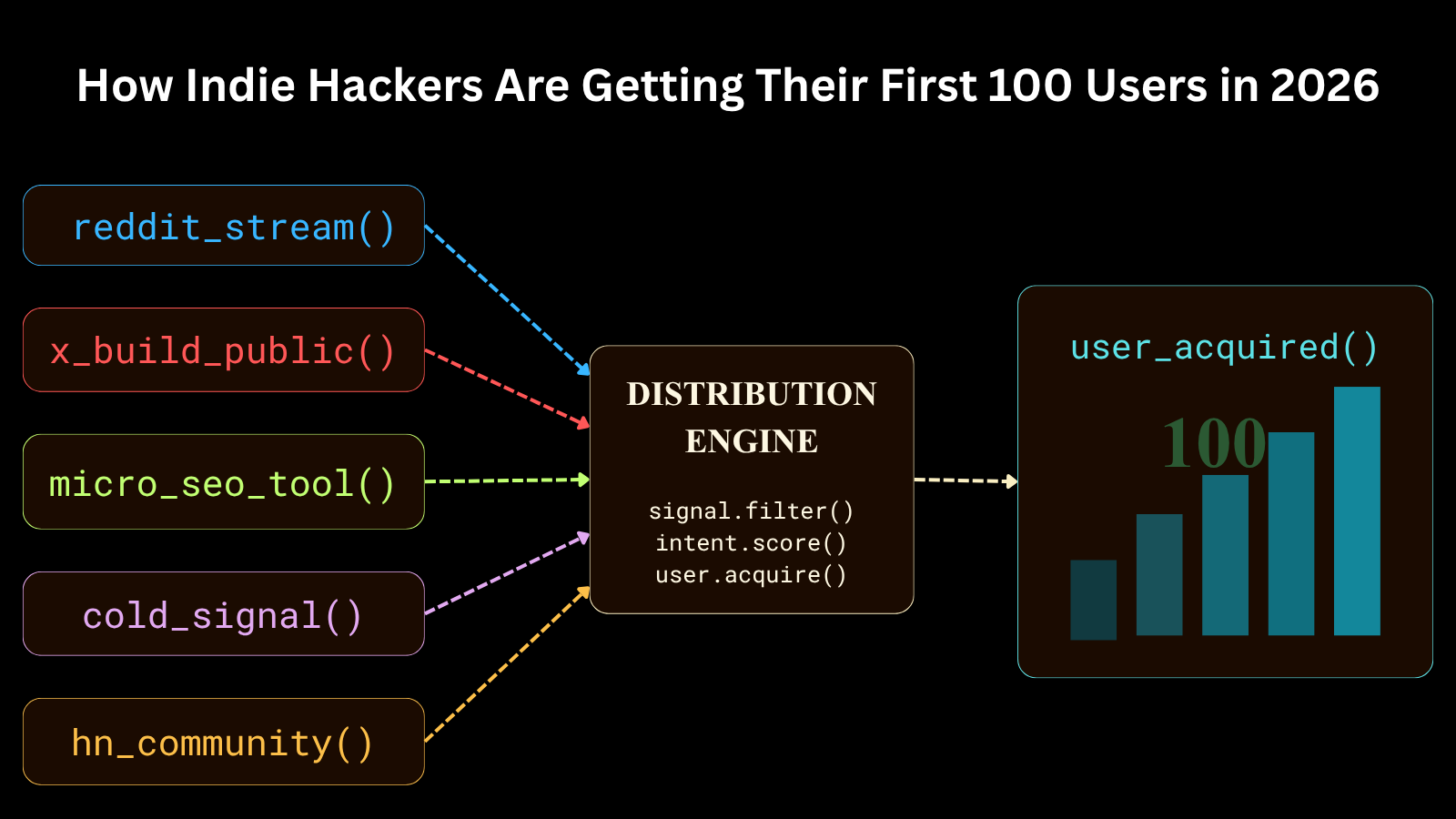
How Indie Hackers Are Getting Their First 100 Users in 2026
The standard playbook for launching a software product - drop it on Product Hunt, schedule ten tweets, spam a few subreddits, and wait for the Stripe webhooks to roll in - is completely broken. In 2026, programmatic SEO spam and LLM-generated wrapper noise have completely saturated traditional aggregate feeds. Buyers are fatigued, and filter algorithms are aggressive. To get your first 100 users right now, you need un-scalable, highly targeted programmatic and manual distribution layers. We analyzed data from 42 successful SaaS micro-launches tracked on ProductWatch.io over the last two quarters. The metrics show a distinct shift: distribution has moved away from broad broadcast channels toward high-intent, hyper-niche communities and hard-engineered discovery loops. Here is the exact breakdown of what works, what fails, and how to execute the technical mechanics of 2026 user acquisition. ACQUISITION CHANNELS FOR FIRST 100 USERS | Channel | Share of Initial Signups | | | | | Reddit & Niche Forums | 34% | | Programmatic SEO & Micro-Tools | 24% | | Targeted Cold Outbound | 18% | | Directories & Launch Frameworks | 12% | | Twitter/X Build in Public | 10% | 1. REDDIT - SUBREDDIT MONITORING VIA KEYWORD TRIGGERS Reddit remains the single highest-converting channel for early users, but drop-shipping links into subreddits will get your domain blacklisted by AutoModerator within seconds. The 2026 approach requires monitoring high-intent, low-volume subreddits for structural friction points where your software provides an immediate fix. Instead of manually browsing, developers are setting up listeners against the Reddit API streams. You want to query for problem-indicative strings like "how can I automate", "is there a tool for", or "alternative to [expensive incumbent]". Here is a bare-bones Node.js listener structure that pipes filtered keyword mentions straight into a Discord webhook for real-time triage: const axios = require('axios'); // Simple Reddit comment stream monitor async function monitorReddit() { const endpoint = 'https://oauth.reddit.com/r/selfhosted/comments.json?limit=100'; const response = await axios.get(endpoint, { headers: { 'User-Agent': 'ProductWatchBot/0.1 by /u/yourusername' } }); const comments = response.data.data.children; comments.forEach(comment => { const body = comment.data.body.toLowerCase(); if (body.includes('alternative to') || body.includes('how do I monitor')) { sendDiscordAlert(comment.data.permalink, comment.data.body); } }); } When you respond to a flagged post, do not pitch your product directly in the top-level comment. Write a short, highly technical explanation of how to solve the user's issue manually. At the bottom, add a brief sign-off: > "I got tired of doing this manually, so I wrote an open-source parser to handle it at yourlink.com - let me know if it breaks on your data." This establishes baseline competence first. 2. TWITTER/X - RE-ENGINEERING THE "BUILD IN PUBLIC" LOOP The era of getting traction by posting clean Tailwind screenshots or vague indie hacker platitudes is over. The algorithm on X heavily suppresses external outbound links unless the tweet secures intense initial engagement. The founders succeeding on X right now are shipping raw engineering retrospectives. Post about system failures, database scaling bottlenecks, or exactly how an unoptimized SQL query ran up a $400 database bill overnight. Use explicit snippets. Show the bad code alongside the fix: -- Before: Full table scan on 2M rows, ~3.4s SELECT * FROM events WHERE user_id = 42 ORDER BY created_at DESC LIMIT 10; -- After: Composite index + covering query, ~1.8ms CREATE INDEX idx_events_user_created ON events(user_id, created_at DESC); SELECT id, type, payload, created_at FROM events WHERE user_id = 42 ORDER BY created_at DESC LIMIT 10; When you give away the technical solution directly inside the platform without forcing a click-through, the algorithm amplifies it. Place your product link exclusively in the auto-DM or as a secondary reply thread once the initial code teardown catches velocity. 3. PROGRAMMATIC SEO AND MICRO-TOOLS Traditional long-form blog posts take months to index and rarely rank for competitive commercial keywords anymore. Successful developers are instead launching dedicated, single-purpose micro-tools that target hyper-specific long-tail search queries. If you are building a database migration SaaS, do not just write articles about database migration. Build a free, zero-auth, client-side browser tool like a "Raw SQL to Prisma Schema Converter" hosted at prisma-converter.yourdomain.com. Ensure it: * Loads instantly * Processes data strictly in local memory using Web Workers (no server round-trip, no data privacy concerns) * Places a prominent, context-aware call-to-action directly next to the output box These micro-utilities rank quickly because they carry strong engagement signals and earn organic backlinks from developer resource lists. The compounding effect of a dozen such tools is significant. The technical architecture matters for SEO too. Serve the tool on a subdomain so it inherits your root domain authority while keeping the slug clean. Implement proper <meta> tags, a canonical URL, and a sitemap.xml that pings Google Search Console on deploy via a CI hook: # In your GitHub Actions deploy.yml - name: Ping Google Search Console run: | curl "https://www.google.com/ping?sitemap=https://yoursite.com/sitemap.xml" 4. LOW-FRICTION LAUNCH PLATFORMS AND SAAS DIRECTORIES Launch platforms no longer guarantee immediate sustainable business, but they are highly efficient for initial regression testing and getting your first 30 to 40 sandbox users. The key is structural timing. Do not launch on Product Hunt, Peerlist, and BetaList simultaneously. * BetaList & Kernal Beta: Use these when you have a bare-minimum working prototype. Expect high churn but highly articulate technical feedback from fellow builders. * Product Hunt: Schedule this strictly after fixing the edge cases surfaced during your beta phase. Launch at exactly 12:01 AM PST on a Tuesday or Wednesday if you want raw volume, or choose a Saturday morning if you are trying to secure a "Top 3 Product of the Day" badge with significantly lower voting competition. * SaaS Directories: Submit systematically to structured indexes like Product Watch, AlternativeTo, BuiltWithMyStack, and specialized lists. This gives your domain early referral pathways and initial domain authority. 5. COLD OUTREACH VIA PUBLIC SIGNAL SCRAPING Cold emails work only if the context is so specific it feels impossible to automate. Generic sequences sent at scale yield near-zero conversion and put your sending domain at risk of being flagged by major inbox providers. Instead, look for public technical triggers. If your product optimizes heavy media assets, monitor public repositories or websites with automated scripts to check for uncompressed images. When you find an unoptimized target, programmatically generate a specific optimized asset and email the engineering lead directly: Subject: Unoptimized assets on your landing page Hey [Name], I noticed your homepage is downloading a 4.2MB uncompressed PNG, which adds about 1.8 seconds to your mobile load times. I ran it through our compression stack - here is the optimized 310KB version. Saved you about 90% of the payload size. If you want to automate this across your asset pipeline, I built a simple webhook listener that does it automatically on every deployment: yourlink.com - Your Name The response rate on this approach is high for one reason: it bypasses conventional marketing frameworks entirely and delivers quantifiable value before asking for anything. You have already done the work. The ask is a footnote. You can build the scraper with a straightforward Playwright or Puppeteer script: const { chromium } = require('playwright'); async function checkAssets(url) { const browser = await chromium.launch(); const page = await browser.newPage(); const oversizedImages = []; page.on('response', async (response) => { const contentType = response.headers()['content-type'] || ''; if (contentType.includes('image')) { const buffer = await response.body().catch(() => null); if (buffer && buffer.length > 1_000_000) { // > 1MB oversizedImages.push({ url: response.url(), size: buffer.length }); } } }); await page.goto(url, { waitUntil: 'networkidle' }); await browser.close(); return oversizedImages; } 6. HIGH-INTENT DEVELOPER COMMUNITIES Getting traction in Discord servers, Slack communities, and Hacker News requires respecting strict cultural boundaries. On Hacker News, the tolerance for marketing copy is zero. A post that reads like an ad will be downvoted into oblivion within minutes. To succeed on Hacker News, tell the story of your technical architecture. Explain exactly why you chose SQLite over PostgreSQL for a multi-tenant platform, or how you cut Docker layer rebuild time from 4 minutes to 22 seconds by restructuring your COPY ordering # Slow: copies app code early, invalidates layer on every change FROM node:20-alpine COPY . /app RUN npm ci CMD ["node", "server.js"] # Fast: copy package files first, cache npm install layer FROM node:20-alpine COPY package*.json /app/ RUN npm ci COPY . /app CMD ["node", "server.js"] Open-source the core infrastructure or the underlying engine of your product if possible. The Hacker News audience explores landing pages from genuinely interesting technical posts, but only if the technical core earns it. On Discord and Slack, lurk in the channels relevant to your niche for at least two weeks before posting anything. Answer questions genuinely. Provide value without expectation. When you eventually mention your tool, it lands as a recommendation from a known contributor, not a cold drop. CONCLUSION Getting your first 100 users in 2026 is an exercise in engineering distribution with the exact same precision you apply to your codebase. Broadcasting to massive groups is a waste of time. Instead, focus your energy on setting up programmatic listeners, launching hyper-focused micro-utilities, and delivering highly individualized cold outreach that leads with concrete engineering value. Once you secure those initial 100 high-touch users, your primary product feedback loops will stabilize, giving you the real-world validation data required to build out scalable programmatic acquisition funnels. Getting your first 100 users in 2026 is an exercise in engineering distribution with the exact same precision you apply to your codebase. Broadcasting to massive audiences is a waste of time and budget. Instead, focus on: * Setting up programmatic keyword listeners on Reddit and niche forums * Launching hyper-focused micro-utilities that target long-tail search intent * Running highly individualized cold outreach that leads with concrete, pre-delivered engineering value * Timing your launch-platform appearances strategically, beta platforms first, Product Hunt after fixing edge cases * Building genuine credibility in developer communities before you need anything from them Once you secure those first 100 high-touch users, your feedback loops stabilize. You get a real-world signal. And then, only then, you have the data required to build scalable programmatic acquisition on top of a foundation that actually holds.