
Blogs in documentation
stay updated with the latest news, insights, and guides on documentation from ProductWatch.
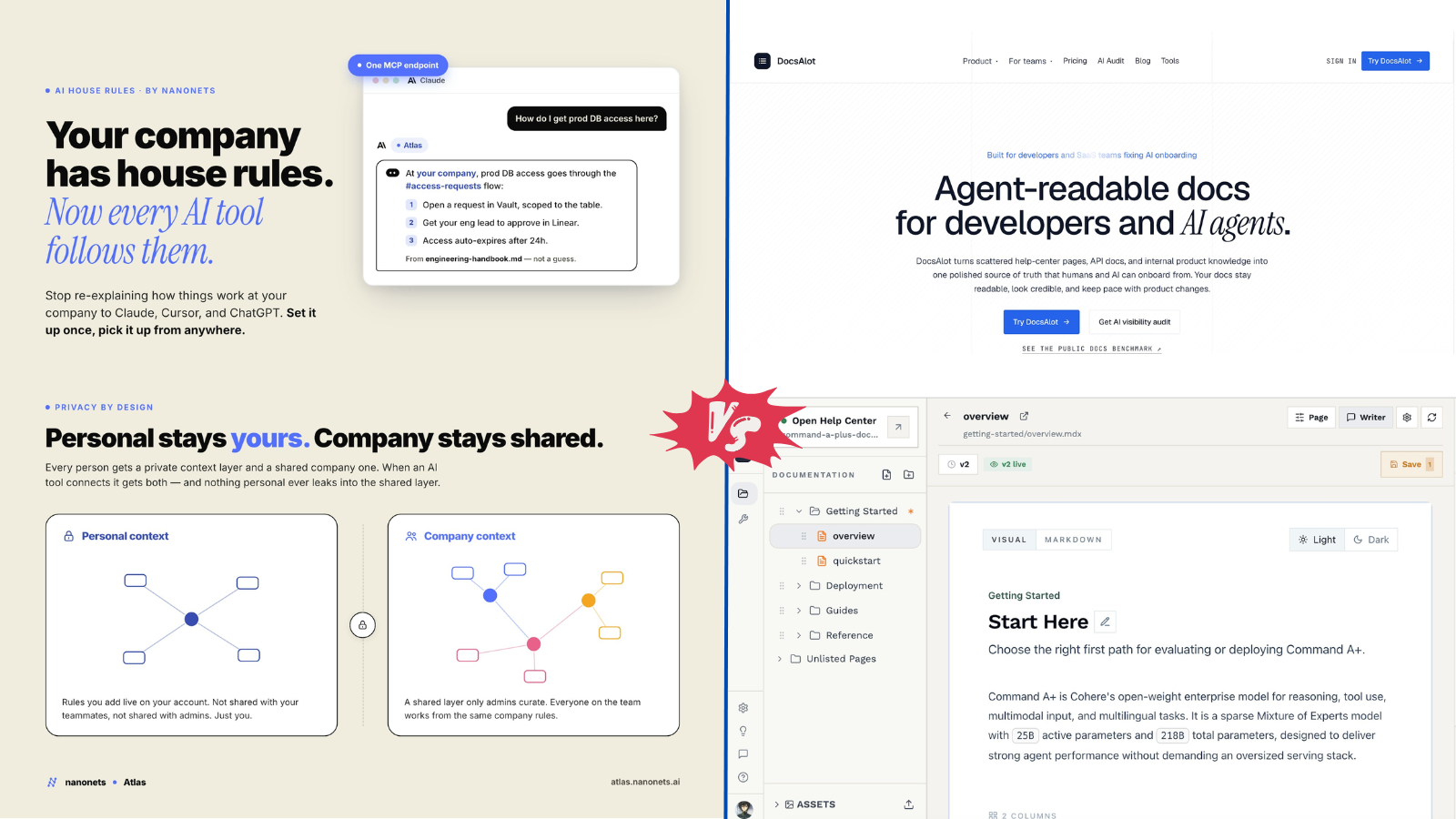
Nanonets vs DocsAlot: Two AI Tools Solving Different Enterprise Problems in 2026
Artificial intelligence is no longer just about generating text or writing code. The biggest productivity gains now come from removing repetitive work and making business knowledge instantly accessible. Every company sits on thousands of invoices, contracts, PDFs, emails, help articles, and internal documentation. The challenge is no longer creating information. It is finding it, understanding it, and putting it to work. Two recently launched products on ProductWatch approach this challenge from completely different directions. Nanonets focuses on turning unstructured business documents into structured, actionable data, while DocsAlot transforms scattered documentation into an AI-ready knowledge platform that both humans and AI agents can understand. Although both products use AI, they solve very different problems. One automates document-heavy business operations. The other ensures every AI assistant has accurate and up-to-date knowledge. NANONETS: TEACHING AI TO UNDERSTAND BUSINESS DOCUMENTS Every finance, logistics, healthcare, or insurance team deals with the same frustration. Important business information arrives inside PDFs, scanned invoices, receipts, contracts, purchase orders, and handwritten forms. Before any analysis can happen, someone has to manually copy that information into spreadsheets or ERP systems. Nanonets eliminates this manual step. Using AI-powered Optical Character Recognition (OCR), computer vision, and deep learning models, the platform automatically extracts information from complex documents, validates it, classifies it, and routes it into business workflows. Instead of simply recognizing text, Nanonets understands document structure, making it useful even for invoices and forms that differ between vendors. Unlike traditional OCR software that often requires fixed templates, Nanonets adapts to varying layouts and document types, significantly reducing manual intervention. It also integrates with popular ERP systems, CRMs, cloud storage providers, and accounting software to automate complete business workflows rather than just data extraction. Organizations use Nanonets for accounts payable automation, invoice processing, order management, insurance claims, identity verification, customs documentation, logistics paperwork, and many other document-intensive operations. The biggest advantage is that employees stop spending hours copying information and can instead focus on reviewing exceptions and making business decisions. DOCSALOT: DOCUMENTATION BUILT FOR HUMANS AND AI As AI assistants become part of everyday workflows, documentation has become far more important than a traditional help center. Most companies maintain documentation across GitHub repositories, Notion pages, internal wikis, support articles, Markdown files, and developer portals. Over time, these sources drift apart, making it difficult for employees and AI assistants to know which information is correct. DocsAlot addresses this growing problem by creating a centralized documentation platform designed specifically for the AI era. Instead of only publishing documentation for human readers, DocsAlot makes documentation consumable by AI systems through support for standards such as Model Context Protocol (MCP), llms.txt, and skill.md. This allows AI assistants to reference current documentation directly instead of relying on outdated training data or incomplete context. The platform also includes AI-assisted documentation generation, automated maintenance, multilingual publishing, hosted MCP endpoints, AI-ready help centers, and governance features that make documentation easier to maintain as products evolve. Teams can onboard new developers faster while ensuring AI-powered customer support remains consistent and accurate. Rather than replacing documentation writers, DocsAlot makes documentation significantly more useful for both people and intelligent systems. DIFFERENT PROBLEMS, DIFFERENT AUDIENCES Although both platforms rely heavily on artificial intelligence, they target entirely different business challenges. Nanonets helps companies automate operational workflows where documents are the primary source of business data. DocsAlot helps software companies, developer platforms, and SaaS teams maintain documentation that modern AI systems can reliably understand. One extracts information from incoming documents. The other organizes existing knowledge so AI can retrieve it correctly. For organizations investing heavily in AI, both problems are becoming increasingly important. FEATURE COMPARISON | Feature | Nanonets | DocsAlot | | | | | | Primary Purpose | AI document processing and workflow automation | AI-ready documentation platform | | Best For | Finance, logistics, insurance, operations, healthcare | SaaS companies, developer platforms, product teams | | Core AI Technology | OCR, deep learning, intelligent document extraction | AI-powered documentation management | | Handles PDFs & Scanned Documents | ✓ | Limited (documentation focused) | | Workflow Automation | ✓ Advanced | ✓ Documentation workflows | | AI Knowledge Base | ✗ | ✓ | | MCP Support | ✗ | ✓ | | llms.txt Support | ✗ | ✓ | | skill.md Support | ✗ | ✓ | | AI-Assisted Content Generation | Limited | ✓ | | Custom Domain | Enterprise deployments | ✓ Team plan and above | | API Access | ✓ | Available through hosted MCP infrastructure | | Enterprise Security | ✓ SSO, RBAC, compliance options | ✓ SSO and governance features | | Ideal Users | Business operations teams | Developers, technical writers, AI product teams | PRICING COMPARISON | Plan | Nanonets | DocsAlot | | | | | | Free Tier | $50 free processing credits | No permanent free plan | | Entry Pricing | Usage-based. After free credits, starts at $100/month for 100 credits | $39/month Startup plan | | Mid Tier | Volume pricing (Contact Sales) | $99/month Team plan | | Enterprise | Custom pricing | Custom pricing | | Pricing Model | Consumption-based, pay per workflow block | Fixed monthly subscription | WHICH TOOL SHOULD YOU CHOOSE? The answer depends entirely on the problem you're trying to solve. If your business spends hours processing invoices, receipts, contracts, purchase orders, or other business documents, Nanonets can dramatically reduce manual data entry while improving processing speed and accuracy. If your organization builds software, maintains APIs, or deploys AI assistants that rely on accurate documentation, DocsAlot provides a modern documentation platform designed specifically for AI-powered workflows. Some companies may even benefit from using both. Documents processed by Nanonets can feed structured business data into operational systems, while DocsAlot ensures employees and AI assistants always have access to accurate documentation about those systems. CONCLUSION Enterprise AI is moving beyond chatbots and text generation. Today's most valuable AI tools solve practical business problems by removing repetitive work and making knowledge easier to access. Nanonets demonstrates how AI can automate complex document processing that once required hours of manual effort. DocsAlot shows that as AI assistants become part of everyday work, documentation itself must evolve into something machines can understand as reliably as humans. Both products highlight an important trend in enterprise software: the future of AI is not just generating information, but organizing it, understanding it, and making it immediately useful.