Demand forecasting is no longer just about looking at last year's sales and estimating what might happen next month.
For retailers, manufacturers, distributors, and consumer brands, demand can change because of promotions, seasonality, pricing, weather, customer behavior, new product launches, economic conditions, and supply disruptions. A forecast that misses those changes can quickly turn into excess inventory, stockouts, rushed production, or lost sales.
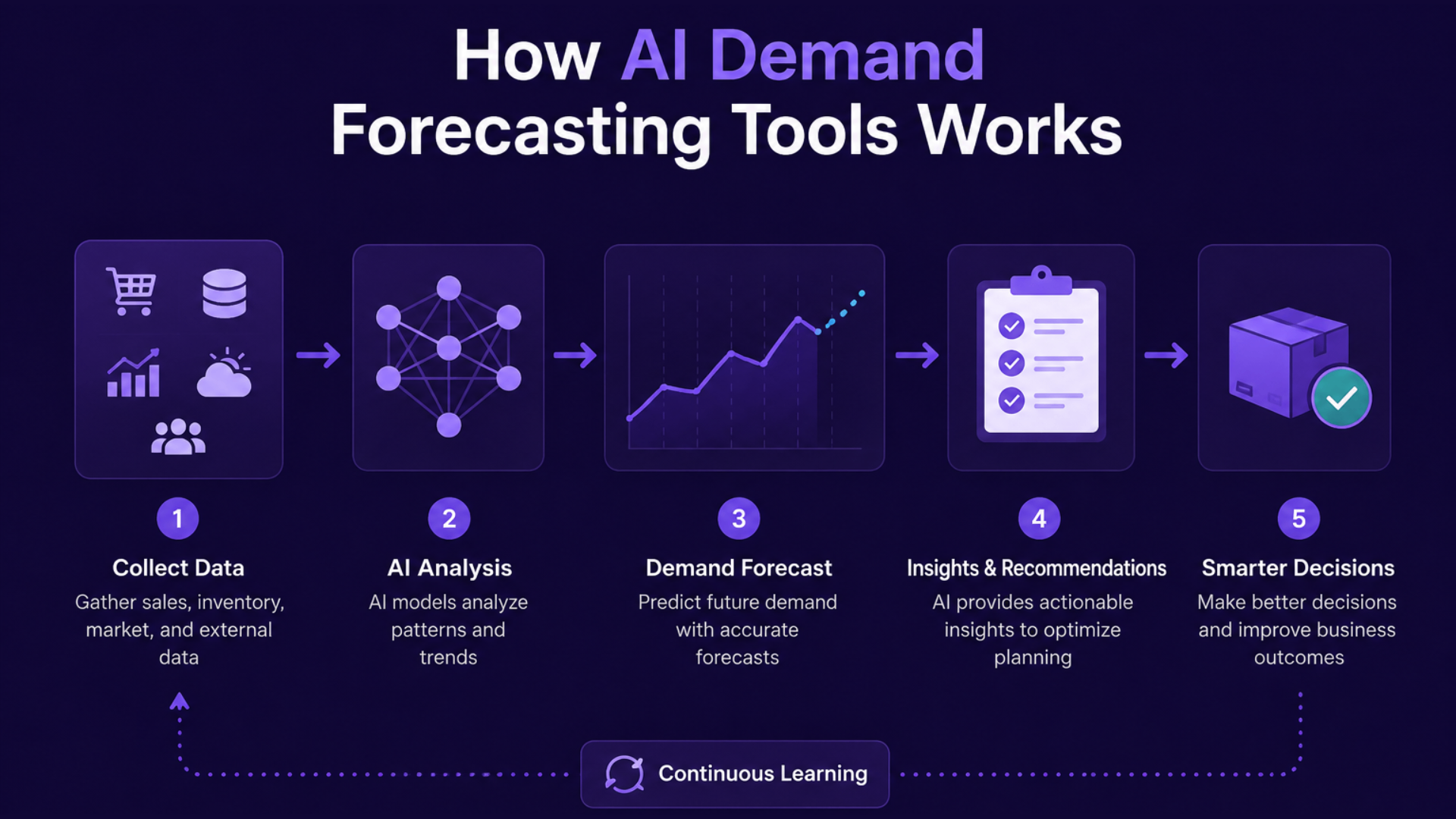
AI demand forecasting tools help planning teams analyze historical demand alongside additional signals and automatically generate forecasts. Depending on the platform, they can also support demand sensing, scenario planning, inventory optimization, collaborative planning, and automated decision-making.
The right platform, however, depends heavily on company size and planning complexity. A global manufacturer managing thousands of SKUs across multiple markets may need a completely different system from a $50 million manufacturer trying to move beyond spreadsheets.
This guide compares and explains what each one is designed to do, who should consider it, and how its pricing works.
Quick Summary
- o9 Solutions: An enterprise AI planning platform that combines ML forecasting, demand sensing, scenario planning, and an Enterprise Knowledge Graph for complex global supply chains.
- Kinaxis Maestro: Uses machine learning, real-time signals, and concurrent planning to help large organizations create explainable forecasts and respond quickly to demand changes.
- Blue Yonder: A broad supply chain planning platform using statistical methods, ML, AI, external signals, and demand-driver analysis for enterprise demand planning.
- SAP Integrated Business Planning: Combines AI with traditional time-series forecasting, demand sensing, automated forecasting, collaboration, and SAP's wider supply chain planning ecosystem.
- Anaplan PlanIQ: Provides ML-powered forecasting without requiring a dedicated data science team and can be embedded into broader Anaplan planning workflows.
RELEX Solutions, ToolsGroup, Logility, BetterDemand, and Netstock cover different parts of the market, from retail-focused AI forecasting and probabilistic planning to mid-market manufacturing and developer-oriented forecasting. Amazon Forecast is now closed to new customers, so it should generally be considered a legacy option rather than a new project choice.
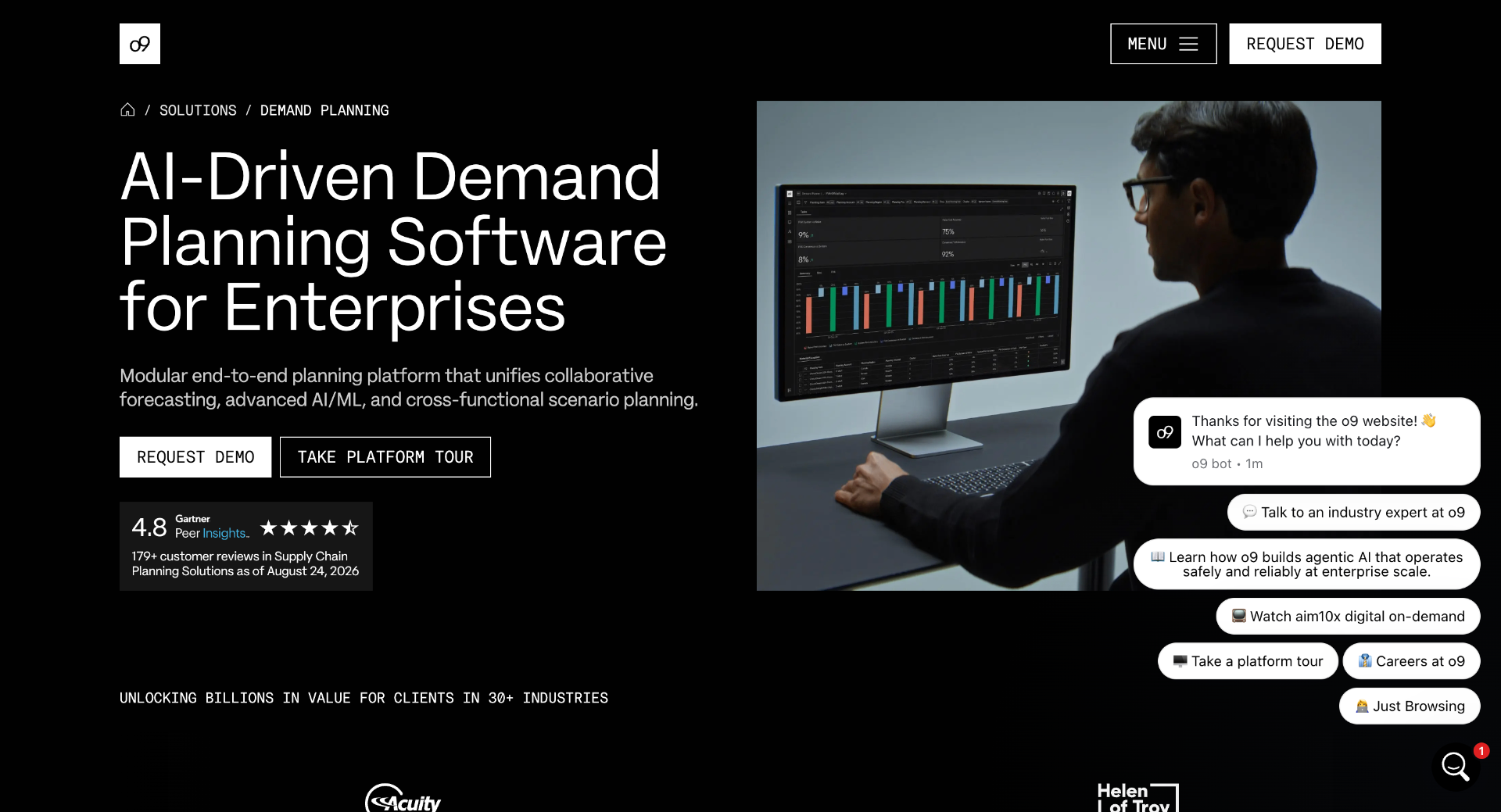
o9 Solutions is designed for organizations that need demand forecasting as part of a much larger planning environment rather than as an isolated forecasting application.
Its demand planning capabilities combine AI and machine learning with internal and external demand signals. The platform supports multi-level and multi-horizon forecasting, demand sensing, demand assumptions, collaborative planning, and exception-based forecasting.
One of its notable components is the Enterprise Knowledge Graph. o9 describes this as a digital twin of the business that connects data, models, and decisions. This makes the platform particularly relevant when demand planning needs to connect with supply planning, inventory, financial planning, and other business processes.
The platform is primarily aimed at large multinational organizations with complex operations. o9 states that its typical customers manage multiple business units, product portfolios, ERP systems, and global supply networks. Pricing is not publicly listed and is scoped according to business complexity, users, functions, and deployment requirements.
Best for: Large enterprises with complex global supply chains, multiple planning functions, and a need to connect demand forecasting with broader business planning.
Price: Custom enterprise quote.
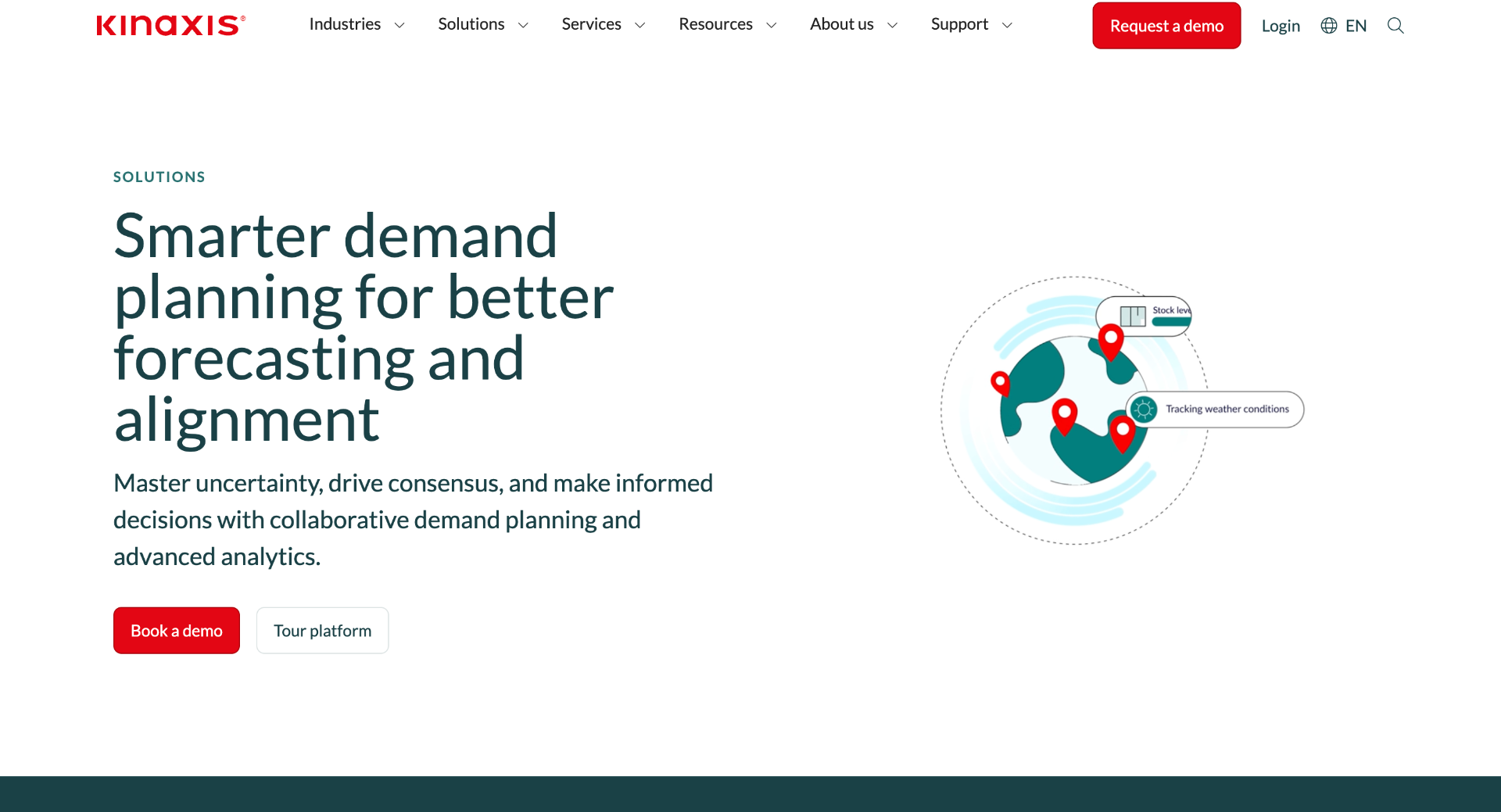
Kinaxis Maestro takes a different approach by connecting AI forecasting with concurrent supply chain planning.
Its machine learning demand forecasting can combine historical data with real-time signals such as promotions, weather, and market activity. The system is designed to produce forecasts across different time horizons while helping planners understand the factors influencing those forecasts.
A major strength is explainability. Rather than presenting a forecast as an unexplained number, Kinaxis provides visibility into the demand drivers affecting the result. This can be important when sales, operations, finance, and supply chain teams need to agree on one forecast.
Kinaxis also emphasizes concurrent planning. Changes in demand can be evaluated alongside their effects on supply, inventory, production, and logistics. This makes Maestro more suitable for organizations where forecasting is directly connected to complex operational decisions.
Best for: Large manufacturers and enterprises that need AI forecasting connected to real-time supply chain decisions and cross-functional planning.
Price: Custom quote. Kinaxis directs prospective customers toward a demo rather than publishing a standard public price.
Blue Yonder offers demand planning as part of a wider supply chain platform.
The system combines statistical forecasting, machine learning, AI, and external signals to understand customer demand. Its demand planning capabilities include consensus planning, demand transparency, automated predictions, demand and supply planning, and scenario planning.
One useful feature is its focus on demand drivers. Instead of relying only on historical sales, Blue Yonder can incorporate internal and external signals to identify the factors affecting demand. Its outside-in forecasting approach is particularly relevant for retailers and consumer businesses where promotions, market conditions, and customer behavior can change quickly.
Blue Yonder is therefore a strong option when demand forecasting needs to connect with inventory, supply planning, retail operations, and broader enterprise planning. It is not positioned as a lightweight forecasting tool for a small team.
Best for: Enterprise retailers, manufacturers, and supply chain organizations that need demand forecasting integrated with broader planning and inventory operations.
Price: Custom quote.
SAP Integrated Business Planning is particularly relevant for companies already operating within the SAP ecosystem.
Its demand planning functionality combines AI with traditional time-series algorithms. It can automatically analyze demand drivers, classify historical patterns, select forecasting algorithms, detect and correct outliers, and automate statistical forecasting.
SAP also provides demand sensing for short-term forecasts. The system can use current order patterns and downstream signals such as point-of-sale data to adjust forecasts and help supply planning respond to near-term changes. It also supports forecasting for new products using synthetic history or representative product curves when sufficient historical data does not exist.
Pricing is one of the few areas where SAP provides a public reference point. Its published Integrated Business Planning starter edition is listed at $2,707 per month, with a three-month contract, up to 10 concurrent users, and specific proof-of-concept limits. A full production deployment can have different pricing and requirements.
Best for: Organizations already using SAP that want AI-powered demand planning connected to S&OP, inventory, supply planning, and the broader SAP ecosystem.
Price: SAP IBP starter edition listed at $2,707/month. Production pricing varies by configuration.
Anaplan PlanIQ brings AI and machine learning forecasting into the Anaplan planning environment.
PlanIQ combines statistical, AI, and ML techniques to generate forecasts from internal and external data. Anaplan positions it as a way to generate forecasts without requiring an in-house data science team to build and maintain forecasting models.
The platform can be used for demand forecasting, sales forecasting, inventory planning, and other planning scenarios. Its connection to the wider Anaplan platform makes it particularly useful when forecasts need to flow into business planning and scenario analysis rather than remain inside a separate forecasting application.
PlanIQ uses a prediction-point model for usage. Anaplan documentation explains that prediction points depend on the number of items being forecast and the number of forecast actions being run. This means the cost depends partly on how extensively the forecasting engine is used.
Best for: Enterprises that already use Anaplan and want AI-powered forecasting integrated with broader business planning.
Price: Custom quote. Usage is based partly on forecasting activity and prediction points.
RELEX Solutions is particularly strong for retail and consumer goods companies where demand changes rapidly across stores, products, and channels.
RELEX uses machine learning to analyze demand drivers and automate large parts of the forecasting process. Its platform can process large datasets and generate forecasts at scale, which is important for retailers dealing with large numbers of products and locations.
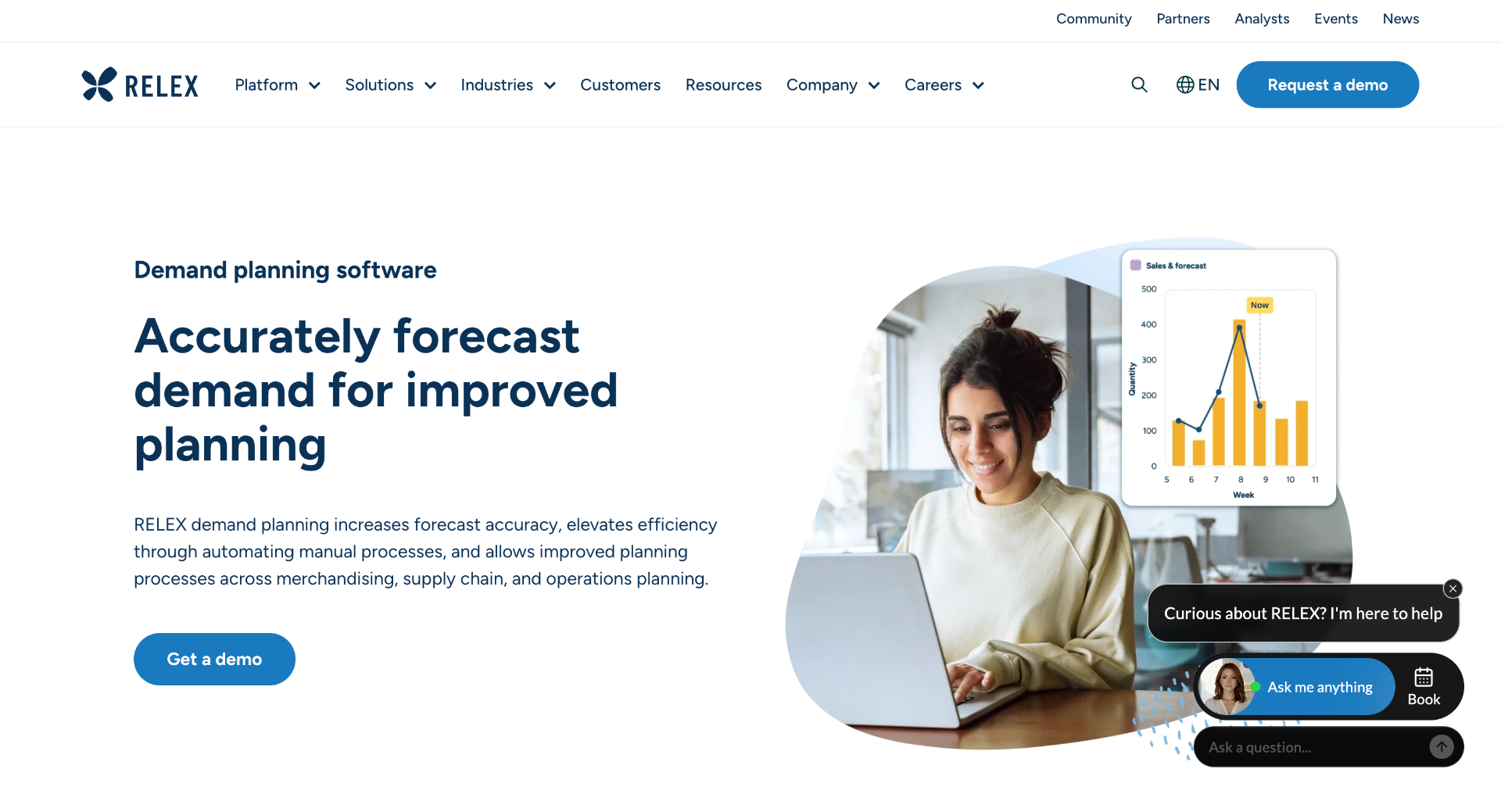
Its demand sensing functionality uses new internal and external signals to identify short-term changes in demand. RELEX also has a Product Attribute AI agent designed to help forecast new products by finding suitable reference products and creating day-one forecasts.
This makes RELEX especially interesting for businesses dealing with promotions, seasonality, new products, omnichannel sales, and frequent changes in customer behavior. It is designed as part of a broader planning platform rather than a simple standalone forecasting API.
Best for: Retailers, consumer packaged goods companies, and large organizations managing complex product and location networks.
Price: Custom quote.
ToolsGroup Decision focuses heavily on probabilistic forecasting.
Instead of producing only a single expected demand number, ToolsGroup's approach models a range of possible demand outcomes and their probabilities. This can be particularly useful for businesses dealing with intermittent, seasonal, long-tail, or highly variable demand.
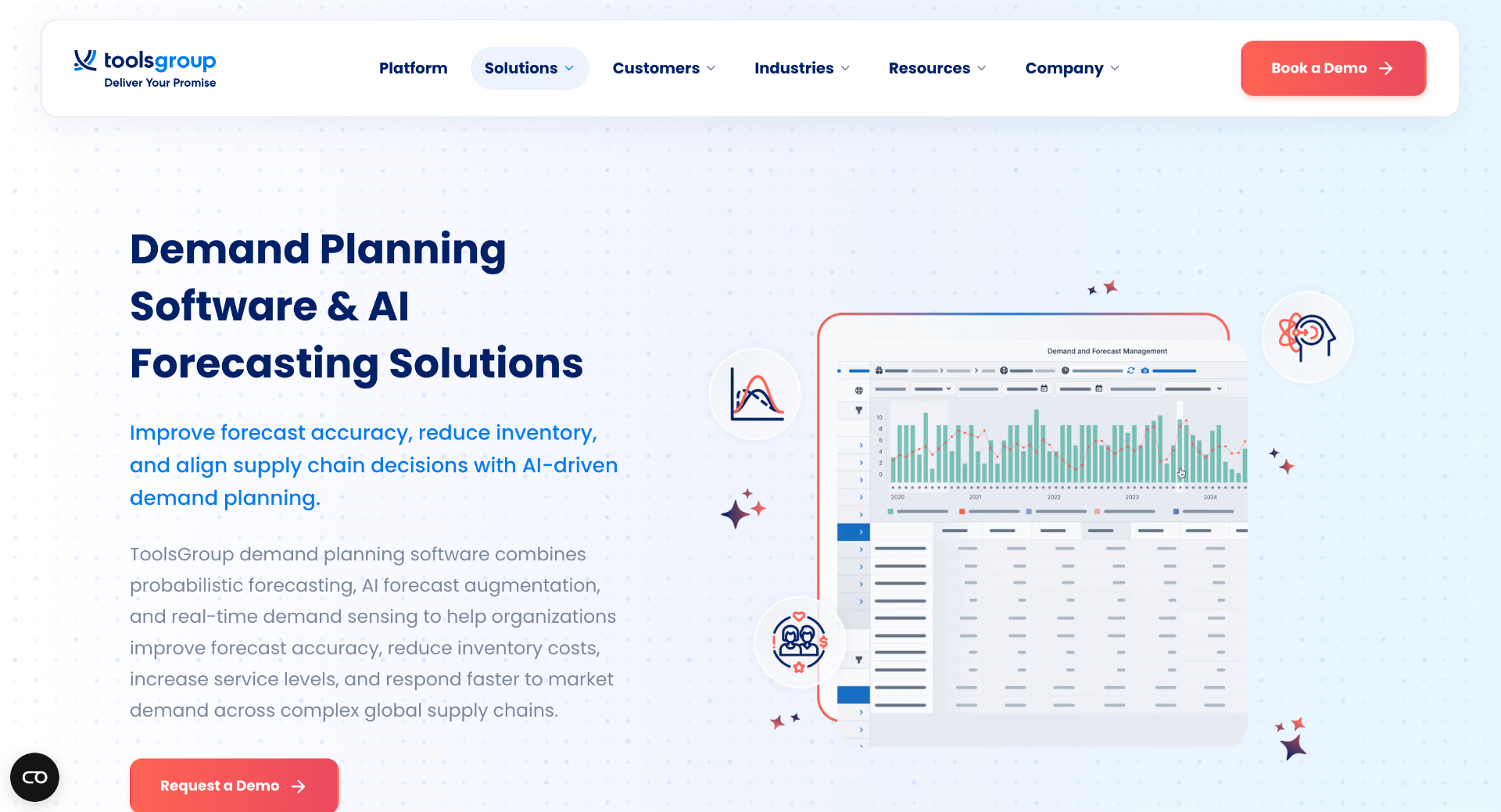
The platform combines probabilistic forecasting, machine learning, real-time demand sensing, and demand shaping. It also supports collaborative demand planning and connected planning across demand, inventory, supply, and operations.
ToolsGroup is designed for manufacturers, retailers, distributors, and other organizations with large and complex product portfolios. Its official materials report forecast accuracy improvements and inventory reductions, although those figures are company-reported results rather than guarantees for every implementation.
Best for: Organizations with unpredictable, intermittent, long-tail, or promotion-driven demand that need probabilistic forecasting and inventory-aware planning.
Price: Custom quote.
Logility combines AI-first demand forecasting with generative AI and broader supply chain planning capabilities.
Its DemandAI+ solution is designed to help planners understand the factors driving demand instead of simply presenting a forecast number. The system can expose the impact of events and promotions on forecasted demand, helping planners understand why the forecast changed.
Logility is also moving beyond forecasting into AI-assisted decision-making. Its current DemandAI+ offering includes agents designed to surface risks, recommend next actions, and guide planners through multi-step workflows.
This makes Logility worth considering for organizations that want demand forecasting combined with supply chain collaboration and AI assistance. Its official materials also describe an AI accelerator package combining DemandAI+ with its Logility Expert Advisor.
Best for: Supply chain teams looking for AI-powered forecasting combined with generative AI and planning assistance.
Price: Custom quote.
BetterDemand targets a different segment from many of the enterprise platforms on this list.
BetterDemand is built specifically for mid-market manufacturers and distributors, particularly companies in the $30 million to $250 million revenue range that have outgrown spreadsheets but may not need a large enterprise planning implementation.
Its Forecaster module supports weekly or monthly customer-level forecasts using shipments, orders, POS data, and other available business data. It can also reconcile retailer forecasts against the company's own forecast and calculate safety stock and reorder points that change as demand changes.
Pricing is significantly more transparent than most enterprise competitors. BetterDemand states that its platform costs $6,000 to $70,000 per year all-in depending on the package and also lists a starting price of $500 per month. This makes it one of the more accessible options for mid-market manufacturers that need dedicated forecasting without moving directly into a large enterprise planning suite.
Best for: Mid-market manufacturers and distributors that have outgrown spreadsheets but are not ready for a large enterprise planning platform.
Price: Starts at $500/month; official site also states $6,000 to $70,000/year all-in.
Netstock is an AI-powered supply and demand planning platform designed to help businesses improve inventory decisions and forecast future demand. It is particularly focused on small and mid-sized businesses that need more accurate forecasting without the complexity of large enterprise supply chain platforms.
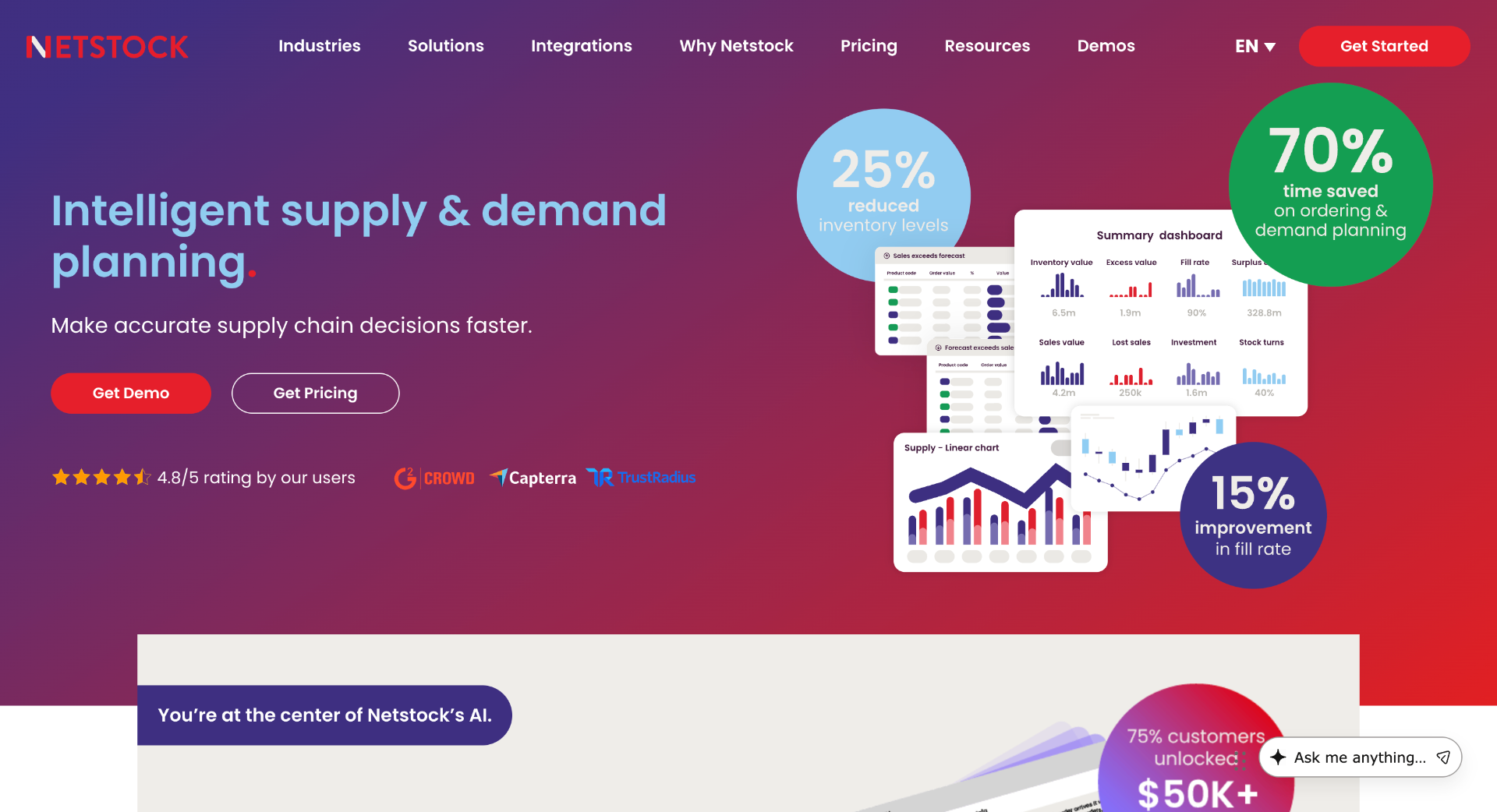
The platform uses demand forecasting, inventory optimization, and supply planning capabilities to help teams identify potential stockouts, excess inventory, and changing demand patterns. Netstock can also provide recommendations that help businesses determine what to order and when, making forecasts more actionable for inventory and purchasing teams.
One of Netstock's advantages is its focus on turning forecasts into practical inventory decisions. Rather than treating demand forecasting as a standalone analytics task, the platform connects forecasting insights with inventory planning and replenishment decisions.
G2 currently lists Netstock among the products defining its AI-Powered Solutions theme for demand planning. The platform is also rated highly by users for demand forecasting and inventory management on Capterra.
Best for: Small and mid-sized businesses looking for AI-powered demand forecasting and inventory planning.
Price: Starts at $900/month.
There is no single best demand forecasting platform for every business.
For a large multinational enterprise, o9 Solutions, Kinaxis Maestro, Blue Yonder, SAP IBP, and Anaplan PlanIQ are the more natural choices because they connect forecasting with wider planning processes.
For retail and consumer goods, RELEX and Blue Yonder are particularly relevant because their forecasting capabilities are designed around complex product, store, promotion, and demand-sensing scenarios.
For businesses dealing with highly variable or intermittent demand, ToolsGroup's probabilistic approach is worth evaluating because it models uncertainty rather than relying only on a single forecast value.
For mid-market manufacturers, BetterDemand is particularly interesting because it targets companies between spreadsheet-based planning and large enterprise planning suites, while publishing a starting price that is easier to understand than most enterprise platforms.
For organizations already deeply invested in SAP or Anaplan, staying within the existing ecosystem can reduce integration complexity and make the forecasting output easier to connect with other planning processes.
Forecast accuracy should not be the only metric used to compare these platforms.
A good system should be able to work with the data your business actually has. Historical sales are important, but promotions, pricing, weather, holidays, customer behavior, point-of-sale data, inventory levels, and external market signals can also influence demand.
Explainability is another important consideration. A forecast that says demand will increase by 18% is less useful if planners cannot understand what caused the change. Tools such as Kinaxis, SAP, Blue Yonder, and Logility emphasize visibility into demand drivers and forecast logic.
The system should also fit the planning process. If forecasts remain inside an analytics dashboard and never influence purchasing, inventory, production, or replenishment decisions, the business may not get the full value of the technology.
Finally, consider implementation effort. Enterprise platforms can provide extensive capabilities, but they may require significant integration and change management. A mid-market manufacturer may get more practical value from a focused platform such as BetterDemand than from implementing a large enterprise suite.
AI demand forecasting is becoming less about simply predicting next month's sales and more about connecting prediction with action.
The strongest platforms on this list do more than generate numbers. They can analyze demand drivers, detect short-term changes, model uncertainty, explain forecast changes, automate repetitive planning tasks, and connect demand decisions with inventory and supply planning.
For enterprise-scale planning, o9 Solutions, Kinaxis Maestro, Blue Yonder, SAP IBP, and Anaplan PlanIQ offer broad planning capabilities. RELEX and ToolsGroup are strong options for businesses dealing with retail, consumer goods, complex inventory, and volatile demand. Logility adds AI-assisted forecasting and generative AI capabilities, while BetterDemand focuses on making advanced forecasting more accessible to mid-market manufacturers.
The most important consideration is not which platform has the most AI features.
It is which tool can turn your company's actual demand data into forecasts that planners can understand, trust, and use to make better inventory, production, purchasing, and customer decisions.
| Paid |
| BetterDemand | Customer-level forecasting, weekly/monthly forecasts, safety stock, reorder points, AI agent | From $500/month | Mid-market manufacturers and distributors | Paid |
| Netstock | AI-powered demand forecasting, inventory optimization, demand planning, scenario forecasting, ERP integrations | $900/month | SMBs and mid-market businesses managing inventory and supply chains | Paid |
