

Cueston
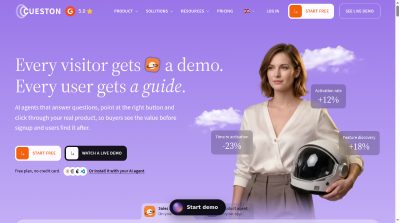
Cueston is an AI sales agent and in-app product agent for SaaS that demos your product to website visitors and guides signed-in users inside your real app.
Cueston puts two AI agents on your SaaS: a sales agent that works your website before signup, and a product agent that helps people inside your app after they sign up. The sales agent runs live demos on your real product, pointing, zooming and clicking through your site or a demo copy of your app while it answers questions, follows your playbook, and sends each lead to Slack or your CRM with an AI summary. The product agent knows your buttons, fields and help docs, answers in context, walks people through tasks step by step, can click and type for them, and spots clicks that go nowhere. Both agents learn your interface from one snippet and one scan, share one knowledge base of help docs and guides, and every conversation lands in one place you can review. You also get guides built in a visual editor or by Claude and Cursor: product tours, tooltips, checklists, announcements, banners, NPS and surveys, and a help hub, with AI translation into many languages. The payoff the page claims is faster activation, more feature discovery, higher conversion and fewer support tickets, with 200+ growing SaaS companies already on it.

Launch Team / Built with
Overview
Cueston lives at the two moments where SaaS products lose people. Most visitors leave before they see the product work, and plenty of new users stall before they find what they signed up for. So it puts an AI agent on each side of signup: sales mode on your website, support mode in your app. Both are the same agent in two modes, sharing one snippet, one knowledge base of UI elements, help docs and guides, and one place to review answers.
On your website the agent runs a live demo and qualifies like a rep, following the playbook you write. Inside your app it answers in context, steps in when someone is stuck, and hands out the tours, tooltips, banners and checklists you build. Set up is one script tag on your website and app, or you can hand it to the CLI or your coding agent, with no other code changes.
Features
- Sales agent demos: Greets visitors on your website, shows your key workflows by pointing, zooming and clicking through your site or a demo copy of your app, and follows your playbook from pitch to qualifying questions. Visitors can type or talk to it, and it can ask for an email before the demo.
- In-app product agent: Answers how-to questions from the buttons, fields and menus it learned and from your help docs, points at the right control, and walks someone through a task step by step. It can also do the clicking and typing for them.
- Friction detection: Notices clicks on disabled buttons, clicks that do nothing, errors after a click and people going back and forth between pages. A spot counts as a stuck point once 3 or more visits struggled there in 7 days, and the agent can offer help with that control.
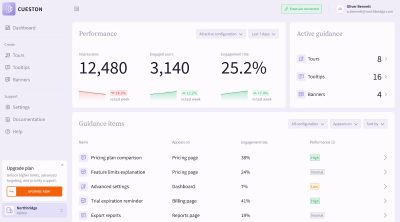
- Guides without code: Product tours, tooltips, checklists, announcements, banners, NPS and surveys, plus a help hub that brings them together with the product agent. Built in a visual editor or by Claude and Cursor, and shown by plan, trial, pages visited and signup date.
- Build with your agent: Paste a prompt into Claude Code, Cursor, Codex or VS Code and it connects Cueston, signs you in and adds it to your app. The hosted MCP server builds tours and checklists from your real pages and saves drafts, and pull and push keep guidance as JSON in git.
Pricing
There is a free plan, and no credit card is needed to start. Paying annually takes 20% off. The sales agent is priced by quote, from $299 a month, based on how many demo conversations you expect, and paid plans add extra AI answers at $10 per 1,000.
Who It's For
Trusted by 200+ growing SaaS companies. The industry pages speak to HR software, CRM software, ATS software and project management software teams, so admins and employees get guided through setup, sales teams pick up pipelines and reports, recruiters post jobs and move candidates, and new workspaces turn into active teams.
Pricing describes it for people trying Cueston on their own product, teams exploring in-product growth and chasing first measurable results, small teams improving activation, conversion and product adoption, and larger products that need more AI answers, more workspaces and single sign-on.
Frequently Asked Questions
Does Cueston connect to the analytics and CRM tools we already use?
Yes. Integrations cover PostHog, Amplitude, Segment, Mixpanel and Google Analytics, and you can send guide events to PostHog.
Can we build and publish guides without engineering help?
Yes. Guides are built in a visual editor, and the tour flow is pick a page, add a few steps and publish. No code needed.
What happens to a visitor who is not ready to book a call?
They still land in Leads. Each conversation shows up with an AI summary, intent, sentiment, whether the visitor qualified and suggested next steps, and statuses like Not ready yet, so someone who is just looking around is captured too. Leads post to Slack or your CRM through the agent.lead_captured webhook, export to CSV, and admins get a daily email digest.
Can competitors use the sales agent to see our product?
You can block company domains, including their subdomains, and exact email addresses. A blocked visitor sees a message that the demo isn't available, gets no further steps and never appears in your Leads. The live demo environment should be a demo copy of your app with sample data, never real customer data.
How does Cueston compare with other onboarding and tour tools?
The comparison table sets Cueston against Appcues, Userpilot, Chameleon and Pendo. Cueston is listed with contextual triggers as native, minutes to first value, activation-focused and in-app banners, in the lowest pricing band of the group.
Can our guidance reach users in other languages?
Yes. Cueston translates tours, tooltips, banners and checklists with AI, so guidance can launch in multiple languages without manual localization work.