

YouMightNotNeed
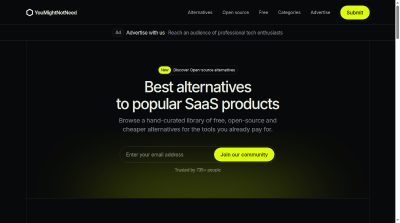
YouMightNotNeed, a hand-curated library of free, open-source and cheaper alternatives to the SaaS tools you already pay for.
YouMightNotNeed is a curated collection of alternatives to everyday SaaS products. You can jump straight to alternatives for Google Analytics, Mixpanel, Buffer, Hootsuite, Notion or Product Hunt, or wander through categories such as AI, desktop apps, productivity, communication, no-code and design. Guides cover where to submit a SaaS, AI tool directories, free dofollow directories and other launch platforms, with details like domain rating, price and link type. If you build something yourself, you can submit it and put it in front of developers, tech leaders and founders looking for tools to adopt.
Launch Team / Built with


Overview
YouMightNotNeed is a hand-curated library of free, open-source and cheaper alternatives to the SaaS tools you already pay for. You can browse by category, jump straight to alternatives for a specific product, or filter down to only open-source or only free tools. Every listing is checked by hand, and there's a page explaining how the curation works.
For makers there's a second half. Directories and launch platforms are collected with their DR, price and link type, so you can see where to submit a SaaS and what each one charges. You can also add your own product to the library through a free listing and reach people who are already shopping for tools.
Features
- Browse by category: Categories group tools by what they do, from AI and desktop apps to productivity, communication, no-code and design, with a count of how many sit in each.
- Launch directory guides: Lists of SaaS directories, AI tool directories and free dofollow directories, each with its DR, price and link type, plus other launch platforms.
- Submit your product: Makers can add their own tool to the library and put it in front of developers, tech leaders and founders browsing for something to adopt.
Who It's For
The site describes its audience as professional tech enthusiasts, and the advertising page talks about reaching developers, tech leaders and founders looking for open source tools to adopt. Makers and startups are the other half of the crowd: they come for the launch directory guides and to submit their own products.
Frequently Asked Questions
What do the open-source and self-hosted tags mean on a card?
Plausible, Umami, Supabase, Logseq and Mattermost all carry them, and there are separate pages that show only open-source or only free tools.
How many alternatives are there for a given tool?
Google Analytics has 12 alternatives, Mixpanel has 11, and Buffer, Hootsuite, Notion and Product Hunt each have 9. The full list sits on the alternatives page.
Is there a newsletter?
Yes, you can subscribe from the footer to get the latest software tools updates and exclusive offers.
How many tools are in the library?
The open-source page shows 157 products and the free page shows 92. Categories break that down further, like 37 AI tools, 28 desktop apps and 21 productivity tools.
What counts as free here?
A tool is listed as free when it offers a permanent free tier, not a trial, that lets individuals or small teams use core features without a credit card. That covers freemium products, fully free tools and open source software you can self-host at no cost.
What does open source mean on this site?
A tool is tagged open source when its core codebase is published under a recognised OSI-approved licence like MIT, Apache 2.0, GPL or AGPL. Some also offer a hosted commercial tier on top of the open core.