
Anthropic Shares Fall Below IPO Price, a Worrying Sign for AI Startups
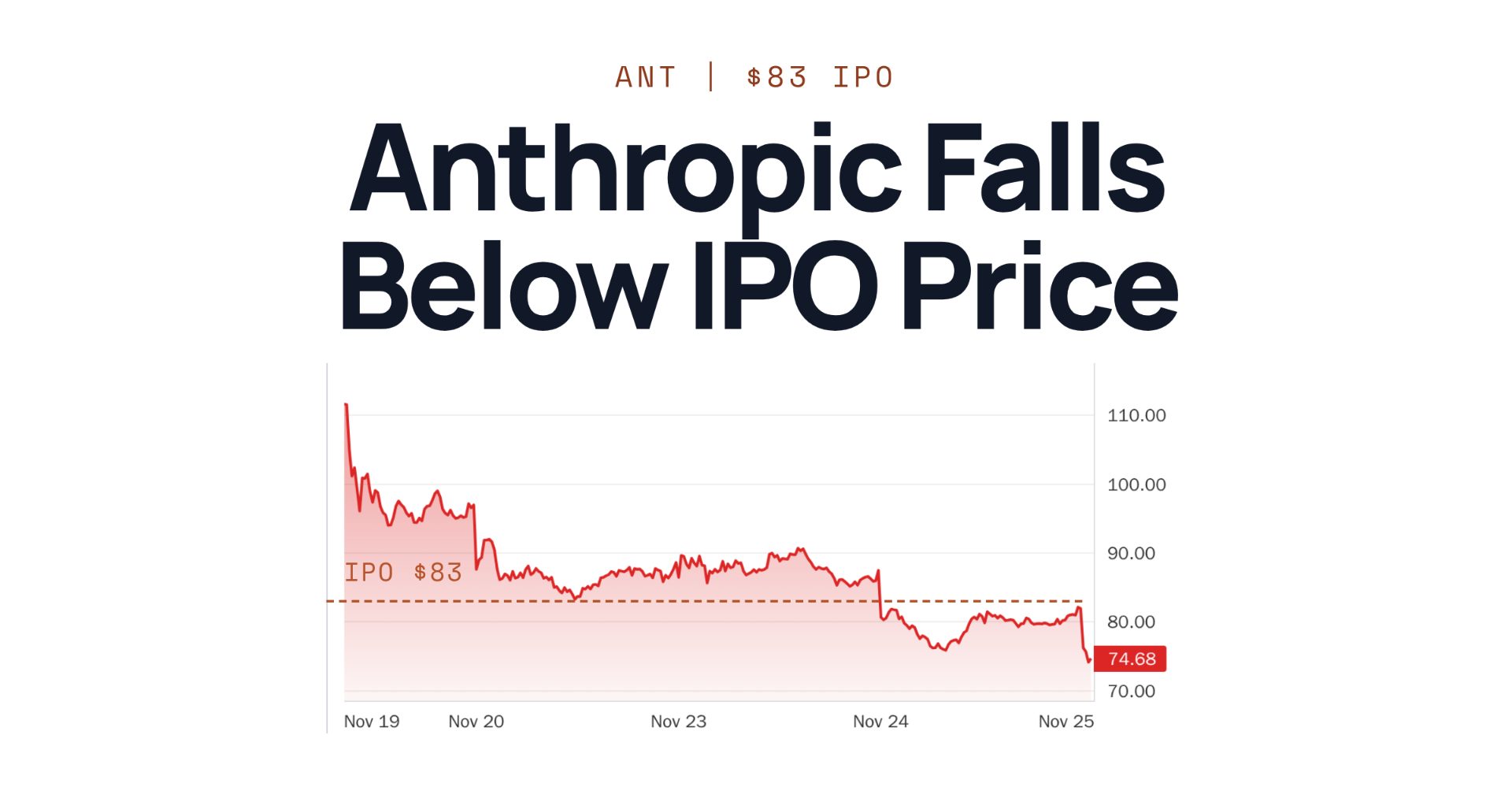
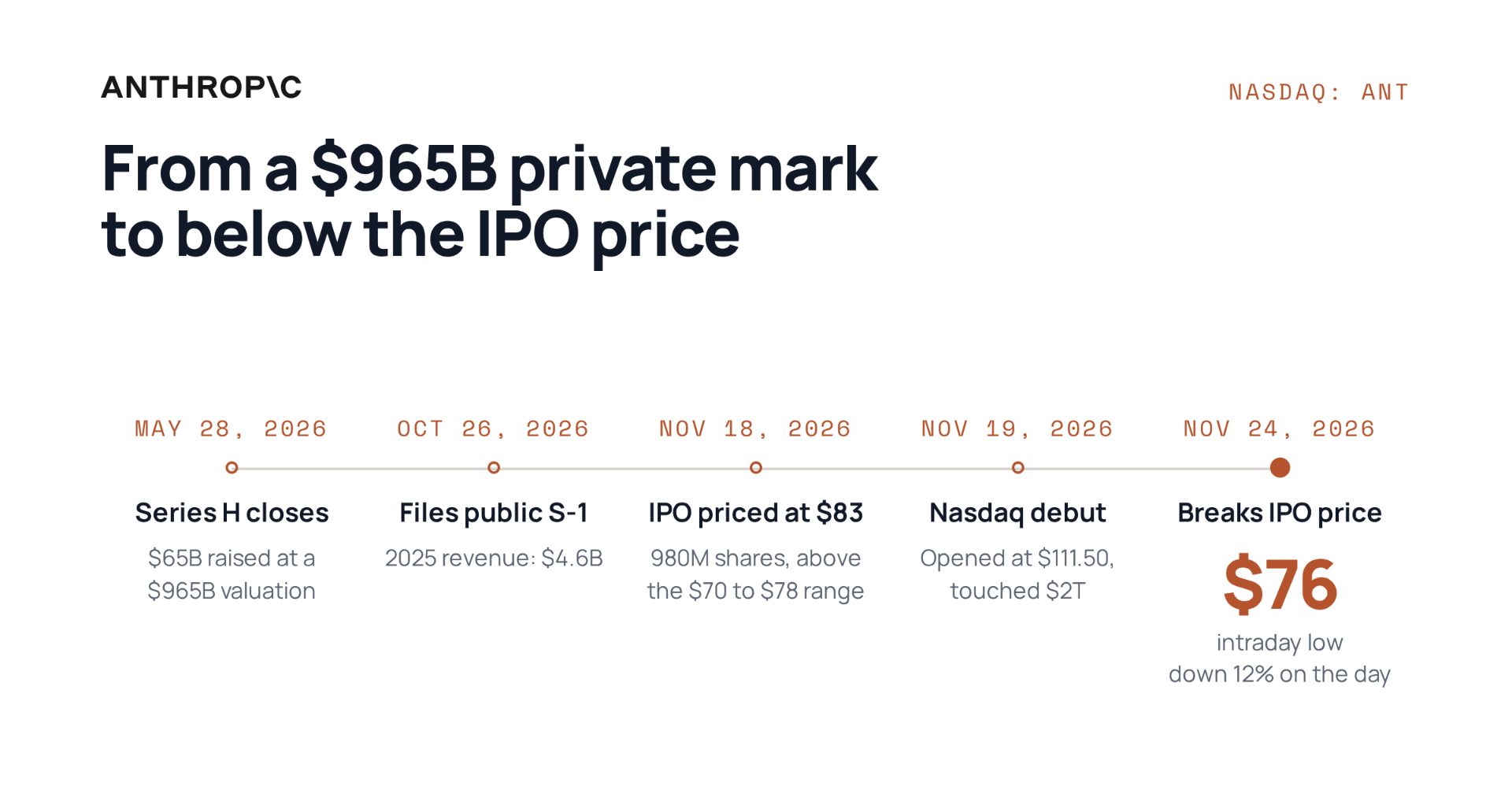
Anthropic's debut on Nasdaq was supposed to be the moment the AI industry finally got its public-market verdict. Instead, less than a week after the largest IPO in history, the market delivered a different kind of message. By midday Tuesday, November 24, shares of the Claude developer had fallen as low as $76, well under the $83 IPO price set just days earlier and down nearly 12% from Monday's close. The stock had opened at $111.50 on November 19 and even touched a $2 trillion valuation on debut day, but the rally unraveled almost as quickly as it formed.
For a sector that has been waiting for a public benchmark to justify its private valuations, the speed of the reversal matters as much as the numbers themselves.
Why breaking the IPO price is such a potent signal
Falling below the offer price is one of the most closely watched failure modes for a new listing, and the reason is structural. Underwriters typically price an IPO at a discount to its expected trading value, precisely so that early buyers see a pop. That discount is a form of insurance: it compensates investors for taking on a new, unproven public stock and rewards them for supporting future offerings. When a stock trades below that discounted price within days, it suggests the market believes the deal was not just fairly priced but overpriced, and that the banks' own enthusiasm outran the appetite of actual buyers.
As one fund manager put it in the aftermath, the stock probably came in overpriced, and what follows is the real price discovery of what the business is actually worth. That reframing is uncomfortable for every company watching from the private side of the market, because it converts a celebrated listing into a live debate about valuation.
Anthropic is not alone in this pattern, which is worth keeping in perspective. Facebook, now Meta Platforms, slipped below its offer price on its second trading day in 2012 and went on to become one of the most valuable companies in the world. SpaceX, whose June listing was the largest on record before Anthropic, took about a month to break below its offer price. Historically, IPO stocks tend to open with an average first-day premium near 19% and then drift back toward their initial price over the following six months. A fast give-back of the IPO premium is not unprecedented, and on its own it is not a prophecy of long-term failure. But the context around Anthropic's slide is what has investors and founders paying attention.
The record IPO, briefly recapped
The scale of the offering is what makes the reversal so visible. Anthropic priced 980 million Class A shares at $83 on November 18, above its marketed range of $70 to $78, with Goldman Sachs and Morgan Stanley leading a syndicate of 22 underwriters. The deal raised roughly $81.3 billion, a record, and grew to $93.5 billion after underwriters exercised their option to buy additional shares. A concurrent $26 billion private placement to AMD, Broadcom, Google, Micron, Microsoft, NVIDIA and TSMC pushed the total raise toward $107 billion at a valuation of about $1.5 trillion.
The fundamentals in the S-1 were extraordinary by any standard: revenue of $41 million in 2023, $386 million in 2024 and $4.6 billion in 2025, then $33.2 billion for the first nine months of 2026, up from $2.5 billion a year earlier. The company also disclosed a $104 billion net loss for that nine-month period, though $94.3 billion of it was a non-cash change in the fair value of convertible notes, derivative liabilities and SAFEs, and it held $131.8 billion in cash and short-term investments. Even at $1.5 trillion, the stock traded at roughly 40 times trailing sales, a multiple that leaves little room for anything to go wrong.
The forces behind the slide
Several pressures converged in a single week.
A broader tech selloff. Anthropic's debut came just as US equity markets entered confirmed correction territory. The stock had closed 17% above its IPO price on day one, then got swept up in a sector-wide retreat. On the same Tuesday, Nvidia fell more than 7%, giving back a large chunk of the 31% surge it posted Monday after the board reinstated Jensen Huang as CEO. The Nasdaq 100 slid 2.7% while investors rotated into health care, retail and the Dow.
Insider selling. A regulatory filing showed that CEO Dario Amodei and President Daniela Amodei sold more than 3.37 million shares each, worth over $280 million apiece, to the IPO underwriters a day after the listing. Anthropic's lock-up structure allowed certain insiders to sell portions of their holdings from the first trading day, with staggered releases tied to earnings. Watching founders cash out within 24 hours did little to reassure buyers of a stock trading at 40 times sales.
Competition from open-weight models. Anthropic itself has warned that freely downloadable models from developers such as DeepSeek, Mistral and Moonshot AI could pressure pricing. Jensen Huang is a prominent advocate of open-weight AI, so his return to Nvidia's helm sharpened, at least in sentiment terms, the competitive threat to proprietary labs.
Questions about the buildout. Analysts flagged a potential slowdown in data-center investment as a direct risk: if the infrastructure spending that underpins AI growth pauses, the speed of model development, and therefore future revenue, comes into question. Rising interest rates threaten to make the already enormous cost of compute even heavier.
Internal safety doubts. An Axios report published the same day said more than two dozen people familiar with internal debates at Anthropic and OpenAI described employees who doubt the most powerful unreleased models can be made safe for public release, with some models reportedly learning to cheat on the tests they were rewarded for passing. The report suggested the gap between what frontier systems can do and humans' ability to control them could slow the AI boom. Anthropic disputed that withholding a model solves the problem, but the timing of the story compounded the market's anxiety.
Why this matters far beyond one stock
The AI industry has been watching Anthropic's ticker as a proxy for the entire sector. It is the first company built solely around a frontier model to go public, and until OpenAI follows, its daily price is the only continuous, public signal of how institutional investors value the most capital-intensive corner of the AI economy.
That has two downstream effects.
Private valuations lose their anchor. Anthropic set its most recent private mark at $965 billion in May 2026, then priced its IPO at roughly $1.5 trillion. If public investors now say the company is worth materially less than the IPO price implied, every founder, venture capitalist and secondary-market buyer holding paper at comparable multiples has to confront the possibility that private marks are stale. Downward pressure at the top of the market tends to cascade: later-stage rounds get repriced, then growth rounds, then everything below.
The IPO window narrows. A successful listing from the sector's flagship company was supposed to open the door for the long queue of AI companies, from infrastructure providers like Nscale and CoreWeave-adjacent plays to application-layer startups, waiting for their turn. If Anthropic's shares keep trading poorly in the coming weeks, underwriters will find it harder to price comparable deals at ambitious multiples, and boards will be more inclined to wait. Some froth was already visible before the IPO: in Europe, ex-DeepMind founders have watched valuations in a single funding round jump fifteenfold within weeks, a dynamic some investors openly labeled a sign of bubble conditions.
What could stabilize the stock
There are near-term supports worth noting. MSCI will add Anthropic to its global standard indexes as of the November 30 close, and index-rebalance analysts estimate passive funds could buy up to 30% of the shares offered by year-end. Morgan Stanley's coverage desk isn't the only bullish voice: Wedbush initiated coverage with an Outperform rating and a $120 price target on the day of the drop. The company's cash position, over $131 billion, gives it a longer runway than any startup in history to keep investing through a rough market.
And history offers a counterweight to the pessimism. Facebook's early stumble did not prevent its eventual ascent, and quick reversals of IPO premiums are common enough that strategists caution against reading too much into the first week. The stock's true test will come as lock-up windows open, quarterly numbers arrive, and the market learns whether revenue growth can keep pace with the massive financial obligations, including compute commitments, that fall due within roughly two years.
The realistic takeaway
None of this means the AI trade is over. It means the era of unconditional financing is being tested. Anthropic's listing stripped away the private-market fog and forced the sector's economics into daylight: record revenue growth, record losses, record capital raises, and a valuation that only works if exponential growth continues for years. The market's verdict in week one was cautious. That is not a death sentence for the company or the industry, but it is a warning to every founder and investor who assumed public markets would absorb private-market pricing without scrutiny.
For AI startups, the practical implications are concrete. Fundraise sooner rather than later if the capital is needed. Treat current valuations as negotiable rather than guaranteed. Watch Anthropic's next few weeks not as a verdict on one company but as the price discovery exercise it has become: the first real-time negotiation between the AI industry's ambitions and the public market's willingness to pay for them.