
Nvidia Halts AI Server Shipments to Southeast Asia as US Closes the Cloud Loophole
Nvidia has instructed its manufacturing partners to suspend shipments of servers equipped with its advanced AI chips to four Southeast Asian countries, according to reporting by the Financial Times. Partners including Dell and Supermicro, which assemble Nvidia processors into server racks, have told buyers in Malaysia, Singapore, Thailand and Indonesia that Nvidia will not allow their orders to ship.
The suspension is the practical consequence of a sweeping new export control regime introduced by the US Commerce Department, and it lands on a region that has become central to the global AI infrastructure boom. It is not a blanket ban on Nvidia products in Southeast Asia, but it freezes new deliveries at exactly the moment regional data centre construction was accelerating fastest. The story behind the halt reveals how export controls designed for physical chips are being stretched to cover something far harder to regulate: remote access to computing power.
Why Southeast Asia Became a Bottleneck
Chinese technology companies cannot legally buy Nvidia's most advanced AI processors. Direct sales of chips like the H100 and H200 to Chinese AI developers have been blocked for years under progressively tighter US restrictions. But for most of that period, there was an obvious workaround. If you could not buy the chip, you could rent its capabilities.
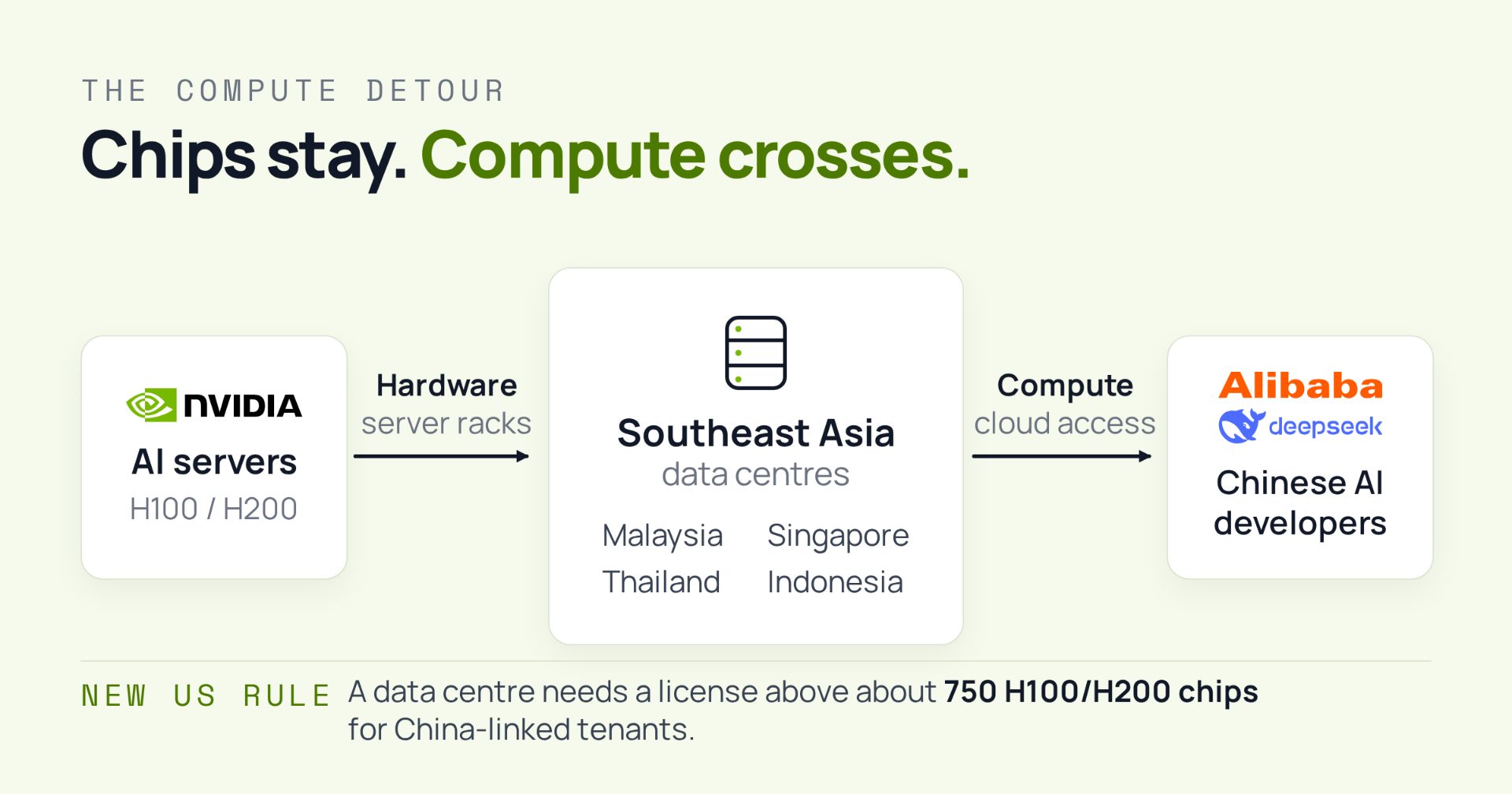
A cloud provider in Malaysia or Singapore could purchase servers filled with restricted Nvidia processors, install them in a local data centre, and lease access to Chinese customers through ordinary cloud computing contracts. The hardware never entered China. The computing power did. Chinese AI developers signed large contracts with regional data centre operators, and Southeast Asia's data centre industry grew rapidly on the back of this demand alongside legitimate regional growth.
The scale of the flows running through the region was enormous. Nvidia booked $104 billion in revenue through its Singapore subsidiary in 2025, a 72 percent increase in twelve months. Singapore's own trade minister noted in Parliament that while 22 percent of Nvidia's quarterly revenue was attributed to Singapore in late 2024, less than 1 percent of overall revenue came from products physically shipped into the country. Billing addresses, in other words, said little about where chips actually ended up.
The New Rules: Licenses for Data Centers, Not Just Chips
On November 19, the Commerce Department's Bureau of Industry and Security published an interim final rule titled 'Addressing Remote Access to Advanced Semiconductors'. It works around a fundamental legal gap: under current US law, cloud computing is not an export, so regulators cannot directly license a cloud login. Instead, the rule attaches conditions to chip shipments themselves.
The key provisions:
- Advanced chip exports to Indonesia, Malaysia, Singapore, Thailand and Brazil now require a license, because these destinations present what the department calls a higher-than-normal risk of diversion.
- Any data centre that will give companies headquartered in China, Macau, or other arms-embargoed D:5 countries access to more than 12 million aggregate Total Processing Performance needs a license. That threshold is roughly equivalent to about 750 Nvidia H100 or H200 chips.
- The threshold applies to linked data centres, so operators cannot evade scrutiny by spreading infrastructure across multiple facilities.
- Exporters and operators must conduct due diligence on customers, including ownership and control structures, and a data centre that cannot supply sufficient ownership information is presumed to present a diversion risk.
- Existing data centres already serving restricted customers have 90 days from the effective date to obtain a license.
The rule also formally rescinds the Biden administration's AI Diffusion Rule from January 2025, replacing country-tier caps with destination-based licensing focused on remote access. Notably, the rule was reportedly written at the direction of the Treasury Department and the National Security Council, reflecting frustration within the administration over how slowly Commerce had acted on the case that triggered all of this.
The Megaspeed Scandal
The immediate catalyst was Singapore-based data centre operator Megaspeed International. The company ran data centres in Malaysia and bought more than $4.8 billion worth of Nvidia chips over two years. A Wall Street Journal investigation reported that records showed Megaspeed had arranged orders for nearly $12 billion in advanced Nvidia chips for Chinese companies between March 2024 and June 2025, involving several hundred thousand processors.
The case became explosive because of its entanglement with Nvidia's leadership. Jensen Huang admitted to an affair with Alice Huang, a former Megaspeed executive whom US officials suspected of working for Chinese intelligence. The revelations led to Huang's resignation as Nvidia CEO, plunging the company into a leadership crisis just as regulators were intensifying their scrutiny. US authorities suspected Megaspeed of diverting restricted chips to China; the company denies wrongdoing.
The enforcement response was rapid. In June 2025, Nvidia placed Megaspeed on its no-sell list after investigators requested sales records. On November 23, the Commerce Department added Megaspeed and several associated companies in Singapore, Malaysia and Thailand to its Entity List, along with Apex Enterprise Solutions, a Singapore-based Alibaba subsidiary with business ties to Megaspeed. Licence applications involving these entities will be reviewed under a presumption of denial.
Huang has since returned as CEO, but the company remains under pressure on multiple fronts. The Securities and Exchange Commission is conducting an early-stage inquiry into potential accounting issues, with attention on how Nvidia calculates regional revenue. Nvidia changed its attribution method last year, moving from billing address to customer headquarters, which removed Singapore as a listed revenue region entirely. Huang is also scheduled to testify before three House committees on December 1 about chip exports and potential national security breaches.
What the Halt Means for the Supply Chain
For server manufacturers, the suspension creates immediate compliance paralysis. One supplier told Nikkei Asia that it suspended all shipments from November 20, while another paused deliveries on the advice of its legal department while checking whether products comply with the rules. One supplier executive captured the commercial risk plainly: before applying for an export licence, the company would have to collect more information from clients, and the executive feared ending up with too many expensive GPU boards as inventory.
The timing compounds an already turbulent period. Suppliers told reporters that near-term projects were proceeding and orders for the next two years were largely unchanged, but that specifications and capacity planning for next-generation products beyond the second half of 2028 faced greater uncertainty. Elon Musk, quoted by the Wall Street Journal, argued that some supply chain deals had been sealed entirely through Huang's personal relationships, sometimes without written contracts, and that at least some critical deals would be lost without him.
The regional impact could be substantial. Malaysia, particularly the Johor region, has attracted billions of dollars in data centre investment thanks to cheap land, power and proximity to Singapore. Singapore, Thailand and Indonesia have all been competing for AI infrastructure projects. Licence approval delays alone could push back equipment deliveries and project schedules across the region. A reported $500 million ByteDance project now faces uncertainty, and Chinese AI companies have been rushing to secure overseas computing capacity before restrictions tighten further.
Enforcement Was Already Closing In
The new rules did not emerge from nowhere. Enforcement actions over the past two years documented exactly the diversion routes the regulations now target. In August 2025, the Justice Department arrested two Chinese nationals who allegedly used a California shell company, ALX Solutions, to ship Nvidia H100 chips through Singapore and Malaysia, collecting payments from buyers in Hong Kong and mainland China. Prosecutors in Los Angeles later charged the owner of Earthmade Computer Inc. with smuggling roughly $300 million of export-controlled AI servers to China between 2023 and 2024, routed through the same two countries.
The methods were often crude and inventive. Investigators described serial stickers peeled off server packages in Southeast Asian warehouses, processors hidden in prosthetic baby bumps, and GPUs packed alongside live lobsters. Singapore authorities seized a mansion valued at SGD 55 million tied to the trade. Under mounting pressure, Nvidia removed more than half of its previously authorized Asian buyers from its whitelist and intensified due diligence in Singapore, Malaysia and Japan.
Despite these efforts, forensic analysis of top Chinese AI models suggested that Chinese labs continued obtaining Nvidia's newest chips despite the ban, and Huawei's domestic alternative chip business has been expanding rapidly as US restrictions push Chinese customers toward local suppliers.
The Policy Dilemma
The Southeast Asia halt illustrates the fundamental tension in US chip policy. The restrictions are designed to slow China's AI development by denying access to the most advanced computing hardware. But they impose real costs on everyone else: Southeast Asian countries that invested heavily in data centre infrastructure, US server makers navigating a compliance maze, and Nvidia itself, which has consistently argued that such controls backfire by accelerating Chinese domestic alternatives like Huawei.
Huang made that argument explicitly over the past two years, calling the restrictions a failed strategy and noting that Nvidia's share of the China AI market fell from 95 percent to zero. Beijing has in turn discouraged local firms from buying Nvidia chips, and Chinese companies like Huawei and Alibaba have unveiled chips they claim rival Nvidia's products for the domestic market.
There is also a legal question hanging over the new rule. Export control lawyers have widely doubted whether Commerce can enforce a remote-access regulation under existing law, since cloud computing is not legally an export. The House passed the Remote Access Security Act to grant that authority explicitly, but the rule does not wait for the Senate to act, citing the Export Control Reform Act of 2018 instead. Whether the rule survives legal challenge remains to be seen.
For now, the practical reality is simple: server racks bound for Malaysia, Singapore, Thailand and Indonesia are not shipping, and no one knows exactly when they will. The gap between a chip shipment and a cloud login, which regulators spent years trying to bridge, has finally been addressed on paper. Actually enforcing that line across a globally distributed supply chain is the harder task, and the frozen warehouses of Southeast Asia are where that difficulty is now playing out.