
CrowdStrike to Acquire Zscaler for $44 Billion: The Deal That Rewrites the Cybersecurity Map
A $44 Billion Bet on the AI Era of Security
CrowdStrike has agreed to acquire Zscaler in an all-stock deal valued at approximately $43.9 billion, the companies announced on Monday, November 23, 2026. The transaction unites two of the most prominent names in enterprise cybersecurity and, if it clears regulatory review, will create a company with a combined market value that exceeded $265 billion before the deal was even announced.
On the surface, this is another entry in a long run of cybersecurity consolidation. But the scale, the timing, and the framing all point to something bigger. Both companies are positioning the merger as a direct response to a shift that is transforming security itself: artificial intelligence is turbocharging both the attacks enterprises face and the tools they need to defend themselves. As CrowdStrike CEO George Kurtz put it, "Security used to be about keeping the adversary out. Today, safety is required to let AI in."
What Each Company Brings to the Table
To understand why this deal matters, it helps to understand how differently the two companies approach security.
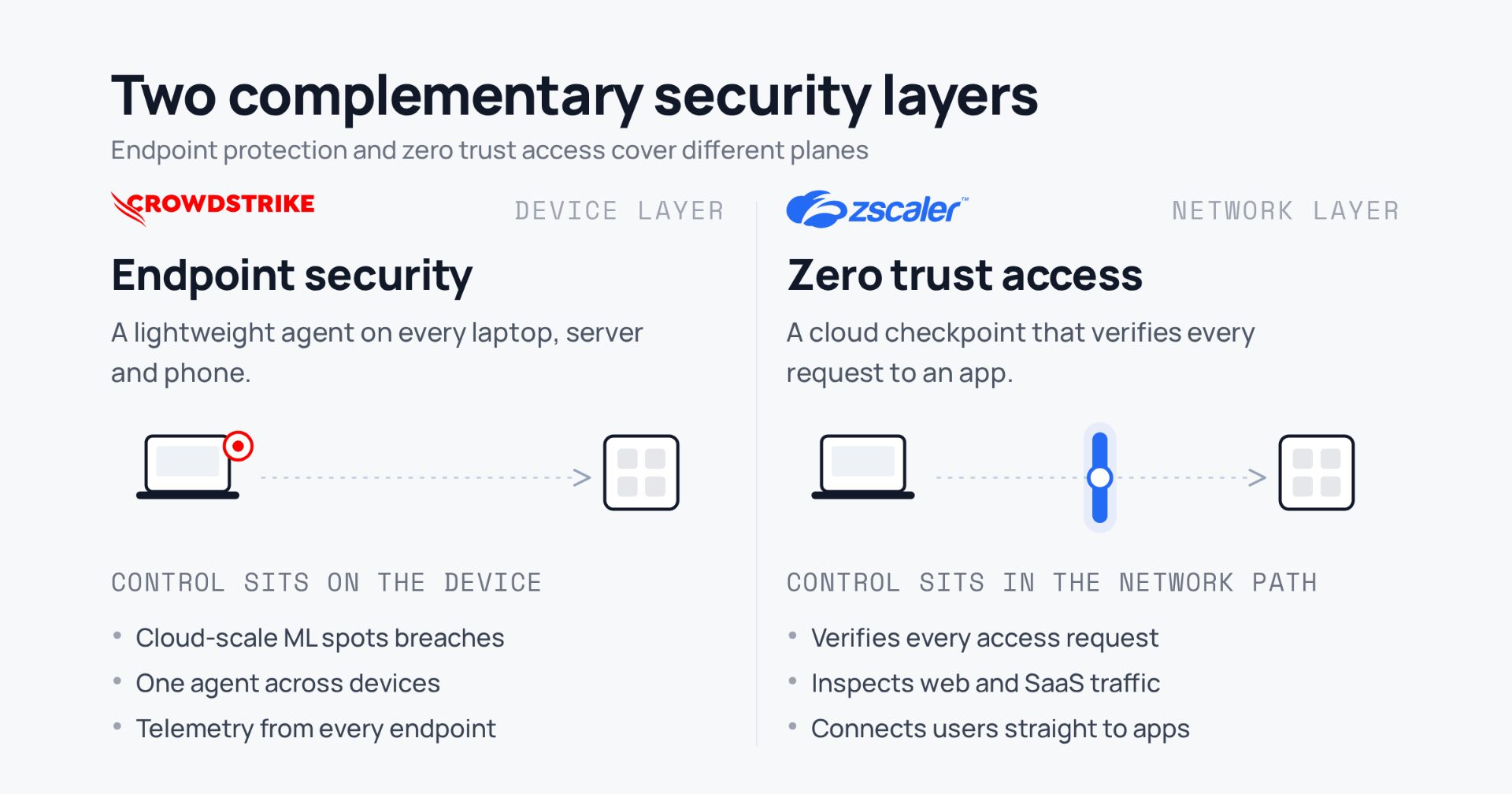
CrowdStrike, founded in 2011 and headquartered in Austin, Texas, built its reputation on endpoint security. Its Falcon platform runs a lightweight agent on laptops, desktops, phones, servers, and other devices, using cloud-scale machine learning to detect and stop breaches. Over the years, CrowdStrike expanded from endpoint detection and response into cloud security, identity protection, threat intelligence, log management, and a next-generation SIEM, all under the same platform umbrella. The company's fiscal third-quarter results, announced the same day as the deal, beat expectations with earnings of 34 cents per share on $1.58 billion in revenue.
Zscaler, founded in 2007 by serial entrepreneur Jay Chaudhry and K. Kailash, took a different path. Based in San Jose, California, the company pioneered cloud-delivered zero trust security: the idea that no user or device should be trusted by default, and that every access request must be verified. Its Zero Trust Exchange platform includes Zscaler Internet Access, a secure web gateway that inspects web and SaaS traffic, and Zscaler Private Access, a zero-trust network access service that replaces traditional VPNs by connecting users directly to specific applications without ever placing them on the corporate network. Zscaler serves roughly 8,000 to 11,000 enterprise customers, including more than half the Fortune 500, and reported fiscal 2026 revenue of $3.35 billion, up 25 percent year over year.
The two companies were already partners, with about 2,000 shared customers. The acquisition formalizes what the market has been pushing toward: a single vendor that can protect both the devices employees use and the networks and applications those devices connect to.
The Strategic Logic: One Control Plane for Security and AI
Kurtz framed the merger as building "cybersecurity's operating system: a single control plane to deploy AI, control AI, and enable any agentic application to run safely." He went further, saying CrowdStrike sees "a path to become the largest AI safety and security company the world has ever seen."
That language may sound like standard deal-making hyperbole, but it reflects a genuine architectural argument. Modern attacks do not respect the boundaries between endpoint and network. A phishing email compromises a laptop; the attacker moves laterally through the network; data exfiltrates through a cloud application. Defending against that chain requires visibility and control at every stage. By combining Falcon's endpoint telemetry with Zscaler's position in the network traffic path, the combined company can, in principle, detect and block attacks that a single-layer product would miss.
There is also an AI-specific argument. Enterprises are rushing to adopt AI tools, from coding assistants to autonomous agents, and security teams are struggling to govern them. Zscaler has been building in this direction: its AI Access Security product uncovers "shadow AI" usage and moderates prompts to prevent data leaks, and in May 2026 it agreed to acquire Symmetry Systems, whose access graph technology maps how identities, including AI agents, reach applications and data. Jay Chaudhry was explicit about the threat: "In the AI era, Zero Trust security has become non-negotiable, and AI agents are rapidly becoming the new weakest link."
The combined pitch is that a single platform can govern both human and machine access, across devices and networks, as AI agents proliferate inside enterprises.
A Year of Record Cybersecurity Deal-Making
The CrowdStrike-Zscaler agreement is the latest and largest move in a wave of consolidation that has reshaped the security industry:
- Google announced a $32 billion acquisition of cloud security startup Wiz last year.
- Cisco spent roughly $28 billion on Splunk in 2024.
- Palo Alto Networks closed a $25 billion acquisition of CyberArk earlier this year and has bought several other cyber and AI businesses, including startup Applied Compute.
- Zscaler itself made a string of tuck-in acquisitions, including Red Canary for managed detection and response in 2025, browser security firm SquareX in February 2026, and Symmetry Systems in May 2026.
The pattern is clear. Security vendors are buying their way into platform status, trying to capture more of each customer's security budget and close product gaps before rivals do. Analysts view the Zscaler deal in exactly this light: JPMorgan analysts wrote that the acquisition could bring "more breadth in an era of vendor consolidation" and, importantly, network security that positions CrowdStrike "more effectively for rising demand for AI Sovereignty."
The competitive context matters. Palo Alto Networks, at $282 billion in market value, remains the market leader and has pursued the same platform strategy. CrowdStrike, whose shares had soared about 80 percent this year before the announcement, is buying Zscaler partly to close that gap. Kurtz noted that the deal expands the combined company's total addressable market by more than $185 billion by 2029, largely in the network security space.
Deal Terms and Market Reaction
The structure of the deal is straightforward: Zscaler shareholders will receive 1.135 shares of CrowdStrike for each Zscaler share, a 34 percent premium to Zscaler's closing price on the Friday before the announcement. After closing, existing CrowdStrike shareholders will own about 84.1 percent of the combined company, with Zscaler holders owning 15.9 percent.
The market's initial verdict was divided, which is typical for large all-stock acquirers. CrowdStrike shares dropped as much as 9 percent on the news, reflecting investor concern about integration risk and the premium being paid, while Zscaler surged nearly 18 percent. Both companies reported quarterly earnings that same day, and both beat estimates, a reminder that the deal was announced from positions of strength rather than weakness.
The transaction is subject to regulatory approval and is expected to close in the second half of CrowdStrike's fiscal 2028 year, which begins in February. That timeline, roughly a year out, reflects the antitrust scrutiny a deal of this size in a concentrated industry will likely face.
The Risks: Integration Is the Hard Part
Big deals are easy to announce and hard to execute, and this one carries real execution risk.
First, there is the technical challenge. CrowdStrike's Falcon platform was built around a single lightweight endpoint agent; Zscaler's platform is a globally distributed cloud proxy that sits in the traffic path for hundreds of billions of daily transactions. These are fundamentally different architectures, and customers will judge the combined company on whether the integration delivers genuinely unified telemetry, policy, and workflow rather than two products sold from one catalog.
Second, there is commercial risk. Both companies have their own subscription models, CrowdStrike with Falcon Flex and Zscaler with its Z-Flex program, which let customers commit spend and activate modules over time. Reconciling those models, pricing structures, and renewal cycles across a combined platform will take careful work. Zscaler is also in the middle of a business model shift toward metered, non-seat-based usage, which adds another layer of complexity.
Third, there is retention risk on both sides. Zscaler's identity is deeply tied to Jay Chaudhry, its founder and CEO, and the company recently reshuffled its sales leadership. Key talent departures during a year-long integration period could slow momentum. And customers who chose Zscaler precisely because it was independent of any endpoint vendor may reassess their options, particularly competitors like Netskope and Palo Alto Networks that offer comparable secure access service edge platforms.
Finally, antitrust review is a genuine unknown. The combined entity would be one of the largest cybersecurity companies in the world, and regulators in the United States and Europe have shown increased willingness to scrutinize large technology mergers.
What It Means for Enterprises
For security and IT leaders, the deal is best understood as an acceleration of a trend that was already underway: platform consolidation. Buying security from fewer vendors with integrated products is increasingly attractive not only for cost reasons but because integrated telemetry genuinely improves detection. The combination of endpoint signals and network-level visibility is one of the more defensible versions of that argument, since the two data sources complement each other in ways that are hard to replicate with separate tools.
At the same time, the deal is a reminder that vendor choice remains contested. Palo Alto Networks, Google, Cisco, Fortinet, Netskope, and others are all pursuing their own versions of the platform thesis. Enterprises should expect more aggressive bundling, more flexible subscription programs, and more pressure to consolidate in the next two to three years, regardless of whether this specific deal closes on schedule.
The deeper question the deal raises is about AI. Both CEOs framed the merger around a future in which autonomous AI agents become both a security burden and a security tool. Whether a combined CrowdStrike-Zscaler can actually deliver a credible control plane for agent identities, agent-to-agent communication, and AI data flows, as opposed to marketing one, will be one of the most watched product stories in the industry.
Conclusion
CrowdStrike's $43.9 billion acquisition of Zscaler is the largest deal in cybersecurity history by the companies' own framing, and it lands at a moment when the industry's economics are being rewritten. AI is simultaneously the threat driving enterprises to spend more and the product category every major vendor is racing to own. By pairing the leading endpoint platform with the leading zero trust network platform, CrowdStrike is betting that breadth, integration, and scale will determine who wins the next decade of security spending.
The bet is plausible but unproven. Merging two cloud-native platforms with different architectures, different subscription models, and different cultures is among the hardest things in enterprise software. The market's split reaction on announcement day captured that tension perfectly: investors rewarded Zscaler's premium and punished CrowdStrike's risk. Over the next year of regulatory review and the integration that follows, the companies will have to prove that a single control plane for security and AI is more than a slogan. If they can, the deal will be remembered as the moment cybersecurity's platform era truly began. If they cannot, it will join the long list of transformative mergers that looked better in press releases than in product roadmaps.