
India's Opposition Storms Meta's Offices to Get Its Instagram Accounts Back
On November 20, 2026, activists from the Indian Youth Congress, the youth wing of the country's main opposition party, forced their way into the building housing Meta's offices in Hyderabad. Videos released by the group showed protesters carrying placards, marching through corridors, smashing potted plants, and clashing with police. Later the same day, the scene repeated itself in Mumbai, where demonstrators spray-painted anti-Meta slogans on the walls of the building housing the company's office and burned placards outside the entrance. In Gurugram, near New Delhi, protesters held banners demanding the return of the movement's accounts.
The immediate trigger was small: two Instagram accounts belonging to the youth wing's national president, Uday Bhanu Chib, and the party official who oversees the wing, Manish Sharma, had been restricted in India on November 19. But the anger behind the protests is much larger, and it reaches to the heart of how Meta operates in India, a country where the company must constantly balance a demanding government, an aggressive opposition, and its own commercial interests.
What the Youth Congress Is Demanding
The Indian Youth Congress argues that Meta blocked its leaders' accounts on orders from the ruling Bharatiya Janata Party (BJP), led by Prime Minister Narendra Modi. The organization claims the restriction was illegal and that Meta, along the way, has restricted thousands of accounts belonging to journalists, content creators, and influencers critical of those in power.
Before the protests, the group had warned on X that it would storm Meta's offices across the country if the accounts were not reinstated. It followed through on that promise. And the method appears to have worked: according to Manu Jain, who oversees the youth wing's social media operations, two accounts were restored shortly after the protests. The group's X account claimed the accounts became accessible again within 10 to 15 minutes of the Hyderabad demonstration, though this connection has not been independently confirmed.
Emboldened, the movement issued a seven-day ultimatum on November 21. Its demands are specific and go well beyond its own two accounts:
- Meta must reveal how many Indian accounts were withheld on government orders in the past six months, and how many remain blocked.
- It must explain the automated blocking of posts that mention Congress leader Rahul Gandhi or criticize Prime Minister Modi and the BJP.
- It must lift all restrictions on opposition voices, journalists, and creators.
- It must respect the Indian Constitution rather than, in the group's words, "surrender to arbitrary BJP government orders."
The youth wing also launched what it calls a Digital Azaadi (Digital Freedom) campaign, in which it has been legally assisting creators, influencers, and independent journalists facing restrictions for months. On the day after the ultimatum, protesters put up a banner in central Delhi mocking Meta's chief executive as "Mark BJPberg," a pointed suggestion that the company favors Modi's party.
The Scale of the Crackdown
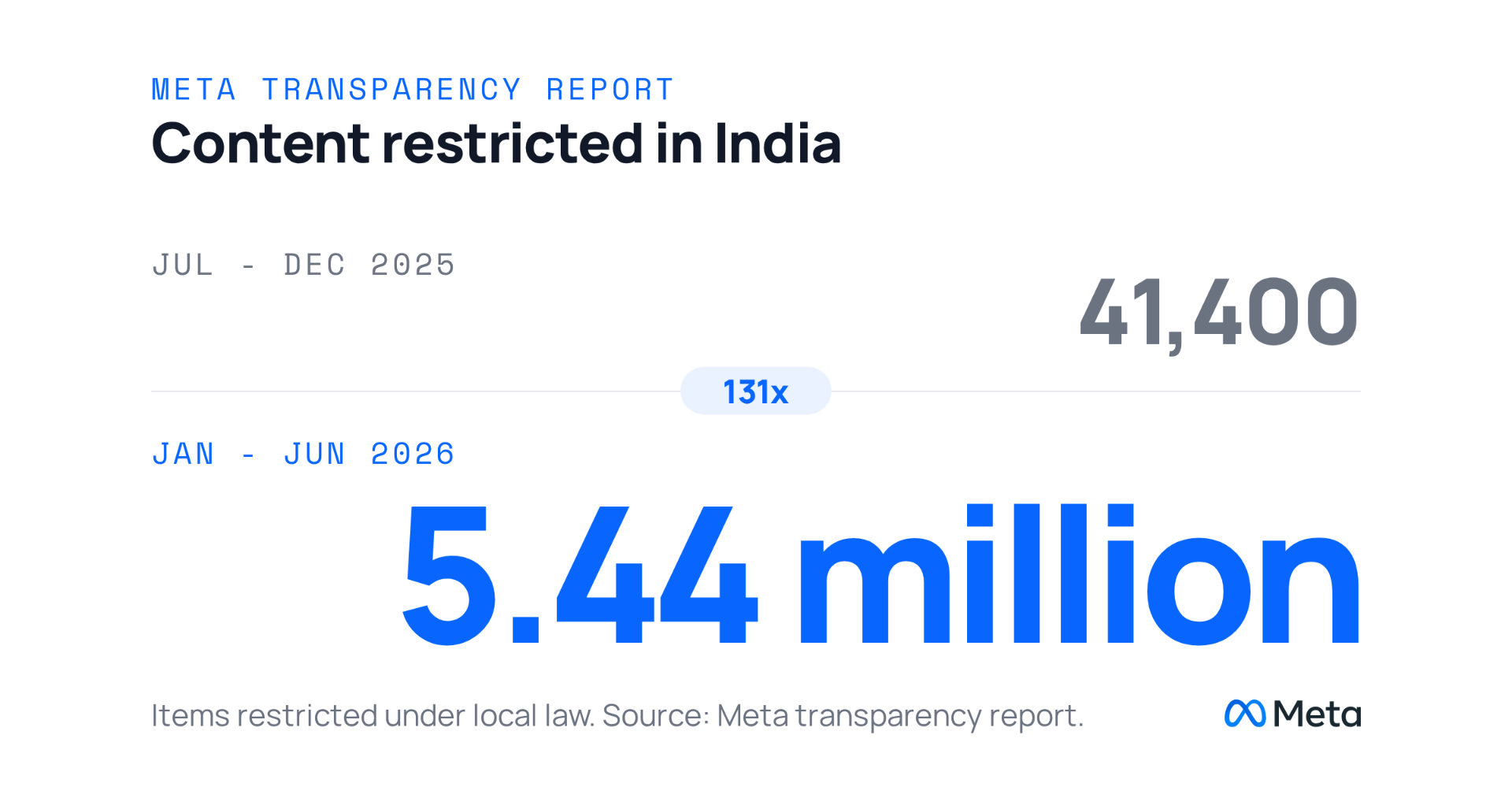
The dispute would be a local political skirmish if it were not for the numbers underneath it. Meta's own transparency disclosures show that the company restricted more than 5.4 million posts or accounts in India in the first half of 2026, compared with roughly 41,000 to 70,000 in the previous six months. That is a more than 130-fold surge in a single reporting period, and it placed India second globally in content restricted under local laws, trailing only Indonesia.
Several factors explain the explosion. In February 2026, the Indian government amended its Information Technology Rules, slashing the time platforms have to act on takedown orders from 36 hours to just three hours. The amendments also allow authorized police officials to notify platforms about content they consider unlawful without necessarily filing a formal complaint, leaving companies with hardly any time to review and independently verify the material before removing it.
The government has been aggressive in issuing orders. Between March and July 2026, authorities issued nearly 200,000 blocking orders to Instagram, Facebook, and YouTube, up from around 2,300 between October 2024 and 2025. To comply with the new three-hour deadline, Meta reportedly connected its systems directly to the Sahyog portal, a government system that allows law enforcement agencies to request immediate content removal, so that removal requests are processed automatically without review by Meta employees.
Meta says a "large majority" of the 5.4 million restrictions involved cases where it was "obligated to proactively restrict content" based on local law requirements, including blocking identical copies of content at scale. The company points out that much of the restricted material involved categories such as unlawful online gaming, deepfakes depicting prominent figures, threats to India's sovereignty, gender-based harassment, and content promoting enmity between groups. It also notes that the content typically remains available outside India, meaning the restrictions are geoblocks rather than global removals.
Free speech advocates see something more troubling in these numbers. Categories like "threats to the sovereignty and integrity of India" and "promoting enmity between groups" are notoriously vague, and automated systems making these judgments at scale can sweep up political satire, protest videos, and critical journalism alongside genuinely harmful content. Reporters Without Borders has noted that removal of journalistic content from social media has been on the rise in India this year. When Meta follows government orders, users are often told only that a "legal request" or an "automated system" flagged their content, with no information about who ordered it, why, or how to appeal.
Why India Matters So Much to Meta
India is Meta's biggest market by number of users. That fact shapes everything about how the company behaves there. Losing safe harbor protections, which shield platforms from legal liability for what users post, is an existential threat to Meta's business model in any country, and the Indian government has made clear it is willing to strip that protection. In 2026 alone, the government questioned whether Meta's recommendation systems and paid content promotion were compatible with its status as an intermediary, threatened to reclassify it as a "service provider" with greater liability, and summoned Meta executives over issues ranging from child safety advertisements to the temporary restriction of a Modi Facebook post.
The pattern of the past year shows a government that has learned how much leverage it holds. After Meta briefly restricted a post by the Prime Minister in July and blamed a "glitch," the government summoned Meta's global head of public policy, rejected the explanation as inadequate, and received an apology from Meta's chief global affairs officer. Days after that apology, Meta unleashed what journalists described as a heightened censorship spree targeting opposition figures and media outlets.
From Meta's perspective, the calculus is stark. Complying with the government keeps its largest user base intact and its legal position safe. Defying it risks the business itself. The result is what critics describe as a platform that no longer merely complies with state censorship but streamlines it, automating the processing of takedown orders and proactively restricting content before any explicit order arrives.
The Political Storm
The BJP has not taken the accusations of political bias lying down. National spokesperson Pradeep Bhandari accused the protesters of vandalizing Meta's Hyderabad office and "flaunting it on social media," calling the episode an example of "the Congress model: vandalise offices of private companies." He referenced an earlier Youth Congress protest at the World AI Summit, alleging that activists had disrespected the country.
The controversy also drew regional political reactions. KT Rama Rao, working president of the BRS party and a former Telangana minister, criticized the Hyderabad protest for damaging the city's reputation as a business hub. He noted that Meta's largest campus in India is in Hyderabad and asked whether "hooliganism" was the opposition's way of attracting companies to India. "In yesterday's incident, it was not just glass that was broken; the trust in Brand Hyderabad was also shattered," he wrote.
Samajwadi Party chief Akhilesh Yadav, meanwhile, sided with the protesters, telling Meta to "do business, not politics."
Caught Between a Government and an Opposition
Meta has remained silent on the protests, declining to comment when approached by reporters. The company has previously maintained that it restricts content in India to comply with local laws. That position is technically accurate but does little to address the core complaint: that the laws themselves, and Meta's automated compliance with them, function as a machinery for silencing dissent.
The standoff crystallizes a dilemma facing every major platform operating in authoritarian-leaning markets. Platforms need legal certainty and market access. Governments know this and exploit it. Opposition parties and civil society, meanwhile, have discovered that public confrontation works, at least in the short term. Two accounts were restored after the protests, and the Youth Congress is now betting that escalation, in the courts, on the streets, and at Meta's offices, will force broader concessions.
Whether Meta responds to the seven-day ultimatum with transparency or silence will say a lot about how the next phase of India's battle over digital speech unfolds. What is already clear is that the era of quiet, invisible compliance is over. When 5.4 million restrictions happen in six months, someone notices. And increasingly, they are showing up at the door.