
GTA 6 and the AI Race to Clone the World's Biggest Game for PC
When Grand Theft Auto 6 launched in November 2026, it set the record for the biggest entertainment launch in history, pulling in $3.8 billion in retail sales on its first full day. Yet a large slice of the gaming world was left out: Rockstar has released the game only on PlayStation 5 and Xbox Series X|S, with no PC version announced. Historically, that gap has been tolerated. GTA 5 took 19 months to reach PC. Red Dead Redemption 2 took roughly a year.
This time, the wait may not hold. Days after launch, an apparent leak of a near-complete Xbox build of the game appeared online, and almost immediately, teams of coders began using AI-assisted tools to decompile, modify, and recompile the game to run natively on Windows. The effort has already triggered one of the largest copyright takedowns in GitHub's history, forced Anthropic to change how its Claude Code tool behaves, and sent a chill through independent studios far smaller than Rockstar.
The story is not really about one game. It is about what happens when the effort required to copy software collapses, and when a company can no longer control how, where, and when its work is consumed.
Why PC players are waiting at all
The delay between a console launch and a PC release is not arbitrary. Console hardware is standardized: every PlayStation 5 has the same CPU, GPU, memory, and operating system, so developers can optimize deeply against a fixed target. PC is a sprawl of combinations: different GPUs from Nvidia and AMD, CPUs across generations, drivers, storefronts, and operating system versions. As Christopher Dring, editor-in-chief of The Game Business, explained, PC versions are complex precisely because of that hardware variety.
There is also a commercial logic. Rockstar can create a second launch moment when the PC version finally arrives, re-monetizing attention and pushing a second wave of sales. GTA 5 followed exactly that playbook, arriving on PC in April 2015 after launching on consoles in September 2013, and it went on to sell enormously on PC. Take-Two CEO Strauss Zelnick has framed the strategy as serving the game's core console audience first.
Unconfirmed industry reporting has suggested a PC release as early as the first quarter of 2027, but nothing is official. Against that backdrop, a leaked console build plus powerful AI tools has changed the calculus.
The leak that started the race
A leaker or group operating under the name Cyberleek, which had dripped GTA 6 gameplay footage for months and tied leaks to a crypto token, released what it claimed to be a near-complete Xbox build of the game, about 209 GB of files labeled as the November 2026 build. Crucially, it withheld the main executable file, the piece needed to actually launch the game, dangling it behind a memecoin market cap target and a countdown timer. The executable arrived on November 23 regardless.
With the full package in hand, the community's attention shifted from piracy to porting. Within hours of the executable's release, modders reportedly had the game booting into its first settings menus on Windows. Multiple groups posted progress clips on X, from getting the game to start to running segments at a stable frame rate on high-end PCs. Tracker sites such as PortWatch VI emerged to follow dozens of parallel attempts, scoring each milestone.
None of the leaked material has been authenticated by Rockstar or Take-Two, and none of the projects has produced a genuinely playable, complete PC version. But the pace has been startling, and it is driven by a shift in tooling.
Decompilation, recompilation, and why AI changes the math
Mark Brown, creator of the Game Maker's Toolkit YouTube channel, distinguishes between two kinds of cloning. The first is replication: asking a chatbot like Claude or ChatGPT to build a new game based on an existing one, using screenshots or a description. He compares it to looking at a painting and making your own replica, a very close copy that is ultimately a new painting. The second is reverse engineering: working backwards from a finished binary to understand how it was built.
Decompilation is the classic reverse-engineering technique. Brown likens it to taking a cake and somehow turning it back into the original recipe, with the exact quantities of flour, eggs, and milk, so anyone can remake the same cake. Recompilation then takes that reconstructed understanding and adapts it to run on different hardware. This combination is what previously brought games like Halo: Combat Evolved and Grand Theft Auto: Vice City to web browsers.
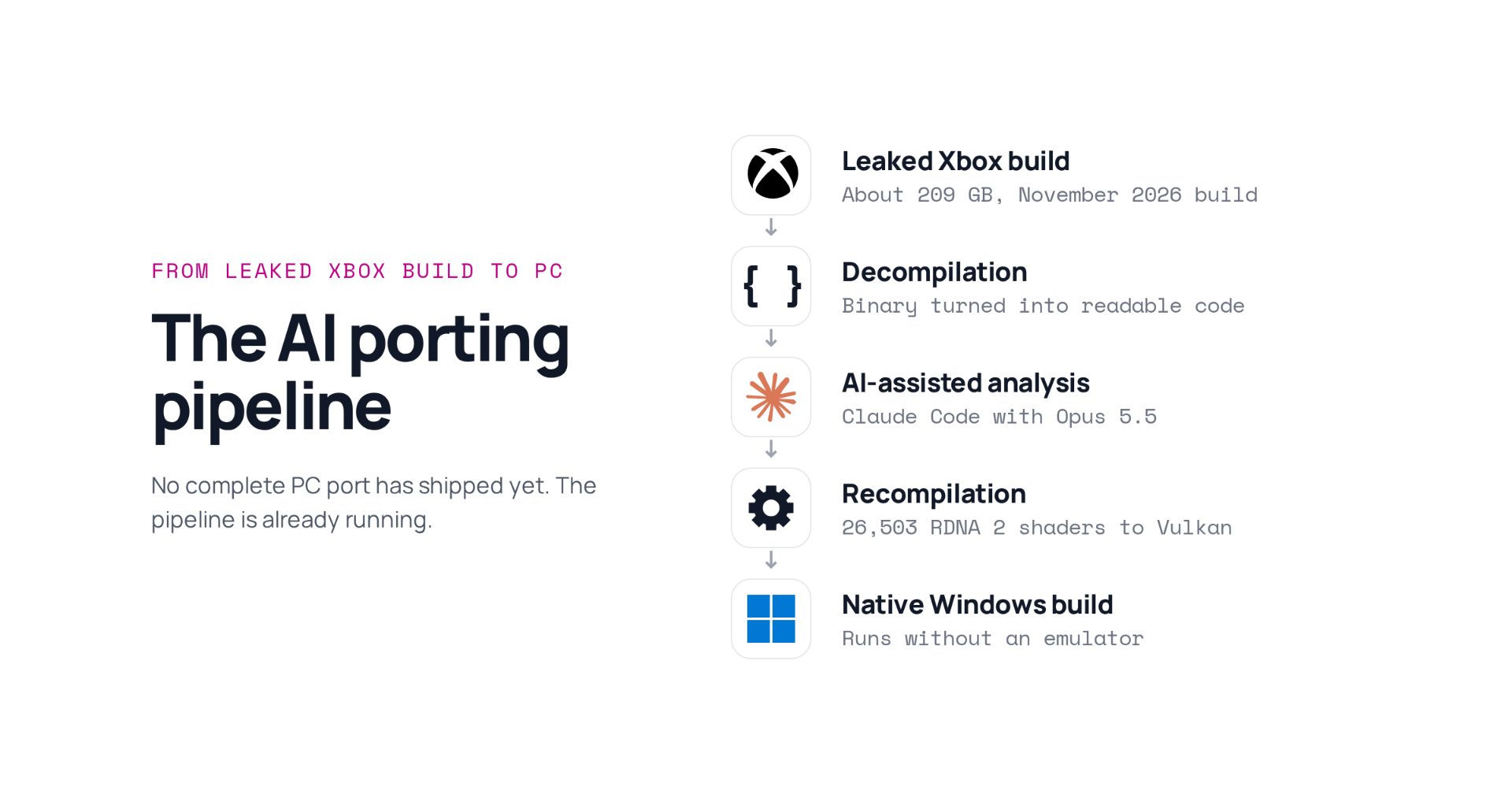
Historically, decompiling a modern AAA game was a herculean task. The binary is enormous, obfuscated, and interwoven with platform-specific code. What changed is the arrival of agentic AI tools, most notably Anthropic's Opus 5.5 model and the Claude Code platform, released in September 2026, along with community tools such as Reverse Engineer Anything that pair AI agents with static analysis to turn native binaries into readable pseudocode. Work that took skilled reverse engineers months can now be seeded and accelerated in days.
In the case of GTA 6, the leaked Xbox build made the job concrete. As Brown put it, people are now using AI to decompile it, make a modified version that could run on PC, and compile a new version. One widely cited recompilation project, called Leonida, opened its repository on GitHub just one day after the leak and claimed to have translated all 26,503 RDNA 2 shaders to Vulkan. The game reportedly almost booted, black screen and audio failures notwithstanding.
Take-Two's response: 3,007 repositories in one sweep
Take-Two's answer came quickly. On November 24, GitHub processed a DMCA takedown notice against the Leonida repository and its entire fork network: 3,007 repositories in total, the largest enforcement action the company has taken around GTA 6.
The legal argument in the notice is instructive. Leonida shipped no game files and told users to supply their own Xbox Series game files. Take-Two called that disclaimer intentionally misleading, arguing that the only files users could realistically supply were the leaked ones, since installed Xbox games remain encrypted even for legitimate buyers. The notice claimed the repository reproduces copyrighted expression in GTA 6 and constitutes a derivative work, and that it violates Section 2.3 of Rockstar's terms of service, which bars decompiling, reverse engineering, and creating derivative works. The notice closed with no room for negotiation: this content must be completely disabled, with no remedies available to rectify it.
Days earlier, Take-Two had filed similar notices against fan ports of GTA 5 built on a WebAssembly version of the game, including projects for iOS, macOS, and Android. The message across all of them is consistent: a bring-your-own-files disclaimer does not shield a project built around someone else's game.
The takedowns have not stopped the work. PortWatch VI still tracks around 30 projects, and developers have simply moved into private Discord servers and off-platform repositories. One effort claimed a 90-minute session on an RTX 3050, albeit at an unplayable 1 to 3 frames per second. Another post claimed 30 FPS with a target of 60. Take-Two is playing whack-a-mole, and some observers argue the only durable remedy is a faster official PC release.
Where the law actually stands
The legality of all this sits in a genuine grey area, and it is worth being precise about it. Decompiling code for educational purposes can, within limits, be lawful. Dr Tommy Thompson, an AI consultant and host of the AI and Games channel, notes that decompilation crosses a line when it reaches copyright and intellectual property infringement, and that using it to redistribute or repackage existing software is largely illegal.
IP lawyer Aaron Trebble of Lewis Silkin goes further for practical purposes: in most cases, decompiling or recompiling code likely involves unauthorized use of the game's IP, and anyone who releases or sells a clone will almost certainly be infringing copyright. The murkier question, which the law has not settled, is the responsibility of the AI companies themselves when their tools are used for infringement.
Anthropic has not waited for that question to be answered. In late October 2026, Anthropic engineer Addy Osmani confirmed that two sentences had been added to Claude Code's system prompt for Opus 5.5, steering the tool away from recreating specific existing games, even when renamed or passed off as original, because using Claude to infringe IP violates the company's usage policy. Original games, genre-based games, and projects built from a user's own designs and assets are meant to keep working.
The rule has real limits. It is a prompt-level constraint, not a hard technical block, and users report mixed results even after the change. More importantly, determined users can route around it entirely with locally run open-weight models that answer to no one's usage policy. Anthropic's move raises the cost of casual cloning without eliminating the capability.
The warning for everyone smaller than Rockstar
It is tempting to see this as a dispute between a giant publisher and pirates, but the AI cloning wave is hitting hardest further down the food chain. Indie developers Sodoj and Marco of the studio Robotonic discovered a version of their unreleased puzzle game 204Snake, same name and same mechanics, published on the free platform Yandex with slightly off art. They managed to get it taken down with copyright strikes, but described the win as small and unsettling.
Others have moved preemptively. The Korean studio YNOT pulled the public demo of its game Spookitchen after receiving emails announcing an intent to clone it with AI and telling the developers not to waste their time. Japanese studio Alliance Arts canceled its Steam Next Fest demo for Drunken Goddess Reflux over the same fear. Developer Weasel Pit publicized a threatening email demanding Steam content in exchange for not releasing an AI copy of Iron Pilgrim first. Some high-profile developers, including Papers, Please creator Lucas Pope, have said they will stop sharing information about upcoming games until close to launch.
The economics are brutal. Original creators spend years testing ideas and polishing execution; copiers can watch a demo, have AI rebuild the mechanics, and race the original to market. One developer likened it to a new kind of gold farming: take something that looks decent, change the appearance slightly, and release it over and over for steady income without ever making a game.
What it means for the industry
GTA 6 is the stress test precisely because it is the hardest possible target. A 200-plus GB open-world game with proprietary tech, built by a studio with deep pockets and aggressive legal representation, is the last thing anyone expected to see unofficially ported within days. If even this can be attacked this quickly, every developer that launches on console without a simultaneous PC release has to ask a new question: what happens if the community ports it first?
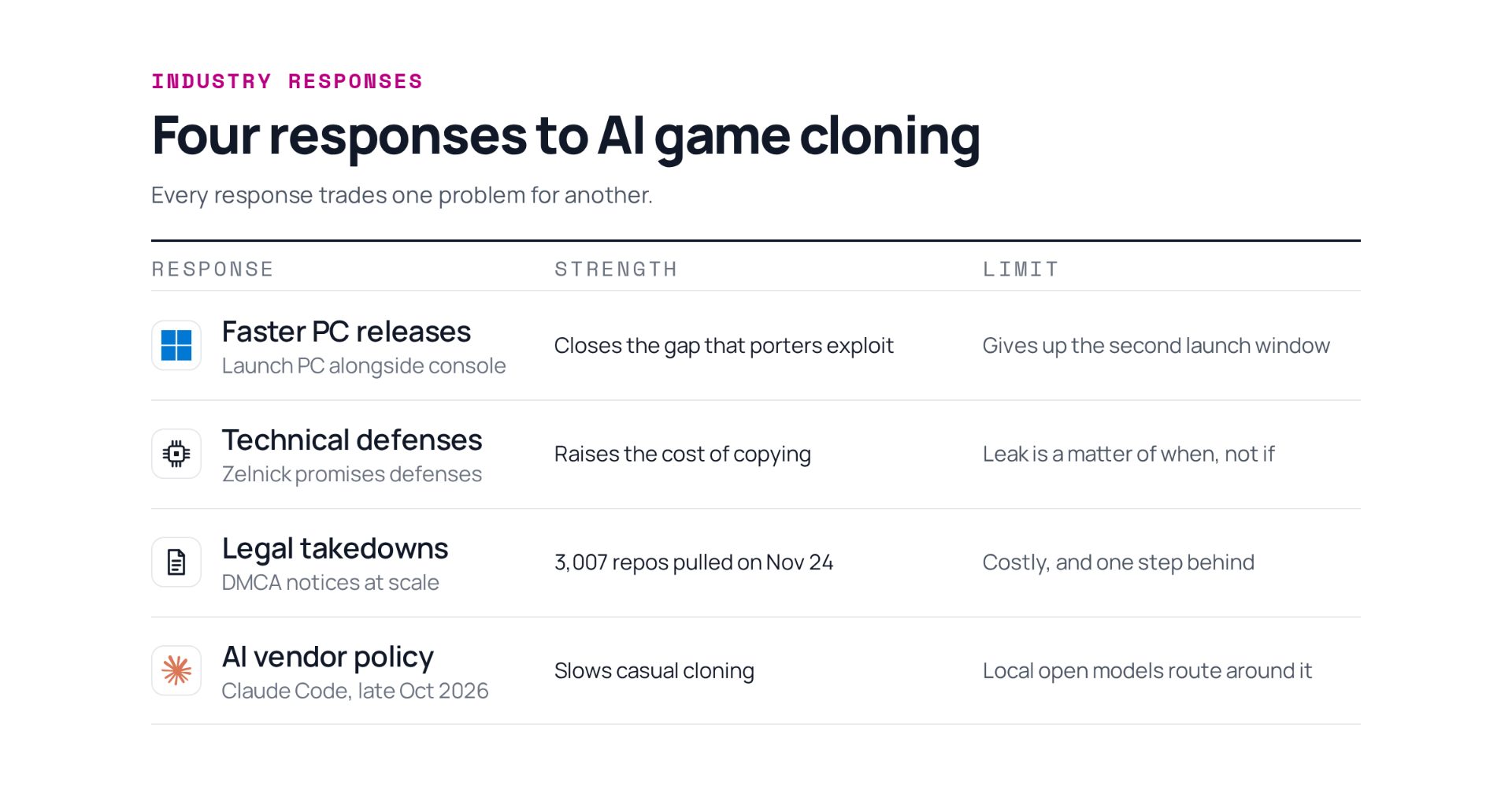
The possible responses are already visible. Publishers can accelerate PC releases and drop the deliberate stagger that made commercial sense when porting was slow and expensive. They can invest in technical defenses, as Zelnick has promised, though the history of DRM suggests leakage is a matter of when, not if. They can pursue legal enforcement at scale, as Take-Two is doing, which is costly and always one step behind. AI vendors can tighten their tools, as Anthropic has done, which raises friction but cannot control locally run models.
There is also a slower, more corrosive risk. If the market rewards speed of copying over depth of creation, studios may stop showing work in public, indie ecosystems may contract around whatever AI cannot easily replicate, and development could shift toward a battle of capital where only the biggest, hardest-to-copy games survive. That outcome would be a loss for players as much as creators.
Rockstar will almost certainly release GTA 6 on PC, and it will almost certainly sell millions. What the unofficial porting race has already settled is something else: the moat between a console build and a playable version on any other platform is no longer measured in months of specialist labor. The bear has been poked, as Mark Brown put it, and how the industry reacts, in release strategy, in law, and in AI policy, will define far more than one game's PC launch.