
The Commission Calls Browser Competition a DMA Priority. Now It Has to Enforce It.
In late November 2026, something unusual happened in the long-running standoff between Apple and the European Union: the European Commission put its position on the record. In comments to Politico, responding to an open letter organized by Open Web Advocacy, the Commission acknowledged that browsers are "effectively the entry point to the web" and one of the main ways publishers reach readers. It went further, stating that "browser competition is one of the priorities of the Digital Markets Act" and that it is in talks to ensure rival browsers "can effectively compete" with Safari on iPhones and iPads.
For the coalition behind the letter, this was a welcome acknowledgment. For everyone who has watched Apple's DMA compliance unfold since March 2024, it also raised an obvious question: if browser competition is a priority, why has more than two and a half years passed without a single browser vendor being able to move its existing EU users off Apple's WebKit engine?
The Letter That Forced a Response
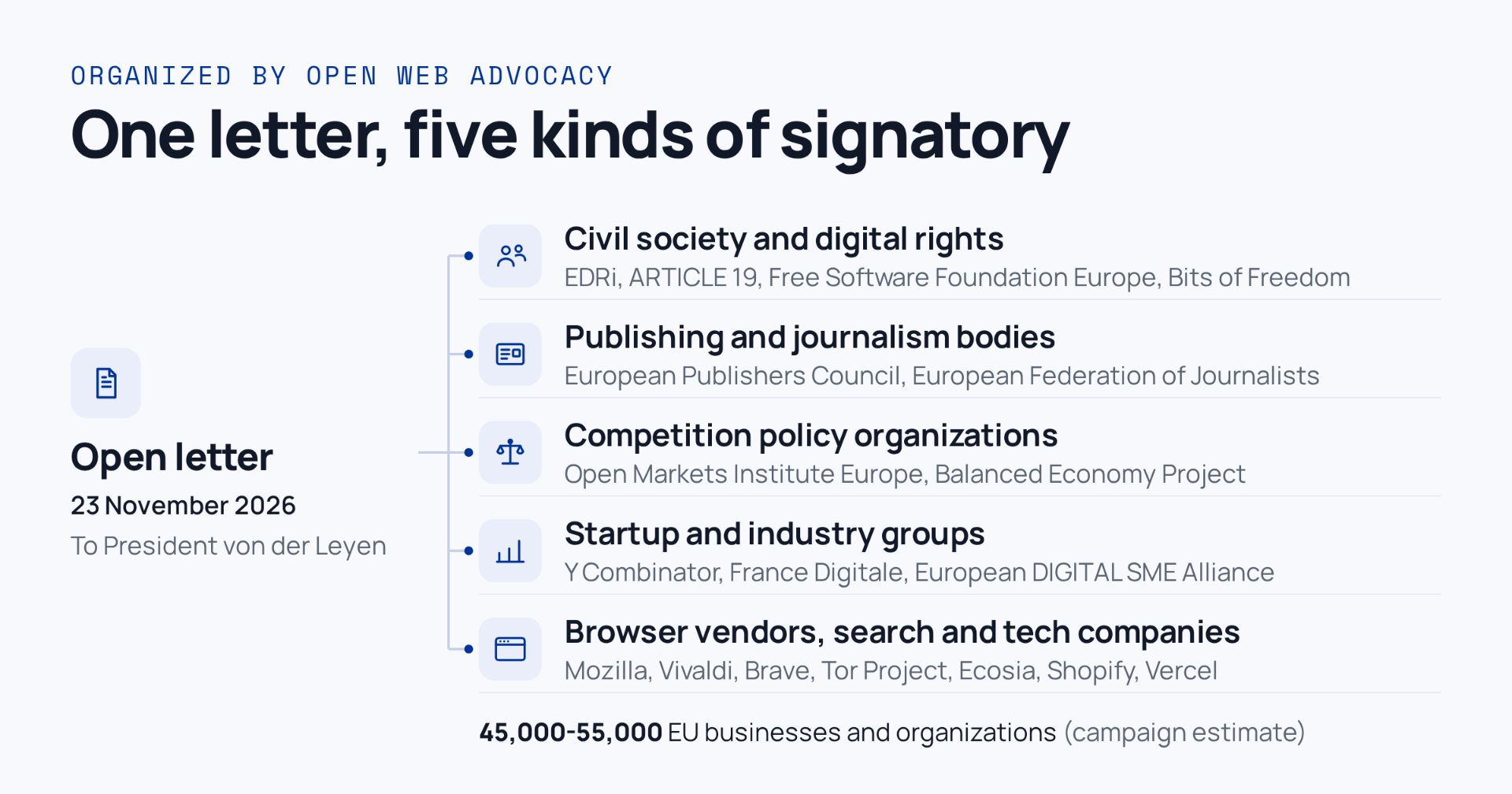
The Commission's statement did not arrive in a vacuum. On 23 November 2026, Open Web Advocacy published an open letter to Commission President Ursula von der Leyen, calling on the Commission to immediately launch formal enforcement proceedings against Apple and compel it to comply with the DMA as written.
What made the letter difficult to dismiss was not just its content but who signed it. The coalition spans nearly every corner of the digital economy:
- Civil society and digital rights organizations, including European Digital Rights (EDRi), the Norwegian Consumer Council, ARTICLE 19, the Free Software Foundation Europe, Bits of Freedom, and Digitalcourage
- Europe's major publishing and journalism bodies, including the European Publishers Council, the European Federation of Journalists (representing over 296,000 journalists across 44 countries), the European Magazine Media Association, ENPA, and News Media Europe
- Competition policy organizations such as the Open Markets Institute Europe and the Balanced Economy Project
- Startup and industry groups including Y Combinator, France Digitale, the German Startup Association, the European DIGITAL SME Alliance, the Coalition for App Fairness, and the European Games Developer Federation
- Independent browser vendors (Mozilla, Vivaldi, Brave, the Tor Project), search engines (Ecosia, Qwant, Kagi), and technology companies including Shopify, Vercel, and Fastmail
According to the campaign's own estimate, the signatories represent between 45,000 and 55,000 EU-established businesses and organizations. That figure is the campaign's own and has not been independently audited, but the diversity of the coalition is verifiable and is the point: browser and web app competition is not a niche grievance of browser vendors. It affects publishers who need readers to reach their content, startups who need a distribution channel that does not run through a gatekeeper's approval process, journalists who care about access to information, and consumers who care about choice.
Why Browser Engines Matter More Than They Sound
The word "engine" makes this dispute sound technical and abstract. It is not. A browser engine is the software that interprets HTML, CSS, and JavaScript, renders web pages, and determines which web platform features exist at all. The three major engines in widespread use are Apple's WebKit, Google's Blink, and Mozilla's Gecko.
On every major operating system except iOS and iPadOS, browsers can use whichever engine they choose. On Android, Firefox runs on Gecko and Chrome, Edge, and Brave run on Blink. On the Mac, the same is true. Only on the iPhone and iPad has Apple required, since the App Store launched in 2008, that every browser use WebKit. Chrome on an iPhone is Chrome in name and interface but WebKit underneath.
This matters for two reasons. First, the engine determines what a browser can actually do. Mozilla has noted that many of Firefox's distinguishing features are built into Gecko, and a WebKit-based Firefox on iOS cannot deliver them. The same logic applies to every independent browser. Second, and more broadly, whoever controls the engine controls the ceiling of what the web itself can do on the platform. If a web capability does not work in WebKit on iOS, developers cannot rely on it, because hundreds of millions of people use iPhones. That suppresses the web as a platform everywhere, not just in Europe.
The UK's Competition and Markets Authority examined exactly this question in its mobile browsers market investigation and set out the concern plainly: the WebKit restriction excludes all competition between browser engines on iOS and may reduce Apple's incentive to improve WebKit itself.
Apple's Compliance, on Paper and in Practice
The Digital Markets Act required designated gatekeepers to comply by 7 March 2024. The DMA explicitly prohibits gatekeepers from banning third-party browser engines, and its recitals state the purpose: to prevent gatekeepers from determining the performance, stability, and functionality of third-party browsers and the web apps they power.
Apple's response was to create the BrowserEngineKit framework and an entitlement process allowing developers to apply to use alternative engines in the EU. On paper, the door is open. Apple's own compliance materials confirm developers can apply, and Apple's vice president of legal, Kyle Andeer, said at a 2025 DMA workshop that Apple created a program allowing third parties to bring their engines to the platform, and that vendors "have chosen not to do so."
The reality is that nobody has walked through the door, and the reasons are structural, not motivational. Google and Mozilla both began porting their engines to iOS, and both have worked on experimental versions. Nearly three years after Apple published its conditions, neither has shipped. As Mozilla put it in November 2026, the conditions remain unworkable, and the open door "feels more like a trap door."
The core barriers are consistent across every account from the vendors:
-
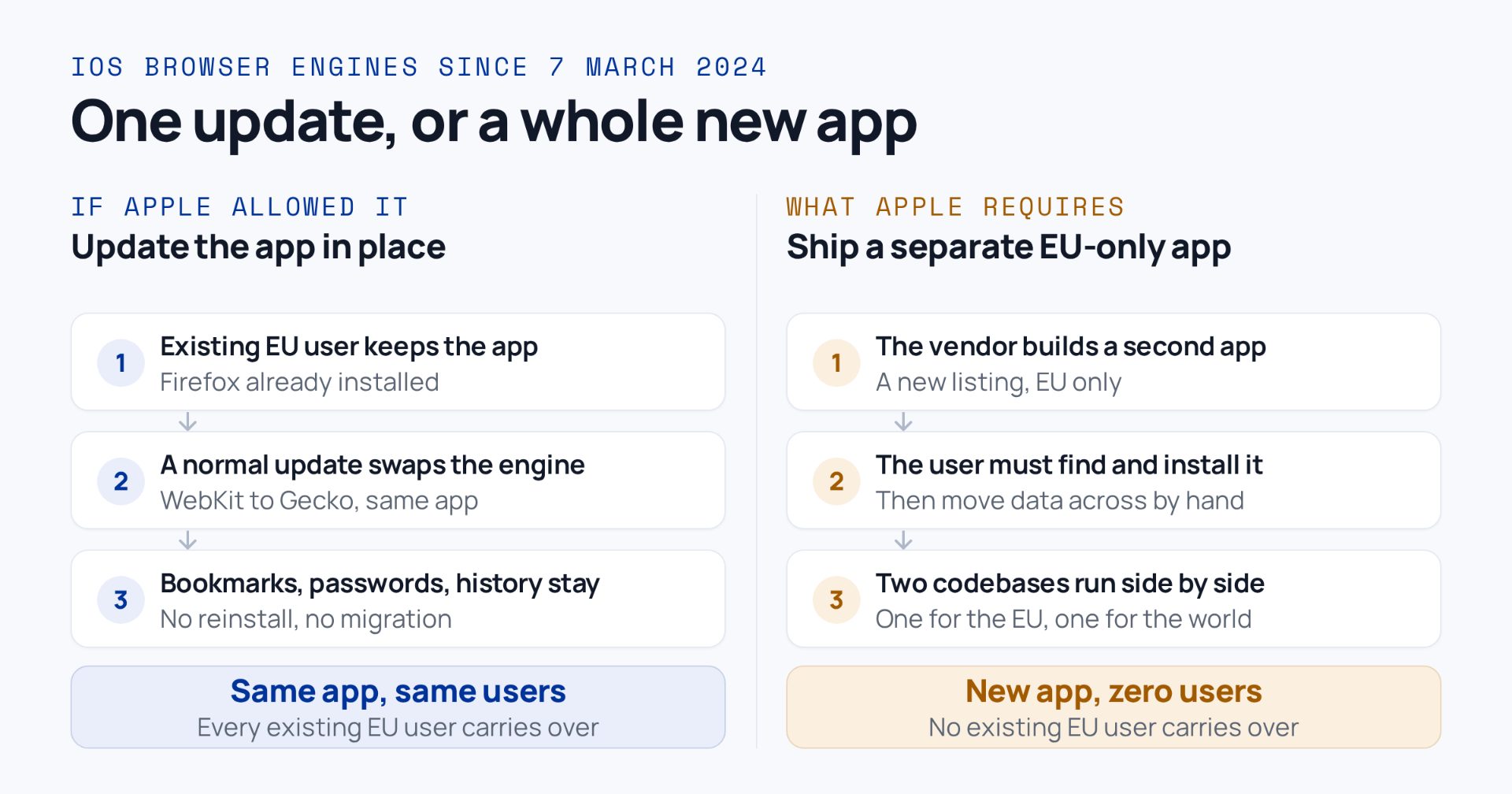
The existing-user problem. Apple does not allow a browser to update its existing EU users from WebKit to its own engine. A vendor must ship an entirely separate, EU-only application. Every current user of Firefox or Chrome in the EU would have to find the new app, download it, and manually migrate bookmarks, passwords, and history. Many would simply give up, including users who picked Firefox from the EU's own choice screen.
-
The two-codebase problem. Because the alternative-engine app is EU-only, vendors must build and maintain two separate versions of their browser indefinitely: one for the EU and one for the rest of the world. Even independent European vendors like Vivaldi have historically found sustaining two iOS codebases too costly.
-
The testing problem. Apple initially restricted development and testing of third-party engines to devices physically located in the EU, geofencing development teams. Under criticism, Apple relented and allowed vendors to test their own engines outside the EU, but web developers still lack a way to test their sites and apps against third-party engines on iOS the way native developers can test EU-specific functionality.
-
The travel problem. Apple has never confirmed that browser updates, including security patches, will continue to work for an EU user who spends more than 30 days outside the EU. Whatever the intent, the effect is to lower users' security.
-
The contract problem. The legal terms attached to the entitlements have been described by industry participants as harsh, one-sided, and, in the words of one veteran quoted by The Register, so "broad and sweeping as to try to duck most of the DMA by contract."
The single most important barrier is the first one. Building and maintaining a full browser engine is one of the most expensive undertakings in software. Requiring a vendor to do it for one region, as a brand-new app, starting from zero users, destroys the business case. This is why the demand from the coalition is precise and modest: allow browsers to upgrade their existing EU users in place, as any normal software update works.
The Economics Behind the Fight
Why does this matter beyond browser vendors? Because the browser engine is the choke point for the web as an alternative to the App Store. Web apps run in the browser sandbox, which Apple itself has described as orders of magnitude more stringent than the sandbox for native iOS apps. They require no contracts with the OS vendor, no revenue share, and no approval process. On open platforms, web technologies account for the majority of user activity.
But a capable web requires capable engines, and if Apple can unilaterally limit what the web can do on iOS, it limits the web's competitiveness everywhere. The coalition estimates that EU businesses spend around 120 billion euros annually on web development and another 65 billion on native mobile app development, and that shifting half of iOS native app development to the web could save European businesses 11 billion euros a year in development costs plus 1.3 billion in App Store fees. These are the campaign's projections, not verified figures, but the directional logic is straightforward: a competitive web gives businesses an alternative channel, and publishers and subscription businesses more control over pricing and customer relationships.
There is also an incentive question that is hard to ignore. Open Web Advocacy has reported that Safari is among Apple's highest-margin products, generating around 20 billion dollars per year in search revenue from Google, and that each percentage point of browser share Apple loses costs it roughly 200 million dollars annually. Apple disputes framings like these, but the structural point stands: the company that profits from Safari being the only real engine on iOS is also the company that decides whether other engines can compete. That is precisely the conflict of interest the DMA was written to address.
A Pattern of Compliance on Paper
The browser engine dispute fits a broader pattern in Apple's DMA compliance. In April 2025, the Commission fined Apple 500 million euros for anti-steering restrictions and ordered it to remove technical and commercial restrictions on steering. The Commission has also pursued Apple over the Core Technology Fee, the multi-step installation journey for alternative app stores, and eligibility requirements for alternative distribution, issuing preliminary findings that these terms were not strictly necessary or proportionate. Apple has consistently appealed, arguing the Commission is unfairly targeting it and micro-managing its business.
Not everything has gone badly for consumers. The browser choice screen, introduced in March 2024, produced measurable results: Brave reported daily installs rising from around 8,000 to around 11,000 within a week, and Mozilla reported more than 50 percent growth in Firefox users in Germany and close to 30 percent in France shortly after implementation. Daily Firefox use on iOS has since doubled. The Commission closed its user-choice investigation in 2025, citing constructive dialogue and improvements to the choice screen. People, it turns out, want to choose their browser.
But the choice screen is only meaningful if the choices are real. A browser that must run on the gatekeeper's engine is, as one observer put it, a browser in name only. The Commission's own March 2024 press release announcing the first non-compliance investigations flagged concerns that Apple's browser choice screen design might prevent users from truly exercising choice. The same skepticism needs to apply to the engine question.
What the Commission's Statement Means, and What It Does Not
The Commission's comments are significant in three ways. First, they elevate browser competition to an explicitly stated priority, which matters for how compliance discussions are weighted internally. Second, the Commission framed browsers as the entry point to the web and a main channel for publishers, connecting the issue to media pluralism and not just competition law. Third, the Commission confirmed it is in talks aimed at ensuring rival browsers can "effectively compete," language that echoes the coalition's core argument: the test is effective competition in practice, not options on paper.
What the statement does not include is any commitment to formal enforcement proceedings. The Commission has opened DMA proceedings touching on other aspects of Apple's iOS compliance, but no formal proceedings specifically targeting the alternative-engine migration issue have been announced. That is exactly what the coalition is requesting. Open Web Advocacy's position is that the Commission already has the legal authority, tools, and information it needs; what has been missing is decisive action. The letter's closing argument is that Apple cannot be allowed to indefinitely frustrate the DMA's objectives through successive rounds of ineffective compliance, and that delay is Apple's greatest ally. Every month without enforcement is a month in which the platform status quo hardens and the window for genuine competition narrows.
There is a reasonable counterargument worth taking seriously: enforcement against a company as large and litigious as Apple should proceed carefully, and hasty proceedings that fail in court could set the DMA back. But the timeline cuts the other way. Two and a half years of dialogue has produced exactly zero migrated users, zero shipped non-WebKit browsers, and a set of conditions that every major vendor has judged unworkable. Japan introduced similar engine requirements and Apple applied similar conditions with the same result: nothing shipped. At some point, the absence of any taker for an officially open door is itself the evidence.
The Test Case for the DMA
The browser engine fight has become something larger than a dispute about Safari. It is the test case for what DMA compliance actually means. If a gatekeeper can satisfy the regulator by publishing a framework nobody can use, attaching conditions nobody can accept, and then attributing the lack of adoption to vendors' choices, then the regulation's effective-compliance standard is meaningless, and every future obligation can be neutralized the same way. If, on the other hand, the Commission compels Apple to allow in-place engine upgrades and removes the surrounding barriers, the DMA will have demonstrated that it can convert legal rights into market reality.
The stakes extend past Europe. The web is the only truly open, interoperable platform that spans every operating system, and what happens to it on iOS shapes what developers can rely on everywhere. A Commission that enforces here is not just protecting European consumers; it is protecting the web's ability to compete as a platform anywhere.
The Commission has now said the right things. Browsers are the entry point to the web. Browser competition is a DMA priority. The next step is not another workshop or another round of dialogue. It is formal enforcement proceedings, and a requirement that Apple let Europeans update the browsers they already use. As the coalition put it: the web has waited long enough.