
Poland Signs $300 Million Palantir Deal to Bring Military AI to Its Armed Forces
Poland has signed a five-year contract with Palantir Technologies worth around $300 million to deploy artificial intelligence across its armed forces, becoming one of the largest European adopters of American military AI at a moment when many of its allies are trying to move in the opposite direction.
The agreement, signed by Deputy Prime Minister and Defense Minister Wladyslaw Kosiniak-Kamysz at the Polish Army Museum in Warsaw, gives the Polish military access to Palantir's Maven Smart System, which will operate in Poland under the codename Saturn. The software is already used by the United States military and by NATO's command structure, and it played a visible role in supporting Ukraine's defense. For Warsaw, the appeal is proven performance under fire. For critics at home and abroad, the deal raises hard questions about dependence on American technology, data sovereignty, and privacy.
Both sides of that argument are worth examining, because the Polish contract is more than a procurement story. It is a test case for how European nations will balance urgent security needs against long-standing ambitions of strategic autonomy.
What Poland Is Actually Buying
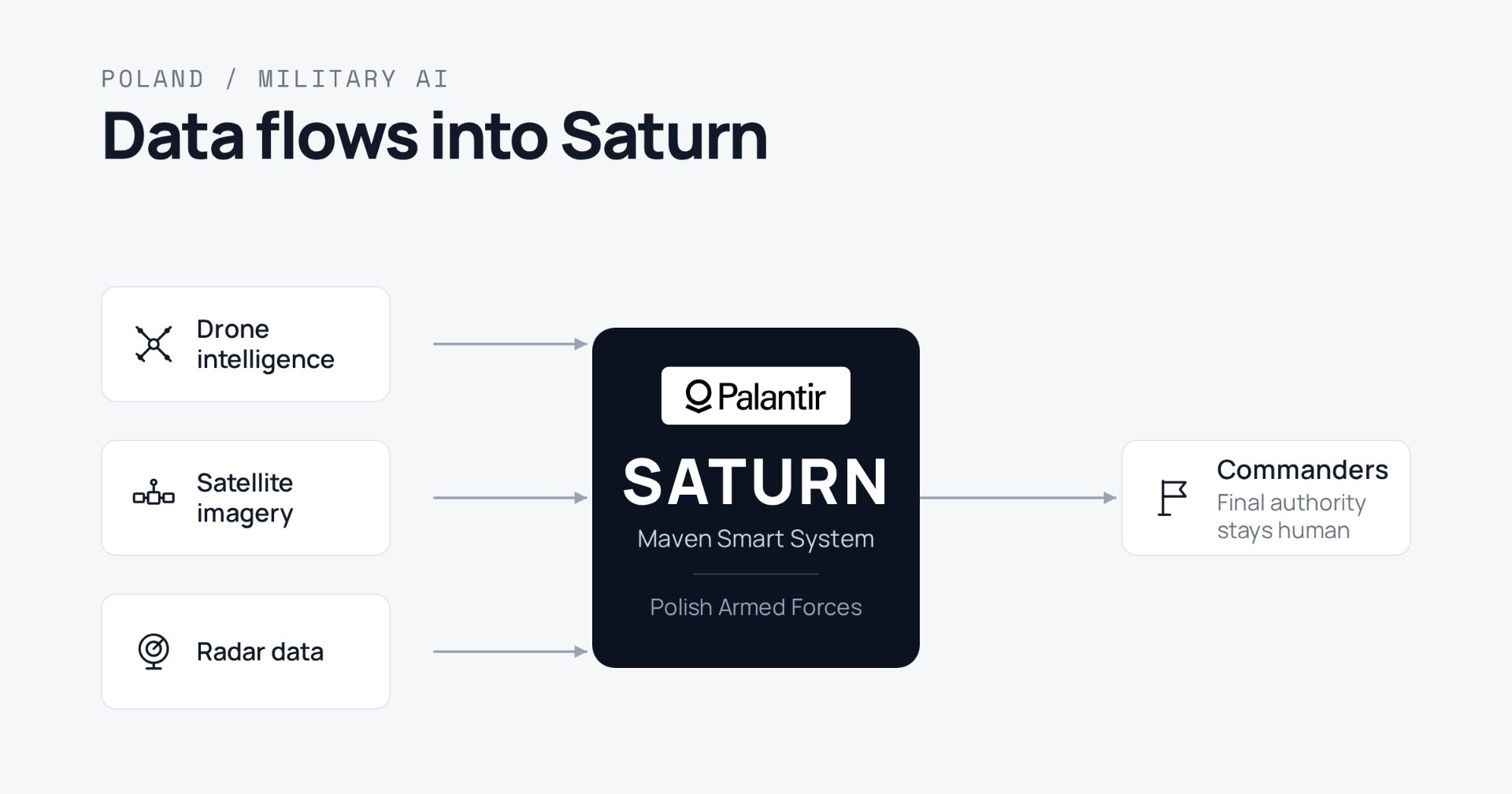
Maven Smart System is Palantir's flagship military AI platform. In practical terms, it is a decision-support tool: it ingests large volumes of data from many sources, applies machine learning to detect and classify objects of military interest, and presents commanders with a consolidated operational picture.
According to Polish military publications, Saturn will combine several categories of input:
- Drone intelligence, analyzing information collected by unmanned aircraft
- Satellite imagery, including data from space-based reconnaissance systems
- Radar data, helping identify and monitor objects and movements
- AI analysis for detecting and classifying objects of military interest
- Decision support, helping commanders assess possible responses to battlefield developments
The framing matters. Polish officials have been careful to stress that the system is intended to support human judgment, not replace it. Human commanders keep final authority over battlefield decisions. That distinction between AI-assisted analysis and autonomous targeting is central to how NATO militaries are trying to legitimize these tools, and Poland has adopted it explicitly.
The scale of the problem the software addresses is easy to underestimate. A modern military generates enormous streams of data from drones, satellites, radars, sensors, and human intelligence. During Russia's war against Ukraine, the volume of imagery and sensor data has grown faster than any human analytical staff could process. Software that can fuse those feeds into a single tactical view, flag threats, and suggest engagement options compresses the time between detection and decision - which in combat terms can be decisive.
A Deal Three Years in the Making
Despite the headline, the contract did not appear out of nowhere. Negotiations began in 2023. Poland tested Palantir technology during experimental military exercises in 2024, signed a cooperation memorandum covering cybersecurity in December 2024, and signed a letter of intent on artificial intelligence, information technology, and cybersecurity in October 2025 with Palantir Chief Executive Alex Karp. Friday's agreement converts that courtship into a binding five-year commitment.
Kosiniak-Kamysz called the signing "a watershed moment for the operational capabilities of the Armed Forces of the Republic of Poland" and compared the system's expected impact to Poland's purchase of F-35 fighter jets. He also noted that several Polish institutions reviewed the agreement beforehand, saying he believed it was "the most thoroughly scrutinized contract in the history of the Ministry of National Defense."
His blunt public defense of the deal captured Warsaw's reasoning. Asked about European pressure to reduce reliance on American technology, he said it would be "stupid and wrong" not to use a system that had helped Ukraine withstand more than four years of fighting Russia. "Whenever possible, we choose a Polish product," he told reporters, adding that where no domestic tool matches the available capability, Poland picks the best system on offer.
Palantir celebrated the agreement publicly, calling Maven "the vanguard of next-generation AI warfare" and saying it was proud to stand with Poland in defending a "sovereign Europe." The company's stock rose nearly five percent on the news.
The Sovereignty Question: Who Holds the Keys
The most consequential aspect of the deal may be its data arrangements. Poland has insisted on what amounts to a sovereign deployment model: the Polish Armed Forces retain exclusive ownership of the encryption keys, the servers, and all data processed through the system. According to Polish military reporting, Palantir receives neither the encryption keys nor remote access to Polish military data.
This matters for two reasons.
First, it addresses the core European fear about American defense software: that a foreign power could, in a crisis, cut off access or reach into the system. European policymakers have warned for years that over-dependence on US technology creates a vulnerability that could undermine the continent's ability to defend itself. By keeping keys, servers, and data inside Polish control, Warsaw is trying to buy Palantir's capability without buying Palantir's leverage.
Second, it sets a template. Palantir has faced criticism in Europe for its work with US immigration authorities and the Israeli military, and the company's brand carries political baggage. A deployment in which the customer controls the infrastructure while licensing the software is the company's standard approach for international government clients, but Poland's explicit, high-profile guarantees - endorsed publicly by its defense minister - give other governments a model to point to when they face the same debate.
Whether those guarantees fully satisfy skeptics is another matter. Contractual assurances depend on trust, enforcement, and the persistence of the political relationship behind them. A future change in US export policy, sanctions law, or alliance politics could test how much sovereignty a licensing arrangement really delivers. Poland is betting that five years of operational benefit outweighs that tail risk - and that by the time the contract expires, it will have built something of its own.
Swimming Against the European Current
Poland's decision stands out because much of Western Europe is paddling the other way. Defense authorities in Denmark, Finland, Italy, the Netherlands, Spain, and Sweden already use Palantir software, though not all use Maven. But the trend among several major powers is toward replacement:
- In June, France's domestic intelligence agency selected local supplier ChapsVision to replace Palantir, with French officials warning that "we cannot rely on tools developed by foreign powers."
- France and Germany agreed in July to explore developing their own defense software as a European rival to Palantir.
- Germany is testing roughly 30 military AI tools of its own.
- The Dutch military said in late October it wants a European alternative by 2028.
Poland has moved in the opposite direction, deepening ties with Washington. Earlier in the same week, Polish and US officials signed a joint defense research pact at the Pentagon after 17 years of talks. The country is also negotiating with the US administration over a permanent American military presence on Polish territory.
The contrast reflects different threat assessments and different timelines. France and Germany are large countries with substantial defense industries; they can afford to spend years building domestic alternatives. Poland sits on NATO's eastern flank, has watched a full-scale war unfold next door, and has recently dealt with Russian missile incursions into its airspace. For Warsaw, the question is not whether a European rival to Palantir will eventually exist, but whether Poland can wait for it.
The Domestic Alternative and the Exit Strategy
The Polish government has not framed the deal as permanent dependence. The Defense Ministry is developing two domestic systems, AIRON and NEFRYT, that could eventually replace Palantir's tools. Kosiniak-Kamysz suggested Poland could have a working alternative by the time the five-year contract expires, and said he would have chosen a Polish supplier if one offered comparable capabilities.
There is a reasonable logic to this sequence. Building military-grade AI decision-support software from scratch takes years and benefits from exposure to how mature systems actually work in practice. A five-year deployment gives Polish engineers and commanders hands-on experience with a battle-proven platform, defined integration requirements with NATO command systems, and a clear benchmark for what a domestic successor must match. In effect, Poland is treating Maven as both a capability purchase and a training program for its own future industry.
Domestic software development is progressing elsewhere in the Polish defense ecosystem. In mid-November, the Polish company SATIM signed a contract with the Ministry of National Defense to supply automated analysis of satellite synthetic aperture radar imagery, supporting Poland's sovereign MikroSAR reconnaissance program. These are small pieces compared to Maven, but they indicate the direction: Poland wants sovereign analytical capability, and it is willing to import the core while it builds the rest.
Domestic Politics and Privacy Concerns
The deal has not gone unchallenged at home. Demonstrators gathered in central Warsaw in early November demanding greater oversight, questioning who would have access to sensitive military data, where information would be stored, and how much control Poland would retain. The activist group Nasze Dane asked Poland's human rights ombudsman to review the partnership, and Ombudsman Sylwia Gregorczyk-Abram wrote to the defense ministry in October asking how officials had assessed privacy risks.
These concerns extend beyond the battlefield use case. Palantir's software is used for intelligence analysis and data integration in civilian contexts as well, and civil liberties groups across Europe have long criticized the company over surveillance. Poland's ombudsman review signals that the debate over military AI will not end at the signing ceremony, and that future contracts - domestic or foreign - will face demands for documented risk assessments.
What It Means for Palantir and for Europe
For Palantir, the contract reinforces a position that has been building for years. NATO itself adopted a version of Maven for its Allied Command Operations in 2025, and the company already works with British and Ukrainian military organizations. The Polish deal makes Warsaw one of Europe's largest national adopters and provides a high-profile reference customer at a time when the company's government business is growing rapidly - its third-quarter revenue roughly doubled year over year, with US government revenue alone at $953 million.
For Europe, the deal crystallizes an uncomfortable tension. The continent wants strategic autonomy in defense technology, and several governments are funding alternatives. But capability gaps do not close on political schedules. Poland's answer - buy the best available system now, keep sovereign control over data and infrastructure, and build a domestic replacement in parallel - is a pragmatic compromise that other countries facing urgent threats may copy.
The five-year clock is now running. If AIRON and NEFRYT mature into credible replacements by 2031, Poland will have demonstrated a workable model for adopting foreign military AI without surrendering sovereignty. If they do not, Warsaw will face the same renewal decision with even deeper entanglement - and Europe's argument about technological independence will have grown sharper.
Either way, the Saturn deployment will be watched closely in every European capital that is still deciding whether battlefield AI is something to build, something to buy, or something it cannot afford to do without.