
The Nvidia Backup Plan Inside China's Self-Driving Industry
On November 12, 2026, Nvidia's board announced that Jensen Huang had resigned as CEO. The immediate story was a corporate crisis: Huang acknowledged extramarital affairs, reports linked one relationship to a woman suspected by U.S. intelligence of passing information to Beijing, and the FBI was investigating. Colette Kress, the chief financial officer, became interim CEO. Nvidia's shares fell 10% in premarket trading, and analysts began debating whether the world's most important chipmaker could lose its dealmaking edge.
Those are serious questions. For the autonomous driving industry, however, the more practical question is different. Nvidia is not just a supplier of chips. It is part of the architecture of modern self-driving systems. The company's GPUs train models in data centers; its automotive processors run those models in vehicles; its software stack ties the two together. Any disruption to that pipeline is a disruption to product timelines, not just procurement.
Nvidia's two roles in the self-driving stack
Nvidia's position in autonomous driving is often described as a chip business. That undersells it. The dependency has at least two layers, and they fail in different ways.
At the top is data-center training. Developers collect driving logs, run perception and planning models, simulate edge cases, and retrain. This is GPU-heavy, bandwidth-heavy, and power-heavy. Nvidia's data-center GPUs and networking are the default because the software ecosystem around CUDA is mature.
At the edge is inference. A vehicle must perceive, predict, and plan in real time within tight power and thermal budgets. Nvidia's DRIVE Orin and Thor systems-on-chips, running DriveOS, are used by many automakers and robotaxi developers. Some companies use Nvidia for both layers. Others use Nvidia only for training, or only for in-vehicle compute. A few have full-stack partnerships with Nvidia, including Mercedes-Benz, Zoox, and Wayve.
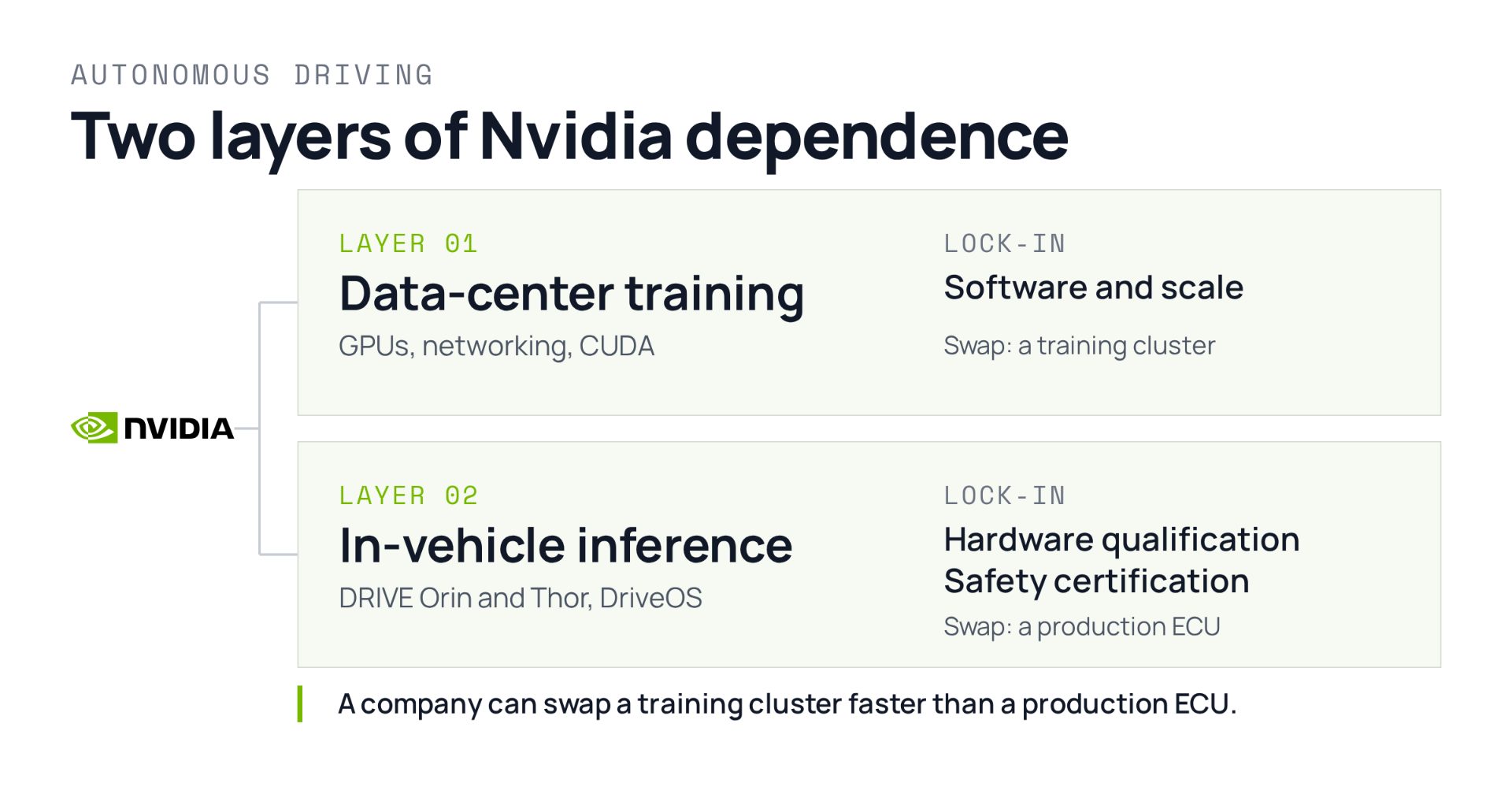
These layers create different kinds of lock-in. Training lock-in is mostly about software and scale. Inference lock-in is about hardware qualification, safety certification, and integration with sensors and vehicle platforms. A company can swap a training cluster faster than it can swap a production ECU. That is why the current backup plan is strongest at the training layer, even as Chinese chipmakers push into vehicles.
The trigger: a leadership vacuum meets export risk
The Huang resignation matters because Nvidia's advantage has been as much about relationships and timing as about silicon. Analysts quoted after the announcement argued that the operational impact would be limited through 2028 because products were already designed, booked, and scheduled. The bigger risk was the next round of deals: the investments, prepayments, and partnerships that keep Nvidia's roadmap funded and its customers locked in. Without Huang, Nvidia loses some of the creative dealmaking that underpinned its market leadership.
For Chinese autonomous driving companies, the more direct risk is policy. U.S. export controls have already restricted China's access to the most advanced AI chips. Nvidia's driver-assist chips have not been subject to the same restrictions as its top data-center accelerators, but the boundary is political, not technical. If the fallout from the Huang investigation leads to stricter controls, or if Beijing decides that dependence on a U.S. supplier is a strategic liability, Chinese companies need somewhere else to go.
That is the context in which Pony.ai's CFO, Leo Wang, described the industry's position. He did not announce a rupture with Nvidia. He described a supply chain that is already stretched and a set of alternatives that have been under development for years.
Pony.ai's two-part hedge
Wang's starting point was not export policy. It was supply. Demand for computing resources in autonomous driving already exceeds what Pony.ai can get, he said, and that shortage is one of the company's pain points. The response has two parts.
First, make the workload fit the hardware. Pony.ai directs engineers to be as efficient as possible when deploying training models. That can mean using midtier compute resources instead of high-end ones when the workload allows. This is not a rejection of high-end chips. It is a recognition that not every training job needs the fastest accelerator. Model architecture, data pipeline efficiency, scheduling, and utilization can matter as much as peak performance.
Second, widen the pool of chips. Pony.ai is turning more to domestically produced chips for AI training. Wang said China's domestic chip ecosystem has received significant attention and development in recent years, giving the company another option and some flexibility.
Asked what would happen if export restrictions tightened, Wang said Chinese companies have been preparing for several years. The alternatives already exist, he said, and they are more mature than they were a few years ago. But he was careful about the economics. Domestic chips are not yet the best choice on cost-effectiveness. The backup plan provides flexibility, not parity.
That distinction matters. A backup plan is not a drop-in replacement. It is a portfolio of options that may be more expensive, slower, or harder to integrate, but that keeps a development program moving when the primary supply is constrained. In an industry where timelines are measured in model iterations and safety validation cycles, keeping the program moving can be worth a premium.
What a real backup plan requires
Replacing Nvidia is not one problem. It is at least three: training compute, in-vehicle inference, and the software that connects them. The Chinese chip market has different answers at each layer.
| Layer | Nvidia's role | Why it is hard to replace | Chinese alternatives |
|---|---|---|---|
| Data-center training | GPUs, networking, CUDA | Peak performance, memory bandwidth, interconnect, mature libraries | Huawei Ascend, Cambricon MLU, Biren, Moore Threads, MetaX, Alibaba T-Head, Baidu Kunlun |
| In-vehicle inference | DRIVE Orin and Thor, DriveOS | Power, thermal, safety qualification, sensor integration | Horizon Journey, Nio Shenji, Xpeng Turing, SiEngine Xingchen, Huawei |
| Software ecosystem | CUDA, TensorRT, DriveOS | Developer tools, model portability, vendor support | Huawei CANN and MindSpore, Moore Threads MUSA, vendor toolchains |
Horizon Robotics is the clearest example of a Chinese supplier built for the automotive market. Its Journey series uses a proprietary BPU architecture, and its Journey 6 chip supports advanced driver-assistance and urban navigation features. The company says it holds a large share of the Chinese ADAS market and has shipped more than 10 million Journey units. Its customers and partners include BYD, Li Auto, Volkswagen, Bosch, and DENSO. In the Level 0-2 segment, which is the largest by vehicle volume in China, Horizon led in 2024 with about 34% share, ahead of Mobileye and Nvidia, according to the consulting firm Gaogong Intelligent Automobile.
Huawei is the most important data-center alternative. Its Ascend 910B became the default option for Chinese companies that could not get Nvidia's A100-class chips. The 910C is a dual-chiplet design intended to approach the H100. Huawei is also betting on rack-scale systems that pool thousands of chips, and on its CANN software stack and MindSpore framework as a domestic alternative to CUDA and PyTorch. That ecosystem play is critical: a chip is only useful if developers can port models to it without rewriting their entire stack.
Other suppliers fill specific niches. Cambricon designs MLU accelerators for training and inference. Biren and Moore Threads build general-purpose GPUs, with Moore Threads offering a CUDA-compatible MUSA architecture. MetaX focuses on GPGPU chips. Alibaba's T-Head has moved from inference chips to a PPU design pitched as a rival to Nvidia's China-compliant H20. Baidu's Kunlun line has been integrated into its data centers and autonomous driving work. Nio and Xpeng have developed in-house chips for their own vehicles, and SiEngine, a Geely-affiliated company, has a 7-nm automotive chip called Xingchen-1 that claims 512 TOPS per chip, compared with up to 254 TOPS for Nvidia's Orin X.
These are not all equal substitutes. Some are designed for data centers, some for vehicles, some for both. Some are fabbed at advanced nodes and face their own capacity constraints. But the direction is clear. Chinese automakers and chip companies are building a domestic stack layer by layer, and the automotive market is one of the fastest-moving proving grounds.
The software moat is the hard part
The hardest part of the backup plan is not silicon. It is software. Nvidia's CUDA ecosystem has been built over more than a decade. It includes compilers, libraries, profiling tools, and a vast pool of developers who know how to optimize for Nvidia hardware. Chinese alternatives have their own toolchains, but they are younger and less standardized. Integration is a real issue. As one industry executive put it, Nvidia is very open-ended and compatible with almost any algorithm or software, while Chinese in-house chips may not integrate as well with third-party users at the initial stage.
That gap is narrowing. Chinese AI developers have been optimizing models for homegrown hardware. DeepSeek's V4 model is compatible with eight China-made chips, including those from Huawei and Alibaba's T-Head unit. MiniMax and Kimi models have also expanded compatibility with domestic semiconductors. That matters for autonomous driving because the same model portability work reduces the cost of switching training hardware.
But portability is not free. A model that runs on a domestic chip may need different quantization, different memory layouts, and different parallelization strategies. Teams may need to maintain two versions of a training pipeline. The backup plan therefore has a hidden cost: engineering time. That cost is easier to justify when supply is uncertain, and harder to justify when Nvidia chips are available.
The cost tradeoff and the scale imperative
Wang's caution about cost-effectiveness is the key economic detail. Domestic chips may be cheaper on paper, but the total cost of ownership includes performance, utilization, software engineering, and reliability. A chip that is 30% cheaper but 40% slower and harder to program is not a bargain. A chip that is 20% slower but available when needed can be a strategic asset.
The pressure to make that tradeoff is increasing because robotaxi fleets are scaling. May Mobility plans to deploy more than 10,000 autonomous Volkswagen ID. Buzz vehicles through 2031. Newmo, a Japanese robotaxi startup, raised 20.8 billion yen, or roughly $135 million, in a round led by KDDI. Tesla is expanding its robotaxi service to San Antonio. Waymo remains the scale leader, even as it faces regulatory scrutiny over a software recall.
These fleets generate data, and data generates training demand. The more vehicles a company operates, the more edge cases it collects, and the more compute it needs to label, simulate, and retrain. Scale is a competitive advantage, but it is also a compute bill. That is why cost per vehicle and cost per training job are becoming strategic metrics, not just procurement details.
Chinese companies are responding in different ways. Zelostech, a robovan startup, told CNBC that it plans to use multiple chip suppliers instead of relying only on Nvidia. Each of its vehicles currently uses two Nvidia Orin chipsets, and the company says China-made chips would cost far less. Nio's CEO said the company is no longer buying chips but renting compute power powered by a variety of processors. Xpeng developed its own Turing chip, and a vehicle co-developed with Volkswagen uses it. Volkswagen has also partnered with Horizon Robotics to develop driver-assist systems in China without Nvidia.
These are not all direct replacements for Nvidia's top training GPUs. But they show the same logic: diversify the supply chain, match the chip to the workload, and keep a domestic option warm.
What Nvidia keeps, and what it loses
Nvidia is not about to disappear from China's self-driving industry. Analysts estimate that Nvidia remains roughly two to three years ahead of its nearest competitor, and its product roadmap is booked well into 2028. Its GPUs are still the default for the most demanding training workloads. Its automotive platforms are still used by a long list of automakers and robotaxi developers, including BYD, Li Auto, Lucid, Mercedes-Benz, Nio, Rivian, Volvo, Xiaomi, and ZEEKR. Its full-stack partnerships with Mercedes-Benz, Zoox, and Wayve show that it can sell more than a chip.
But the leadership change comes at an awkward time. Nvidia's China revenue is already shrinking, even as the company invests heavily in Taiwan. Beijing has an incentive to limit dependence on a U.S. supplier, because domestic chips only improve if they are used in real-world scenarios. As one investor put it, the more Nvidia chips get into the ecosystem, the more dilution there is of that relationship. That is a polite way of saying that every Nvidia deployment in China delays the maturation of a domestic alternative.
The likely outcome is not a clean break. It is a dual-stack market. Nvidia remains the premium option for the hardest training jobs and for vehicles that need its automotive platform. Domestic chips take more of the midtier, the cost-sensitive, and the strategically sensitive workloads. The mix will vary by company, by vehicle program, and by policy. But the direction is toward portfolios, not single suppliers.
What to watch
Three things will determine how fast the backup plan becomes the main plan. The first is cost-effectiveness. Chinese chipmakers need to close the gap not just in peak performance, but in memory bandwidth, interconnect, software maturity, and yield. The second is software. If model portability continues to improve, the switching cost falls. If it stalls, Nvidia's ecosystem remains a powerful moat. The third is policy. Tighter U.S. export controls would accelerate the shift. Looser controls would slow it, but probably not reverse it, because Beijing's industrial policy and Chinese automakers' cost pressure are already pushing in the same direction.
The Huang resignation is a reminder that single-supplier dependencies are fragile in ways that go beyond technology. A scandal, an investigation, an export rule, or a change in leadership can change the calculus overnight. China's self-driving industry has been preparing for that lesson for years. The result is a more resilient supply chain, but also a more fragmented one. The next phase of autonomous driving will not be defined by who has the best chip. It will be defined by who can assemble the best portfolio of chips, software, and supply relationships, and keep iterating when the ground shifts.
That is the real meaning of the Nvidia backup plan. It is not a rejection of Nvidia. It is an admission that no single vendor can be the whole stack anymore. For Chinese autonomous driving companies, the goal is not to replace Nvidia overnight. The goal is to make Nvidia optional. That is a different kind of competition, and it will shape the industry long after the current leadership crisis fades.