
Nvidia's Succession Crisis: The Board, the Scandal, and the Fight to Replace Jensen Huang
Nvidia is not a normal company, and Jensen Huang has not been a normal CEO. The chipmaker he co-founded in 1993 is now worth roughly $4 trillion, supplies the computational backbone of the artificial intelligence boom, and sits at the center of the U.S.-China technology rivalry. Huang is the public face of that rise: the black-jacket keynote speaker, the salesperson-in-chief, the founder who turned graphics chips into the engine of modern AI. That is why the board's move to remove him in November 2026 landed less like a routine corporate succession and more like a test of whether Nvidia can survive without the person who made it.
The immediate trigger was a scandal. The Wall Street Journal reported that Nvidia's board was preparing to oust Huang after he had two extramarital affairs, including one with a woman reported to be a suspected Chinese intelligence asset and another with an Nvidia executive who reported to him. The board met on a Wednesday to decide whether to remove him. The sequence ended with the board announcing that Huang had resigned from his leadership roles. The details remain disputed in places, and China has denied the espionage allegations. But the governance problem is not disputed: Nvidia had built a $4 trillion company around one man, with no obvious successor and no public plan for what happens if he leaves.
From personal conduct to national security
The crisis began with reporting in The New York Times that Huang had a close relationship with Alice Huang, a Chinese executive at Megaspeed, a Singapore-based data center company whose chip flows had come under U.S. scrutiny. Alice Huang, who is not related to Jensen Huang, was alleged to have been recruited by Chinese intelligence. The report did not just raise questions about Huang's personal conduct. It raised questions about whether the head of the world's most important AI chip company had been exposed to a foreign intelligence operation while his company was at the center of U.S. export controls.
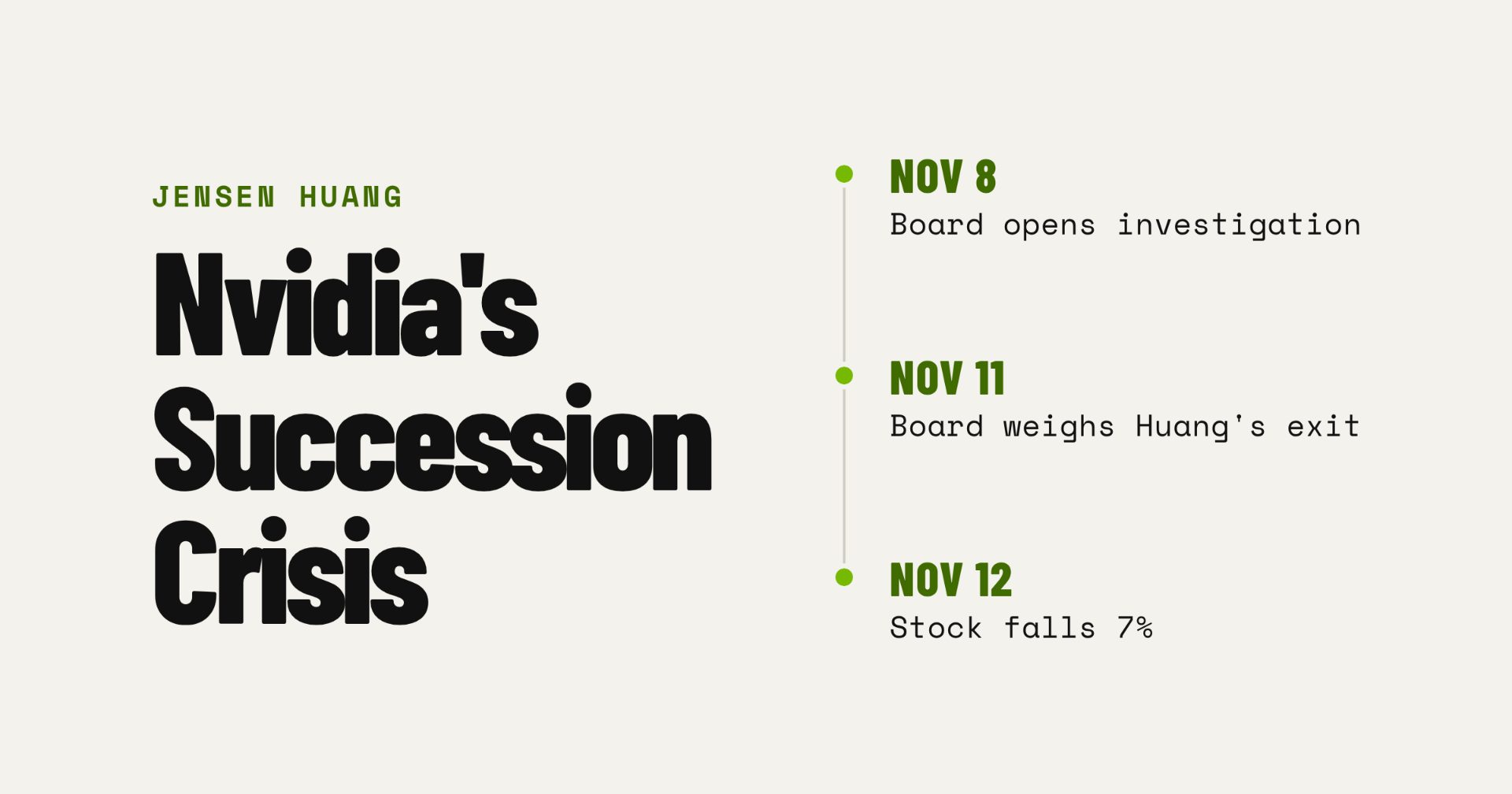
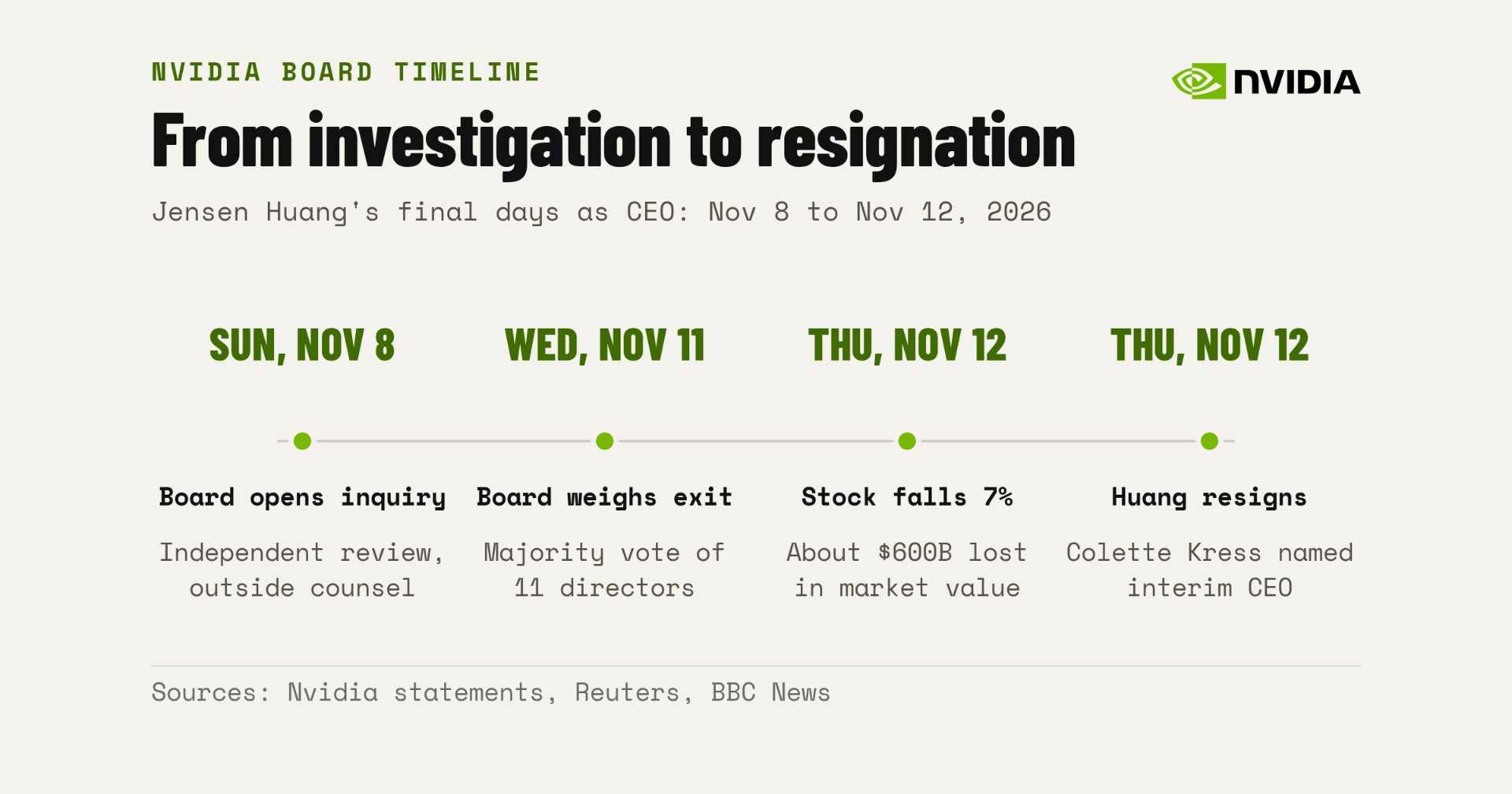
Nvidia's board responded on Sunday, Nov. 8, by announcing an independent investigation. A committee of independent directors, assisted by outside counsel, would oversee the review. The board said it had no reason to believe that national security or Nvidia secrets had been compromised, but it also said the inquiry would examine all available information. Huang said he supported the review and would cooperate. That statement was meant to steady the company. It did not.
Huang then sent an internal message to employees admitting that he had been unfaithful to his wife. He did not name the woman involved. He apologized to his family and said he had fallen short of his responsibility to employees, partners, and shareholders. The message was an attempt to separate a private failure from his public role. It did not separate the two for long. The New York Times soon reported a second extramarital relationship, this time with an Nvidia executive who reported to him. The board's investigation widened, and the political system began to move.
Republicans on the House Select Committee on China asked Huang to appear for a closed-door briefing. The Republican chair of the House Foreign Affairs Committee said he was prepared to subpoena him. President Donald Trump, who had developed a close relationship with Huang, said Huang had told him he had no idea the woman was a spy. The FBI was reported to be examining the affair. China's government denied the espionage allegations and accused Washington of using the claims as a pretext for technology restrictions. What had started as a story about a CEO's private life had become a story about export controls, intelligence, and the credibility of American AI policy.
The board's public position shifted sharply in a matter of days. On Sunday, it expressed confidence in Huang and his leadership team. By Wednesday, it was meeting to decide whether to remove him. That is not a normal sequence. It suggests that the board's concern was not only the affair itself but the wider risk that Huang's presence had become untenable with lawmakers, customers, and investors. Once the question became whether Nvidia could credibly police its own CEO, the answer could no longer be a simple vote of confidence.
The board's authority and the absence of a chair
Nvidia's bylaws gave the board a clear path. Under the company's rules, Huang could be removed with or without cause by a majority vote of directors. Nvidia has 11 directors, and all but Huang are considered independent. That structure matters. It meant the board did not need to prove misconduct in a court of law to remove him. It needed to decide whether his continued presence served the company.
The board also has a lead director, Stephen Neal, rather than a permanent chairperson. Neal, a lawyer with a long career at Cooley, was the key convener as the board weighed Huang's future. Nvidia's founding-era directors, including Tench Coxe, Harvey Jones, and Mark Stevens, are among the board's largest shareholders, with fortunes tied to the company's performance. That can cut both ways. It gives them a powerful incentive to protect Nvidia's value. It can also make them reluctant to move against a founder who built that value.
Huang's own stake added another variable. He owns about 3.6% of Nvidia's stock, a holding worth billions of dollars. He is not a typical hired CEO. He is a founder, a major shareholder, and the company's public symbol. Removing him would not just change management. It would change Nvidia's story.
The board had three broad options.
| Path | What it requires | Main risk |
|---|---|---|
| Keep Huang in place | Board majority accepts the investigation findings and decides the scandal is survivable | Political and reputational pressure continues, and the board looks captured by its founder |
| Remove or suspend Huang | Majority vote of directors, followed by an interim CEO | Immediate leadership vacuum, market shock, and a damaged relationship with the founder |
| Accept a negotiated resignation | An exit deal, an interim plan, and a clear public explanation | Huang remains a major shareholder and could become a powerful outside critic or rival |
Each option carried a cost. Keeping Huang risked looking like a board that would tolerate anything to avoid disrupting the stock. Removing him risked proving that Nvidia was as dependent on him as investors feared. A negotiated resignation offered a middle path, but it required Huang's cooperation and a credible transition plan. The board had to act before the market opened, and it had to do so without appearing to panic.
No bench, no map: the succession problem
The deeper problem was not the scandal. It was the absence of a successor. Nvidia has been led by Huang since 1993. He has no second-in-command in the traditional sense. The company's flat structure left dozens of executives reporting directly to him. As of 2025, he had 36 direct reports. That structure can make an organization fast and focused. It can also make it fragile. When everything runs through one person, no one else has the broad authority to step in.
Nvidia's board had been warned about this in public, if not in private. Analysts and governance experts had noted for years that the company had no visible succession plan. The board's defenders could argue that founder-led companies often resist formal succession planning because the founder has no intention of leaving. The critics could argue that this is exactly the point. A board's job is to plan for the unexpected, not to assume the founder will never leave.
After the scandal broke, Bloomberg reported that Nvidia's board was working with an outside firm to identify potential replacements. That was a sign of how quickly the situation had moved. The names that surfaced were mostly internal. Colette Kress, Nvidia's chief financial officer, was the natural interim choice. She has held the CFO role for more than a decade and knows the company's finances and investor story as well as anyone. Ian Buck, who oversees the business serving Nvidia's data center clients, was another name. Chris Malachowsky, a co-founder, was mentioned, though he has not been involved in day-to-day operations. External names included Rene Haas, the chief executive of Arm, and senior figures at Apple.
None of those names answered the hardest question. Who would lead Nvidia's technology roadmap? The CFO can stabilize the company. The data center chief can manage the most important customer relationships. But Nvidia's advantage depends on a product cadence that Huang has personally driven for years. The company's next generation of AI chips, its software ecosystem, and its relationships with suppliers and governments all bear his imprint. A new CEO would have to earn credibility with the same partners who had spent years dealing directly with Huang.
Prediction markets moved sharply to show an 88% chance that Huang would resign or be removed by the end of the year. The odds for his successor favored Buck. That is not a plan. It is a guess. The board's challenge was to turn a market guess into a credible transition.
What the market is pricing
The market's reaction was severe. Nvidia's stock fell around 7% in Frankfurt trading after the report that the board was preparing to oust Huang. If those losses held, Nvidia would have lost about $600 billion in market value since the board announced its investigation. At one point, shares fell from just over $188 to about $158 in premarket trading, which would have cut the company's value from $4.5 trillion to $3.8 trillion. Bernstein and Oppenheimer downgraded the stock. Citi cut its target.
The analysts were not reacting to the affairs alone. They were reacting to the uncertainty. Citi wrote that a leadership transition creates an overhang on the stock given Huang's central role in strategy, product vision, customer relationships, and investor confidence. That is a polite way of saying that Nvidia's valuation has been built on the assumption that Huang will keep doing what he has been doing. Remove him, and the market has to reprice the company's future.
Armina Rosenberg, a portfolio manager at Minotaur Capital, put it more directly. The market, she said, was starting to price Nvidia without its founder as the likely outcome, not a tail risk. Losing Huang would be a real blow. Stacy Rasgon of Bernstein was blunter. Nvidia is not an ordinary company, and Jensen is not an ordinary CEO; he is Nvidia. He added that the primary beneficiary of Huang's removal would clearly be China.
That last point is important. Nvidia's chips are not just a commercial product. They are a tool of American foreign policy. The United States has restricted exports of advanced AI chips to China, and Nvidia has largely conceded the Chinese AI chip market to Huawei. If Huang's departure weakened Nvidia's relationship with the U.S. government or slowed the company's product cadence, the beneficiary would not just be AMD or Broadcom. It would be China's push for semiconductor self-sufficiency.
There were also signs of stress beyond Nvidia itself. Nvidia's customers, the companies building data centers around its chips, could suffer if the transition distracted the company or forced it to slow its investment plans. Nick Ferres of Vantage Point Asset Management noted that Nvidia is financing its customers, and that in a boom, all it takes is a slowdown to shift the cycle. Micron and CoreWeave fell in after-hours trading. AMD and Broadcom rose. Samsung and SK Hynix moved in opposite directions. The market was not just repricing Nvidia. It was repricing the entire ecosystem around it.
The business beyond one person
The case for Nvidia's resilience is straightforward. Its chips are the most powerful in the world for AI training and inference, and its software ecosystem makes them hard to replace. By some estimates, Nvidia holds more than 80% of the data center AI chip market. Its customers include the largest cloud providers and AI developers. Demand for AI compute is still growing. Even if the stock suffers in the short term, the business does not disappear because the CEO does.
That is the argument Nvidia's partners made in public. Siemens' chief executive said the company would continue working with Nvidia regardless of what happened to Huang. The projects are bigger than one person, he said, and the partnership is between companies, not individuals. That may be true. But it is also what partners say when they want to avoid picking sides in a governance fight.
The competitive threat is real, but it is not immediate. AMD is the most direct rival in GPUs. Broadcom and MediaTek design custom AI chips, known as ASICs, for customers who want cheaper alternatives to Nvidia's premium systems. Google has developed its own TPUs. Amazon has its own chips. Those products are improving, and a leadership crisis at Nvidia could give customers another reason to diversify. But Nvidia's advantage is not just hardware. It is the years of software work, the developer relationships, and the habit of shipping new architectures on a predictable cadence. A new CEO would inherit those advantages. The question is whether he or she could extend them.
The scandal also landed at a delicate moment in Washington. Nvidia had been navigating export controls, congressional scrutiny, and a close relationship with the Trump administration. Huang was one of the few tech leaders who could move between the White House, Beijing, and Silicon Valley without losing credibility. If he left, Nvidia would lose that diplomatic role. The company would still have lobbyists and lawyers. It would not have a founder who could call the president on speakerphone at a conference.
Governance lessons beyond Nvidia
The Nvidia case is extreme, but it is not unique. Founder-led companies often concentrate authority in ways that make them fast and decisive. They also concentrate risk. A board that has never had to plan for succession can find itself improvising in the middle of a crisis. That is what happened here. The board had to investigate the CEO, decide whether to remove him, find an interim leader, and reassure investors, all within days.
There are lessons for other boards. The first is that succession planning is not a retirement exercise. It is a risk-management exercise. If a company's strategy depends on one person, the board needs a visible bench, not a confidential binder. The second is that a flat structure can be a strength until it becomes a vulnerability. Nvidia's direct-report model gave Huang control and speed. It also meant that no one else had been tested at the top. The third is that transparency matters. The board's initial statement of confidence, followed by a meeting to remove him, made the board look reactive. A clearer process from the start would not have eliminated the crisis, but it might have reduced the sense that the company was making it up as it went.
Governance experts made similar points in the days after the scandal broke. Jeffrey Sonnenfeld of Yale said Huang had lost legitimacy to lead internally and credibility with key constituents, including customers. Charles Elson, a corporate governance expert, said the biggest issue is that no human goes on forever, which is exactly why a succession plan matters. Peter Jaworski of Georgetown said the board appeared to have been asleep at the wheel. Those are harsh judgments, but they point to a real problem. Nvidia's board was not wrong to believe in Huang. It was wrong to build a company that had no answer to the question of what happens if he leaves.
Conclusion
Nvidia's chips will not stop working because Jensen Huang resigned. The company's customers still need AI compute. Its suppliers still need its orders. Its software ecosystem still has a moat that will take years to cross. The long-term demand for AI infrastructure is not going away. That is why the most dire predictions may not come true.
But the crisis exposed something that a strong quarter cannot fix. Nvidia had become a $4 trillion company with a founder at the center and no clear line of succession. The board could remove the CEO, but it could not remove the dependence. The next leader will inherit a powerful business, a shaken investor base, a suspicious Washington, and a team that has never had to operate without Huang at the top.
That is the real test. Nvidia's era of founder-led dominance may be ending. The company's future now depends on whether its board can turn a scandal into an orderly transition, and whether Nvidia can prove that it is more than the person who made it.