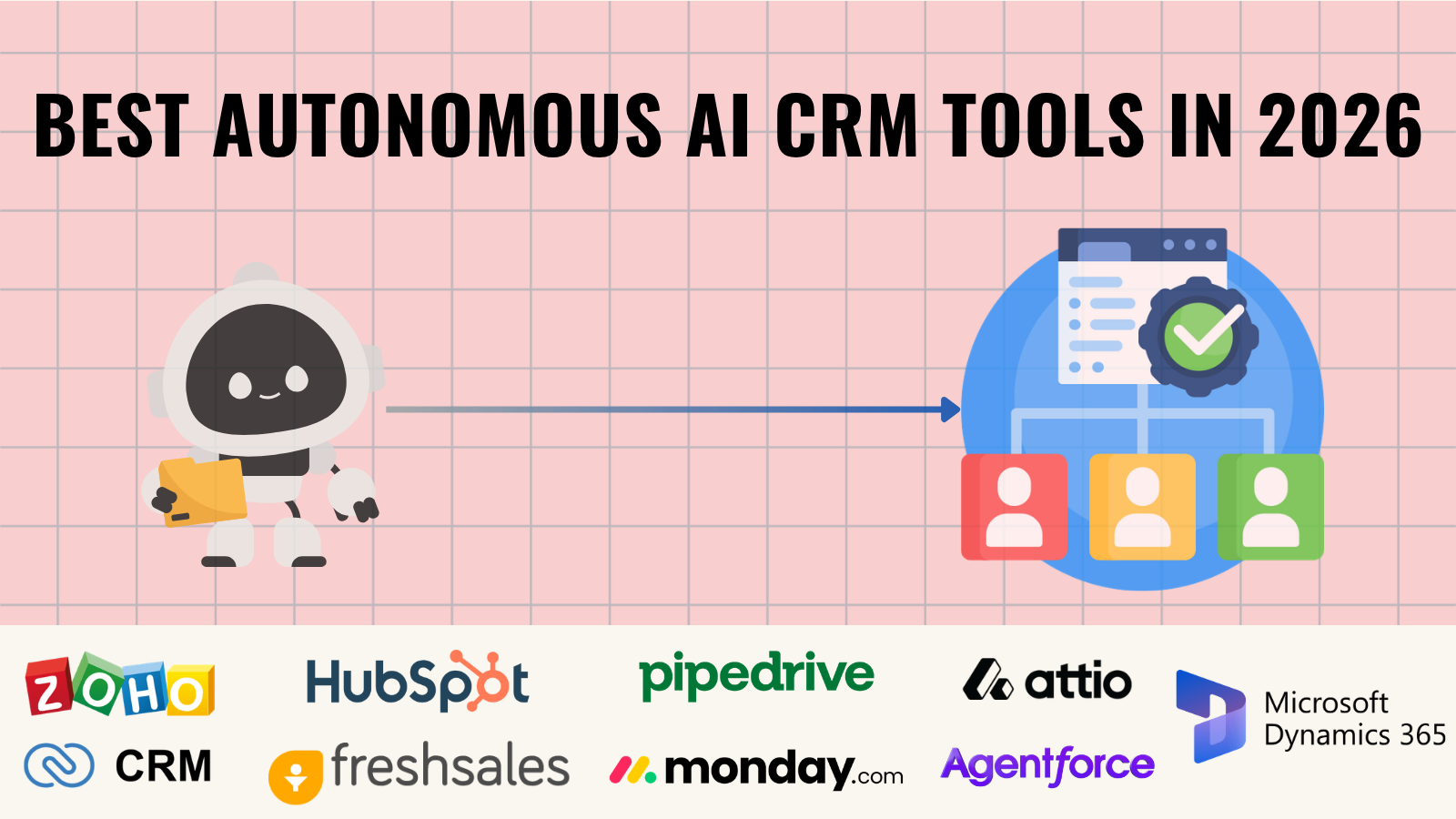
Customer relationship management has changed significantly over the last few years. Traditional CRMs helped teams organize contacts, manage deals, and track customer interactions. The latest generation of AI-powered CRMs goes much further. Instead of waiting for users to update records or create follow-up tasks, autonomous AI agents can analyze conversations, qualify leads, schedule meetings, draft emails, update pipelines, and even recommend the next action automatically.
For startups and growing businesses, this means spending less time on repetitive administrative work and more time building relationships with customers. Sales representatives no longer need to manually update every interaction, while founders can gain insights from conversations without reviewing hundreds of emails or meeting notes.
As large language models continue to improve, nearly every major CRM platform has introduced AI agents capable of completing multi-step workflows instead of simply answering questions. Choosing the right platform, however, depends on the size of the business, existing tools, automation requirements, and budget.
Autonomous AI CRM tools go beyond managing contacts and sales pipelines. They use AI agents to automate repetitive work, analyze customer interactions, recommend next steps, and help sales teams focus on building relationships instead of updating records. While every platform approaches AI differently, the best choice depends on your business size, existing tech stack, and automation needs.
This guide reviews ten leading autonomous AI CRM platforms available today:
A traditional CRM stores customer information and helps sales teams manage opportunities. Most actions still require human input, such as updating deal stages, creating follow-up reminders, or writing emails.
An autonomous AI CRM adds another layer. Instead of waiting for instructions, AI agents continuously observe customer activity, analyze communication, identify opportunities, and complete routine work automatically.
For example, after a customer meeting, an autonomous CRM can: summarize the conversation, update the opportunity stage, create follow-up tasks, draft a personalized email, recommend the next sales action, and alert managers if a deal becomes at risk.
The goal is not to replace sales teams but to remove repetitive work that consumes hours every week.
Modern AI CRMs combine several technologies instead of relying on a single language model. Most platforms integrate natural language processing, workflow automation, retrieval systems, predictive analytics, and external APIs.
A typical workflow looks like this:
Instead of acting as a chatbot, the AI functions more like a digital sales assistant that continuously monitors customer interactions and completes routine work in the background.
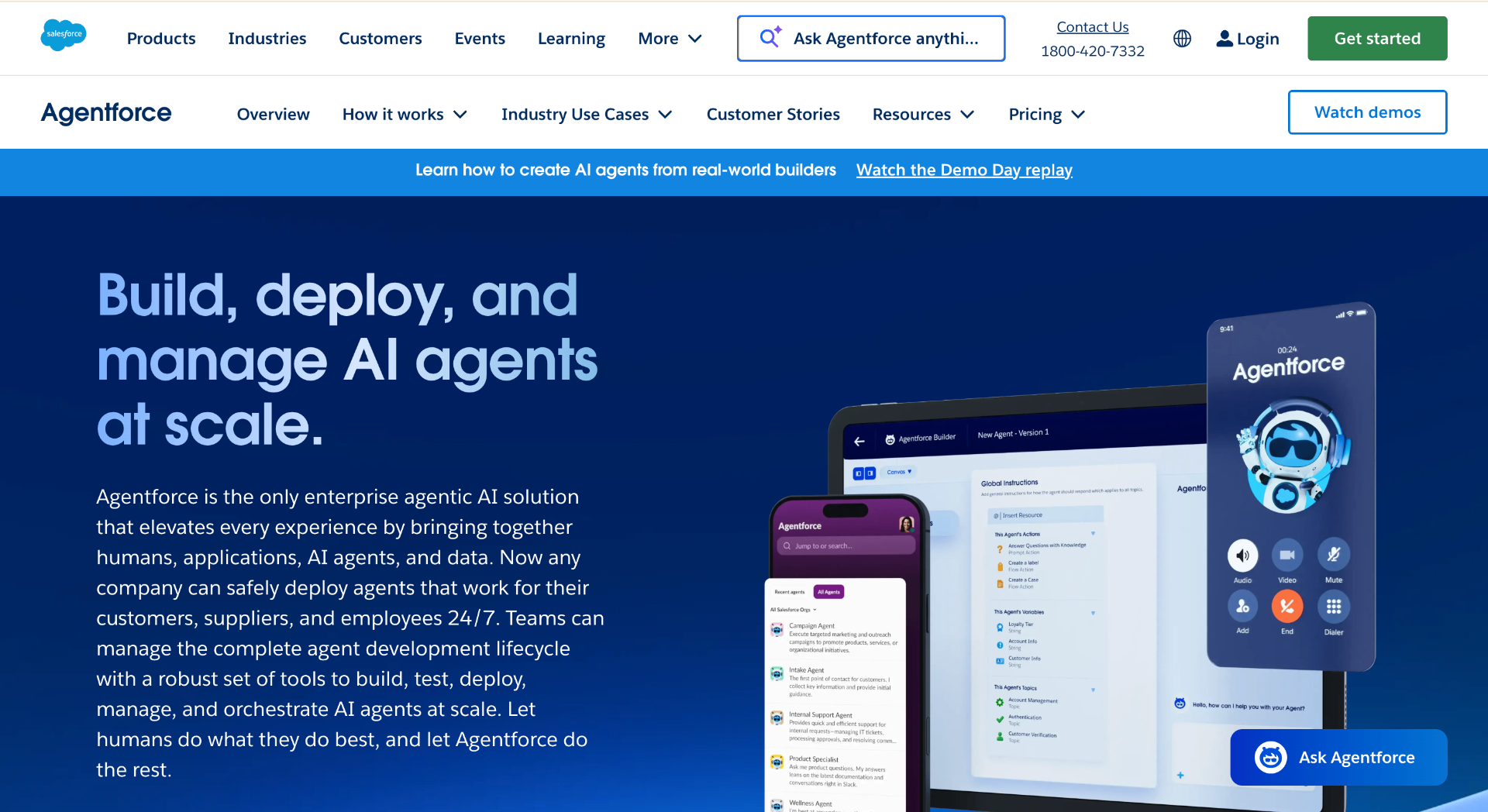
Salesforce Agentforce moves beyond traditional CRM automation by introducing autonomous AI agents that can plan, execute, and complete business tasks with minimal human involvement. Built on the Salesforce ecosystem, it connects seamlessly with Sales Cloud, Service Cloud, Data Cloud, Slack, and Salesforce Flow, allowing customer information and workflows to remain centralized. Rather than assisting with individual actions, Agentforce is designed to complete entire processes, making it particularly valuable for organizations handling complex sales and support operations.
Daily CRM work becomes significantly more efficient through AI-driven lead qualification, workflow execution, customer support automation, and sales coaching. Incoming leads can be evaluated using historical interactions, buying signals, and company information before being routed to the appropriate sales representative. After meetings, the AI can summarize conversations, update CRM records, identify customer objections, recommend follow-up actions, and even prepare personalized emails without manual intervention. The platform's enterprise-grade security, extensive customization, and mature integration ecosystem make it one of the most capable AI CRM solutions for large organizations, although implementation requires planning, experienced administrators, and a budget that is often beyond the reach of smaller businesses.
Best For: Large enterprises that require advanced AI automation across sales, customer support, and business operations.
Website: https://www.hubspot.com
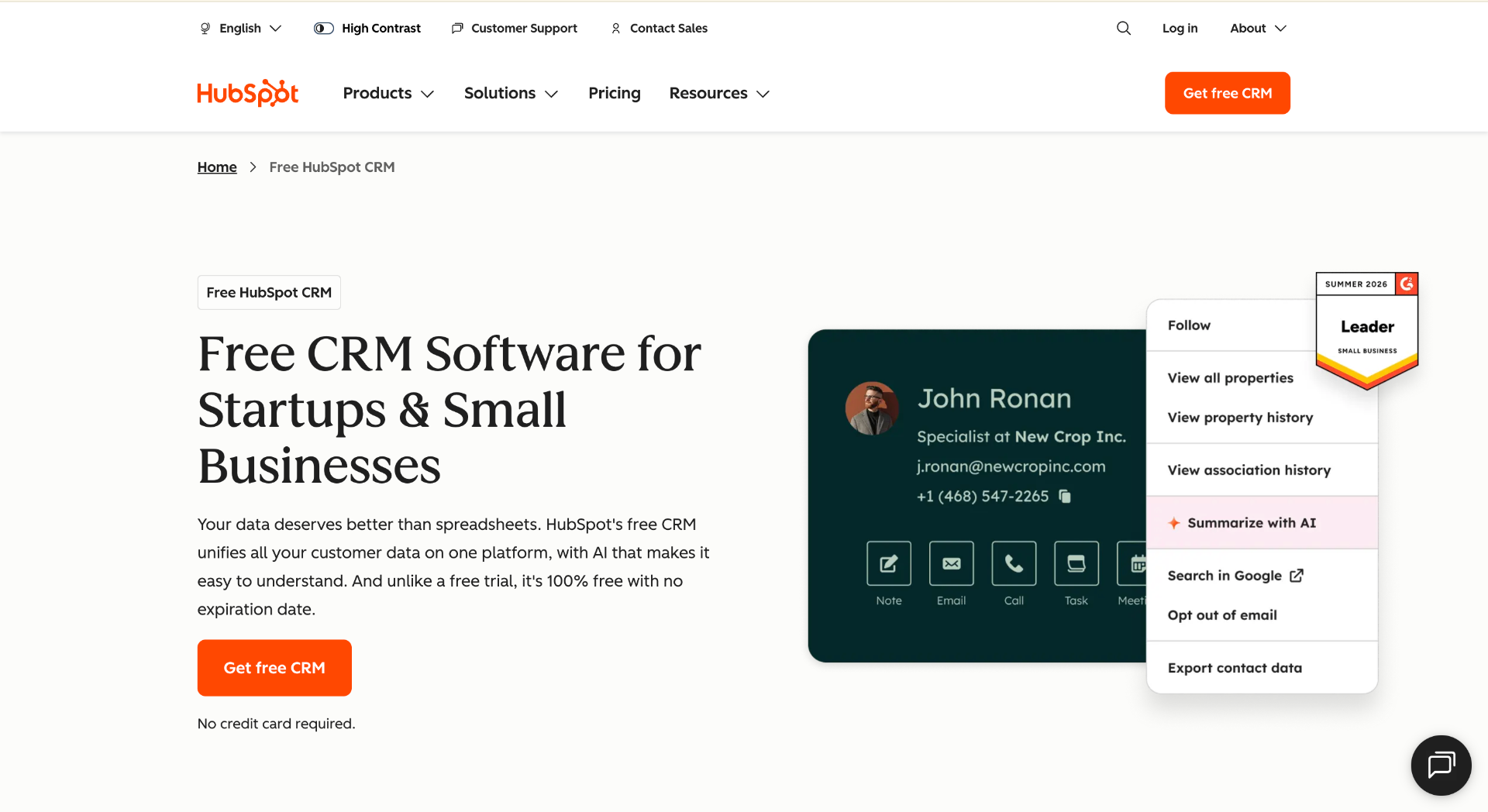
HubSpot AI extends the platform's reputation for simplicity by embedding artificial intelligence throughout marketing, sales, customer support, and content creation instead of introducing a separate AI product. The experience feels familiar to existing users because AI capabilities appear naturally inside everyday workflows, allowing teams to generate emails, summarize meetings, research prospects, qualify leads, and automate CRM updates without switching applications.
A new lead entering the CRM can automatically be enriched with additional information, assigned to the appropriate representative, and placed into the right marketing or sales workflow based on customer behavior. AI-generated meeting summaries, personalized outreach, and intelligent pipeline recommendations reduce administrative work while helping sales teams stay focused on customer conversations. HubSpot remains one of the easiest AI-powered CRMs to learn, making it attractive for startups and growing businesses. Although the free plan offers an excellent starting point, many advanced automation capabilities are reserved for higher subscription tiers, causing costs to increase as organizations expand.
Best For: Startups, agencies, SaaS companies, and growing businesses looking for AI features that require minimal setup.
Microsoft Dynamics 365 Copilot brings generative AI directly into the Microsoft business ecosystem, allowing sales teams to work more efficiently without leaving familiar applications such as Outlook, Teams, and Microsoft 365. Rather than acting as a standalone assistant, Copilot becomes part of everyday business communication by analyzing customer interactions, summarizing conversations, preparing meeting briefings, and recommending the next steps based on CRM history.
Its ability to reference emails, CRM records, meeting transcripts, internal documents, and Azure-powered business data gives sales representatives quick access to relevant information before every customer interaction. Integration with Power Automate and Power Apps also enables organizations to build custom workflows that extend well beyond CRM. This makes Dynamics 365 particularly attractive for enterprises already committed to Microsoft's ecosystem. The trade-off is a more complex implementation process, and licensing costs can become significant for organizations requiring advanced AI capabilities across multiple Microsoft services.
Best For: Medium and large organizations already using Microsoft 365, Azure, Teams, and the broader Microsoft ecosystem.
Website: https://www.zoho.com/crm
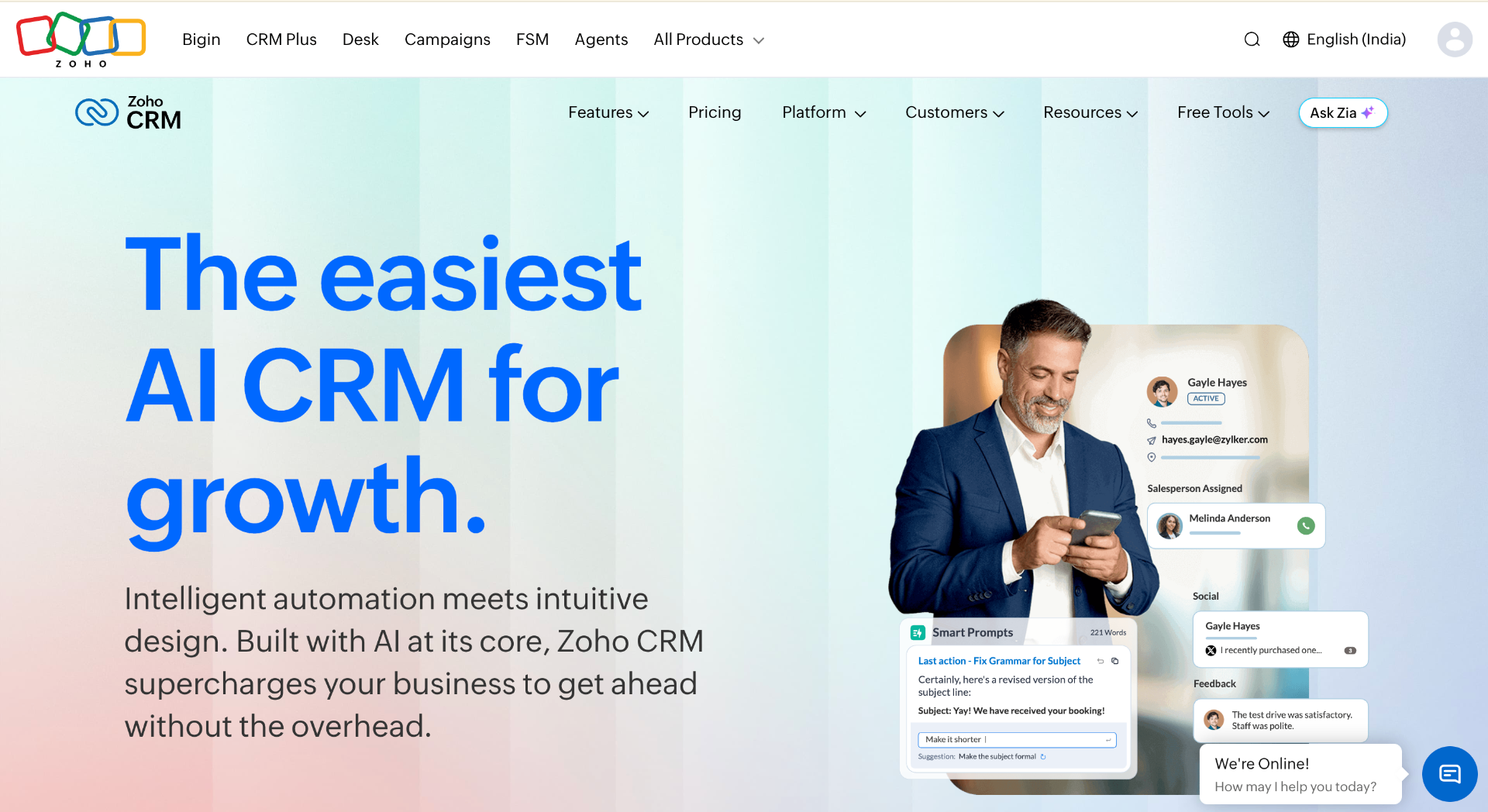
Zoho CRM combines affordability with intelligent automation through Zia, an AI assistant designed to improve decision-making rather than simply generate content. As customer activity changes over time, Zia continuously analyzes CRM data to predict deal outcomes, monitor sales performance, identify unusual patterns, and recommend actions that deserve immediate attention. The result is a CRM that helps sales teams focus on the opportunities most likely to convert.
Organizations already using Zoho's broader business ecosystem benefit from smooth data sharing across accounting, marketing, customer support, HR, and productivity applications. Natural language reporting, lead scoring, sentiment analysis, and workflow recommendations further reduce routine administrative work without requiring enterprise-level infrastructure. While Zia offers impressive automation for its price, it is less autonomous than some enterprise AI platforms, and advanced customization often requires additional configuration and time.
Best For: Small businesses, agencies, startups, and companies already invested in the Zoho ecosystem.
Website: https://www.freshworks.com/crm
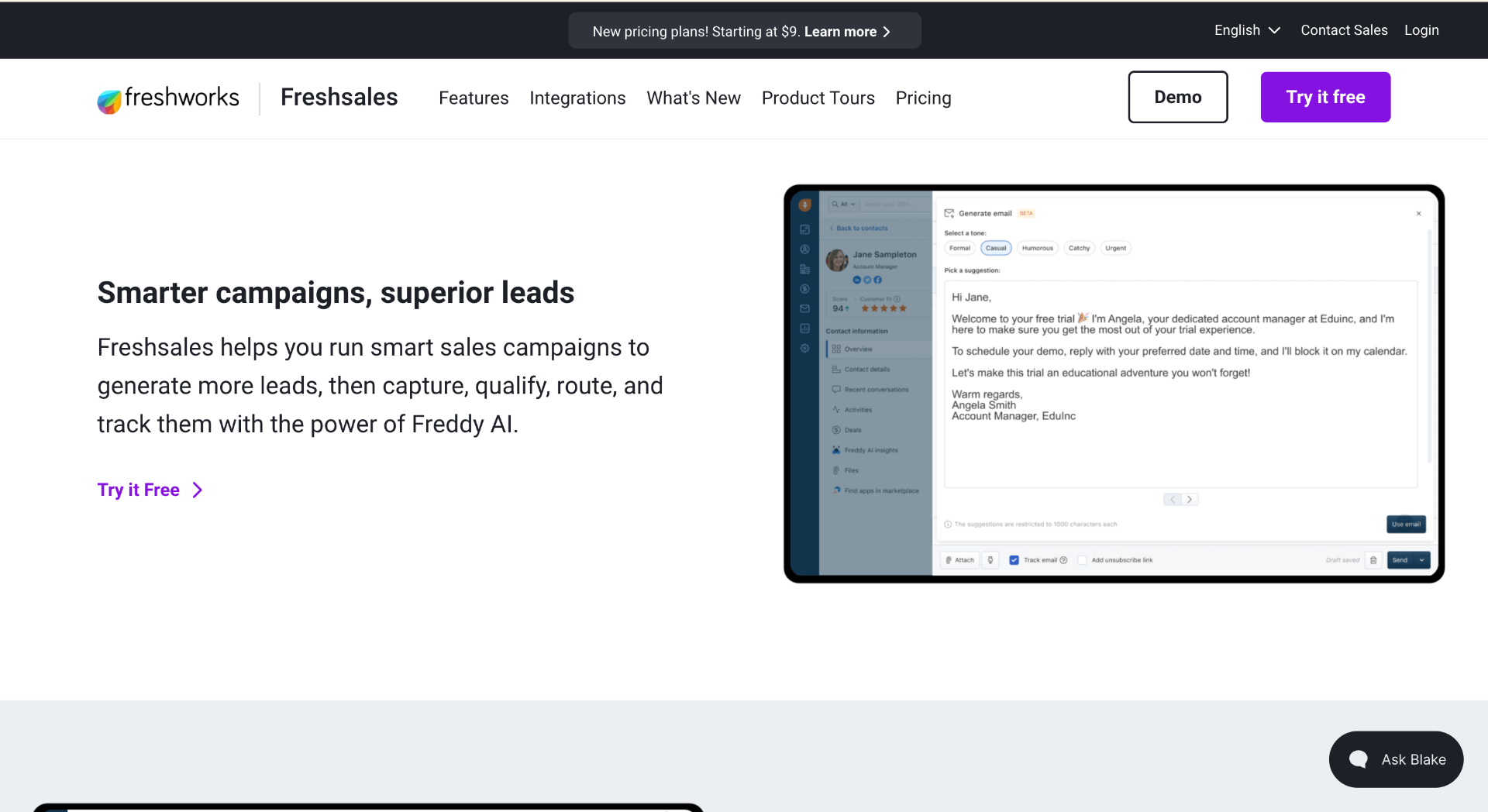
Freshsales approaches AI as a practical productivity tool rather than a replacement for sales teams. Freddy AI helps representatives spend less time updating CRM records and more time building customer relationships by automating routine tasks such as lead scoring, conversation summaries, revenue forecasting, follow-up recommendations, and email generation. Built-in communication tools, customer timelines, and workflow automation further simplify day-to-day sales operations.
The platform also brings customer support and sales information together, allowing teams to view interactions across multiple touchpoints without relying heavily on third-party software. This unified approach makes Freshsales particularly appealing for SaaS companies and growing businesses that want CRM, communication, and AI assistance within a single workspace. Its modern interface and straightforward onboarding process make adoption relatively easy, although organizations requiring extensive enterprise customization or a larger integration marketplace may find competing platforms better suited to their needs.
Best For: Growing SaaS companies, startups, service businesses, and small sales teams seeking practical AI-powered CRM automation.
Website: https://www.pipedrive.com
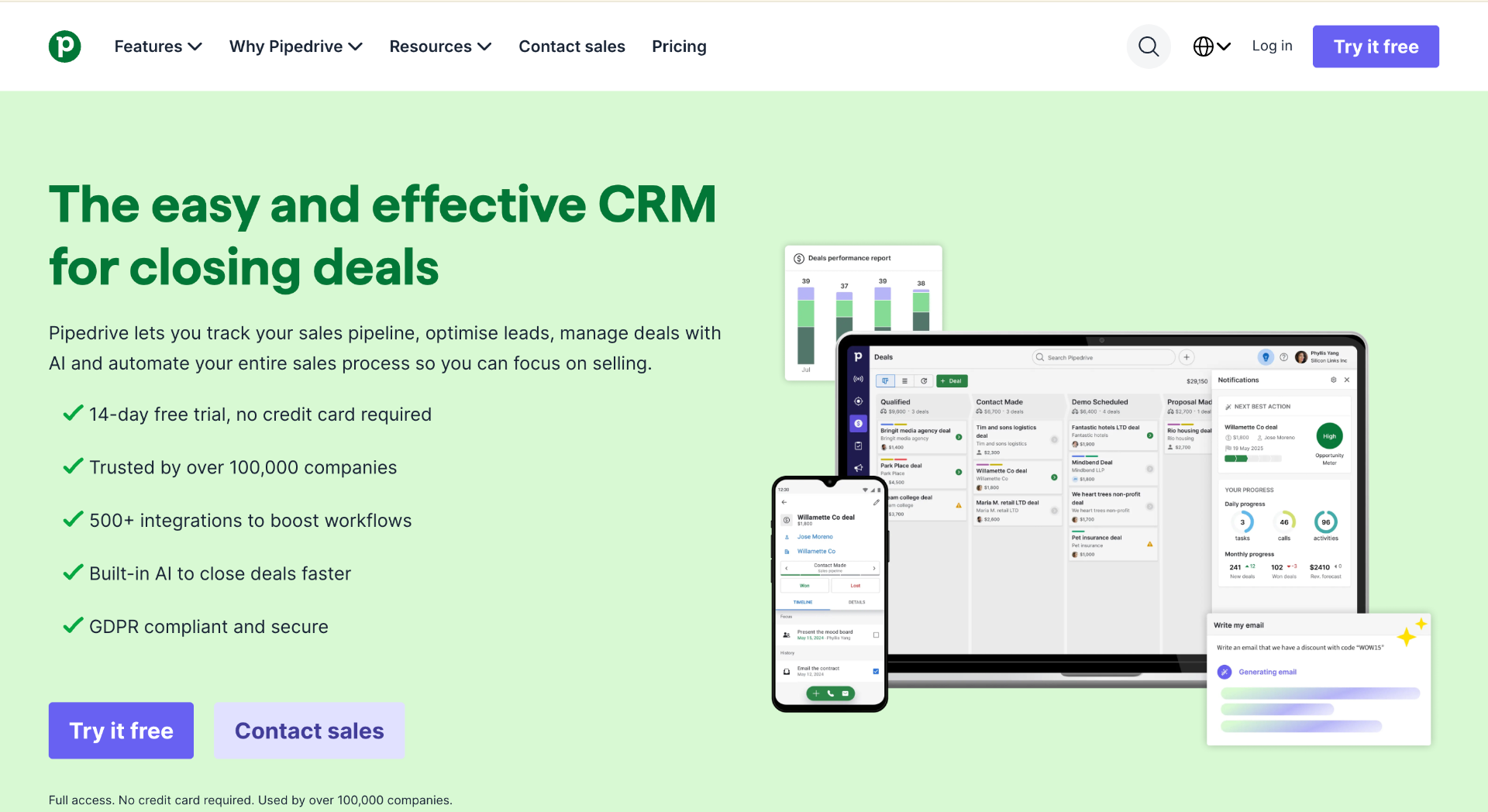
Pipedrive has built its reputation around keeping sales pipeline management straightforward, and its AI features follow the same philosophy. Rather than overwhelming users with enterprise-level complexity, the platform focuses on helping sales teams prioritize deals, stay organized, and spend more time engaging with prospects. AI capabilities are integrated into everyday workflows, making recommendations feel like a natural extension of the CRM instead of a separate tool.
Sales representatives receive intelligent suggestions about which opportunities deserve immediate attention, while AI assists with drafting emails, summarizing conversations, forecasting pipeline performance, and reminding users about overdue activities. Workflow automation and smart contact management further reduce repetitive administrative work without requiring extensive technical knowledge. The clean interface, quick deployment, and competitive pricing make Pipedrive an attractive choice for smaller businesses, although organizations looking for advanced marketing automation or enterprise-grade customization may eventually outgrow the platform.
Best For: Small businesses, startups, consultants, and sales-focused teams looking for an easy-to-use AI CRM.
Website: https://www.creatio.com
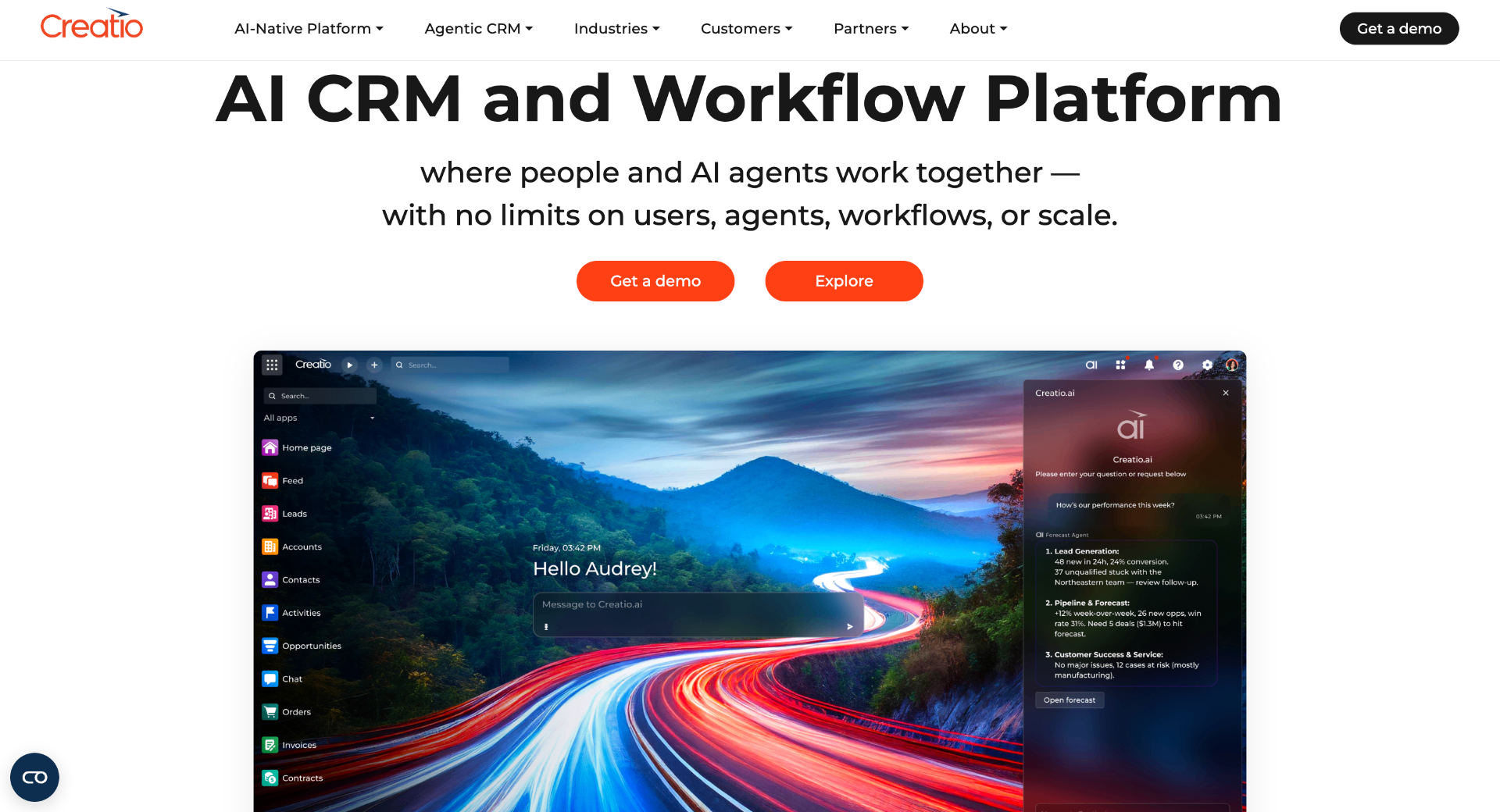
Creatio combines customer relationship management with a powerful no-code automation platform, allowing businesses to build workflows that match their own processes instead of adapting to predefined templates. AI enhances this flexibility by helping organizations automate customer journeys, recommend process improvements, summarize interactions, and coordinate tasks across multiple departments. The result is a CRM that extends well beyond sales and customer support into broader business operations.
Because workflows can be designed without extensive programming knowledge, business analysts and operations teams are able to create sophisticated automations for finance, procurement, onboarding, and customer service alongside traditional CRM activities. This flexibility makes Creatio especially valuable for organizations with unique operational requirements that standard CRM platforms struggle to accommodate. The trade-off is that implementation often requires careful planning, and mastering advanced workflow design can take time before the platform reaches its full potential.
Best For: Large organizations that require highly customized CRM workflows and enterprise-wide business process automation.
Website: https://attio.com
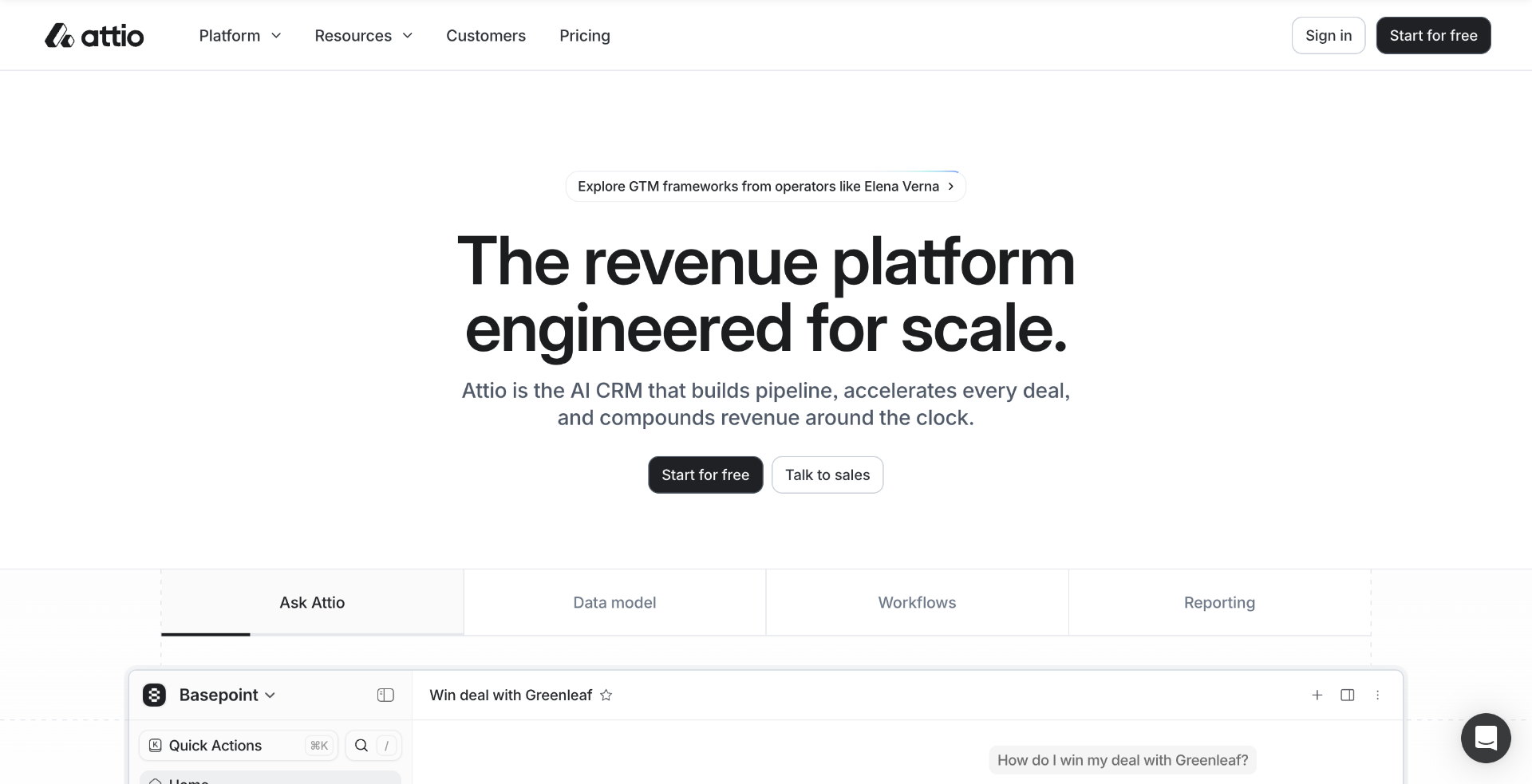
Attio takes a modern approach to customer relationship management by replacing much of the manual data entry traditionally associated with CRMs. Customer records are automatically built and enriched by syncing emails, calendars, meetings, and contacts, allowing relationship data to stay current with minimal effort. Designed with startups and product-led companies in mind, the platform emphasizes collaboration, flexibility, and automation from the beginning.
Its AI continuously organizes customer information, maps relationships between people and companies, and supports customizable workflows that adapt to different sales processes. Teams can create their own data structures instead of relying on rigid CRM templates, making Attio particularly appealing for fast-growing companies with evolving requirements. The modern interface and developer-friendly architecture are major advantages, although the platform's ecosystem remains smaller than those of more established competitors, and some advanced enterprise capabilities are still developing.
Best For: Startups, SaaS companies, founders, investors, and teams looking for a flexible AI-first CRM.
Website: https://www.sugarcrm.com
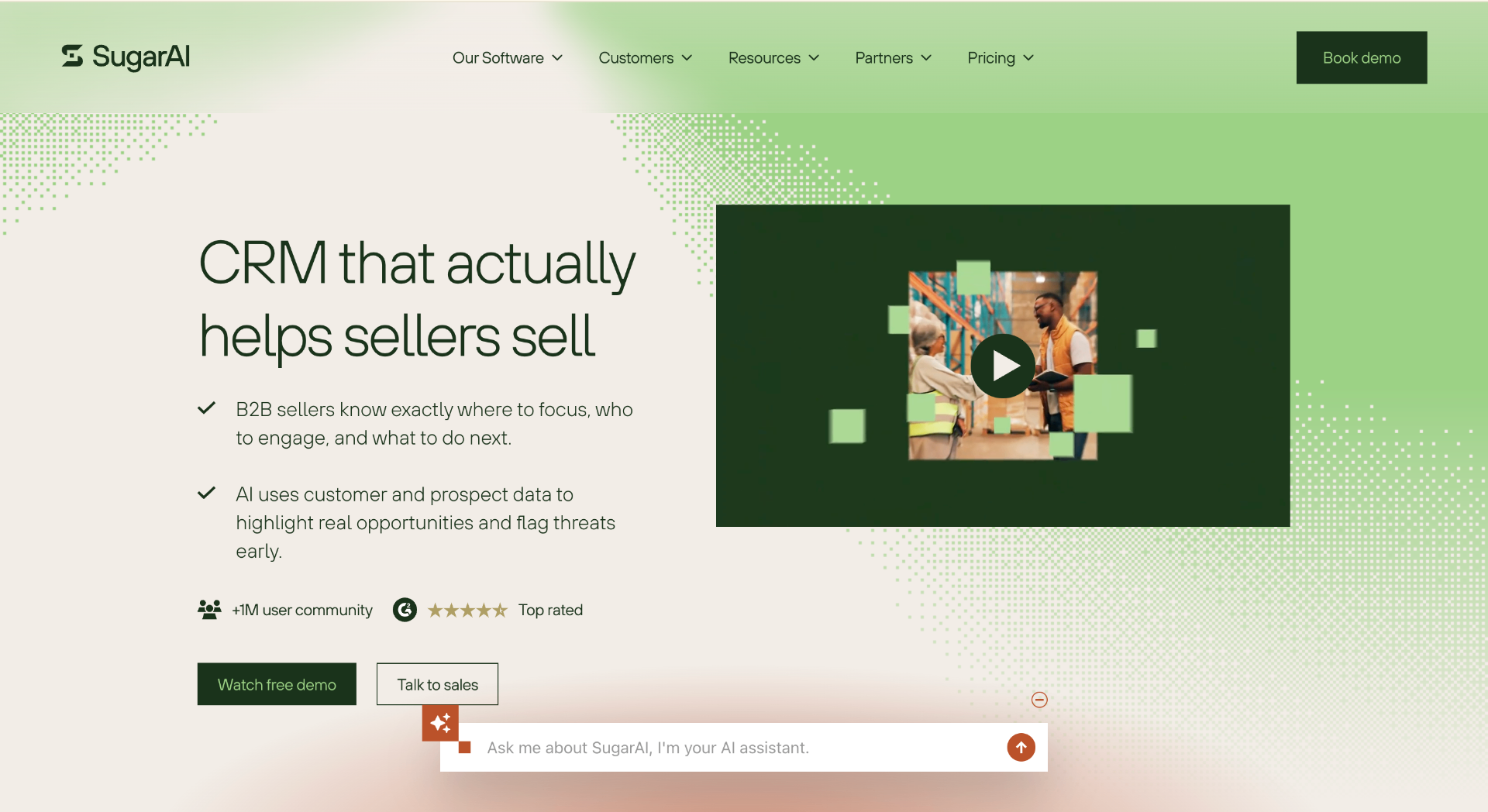
SugarCRM focuses on helping businesses make better decisions through predictive intelligence rather than relying primarily on generative AI. By analyzing customer history, buying behavior, support interactions, and sales performance, the platform uncovers trends that might otherwise go unnoticed. These insights help sales teams prioritize opportunities while giving managers a clearer understanding of pipeline health and future revenue potential.
Strong customization capabilities allow the CRM to adapt to industry-specific workflows, making it suitable for organizations with complex operational requirements. AI-driven lead scoring, forecasting, customer journey analysis, and workflow automation contribute to a more informed sales process without requiring constant manual analysis. Although SugarCRM delivers extensive flexibility and reporting capabilities, its interface feels less modern than many newer competitors, and implementation often benefits from experienced administrators or consulting support.
Best For: Medium and large organizations that prioritize predictive analytics, customer intelligence, and extensive CRM customization.
Website: https://monday.com/crm
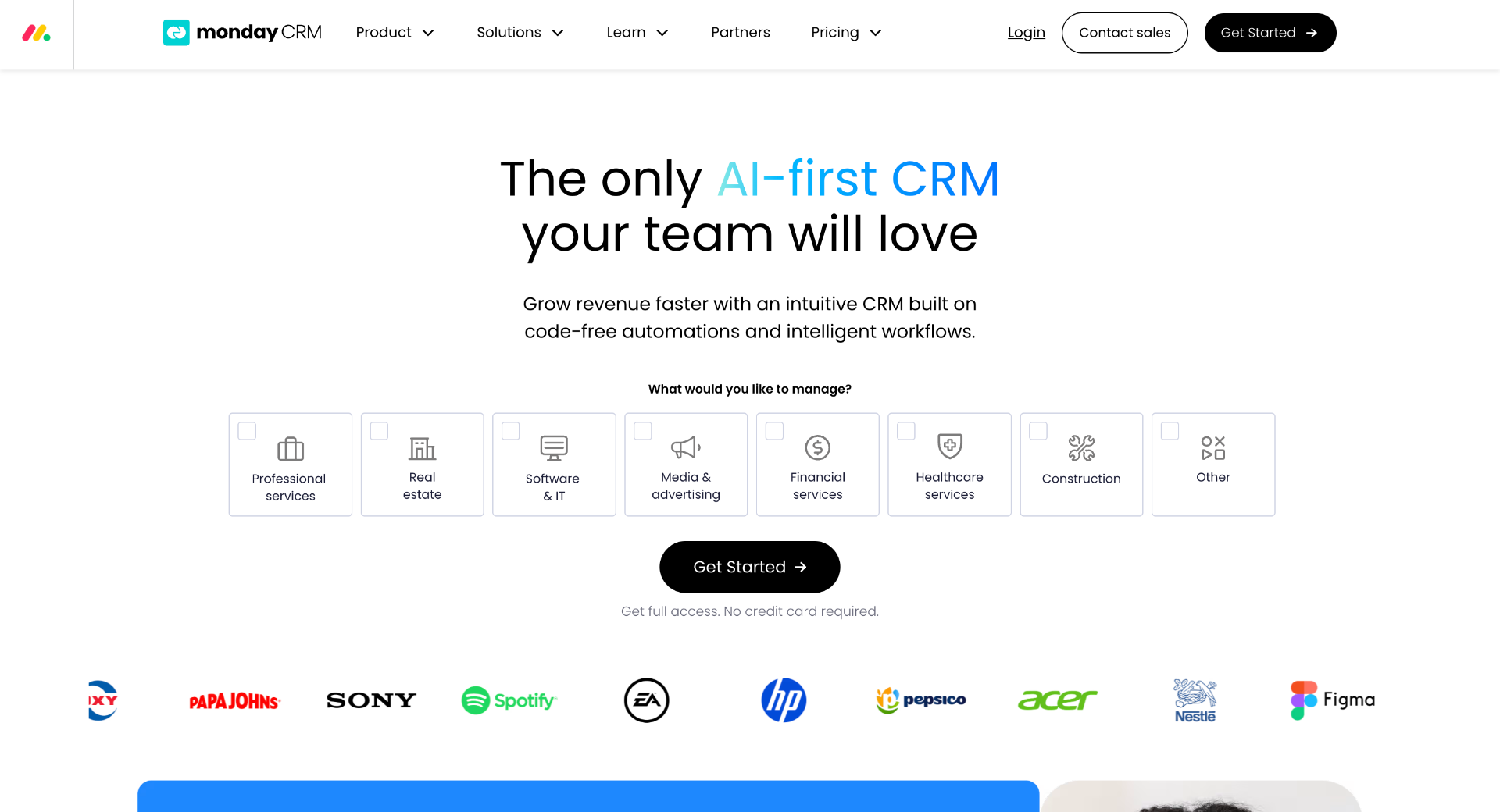
monday CRM extends the familiar monday.com workspace into customer relationship management, making it easy for teams already using the platform to manage projects, operations, and sales from a single environment. Its AI capabilities are designed to simplify everyday work by generating emails, summarizing activities, extracting action items from conversations, and automating repetitive workflows through AI-powered automation blocks.
The platform's visual interface makes customization approachable even for non-technical users, while flexible CRM boards allow businesses to connect customer management with project delivery, onboarding, and internal collaboration. This unified experience reduces the need to switch between multiple applications throughout the workday. While monday CRM excels in collaboration and workflow flexibility, businesses seeking highly specialized CRM functionality or deeper AI automation may find dedicated CRM platforms better suited to those requirements.
Best For: Businesses already using monday.com that want to manage CRM, projects, and team collaboration within a single platform.
Choosing the right platform depends less on AI marketing claims and more on how well the software fits existing workflows.
Salesforce Agentforce remains one of the strongest options for enterprises managing thousands of customers, complex approval processes, and multiple business units. Its autonomous AI agents can execute sophisticated workflows, but implementation often requires dedicated administrators.
HubSpot AI offers one of the best balances between usability and functionality. Startups and growing businesses can begin with the free plan and gradually unlock more advanced AI capabilities as their sales process matures.
Microsoft Dynamics 365 Copilot makes the most sense for organizations already invested in Microsoft 365, Teams, Azure, and Power Platform. Deep integration across Microsoft's ecosystem creates a more consistent experience than adding third-party AI tools.
Zoho CRM with Zia provides impressive value for smaller businesses that need intelligent automation without enterprise pricing.
Freshsales and Pipedrive focus on improving day-to-day productivity for sales teams, making them attractive choices for companies that want practical AI assistance without significant implementation overhead.
Attio stands out for modern startups thanks to its flexible architecture, automatic data enrichment, and developer-friendly approach.
Creatio and SugarCRM are better suited to enterprises that require extensive customization, industry-specific workflows, and advanced business process automation.
Meanwhile, monday CRM is an excellent option for teams that already manage projects and operations inside the monday ecosystem.
AI can automate repetitive work, but successful adoption depends on preparation rather than technology alone.
Clean customer data should always come first. AI systems depend on high-quality information, and inaccurate records often lead to poor recommendations, duplicate contacts, and unreliable forecasts.
Automation should be introduced gradually. Rather than allowing AI to control every workflow immediately, begin with lower-risk tasks such as meeting summaries, email drafting, contact enrichment, and follow-up reminders. As confidence grows, more complex workflows can be automated.
It is also important to review AI-generated outputs regularly. Sales emails, opportunity updates, and customer insights should remain subject to human oversight, particularly for high-value accounts.
Finally, consider integration capabilities before making a decision. A CRM that works well with email, calendars, communication platforms, accounting software, and internal applications usually delivers more value than one with impressive AI features but limited connectivity.
Many organizations expect AI to replace their sales process entirely. In reality, the best results come when AI supports people instead of replacing them.
Another common mistake is purchasing enterprise software that exceeds current business requirements. A startup with a small sales team rarely benefits from the complexity of an enterprise CRM.
Ignoring user adoption is another frequent issue. Even the most advanced AI assistant becomes ineffective if employees avoid using the platform or fail to maintain accurate customer data.
Businesses should also evaluate data privacy, security, compliance, and integration requirements before adopting any AI-powered CRM.
Autonomous AI is gradually changing what businesses expect from CRM software. Instead of acting as digital address books, modern platforms can qualify leads, summarize meetings, generate follow-ups, prioritize opportunities, and automate many of the repetitive tasks that previously consumed valuable sales time.
However, the most capable AI CRM is not necessarily the best choice. The right platform is the one that fits existing workflows, integrates with everyday tools, scales with the business, and provides meaningful automation without adding unnecessary complexity.
For startups and makers, simplicity and fast adoption often matter more than hundreds of enterprise features. Larger organizations, on the other hand, may benefit from advanced workflow orchestration, governance, and custom AI agents.
As AI models continue to improve, autonomous CRM capabilities will likely become a standard feature rather than a premium add-on. Businesses that adopt these tools thoughtfully, while maintaining human oversight, will be better positioned to improve customer relationships and reduce administrative work.