A three-person startup shipped a customer support agent on a Friday afternoon using a $24-a-month workflow tool, and by Monday it had resolved 40 percent of incoming tickets without a human touching them. Meanwhile, a mid-size fintech spent six weeks and two engineers wiring the same kind of agent by hand with raw API calls, retries, and a homemade state machine, because their compliance team would not accept a black-box no-code platform. Both approaches produced working agents. Neither approach was wrong. That gap is the entire story of AI agent builders in 2026: the category has split into tools that get you to a working agent in an afternoon and frameworks that get you to a defensible, auditable one in a few weeks, and picking the wrong lane wastes real time.
The market backs this up. Gartner projects that 40 percent of enterprise applications will include task-specific AI agents by the end of 2026, up from under 5 percent in 2025. McKinsey's 2025 Global Survey found that 62 percent of organizations are already experimenting with or actively scaling agents. That growth has pulled dozens of vendors into a category that barely existed two years ago, and most comparison articles online just repeat vendor marketing copy. This one is built from actual product documentation, pricing pages, and release notes, cross-checked as of July 2026.
An AI agent builder is a platform or framework that lets you define a goal for an AI system and have it plan steps, call tools or APIs, and act with limited human input, rather than following a fixed script. Some builders are no-code, visual, and aimed at business teams; others are code-first frameworks meant for engineers who need control over state, retries, and observability. In short:
AI agent builders include Microsoft Agent Framework, StackAI, Lindy, Make, and Google ADK, offering enterprise, no-code, automation, and Gemini-powered AI agent development.
The term gets thrown around loosely enough that it is worth defining before comparing tools. A chatbot that answers questions from a script is not an agent. An agent observes context, decides what to do next, calls real tools such as APIs, databases, or browsers, and adjusts based on what happens, often across multiple steps without a human approving each one. The distinction that matters for buyers is between automation and judgment: automation tools follow "if this happens, do that" rules set in advance, while agent builders let teams define a goal and let the system work out the steps.
Two things changed the landscape heading into 2026. First, the Model Context Protocol (MCP), originally released by Anthropic, became a common way for agents to connect to external tools without custom integration code for each one, and most serious platforms now support it. Second, multi-agent orchestration moved from a research curiosity to a standard requirement because single agents handling long, branching workflows tend to lose track of state or make cascading mistakes. That is why several tools on this list, including LangGraph and CrewAI, exist specifically to coordinate teams of specialized agents rather than one agent trying to do everything.
Before getting into the ten tools, it helps to know what actually separates a good choice from a bad one, because feature lists on vendor pages tend to look identical. The factors worth weighing are model flexibility (can a team swap between Claude, GPT, and Gemini without rewriting logic), integration depth (does the tool actually complete real tasks reliably, not just connect to an app in theory), multi-agent support (can specialized agents hand off work to each other), and governance (SOC 2, HIPAA, audit logs, and role-based access if the agent touches sensitive data). Pricing model matters just as much: some tools bill per "execution" or workflow run, others bill per step or task, and that difference can make a 10-step workflow cost ten times more on one platform than another.
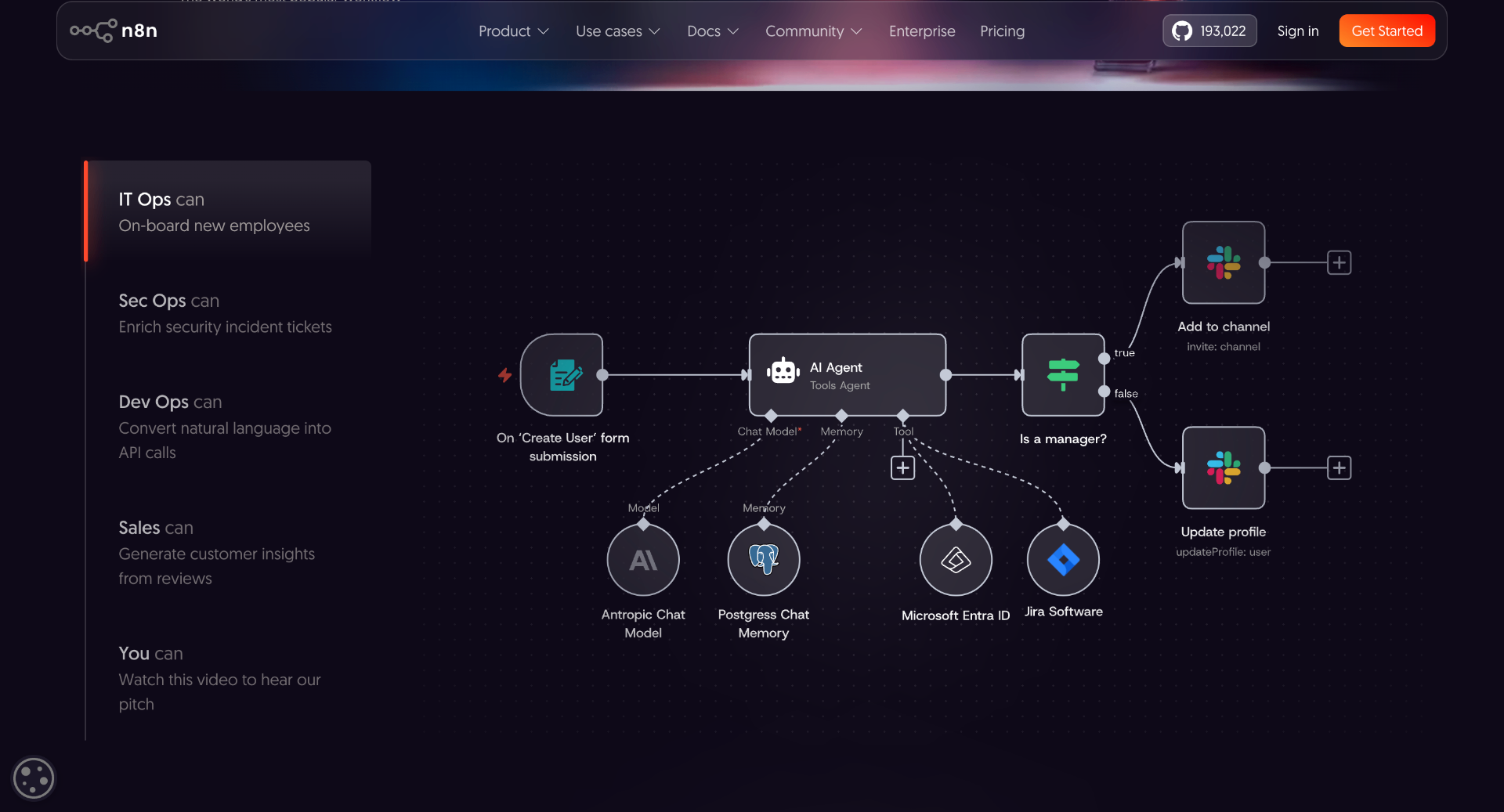
n8n is an open-source workflow automation platform that added native AI agent nodes, LangChain integration, and MCP tool support on top of its existing 400-plus integrations. The core appeal for technical teams is the Community Edition: it is completely free to self-host under a fair-code license, with unlimited workflows and unlimited executions, and the only real cost is a small VPS, typically $5 to $10 a month. For teams that would rather not manage infrastructure, n8n Cloud starts at roughly $20 to $24 a month for the Starter plan (2,500 executions), with Pro at about $50 to $60 a month for 10,000 executions, and a Business tier around $800 a month that adds SSO, Git-based version control, and log streaming.
What makes n8n stand out from typical automation tools is that it bills per execution, meaning one run of an entire workflow counts as a single execution regardless of how many steps or nodes it contains. That is a meaningfully different economic model from tools like Zapier, which charge per task inside a workflow. For an agent that calls five or six tools per run, that difference adds up fast at scale.
A basic agent node in n8n can be wired to call an LLM, reason over a tool list, and act, without leaving the visual canvas, but developers can also drop into JavaScript or Python code nodes for anything the drag-and-drop interface cannot express. The tradeoff is a steeper learning curve than fully no-code tools like Gumloop or Relay, and the interface still assumes some comfort with automation logic. For a solo developer or small technical team that wants to self-host, keep data in-house, and avoid per-seat pricing, n8n remains one of the more cost-effective options available in 2026.
LangGraph, built by the LangChain team, models an agent workflow as a directed graph where nodes represent steps like an LLM call, a tool call, or a human-approval checkpoint, and edges define how control moves between them, including conditional branching. LangGraph reached general availability in October 2025, and by mid-2026 it had absorbed features like per-node timeouts, durable streaming, and a Postgres-backed checkpointer that lets long-running agents persist their state and resume after a failure. It pulls tens of millions of monthly downloads on PyPI, more than any competing agent framework, largely because enterprises value the audit trail and rollback points that a graph structure provides.
The honest tradeoff is verbosity. Even a simple two-agent workflow requires defining a state schema, nodes, and edges explicitly, which is more setup work than a framework like CrewAI. Teams that start with a simpler tool for prototyping frequently migrate to LangGraph once they need production-grade state management, human-in-the-loop approval steps, or precise control over retries and error recovery. It is model-agnostic, so different nodes in the same graph can call Claude, GPT, or a locally hosted model, and it pairs with LangSmith for tracing and evaluation across the full application lifecycle. For teams building anything long-running, branching, or subject to compliance review, LangGraph is close to the default choice for production work in 2026.
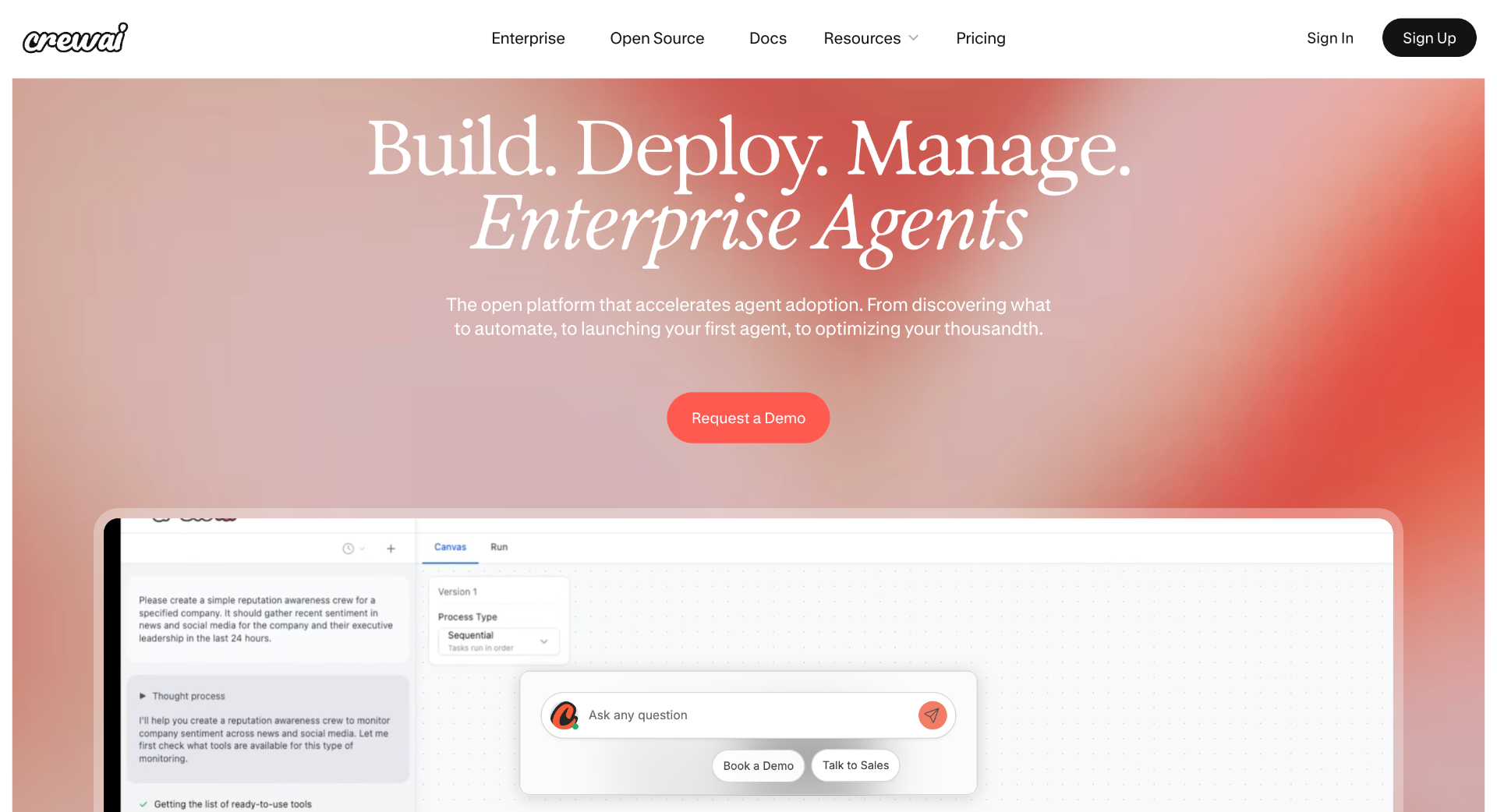
CrewAI takes a different approach: instead of an explicit graph, it models multi-agent collaboration as a "crew" of role-playing agents, each defined with a role, a goal, and a backstory, then assembled into a team with a shared set of tasks. That metaphor maps closely to how people already think about delegating work, which is why developers consistently report getting a working multi-agent prototype running faster with CrewAI than with any comparable framework. CrewAI reports over 5 million monthly downloads and supports three coordination modes: sequential, hierarchical (a manager agent delegates to workers), and consensual (agents vote on decisions).
The framework is open source and free to use, with cost limited to whatever LLM API calls the agents make. It genuinely shines for content pipelines, research assistants, and business analysis workflows where the task naturally splits into specialist roles, such as a researcher agent, a writer agent, and an editor agent working in sequence. The limitation shows up at scale: CrewAI has no built-in checkpointing for long-running workflows, agent-to-agent communication is mediated through task outputs rather than direct messaging, and error handling is comparatively coarse. Independent benchmarks in 2026 found roughly 18 percent more token overhead in a CrewAI ticket-triage setup compared to an equivalent LangGraph implementation. The common pattern, acknowledged even in CrewAI's own documentation, is to prototype in CrewAI to validate whether an agent architecture makes sense, then migrate the production-critical paths to LangGraph once checkpointing and fine-grained control become necessary.
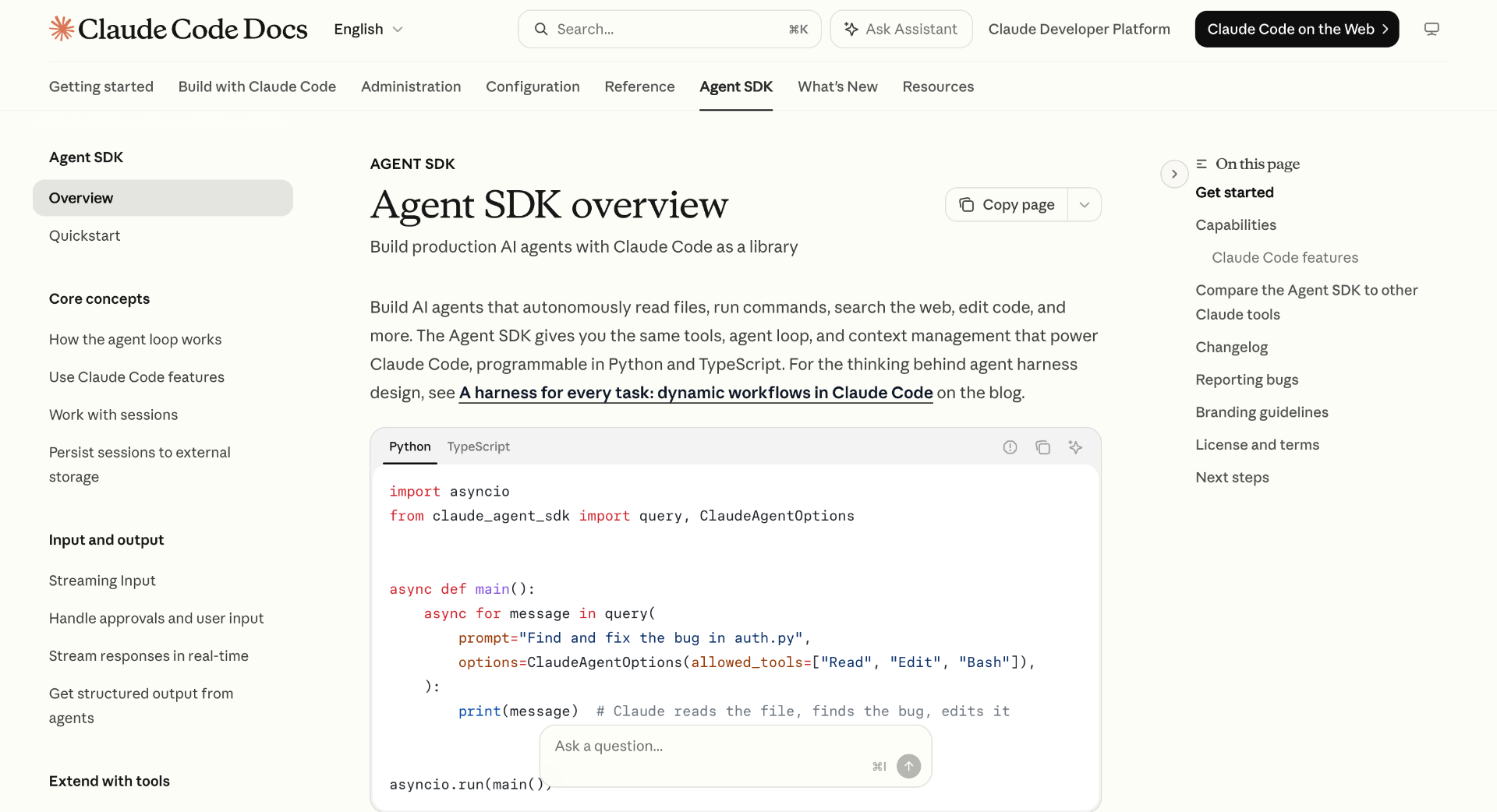
The Claude Agent SDK, renamed from the earlier Claude Code SDK in early 2026, is Anthropic's toolkit for building production agents directly on Claude models, including Claude Sonnet 5 and Claude Opus 4.8. As of June 2026, it added hierarchical subagent spawning and fallback model chains, letting a primary agent delegate subtasks to specialized subagents and automatically fall back to a different model if one becomes unavailable. It ships tool use, memory management, and tracing by default, which several 2026 framework comparisons flagged as a faster path than a general-purpose framework like LangGraph or CrewAI for teams that only need a single agent calling one or two tools rather than full multi-agent orchestration.
The obvious tradeoff is that it is model-locked to Claude, so teams that need to swap between OpenAI, Google, and Anthropic models inside the same agent will find LangGraph's model-agnostic design more flexible. For developers who have already settled on Claude as their model provider, whether for coding tasks through Claude Code, general reasoning, or long-context workflows, the Agent SDK removes a layer of framework abstraction that would otherwise need to be built by hand. It works well alongside MCP connectors, since Anthropic maintains the Model Context Protocol as an open standard that most other tools on this list now also support.
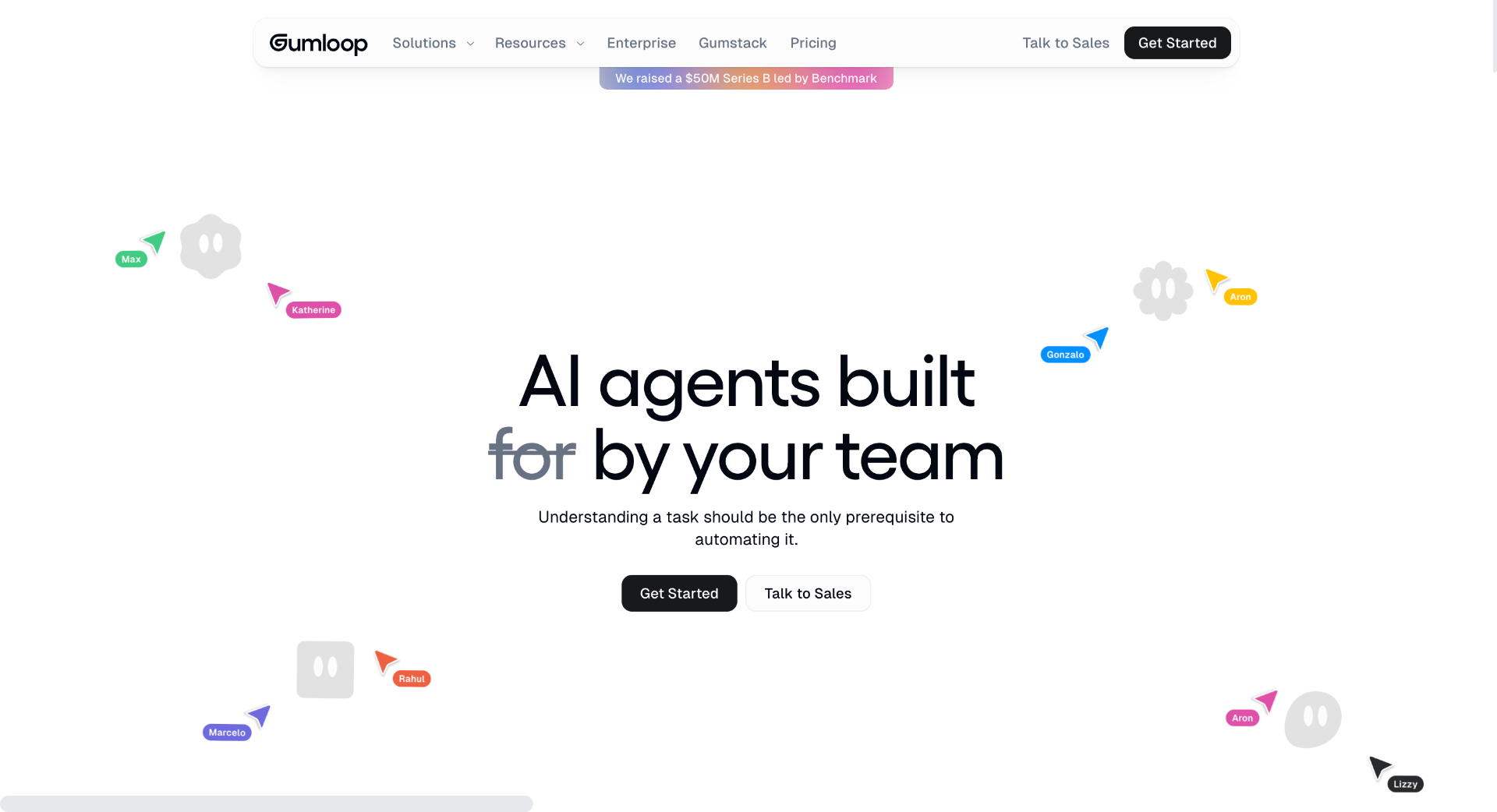
Gumloop is a no-code, AI-first automation platform built around two core concepts: Flows, which are workflows built by dragging nodes representing apps and LLMs onto a visual canvas, and an in-platform assistant called Gummie that can build a workflow from a plain-language description rather than requiring manual node placement. It connects to MCP servers, a large library of built-in integrations, and multiple LLM providers without requiring separate API keys or subscriptions for each model. Pricing starts with a free plan, with paid tiers beginning around $37 a month, and the platform reports usage by companies including Shopify, Instacart, and Webflow across marketing, sales, and operations teams.
Gumloop's appeal is speed to a working result: a non-technical team member can describe a task like "summarize new support tickets and post a daily digest to Slack" and get a functioning agent without touching code. That accessibility is also its ceiling. Teams that need precise control over retries, complex conditional branching, or on-premise deployment will hit the edges of what a visual, no-code canvas can express, and at that point, a code-first framework becomes the better fit. For solo operators, marketing teams, and founders who want to automate real workflows without hiring an engineer, Gumloop remains one of the more capable entries in the no-code segment.
Microsoft Agent Framework unifies AutoGen and Semantic Kernel into a single 1.0 release (April 2026) with graph-based workflows and Python plus .NET runtimes, making it the practical default for teams already standardized on Azure.
StackAI is a low-code builder positioned for regulated industries, offering SOC 2, HIPAA, and GDPR compliance along with on-premises and VPC deployment options for teams that cannot use a fully cloud-hosted agent platform.
Lindy functions less like a general builder and more like a pre-built AI executive assistant that manages inbox triage, calendar scheduling, and meeting follow-ups, including integration via iMessage.
Make offers a visual Scenario Builder with more than 3,000 app connectors, aimed at mid-market operations and marketing teams that want to ship agentic workflows without waiting on an engineering backlog.
Google ADK (Agent Development Kit) gives teams already invested in Google Cloud a native path to building agents optimized for Gemini models, with session-based state management and pluggable backend support.
The honest answer to "which AI agent builder is best" depends entirely on who is building and what happens if the agent gets something wrong. A no-code platform like Gumloop, Relay, or Lindy gets a non-technical founder or marketer to a working agent in under an hour, and for tasks like summarizing tickets, drafting outreach, or managing a calendar, that speed is the whole point. A code-first framework like LangGraph, CrewAI, or the Claude Agent SDK asks for more setup time upfront in exchange for the ability to see exactly what prompt is being sent to the model, add a retry policy when a tool call fails, and pass a compliance audit that requires knowing precisely how a decision was made.
A reasonable rule of thumb: if the agent is customer-facing, touches money, or operates in a regulated industry, lean toward a framework with explicit state management and observability, such as LangGraph, or a compliance-focused platform like StackAI. If the agent is an internal productivity tool with low stakes, if it makes an occasional mistake, a no-code platform will get there faster and with less engineering overhead.
A recurring mistake is treating an agent builder as a chatbot builder and expecting reliability without giving it real tool access, meaningful error handling, or a way to escalate to a human when it is uncertain. Another is picking a fully no-code platform for a workflow that will eventually need custom logic, then rebuilding the entire thing in a code-first framework six months later, a migration pattern that shows up often enough in CrewAI-to-LangGraph transitions that CrewAI's own documentation acknowledges it. A third is underestimating token cost: multi-agent setups with several specialized agents can burn noticeably more tokens than a single well-designed agent, so it is worth prototyping with a smaller model before committing to an expensive one in production.
The best AI agent builder in 2026 is not a single winner so much as a matter of matching the tool to the job and the team. Developers who want free, self-hosted control should start with n8n. Teams building anything long-running or subject to compliance review should default to LangGraph. Anyone who wants a multi-agent prototype running in an afternoon should try CrewAI before anything more complex. Teams already committed to Claude should look at the Claude Agent SDK before reaching for a heavier framework. Founders and non-technical operators who just need something working today should start with Gumloop or a similar no-code platform and only move to a framework once the workflow outgrows the visual canvas. Whichever path gets chosen, the same principle holds across every tool on this list: an agent is only as good as the tools it can call and the guardrails placed around it, so start narrow, watch what actually breaks in production, and expand from there rather than trying to build the perfect agent on day one.
| Enterprise AI agents and internal copilots |
| ✗ |
| ✓ |
| ✓ |
| ✓ |
| OpenAI, Anthropic, Gemini, Azure OpenAI |
| Free plan, Paid plans available |
| Lindy | AI executive assistant and business workflow automation | ✗ | ✓ | ✗ | Partial | Multiple LLMs | Free plan, Paid from $49/month |
| Make | Visual AI workflow automation with 3,000+ integrations | ✗ | ✓ | ✗ | Partial | OpenAI, Anthropic, Gemini, Mistral, and more | Free plan, Paid from $10.59/month |
| Google ADK | Gemini-native AI agent development framework | ✓ | ✗ | ✓ | ✓ | Gemini | Free SDK (Gemini API billed separately) |