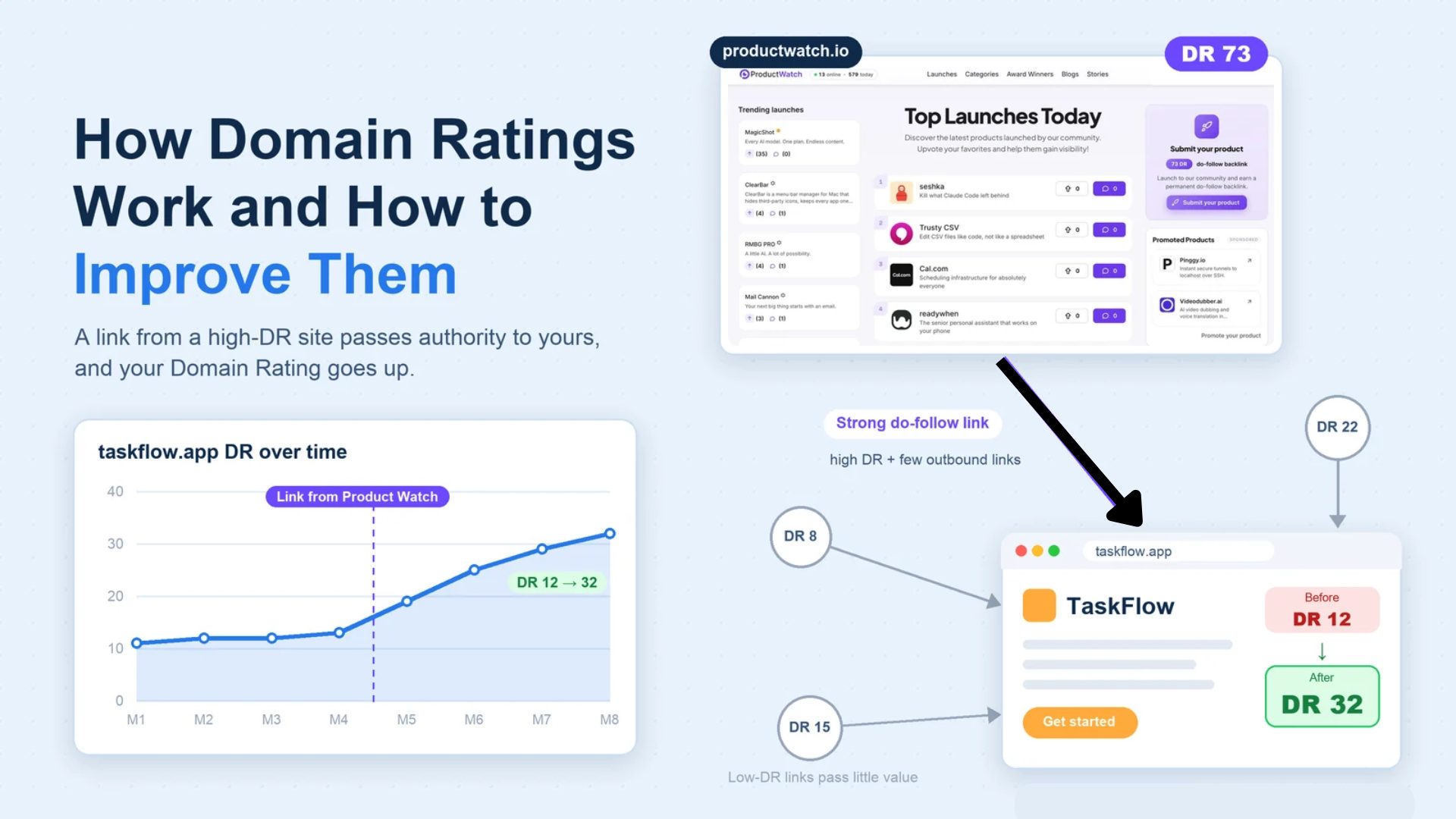
Most founders hear about Domain Rating the first time they try to get a guest post published or pitch a partnership. Someone asks, "What is your DR?", and suddenly a number between 0 and 100 seems to decide whether your site is worth a link.
These scores are useful, but they are often misunderstood. Ahrefs Domain Rating (DR) and Moz Domain Authority (DA) are not Google metrics. They are estimates built by SEO tools from their own link data. Once you understand how they are calculated, it becomes much clearer which actions move them and which ones are a waste of time.
This guide explains how both scores work, uses simple examples and diagrams, and ends with practical steps you can follow to improve them.
Quick Summary
- DR (Ahrefs ) and DA (Moz) estimate the strength of a website's backlink profile on a 0 to 100 scale.
- Neither score is used by Google. They are third-party metrics that help you compare sites.
- DR is calculated from unique linking domains, weighted by each linking site's own DR and divided by how many sites it links to.
- Ahrefs DR4 now gives more weight to links from sites that receive organic search traffic.
- Moz DA uses a machine learning model trained on Google results, with linking root domains and Spam Score as key inputs.
- Both scores are logarithmic and relative, so they get harder to raise as they grow, and they can drop even when you lose no links.
- The reliable way to improve both is to earn links from many different, real, relevant websites that get traffic.
Both scores try to answer one question: how strong is this website's backlink profile compared with every other website in the tool's index?
A useful way to think about them is as a credit score for links. A credit score summarises your history so lenders can compare you quickly. DR and DA summarise link history so marketers can compare sites quickly. Neither score is the whole story, and neither is used by Google to rank pages.
Ahrefs explains DR as a simplified, site-level version of its internal link graph. The process works in four broad steps.
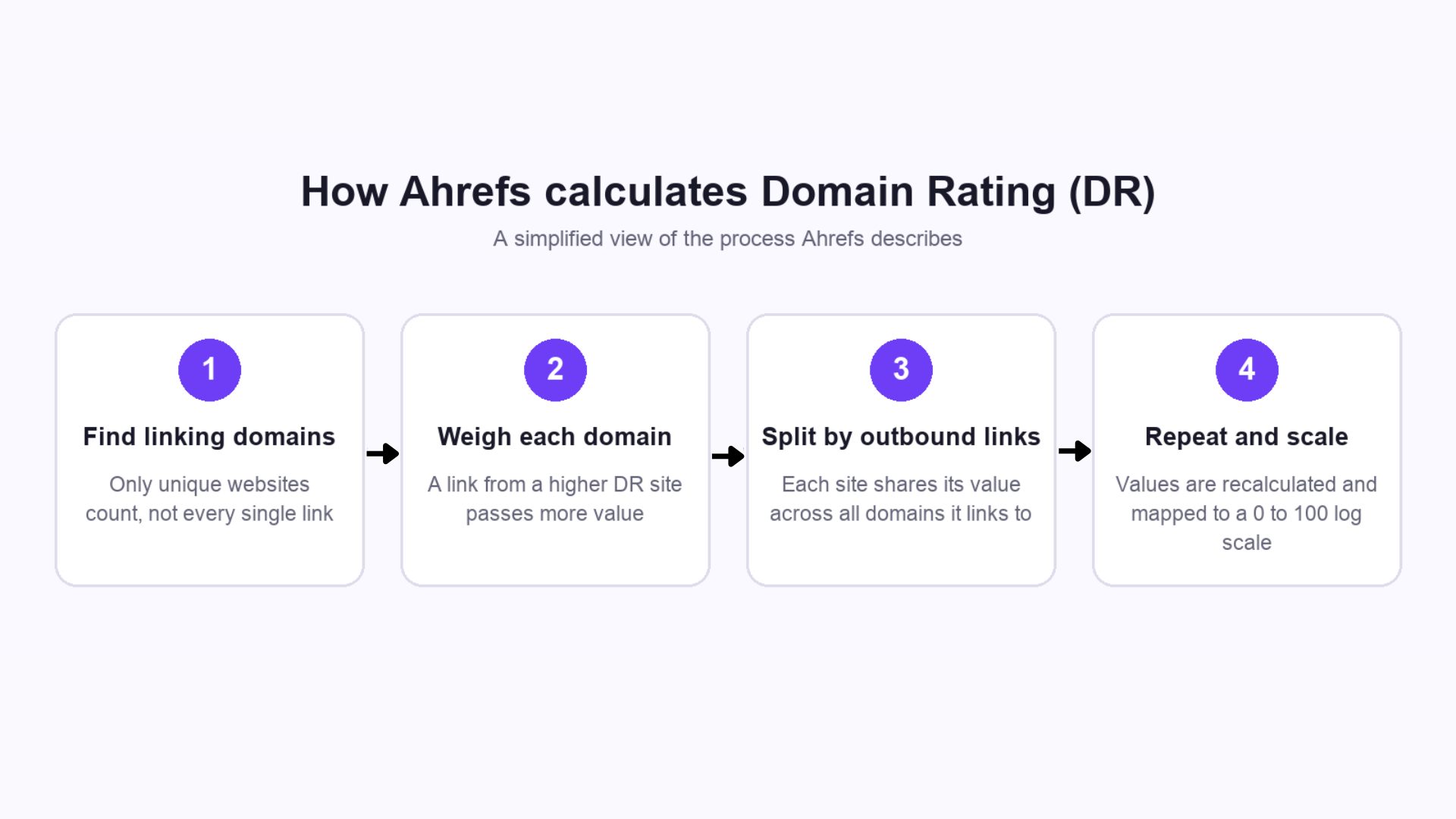
DR counts websites, not individual links. If one blog links to you 50 times, it counts as one linking domain. Ten links from ten different sites are worth far more than fifty links from one site.
A link from a site with a high DR passes more value than a link from a site with a low DR. This is why one link from an established industry publication can move your score more than dozens of links from new blogs.
This is the part most people miss. Each linking site divides its value equally among all the domains it links to. A strong site that links out to thousands of domains passes only a small amount to each one.
Ahrefs gives a clear example of this: a link from a DR 26 site that links to five domains can have more impact than a link from a DR 73 site that links to 5,000 domains.
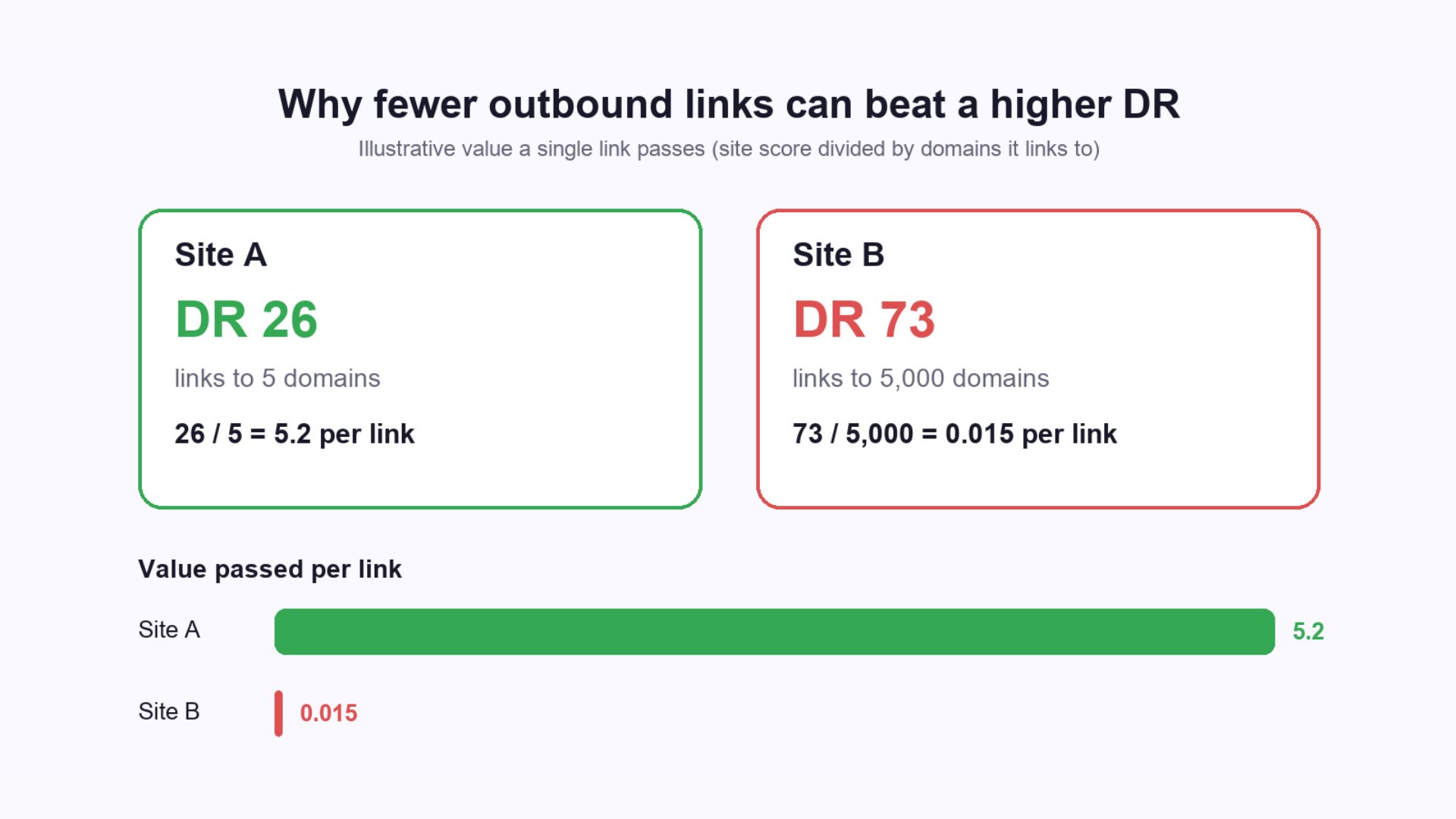
This is a simplified illustration of the logic Ahrefs describes, not its exact formula.
Ahrefs runs these calculations repeatedly across its whole index, then maps the raw values onto a 0 to 100 logarithmic scale. The result is a rating that tells you how your link profile compares with everyone else's.
Ahrefs recently released a new version of the metric, called DR4. The core idea is the same, but three changes matter for anyone trying to grow their score.
Ahrefs shared examples of the impact. Its own help subdomain, help.ahrefs.com, fell from 91 to 75, and github.io dropped 32 points because subdomains now stand on their own. Spam-heavy domains saw the largest falls, with a median drop of around 15 to 20 points for sites that previously sat between DR 30 and DR 70. Meanwhile, most of the top 1,000 sites by organic traffic went up.
The lesson is simple: links from real websites with real audiences matter more than ever.
Moz takes a different approach. Instead of a direct formula, DA is produced by a machine learning model. Moz trains the model on how websites actually appear in Google search results, and then uses it to predict how likely a domain is to rank.
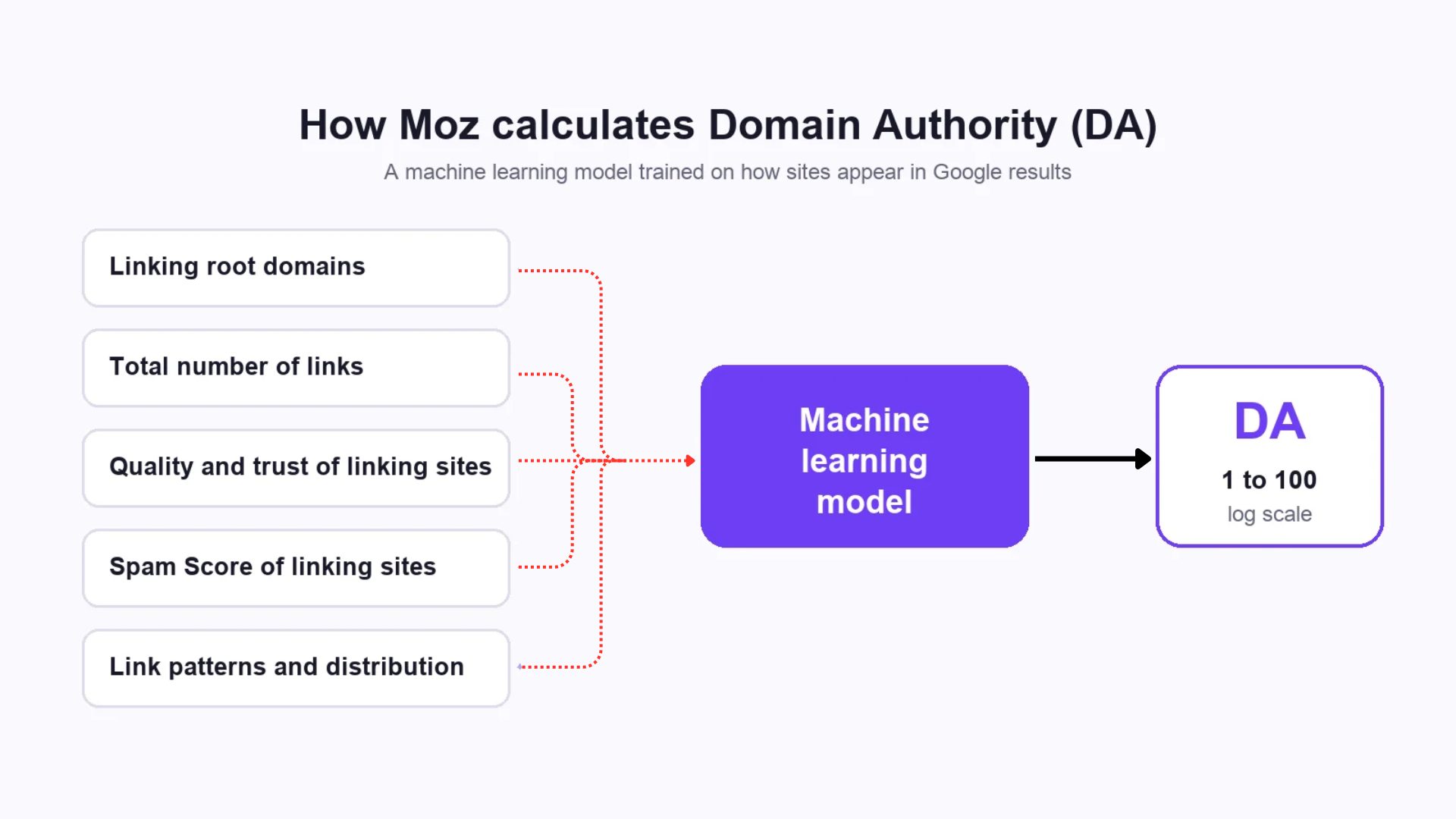
The main inputs include:
Moz introduced this model with Domain Authority 2.0 in 2019. That update added Spam Score and link pattern detection, and sites that relied on comment spam saw their DA fall sharply. Like DR, DA uses a 1 to 100 logarithmic scale and is relative to the rest of the Moz index.
Two features of both metrics explain most of the surprises people see in their dashboards.
Moving from 20 to 30 might take a handful of good links. Moving from 70 to 80 can take hundreds of links from authoritative sites. Ahrefs puts it plainly: going from 84 to 85 is much harder than going from 54 to 55.
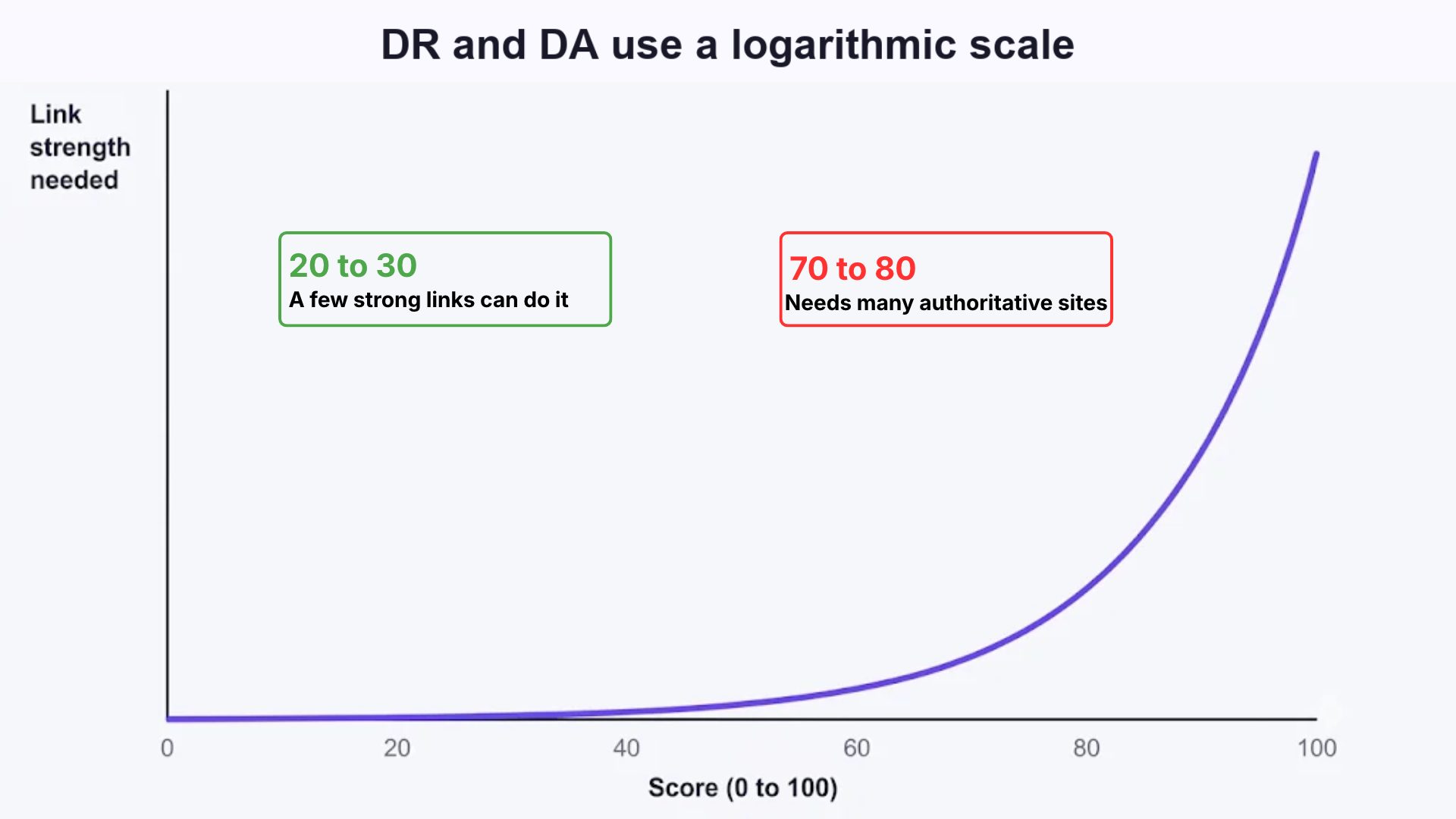
Your score depends on everyone else's. If large sites across the web gain links faster than you, your score can slip even if you lose nothing. Your score can also change when the tool updates its index or its model, as many sites saw with DR4 and DA 2.0.
Other common reasons for a drop:
Because the two tools crawl different parts of the web, the same site often has different DR and DA values. Pick one as your main tracking metric and use the other as a second opinion.
There is no shortcut that works long term. Both metrics are designed to reward the same thing: many real, relevant websites choosing to link to you. These steps help you earn that.
Check your score and the scores of three to five direct competitors in Ahrefs Site Explorer and Moz Link Explorer. Look at how many linking domains each one has, not just the final number. This tells you the realistic gap you need to close.
Use a link intersect or competitor backlink report to list sites that link to several competitors but not to you. Directories, review sites, comparison articles and community pages in your niche are often easy wins.
People link to things that save them time or support their arguments. Strong options include:
For a startup, launch platforms, product directories, integration marketplaces and partner pages are natural link sources. Listing a new product on platforms such as Product Watch, Product Hunt, and relevant niche directories gives you early, legitimate links from sites with real traffic.
Write useful articles for publications your customers read, and answer journalist requests in your area of expertise. Focus on sites with organic traffic and a sensible number of outbound links, since that is exactly what DR4 rewards.
Avoid buying links in bulk, joining link networks or using automated comment and forum spam. These tactics are what DR4 and DA 2.0 were built to discount, and they can also harm your Google rankings. If you inherit a spammy profile, focus on earning good links rather than chasing the bad ones.
Both tools need time to discover new links, and the logarithmic scale means growth slows as you climb. A steady flow of a few good links every month usually beats one large burst.
Domain Rating and Domain Authority are helpful shortcuts for comparing websites, but they are not goals in themselves. Both are built from the same raw material: unique websites that choose to link to you. Ahrefs weighs those links by strength, outbound links, and, with DR4, organic traffic. Moz feeds similar signals into a machine learning model trained on Google results.
If you focus on earning links from real, relevant sites with genuine audiences, both scores tend to rise together, and so does the visibility that actually matters for your business.
