
Blogs in geo
stay updated with the latest news, insights, and guides on geo from ProductWatch.
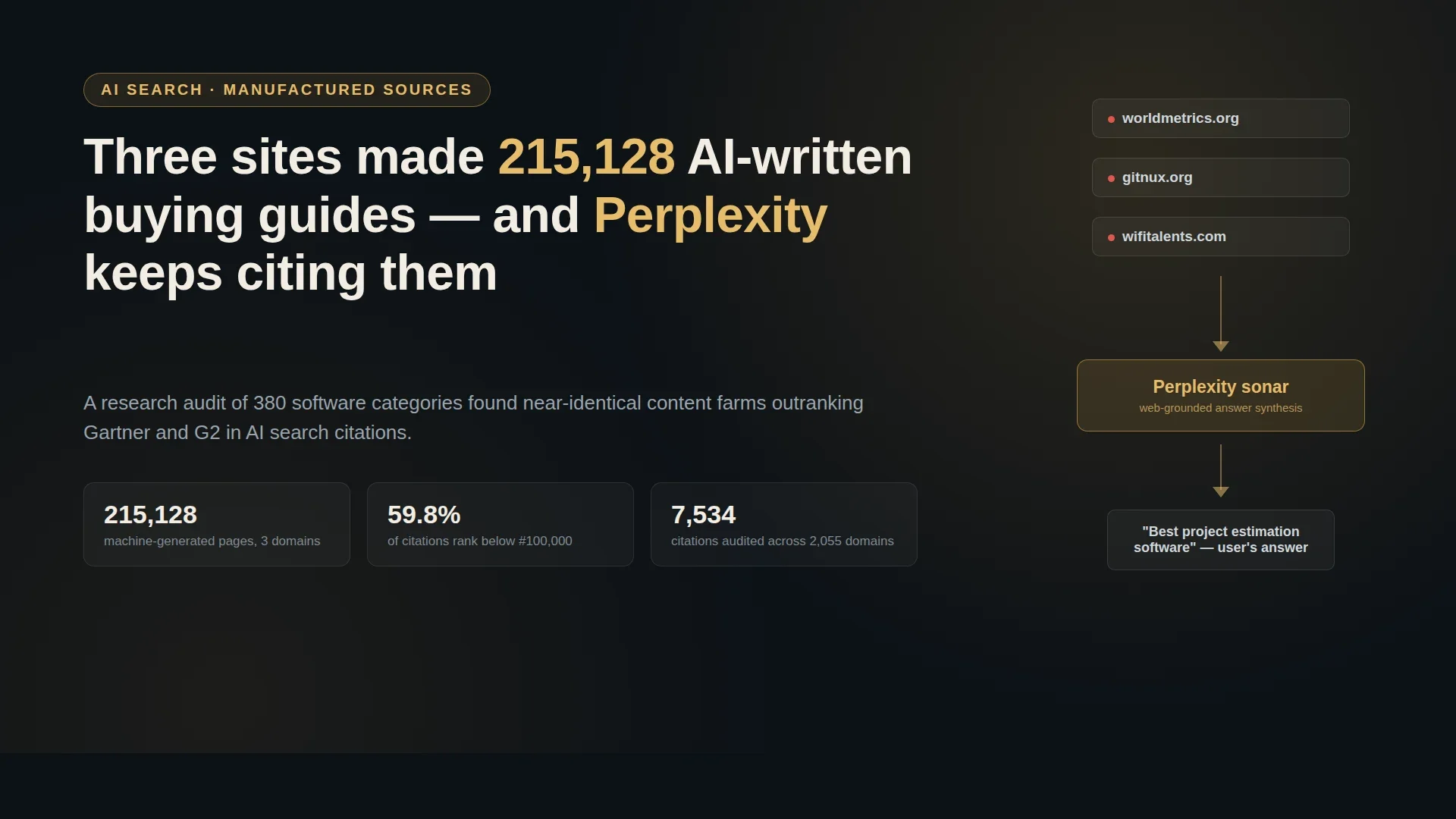
Three sites gamed AI search recommendations with 215,000 fake buying guides
Ask Perplexity for the best project estimation software and, depending on which source it pulls from, you'll get one of at least two different top-five lists, each cited to a research site that looks the same: named analysts, a GDPR badge, a claim of tens of thousands of independently verified software reviews. worldmetrics.org, recommends Float, Scoro, Teamwork.com, and Wrike. wifitalents.com, for the identical question,recommends Float, Scoro, Teamwork.com, Buildertrend, and Apropo. Neither site agrees with the other, and neither is actually independent. They're two of three domains that, according to a report published this week, generated 215,128 near-identical "best software" pages between them and now sit inside the citation graph Perplexity draws on to answer exactly this kind of question. The report comes from Trellner Research, an independent outfit that measures what AI systems actually cite when they answer questions. It queried Perplexity's sonar and sonar-pro models with 380 software-category questions ("best project estimation software," "top research data management platforms," and so on), asked for five ranked recommendations with sourced homepage domains, and logged every citation. The result: 7,534 citations spanning 2,055 distinct domains. It's a small, specific study, but the pattern it surfaces is not small at all. > SUMMARY: > > 1. The finding: Three domains, worldmetrics.org, gitnux.org, and wifitalents.com, published 215,128 machine-generated "best software" pages and now show up as cited sources in Perplexity's answers, more often than Gartner in some categories. > 2. The scale of the miss: 59.8% of all citations in the study point to domains ranked below #100,000 on Tranco's global traffic list; 23.4% aren't ranked in the top million at all. The median cited domain sits at rank 71,611. > 3. The tell: all three sites share the same two Cloudflare nameservers, the same page template and navigation, and were registered through NameCheap within a five-month window in 2023-2024, yet each credits a different set of three "named researchers" for identical rankings. > 4. It's not hypothetical harm: one citation for a research-data-management query resolved to a domain that no longer belongs to the real service and now redirects to a gambling site. > 5. A vendor's own marketing blog, Guideflow, ranked as the third most-cited domain overall, ahead of Gartner, despite not competing in most of the categories it was cited for. > 6. The report is careful about its limits: one prompt wording, one run per category, Perplexity only, no test of whether removing these sources would change the actual recommendations. Read the numbers as a real pattern worth watching, not proof the sources decided the outcome. WHAT THE THREE SITES ACTUALLY LOOK LIKE Open worldmetrics.org or gitnux.org and the pitch is confident: an "independent market research platform," 70,000+ software reviews across nearly a hundred categories, a five-step editorial process, named analysts with degrees from real institutions, and logos claiming citations from Microsoft, Forbes, Bloomberg, and Reuters. gitnux.org says it was founded in 2021. wifitalents.com runs the same pitch with the same structure: custom research from a few thousand euros, software advisory retainers, and a promise that "humans decide what gets published." None of that squares with what Trellner found underneath the branding. All three domains delegate DNS to the identical pair of Cloudflare nameservers, pam.ns.cloudflare.com and sean.ns.cloudflare.com. All three run the exact same page template with the exact same navigation bar: Services, Market Data, Software Advice, Editorial Process, Company. All three were registered through NameCheap between December 2023 and May 2024, a five-month window that doesn't line up with gitnux.org's own "founded in 2021" claim on its About page. The tell that's hardest to explain away is the bylines. Each page carries three named staff credits that never repeat across sites: Worldmetrics credits Kathryn Blake, Alexander Schmidt, and Victoria Marsh; Gitnux credits Diana Reeves, Helena Kowalczyk, and Olivia Thornton; WifiTalents credits Ryan Gallagher, Isabella Rossi, and Natasha Ivanova. Nine distinct named "researchers," for the identical project-estimation-software ranking, none of whom appear to have actually written anything, since the underlying page is a template. Trellner also found unrendered template variables surfacing in some bylines, like a "Within the next 26 days" placeholder that was clearly meant to be filled in by a script and never was. THE CITATION TABLE NOBODY WAS TRACKING Here's where it gets concrete. Across all 7,534 citations Trellner logged, the top of the table looks roughly like what you'd expect, mixed in with what you wouldn't: | Domain | Citations | Share | Tranco rank | | | : | : | : | | g2.com | 291 | 3.86% | 4,027 | | reddit.com | 261 | 3.46% | 105 | | guideflow.com | 194 | 2.57% | 177,039 | | gartner.com | 158 | 2.10% | 1,766 | | zapier.com | 82 | 1.09% | 2,919 | | wifitalents.com | 71 | 0.94% | 105,281 | | capterra.com | 68 | 0.90% | 6,387 | | linkedin.com | 67 | 0.89% | 18 | | worldmetrics.org | 60 | 0.80% | 104,737 | | gitnux.org | 50 | 0.66% | 42,759 | Three of the ten most-cited domains for software buying decisions are the manufactured network. Between them they out-cite Zapier, Capterra, and LinkedIn. And that top-10 list is the tame part: outside it, 59.8% of all citations point to domains ranked below #100,000 globally, 23.4% aren't in the Tranco top million at all, and the median cited domain sits at rank 71,611. Only 17.3% of citations concentrate in what you'd call the top ten "real" sources. The long tail isn't a rounding error, it's most of the answer. WHEN A MARKETING BLOG OUTRANKS GARTNER The other name worth sitting with is guideflow.com, sitting at #3 with 194 citations, ahead of Gartner's 158. Guideflow sells interactive product-demo software. It does not operate in most of the categories where Trellner found it cited, and its blog is, by the report's description, standard content-marketing material aimed at driving signups, not neutral comparison research. It still became "the third-largest evidence base" behind Perplexity's software recommendations, simply because it publishes a lot of content that happens to be structured the way these models like to extract from. That's the part that should worry anyone who has spent the last year hearing "just optimize for AI search" as the new SEO advice. It's true that AI answer engines reward clearly structured, frequently updated, citation-dense content; we wrote about the mechanics of that in our guide to Generative Engine Optimization. What this report adds is the uncomfortable flip side: that same reward function doesn't distinguish a neutral analyst from a vendor's own sales blog, or from three shell domains built specifically to look like one, provided the formatting checks the right boxes. THE BROKEN LINKS ARE THE PART THAT SHOULD HAVE CAUGHT SOMEONE Trellner also spot-checked whether the recommended vendor URLs actually resolved. 1.1% didn't. One example given in the report: a citation for "research data management platforms" pointed a reader toward dryad.co, presumably meant to be the well-known Dryad data repository, but the domain has since lapsed and now redirects to an Indonesian gambling site. Another recommendation, for Monte Carlo-style data tooling, pointed to a URL that now belongs to a Monegasque casino portal. Neither of these is a subtle SEO trick. They're stale links nobody bothered to re-verify, surfaced with full confidence as a citation inside an AI-generated answer that looks, at a glance, exactly as authoritative as every other line in the response. WHAT THE REPORT DOESN'T CLAIM To its credit, Trellner is explicit about where the evidence stops. The methodology is one prompt wording per category, one run, no repeat sampling, and it covers Perplexity's sonar models only, not ChatGPT, Gemini, or any other AI search product. The authors write plainly: "We have not shown that any of this changes the answers," and they didn't test the counterfactual of what Perplexity would recommend if these three domains were removed from its index entirely. It's entirely possible the underlying vendor rankings would look similar either way, since programmatic sites like these tend to scrape and remix the same public review data everyone else does. What the report does establish, carefully, is narrower and still significant: that a small, coordinated, unverifiable content network occupies real, measurable space inside the evidence base an AI search product presents as sourced fact, and that space is comparable to or larger than what long-established, actually-independent analyst firms occupy in the same answers. WHY THIS MATTERS PAST SOFTWARE LISTICLES The three sites in this report happen to sell "software advisory" and market research, which makes the story easy to dismiss as a B2B SaaS problem. It isn't. The same programmatic-content playbook, register a domain, adopt research-site branding, generate tens of thousands of templated pages, works for any category an AI search engine gets asked about: health supplements, financial products, legal services, hardware reviews. Software recommendations are just the category someone happened to audit first, with a public, checkable list of domains that anyone can verify by loading the pages. For founders and indie hackers, there are two takeaways worth carrying past the headline number. First, "an AI search engine recommended us" is not by itself a signal that you've earned real trust with a model. It might just mean your competitor's citation farm hasn't gotten around to your category yet, or already has, and is quietly outranking you with a page that took thirty seconds to generate. Second, if you're relying on ChatGPT, Perplexity, or Gemini traffic as a growth channel, it's worth actually checking who else gets cited alongside you for your category, the way Trellner did manually here. Run the query yourself, note every domain cited, and look up who's actually behind them. It costs five minutes and tells you whether you're competing against real alternatives or against a template with a different logo on it. None of this means AI search is untrustworthy across the board. It means the citation graph underneath it is exactly as gameable as the link graph underneath classic SEO was fifteen years ago, just with less scrutiny on it so far, because most people still assume "cited source" means "verified source." That gap is where 215,128 pages came from, and it's very unlikely to be the last network built to fill it. CONCLUSION AI citations can drive visibility, but being cited does not automatically mean a source is trustworthy. For SaaS brands, the focus should be on building accurate product information, credible reviews, community mentions, and trusted sources that AI systems can confidently reference. The key is not just getting cited, but understanding why you are being cited.
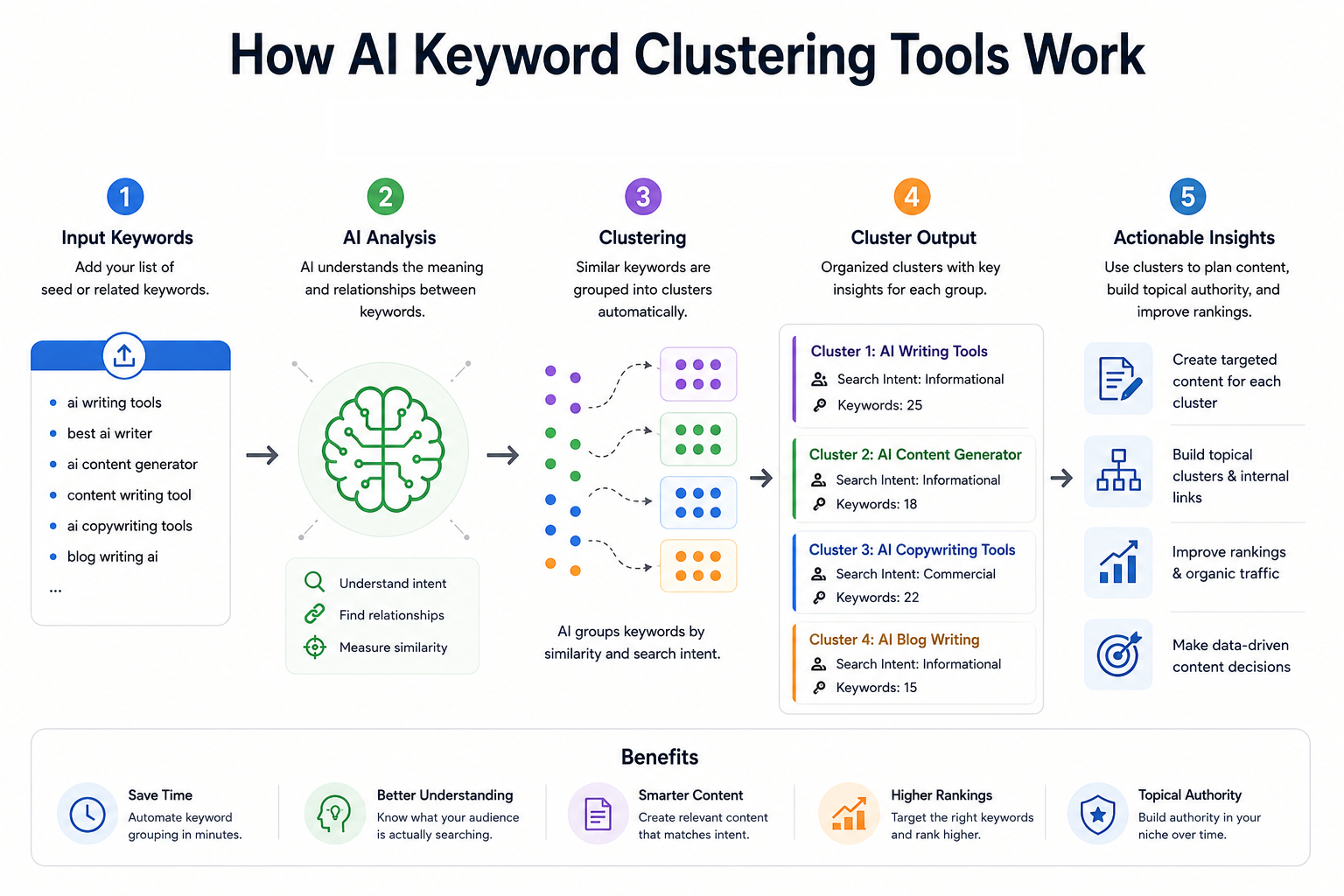
10 Best AI Keyword Clustering Tools in 2026 for Better SEO & Content Strategy
Keyword clustering has become an important part of modern SEO because one search query rarely represents the entire topic a user wants to understand. A SaaS founder researching “API monitoring,” for example, may also need content around API monitoring tools, API observability, API testing, uptime monitoring, alerts, dashboards, and related implementation questions. Treating every variation as a separate article can create overlapping pages, thin content, and keyword cannibalization. AI-assisted keyword clustering tools solve this by grouping related queries into logical topics based on factors such as search intent, semantic similarity, shared SERPs, ranking URLs, and topic relationships. The result is a clearer content architecture that can help developers, solo-founders, SaaS teams, and content teams decide which keywords belong on the same page and which deserve separate pages. The tools in this list take different approaches. Some, such as Keyword Insights and Keyword Cupid, are dedicated clustering platforms. Others, including Ahrefs and Semrush, combine clustering with large-scale keyword research and competitive SEO data. Surfer and Frase connect clustering with content optimization, while MarketMuse takes a broader topic-authority approach. KeyClusters focuses on pay-as-you-go SERP clustering, and Answer Socrates is particularly useful for question-led keyword discovery and clustering. One important distinction is that not every platform here is an AI-first keyword clustering product. Some use proprietary algorithms, SERP analysis, machine learning, or semantic models rather than generative AI. For SEO, that distinction matters less than the quality of the resulting clusters and whether those clusters reflect actual search behavior. > QUICK SUMMARY > > * Keyword Insights: A dedicated SERP-based clustering platform that analyzes live, country-specific search results and supports clustering up to 200,000 keywords at once. > * Keyword Cupid: A SERP-based clustering platform with neural-network clustering, SERP analysis, silo structuring, mind maps, and large keyword-report limits depending on the plan. > * Semrush: A broad SEO platform whose Keyword Strategy Builder organizes keywords into topics, pillar pages, and subpages, with clustering actions available across paid SEO Toolkit plans. > * Ahrefs: A full SEO suite with Keywords Explorer clustering by Parent Topic and related terms, backed by a large keyword database and extensive competitive SEO data. > * Surfer: A content-focused SEO platform whose Keyword Research feature groups keywords by intent and competitor SERP data and connects clusters directly to content optimization workflows. > > KeyClusters, Answer Socrates, LowFruits, MarketMuse, and Frase: These cover pay-as-you-go SERP clustering, question-led keyword discovery, SERP and semantic clustering, topic-authority analysis, and visual topic-cluster planning respectively. COMPARATIVE TABLE: BEST AI KEYWORD CLUSTERING TOOLS | Tool | Key clustering features | Starting price | Best for | Free or paid | | | | : | | | | Keyword Insights | Live SERP clustering, adjustable SERP overlap, search intent, ranking URLs, opportunity volume, up to 200K keywords | $58/month | Dedicated large-scale keyword clustering | Paid, $1 trial | | Keyword Cupid | SERP-based clustering, neural-network clustering, SERP Spy, silo structuring, mind maps, geo/device targeting | $9.99/month | SEO professionals and agencies needing detailed clustering | Paid, 7-day trial | | Semrush | Keyword Strategy Builder, topic clusters, pillar pages, subpages, keyword metrics, content workflow | $139.95/month | All-in-one SEO and content strategy | Paid, 7-day trial | | Ahrefs | Parent Topic clustering, related-term clustering, SERP similarity, keyword metrics, Traffic Potential | £99/month | Developers and teams needing clustering plus competitive SEO | Paid | | Surfer | SERP-driven keyword clusters, intent, sub-keywords, content-score benchmarks, Topical Maps | $99/month or $79/month annually | Content-focused SaaS teams and writers | Paid | | KeyClusters | Real-time Google SERPs, 3+ shared URLs, CSV export, Ahrefs/Semrush imports, geo/device targeting | $19 one-time credit pack | Pay-as-you-go clustering | Paid credits | | Answer Socrates | Keyword research, question discovery, clustering, PAA, recursive searches, trending topics | Free; paid from $15/month | Question-led content and solo founders | Free + paid | | LowFruits | SERP clustering, semantic clustering, intent grouping, low-competition analysis, SERP scores | $29.90/month | Niche sites and low-competition SEO | Paid + PAYG | | MarketMuse | Cluster Analysis, topic modeling, personalized difficulty, Topic Authority, content gaps, content planning | Free tier; paid plans via demo | Topic authority and content planning | Free + paid | | Frase | Visual topic clusters, pillar/supporting pages, missing subtopics, briefs, SEO/GEO optimization | $49/month or $39/month annually | Content teams building topical authority | Paid, 7-day trial | 1. KEYWORD INSIGHTS Keyword Insights is one of the most specialized options in this list. Its primary focus is keyword clustering rather than treating clustering as a small feature inside a much larger SEO suite. The platform uses live, country-specific SERP data and groups keywords when their ranking URLs overlap. The default SERP overlap threshold is 40%, and users can adjust the clustering settings depending on how strict the grouping needs to be. The scale is particularly relevant for large SaaS websites, programmatic SEO projects, agencies, and developers managing thousands of product-related queries. The platform currently supports clustering up to 200,000 keywords in one operation. Reports can include ranking URLs, average rankings, search intent, potential traffic opportunities, difficulty, and SERP features. Another useful feature is intent analysis. The system classifies keywords into informational, commercial, transactional, and other intent categories and can identify the dominant intent of a cluster. This makes the output more actionable than a simple spreadsheet containing groups of similar phrases. A developer launching documentation, comparison pages, or SaaS landing pages can use the intent information to decide whether a cluster should become a guide, feature page, comparison page, or commercial landing page. Price: The current pricing page lists Basic at $58/month with 10,000 credits and Professional at $99/month with 20,000 credits. Clustering costs one credit per keyword, while a $1 seven-day trial provides 5,000 credits and allows up to 500 keywords to be clustered. Enterprise pricing is custom. Best for: For teams that want a clustering-first workflow rather than a general SEO suite, this is one of the strongest options. The ability to control SERP overlap and work with large keyword sets makes it particularly useful for SaaS companies with extensive feature, integration, documentation, or comparison-page inventories. 2. KEYWORD CUPID Keyword Cupid approaches clustering through search-result relationships and is specifically designed for keyword grouping. Its system analyzes live Google SERPs and examines ranking URLs that appear across multiple keywords. Keywords with meaningful SERP overlap are grouped according to search intent, creating clusters that can then be used for content and site architecture. The platform goes beyond simply producing a CSV of grouped keywords. Its feature set includes SERP Spy, URL Analyzer, content briefs, neural-network clustering, interactive mind maps, downloadable Excel reports, SERP geotargeting, and device or search-engine targeting. It also supports silo structuring, which can be useful when the goal is to turn keyword research into an actual website architecture. For developers and solo-founders, the "Bring Your Own Data" approach is useful because keyword research can be collected elsewhere and then sent into the clustering workflow. This makes it possible to export keyword data from another SEO platform, upload it, and use the clustering engine to decide which terms should share a page. Price: The Starter plan costs $9.99/month and includes 500 keyword credits per month with reports supporting up to 2,000 keywords. Freelancer costs $49.99/month with 5,000 credits and up to 20,000 keywords per report. Agency costs $149.99/month with 20,000 credits and reports of up to 40,000 keywords, while Enterprise costs $499.99/month with 80,000 credits and reports of up to 80,000 keywords. A seven-day trial is available. Best for: The main advantage is depth. If the goal is simply to group 500 keywords, there are cheaper and simpler approaches. If the goal is to understand how keywords relate to SERPs, pages, silos, and search intent, Keyword Cupid provides a more specialized workflow. 3. SEMRUSH Semrush is better understood as an all-in-one SEO platform that happens to have a substantial keyword clustering workflow. Its Keyword Strategy Builder can analyze and organize up to 10,000 keywords into topics, pillar pages, and subpages. Users can start from seed keywords, import research from other Semrush tools, or upload their own keyword lists. The structured workflow is useful for building a content architecture rather than merely obtaining keyword groups. The system considers relevance, search volume, keyword difficulty, domain diversity, and SERP features when prioritizing pages. Users can then send keywords to content workflows or Position Tracking, making the transition from research to execution relatively direct. For a developer-led SaaS business, this wider ecosystem can be valuable. A founder may begin with competitor keywords, move those terms into Keyword Strategy Builder, organize them into pillar and supporting pages, and then use the rest of the platform for site audits, ranking tracking, competitor research, and content production. Price: The current SEO Toolkit pricing lists Pro at $139.95/month, Guru at $249.95/month, and Business at $499.95/month. Keyword Strategy Builder clustering actions are limited by plan, with 10 monthly actions on Pro, 30 on Guru, and 50 on Business. Semrush also advertises a seven-day free trial. Best for: Semrush makes the most sense when keyword clustering is only one part of a larger SEO operation. It is more expensive than specialist clustering tools, but the additional competitor, technical SEO, content, and rank-tracking capabilities can justify that cost for growing SaaS companies and agencies. 4. AHREFS Ahrefs takes a slightly different approach to keyword clustering. Keywords Explorer can instantly group keywords by Parent Topic or related terms, allowing users to identify which searches can potentially be targeted by the same page. The platform combines this with keyword difficulty, search volume, Traffic Potential, SERP analysis, and a very large keyword database. Its Parent Topic concept is especially useful for understanding whether a specific keyword belongs under a broader search topic. Ahrefs explains that the Parent Topic is determined from the keyword responsible for sending the most traffic to the top-ranking page. This makes the clustering approach closely connected to actual ranking behavior rather than simply matching words. The tool also provides a SERP similarity comparison for checking whether two individual keywords should be targeted by the same page. This is useful when a developer is deciding between two potentially overlapping articles, such as "API monitoring tools" and "API observability tools." If the SERPs are highly similar, combining them may make more sense than publishing two competing pages. Price: The current Ahrefs pricing page lists the Lite plan at £99/month, Standard at £199/month, and Advanced at £359/month. Annual billing can save up to 17%. Best for: Ahrefs is particularly suitable when clustering needs to sit alongside backlink analysis, competitor research, keyword research, SERP analysis, and traffic estimation. It is not the cheapest choice for clustering alone, but it becomes considerably more compelling when SEO research is part of a broader growth workflow. 5. SURFER Surfer connects keyword clustering directly with content planning and optimization. Its Keyword Research feature analyzes top-performing Google results for a target keyword and identifies how terms are grouped by intent. Each cluster can contain a main topic keyword, search intent, suggested sub-keywords, and a benchmark based on the content scores of ranking pages. The workflow is particularly useful for content teams that do not want to stop at keyword grouping. Once a cluster has been identified, it can be sent into Content Editor to create a content brief. This makes it possible to move from keyword discovery to article planning without manually copying every related keyword into another document. For SaaS teams, this can help when building topical coverage around developer-oriented subjects. A cluster around "webhook testing," for example, could reveal related searches around webhook debugging, webhook testing tools, local webhook testing, webhook security, and webhook automation. Those terms can then inform a pillar page and supporting articles instead of becoming a collection of disconnected posts. Price: Surfer's current Essential plan is $99/month, or $79/month when billed annually. It includes Keyword Research, Topical Maps, 30 Content Editor articles per month, and five AI articles per month. Scale costs $219/month or $175/month annually and raises the limits substantially. Enterprise pricing is custom. Best for: Surfer is a good choice when the real objective is not just clustering keywords but turning those clusters into optimized content. Its strongest use case is therefore content-led SEO teams, SaaS marketers, founders publishing regularly, and developers who also handle their own technical content. 6. KEYCLUSTERS KeyClusters is built around a straightforward concept: upload a keyword list, let the system analyze Google SERPs, and receive the keywords grouped according to shared ranking pages. It checks the top 10 results for each keyword and groups keywords when three or more ranking pages are shared. The pay-as-you-go model makes it different from most large SEO suites. There is no recurring subscription. Users purchase credits, and one credit represents one keyword. Credit packs include 2,500 keywords for $19, 20,000 for $110, and 100,000 for $350. Credits do not expire. The workflow also supports keyword files from Ahrefs and Semrush, along with custom files. Results can be exported to Excel, and the platform supports real-time SERP data, geographic targeting, desktop and mobile clustering, and large-scale keyword processing. That makes it practical for someone who already has keyword research and only needs a dedicated clustering layer. Price: The entry point is $19 for 2,500 keyword credits, with larger packs reducing the cost per keyword. There is no monthly subscription, no recurring charge, and no credit expiration. Best for: For solo-founders, developers, and agencies that only need clustering occasionally, this pricing model can be attractive. Instead of paying for a full SEO suite every month, a team can buy credits when a new content project begins and process the keyword set in one batch. 7. ANSWER SOCRATES Answer Socrates began with question-focused keyword research, but its current feature set also includes keyword clustering and grouping. The platform can generate search ideas from a seed topic, surface People Also Ask questions, identify long-tail searches, and organize related keywords into topic clusters. The question-first approach is particularly useful for developers building documentation, tutorials, help centers, and educational SaaS content. Instead of beginning with a large commercial keyword such as "API gateway," a developer can discover questions around how API gateways work, why they are used, API gateway security, API gateway vs reverse proxy, and implementation-related queries. The platform also includes recursive search, which can uncover additional searches connected to the initial research path. It supports country and language selection, CSV downloads, trending-topic research, and an LLM Brand Tracker. This combination makes it useful for content planning that needs to account for both traditional search and emerging AI-search visibility. Price: There is a free version for basic research. Paid plans currently start with Socrates Lite at $15/month, followed by Seneca at $29/month, Aurelius at $49/month, and Senate at $299/month. Paid plans add SEO metrics, larger keyword allowances, recursive searches, clustering credits, CSV downloads, and LLM tracking depending on the tier. Best for: This is one of the better choices for solo-founders and developers who want to understand what people actually ask rather than only looking at traditional head keywords. It is especially useful for FAQs, documentation, tutorials, comparison content, and question-driven content hubs. 8. LOWFRUITS LowFruits combines keyword discovery, SERP analysis, low-competition research, and keyword clustering. Its clustering workflow has two primary methods: SERP clustering and semantic clustering. SERP clustering groups keywords according to shared ranking URLs, while semantic clustering groups terms according to shared word patterns. The SERP method is particularly interesting because the default grouping threshold is based on a 40% URL overlap. Users can adjust the similarity threshold, allowing the clusters to become broader or narrower depending on the project. The platform also identifies the keyword with the highest estimated search volume as the main keyword for a cluster. LowFruits is also designed around finding weaker SERPs and lower-competition opportunities. That makes the clustering output more useful for smaller sites that cannot realistically compete with high-authority domains for every broad keyword. The platform can export keyword lists containing cluster information, which is useful when building content plans in spreadsheets or project-management tools. Price : The Standard plan costs $29.90/month, or $20.75/month when billed yearly, and includes 3,000 credits per month. Premium costs $79.90/month, or $62.45/month annually, with 10,000 credits. Pay-as-you-go credits start at $25 for 2,000 credits, and purchased PAYG credits remain valid for one year. Best for: LowFruits is a strong option for niche-site builders, smaller SaaS projects, affiliate sites, and founders who want keyword clusters combined with practical competition analysis. It is less focused on enterprise content governance than MarketMuse or Semrush, but its low-competition orientation can make the resulting clusters easier to act on. 9. MARKETMUSE MarketMuse approaches keyword clustering as part of a broader topic-authority and content-planning system. Its Cluster Analysis workflow can group topics and keywords while also examining rankings, search volume, intent, URLs, Topic Authority, Personalized Difficulty, parent terms, and competitive information. The platform's Topic Model is another important part of the workflow. It analyzes related topics and provides information such as volume, CPC, and trend data. Those topics can then be added to an inventory and used to build content plans and briefs. This makes the system more focused on understanding an entire subject than simply grouping a spreadsheet of keywords. MarketMuse can also analyze a site or collection of pages to determine what content already exists within a topic cluster, what is missing, and what should be updated or created. Its personalized metrics are designed to account for the authority and coverage of a particular website rather than relying only on generic keyword difficulty. Price: MarketMuse has a Free plan with one user and 10 queries per month. Paid tiers include Optimize with 100 tracked topics, Research with 1,000 tracked topics, and Strategy with 10,000 tracked topics. The current public pricing page does not display dollar amounts for those paid tiers and instead directs users to book a demo. Best for MarketMuse is best suited to teams that care about topical authority, content gaps, existing-site analysis, and content prioritization rather than simply producing keyword groups. For a mature SaaS site with hundreds of articles, documentation pages, and product resources, that broader perspective can be more valuable than clustering alone. 10. FRASE Frase has evolved from a content research and optimization platform into a broader SEO and GEO content workflow. Its Topic Clusters feature maps pillar pages and supporting content, identifies missing subtopics, and turns those gaps into content briefs. The result is a visual representation of how content fits together around a central topic. The cluster map is particularly useful for content teams that need to understand their website architecture. Instead of receiving a list of keywords and deciding manually where everything belongs, the platform can suggest where a new piece of content fits within existing clusters. It also surfaces questions and sections found in ranking results that the current cluster does not adequately cover. The GEO component is increasingly relevant for 2026. Frase can score content for both SEO and GEO and provides AI visibility features involving systems such as ChatGPT and Google AI. It also supports planning, research, and writing in more than 70 languages, which makes it useful for teams building content for multiple markets. Price: The Starter plan costs $49/month month-to-month, or $39/month when billed yearly. Professional costs $129/month month-to-month, or $103/month annually. Scale costs $299/month month-to-month, or $239/month annually. A seven-day free trial is available without a credit card. Best for: Frase is a strong fit for content teams that want keyword and topic clustering connected directly to briefs, writing, optimization, publishing, and GEO analysis. For solo founders, Starter provides a relatively accessible entry point, while larger content operations can use the higher tiers for multiple sites and users. HOW TO CHOOSE THE RIGHT KEYWORD CLUSTERING TOOL The right choice depends less on the word "AI" and more on how the tool decides that two keywords belong together. A semantic model may group keywords because they look similar linguistically, while SERP-based systems look at whether Google ranks similar pages for those queries. For SEO content planning, SERP-based clustering can often provide a clearer indication of whether two searches can realistically be targeted by one page. For developers and SaaS founders, Keyword Insights, Keyword Cupid, KeyClusters, and LowFruits are worth considering when clustering itself is the primary requirement. They are particularly useful when there is already a keyword list from another source and the next question is, "Which of these keywords should share a page?" For teams that need a complete SEO workflow, Semrush and Ahrefs make more sense. Their clustering features sit alongside keyword research, competitor analysis, rank tracking, backlinks, SERP analysis, and other SEO capabilities. That broader functionality can justify the higher subscription cost when SEO is a major acquisition channel. For content-heavy teams, Surfer, MarketMuse, and Frase offer a different advantage. They connect clustering with content optimization, topic authority, briefs, content gaps, and publishing workflows. This is particularly useful for SaaS companies that need to transform keyword research into a repeatable editorial system. Answer Socrates is the standout option when questions and long-tail searches are central to the strategy. A developer writing technical tutorials, documentation, FAQ pages, or educational content can use question-led clusters to understand what users are trying to solve, not simply what short keyword they entered into Google. KEYWORD CLUSTERING BEST PRACTICES FOR DEVELOPERS AND SAAS FOUNDERS Keyword clustering should not mean putting every keyword containing the same words on one page. The most important question is whether the searches have sufficiently similar intent and SERPs. If "API monitoring" produces tool pages while "how does API monitoring work" produces educational guides, they may belong to different content types even though they contain the same core phrase. A practical workflow is to begin with a broad keyword list, remove irrelevant terms, cluster the remaining keywords, and then inspect the SERPs for the largest or most commercially important clusters. This additional manual review matters because automated clustering is an aid to decision-making, not a substitute for understanding the search landscape. For SaaS websites, clusters can also be mapped to different page types. Informational clusters can become guides and tutorials. Commercial investigation clusters can become comparison or alternatives pages. Transactional clusters can support product, feature, integration, or landing pages. Question clusters can feed documentation, FAQ, and educational resources. Internal linking should then connect related pages. A pillar page can cover the broad concept while supporting pages answer narrower questions. This creates a useful structure for visitors and gives search engines clearer signals about how individual pages relate to the broader subject. Keyword clustering is also useful for avoiding unnecessary content production. If five keywords consistently return the same type of pages in Google, publishing five separate articles may create competing pages instead of five independent ranking opportunities. Combining those queries into one comprehensive page can provide broader topical coverage while keeping the site architecture cleaner. CONCLUSION The best AI keyword clustering tool is not necessarily the one with the most AI features. The more important question is whether it produces clusters that reflect actual search intent, SERP relationships, and the way users expect information to be organized. For a developer or solo-founder starting a SaaS content strategy, a simple workflow can be enough: discover keywords, cluster them by search behavior, identify the primary intent, assign each cluster to a page type, and build internal links between related pages. As the website grows, more advanced platforms can add ranking data, competitive analysis, personalized difficulty, content briefs, topic authority, and GEO insights. Among the ten options, Keyword Insights is particularly compelling for dedicated large-scale clustering, Ahrefs and Semrush are strong for broader SEO research, Surfer and Frase are useful for content execution, MarketMuse stands out for topic authority, LowFruits, is well suited to lower-competition opportunities, KeyClusters works well for pay-as-you-go clustering, Keyword Cupid provides a specialized clustering environment, and Answer Socrates is particularly useful for question-driven content research. The most effective approach is to use keyword clusters as a planning layer rather than treating them as an SEO shortcut. When clusters are based on genuine search behavior and then translated into useful pages, clear site architecture, strong internal linking, and comprehensive answers, they can become the foundation of a scalable SEO and GEO strategy.
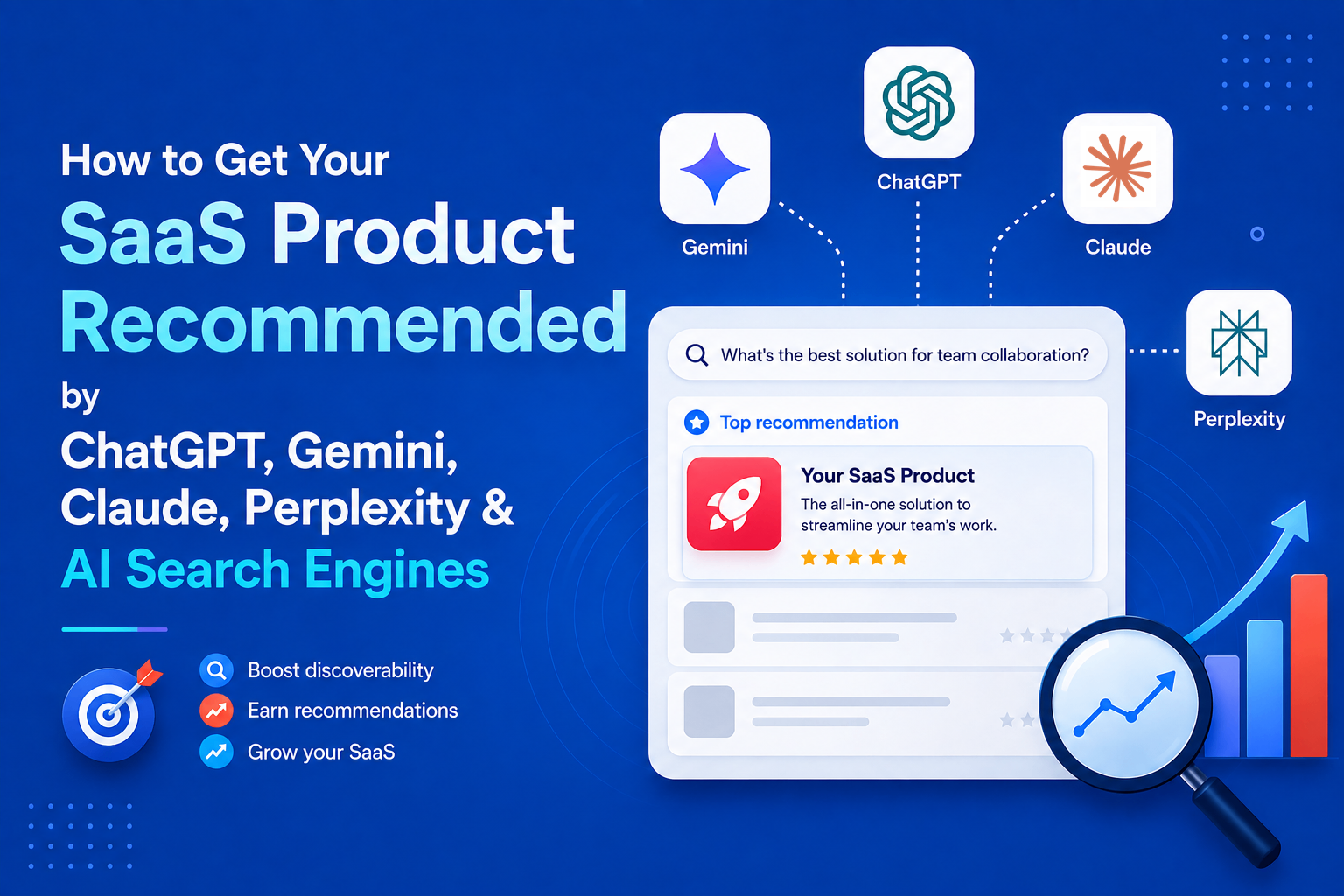
How to Get Your SaaS Product Recommended by ChatGPT, Gemini, Claude, Perplexity & AI Search Engines
A SaaS buyer who once searched Google for “best project management software” can now ask ChatGPT, Gemini, Perplexity, Claude , or Google AI Mode the same question in natural language: “What’s the best project management tool for a 10-person remote team?” Instead of returning a list of blue links, these systems can synthesize information from multiple sources and recommend a small set of products. That changes how SaaS companies need to think about search visibility. Ranking on Google still matters, but it is no longer the only way a potential customer can discover a product. AI search visibility is becoming an additional layer of SaaS SEO. It combines technical SEO, clear product positioning, useful content, third-party mentions, review platforms, community discussions, and consistent brand information across the web. There is no single tactic that guarantees a product will be recommended by an AI search engine. However, research from Google, OpenAI, Anthropic, Perplexity, Microsoft, Ahrefs, Semrush, and independent researchers reveals several recurring patterns. This guide explains what those patterns mean for SaaS companies and how to build a practical strategy for increasing visibility across ChatGPT, Google AI, Gemini, Perplexity, Claude, and Microsoft Copilot. > QUICK ANSWER > > For SaaS companies, AI search visibility comes down to six core areas: > > 1. Technical accessibility: Make sure search engines and AI crawlers can discover, crawl, and understand important pages. > 2. Entity clarity: Clearly explain what the product does, who it is for, what problem it solves, and how it differs from alternatives. > 3. Answer-focused content: Create comparison, alternatives, use-case, pricing, integration, and problem-focused content that directly answers buyer questions. > 4. Third-party presence: Build genuine visibility across platforms such as G2, Capterra, Reddit, YouTube, GitHub, Product Watch, Product Hunt, and relevant industry publications. > 5. Brand consistency: Keep product descriptions, categories, audiences, features, and other important facts consistent across the web. > 6. Measurement: Track realistic buyer prompts across multiple AI platforms instead of assuming that visibility on one platform means visibility everywhere. > > None of these guarantees a citation or recommendation. AI answers vary between platforms, queries, users, and model updates. The goal is to make the product easy for both people and AI systems to discover, understand, verify, and mention. WHAT "AI SEARCH VISIBILITY" ACTUALLY MEANS FOR A SAAS COMPANY Traditional SEO optimizes for a ranked list of links. AI search systems, including ChatGPT Search, Google's AI Overviews and AI Mode, Gemini, Perplexity, Claude, and Microsoft Copilot, instead synthesize answers from multiple retrieved sources and often attach citations. Princeton, Georgia Tech, the Allen Institute for AI, and IIT Delhi introduced the concept of "generative engines" in their Generative Engine Optimization (GEO) research paper, later published at KDD 2024. In a 10,000-query benchmark, adding citations, statistics, and quotations to content improved visibility by roughly 30 to 40% in their test setup. This was a controlled benchmark, not a guarantee of visibility on today's AI search platforms. Three distinctions matter. First, being retrieved is not the same as being cited: AI systems can retrieve pages without ultimately using them in the answer. Second, visibility is platform-specific. A page cited by Perplexity may not appear in ChatGPT for the same query because platforms use different retrieval and ranking systems. Third, AI visibility is not deterministic. The same prompt can produce different sources, so visibility should be measured as an ongoing trend rather than a one-time ranking. HOW THE MAJOR AI SEARCH PLATFORMS ACTUALLY RETRIEVE AND CITE CONTENT Each platform has published at least some documentation about how it handles web content, and independent research has filled in some of the gaps. None of the platforms discloses its full ranking logic, and none should be assumed to work identically to the others. CHATGPT SEARCH ChatGPT can rewrite a user's request into targeted search queries, retrieve web results, and generate answers with linked sources. OpenAI's OAI-SearchBot crawls sites for search visibility, while third-party research indicates ChatGPT may rely partly on Bing's index for live results. Bing indexing therefore matters alongside Google SEO. GOOGLE AI OVERVIEWS & AI MODE Google says there are no special SEO requirements, schema, or AI-specific files needed for AI Overviews or AI Mode. Pages must be indexed and eligible for normal Google Search. Both features use Google's Search index and existing quality signals, making strong traditional SEO the foundation for visibility. GEMINI Gemini and Google AI Mode use Google's Search infrastructure and Knowledge Graph. Third-party citation research suggests Gemini frequently draws from sources such as YouTube, Wikipedia, and Reddit, depending on the query. PERPLEXITY Perplexity uses its own crawler, PerplexityBot, to retrieve and cite web content. Its retrieval system evaluates multiple candidate pages before selecting sources based on factors such as relevance, freshness, and content structure. Fresh, recently updated content appears particularly important for fast-moving topics. CLAUDE Claude's web search and Research features provide real-time results with citations. Third-party reporting identifies Brave Search as its underlying search provider. Independent analysis of Claude citations has also found a strong presence of practitioner and company blogs containing detailed primary-source information. MICROSOFT COPILOT Microsoft Copilot uses Bing for current web information and applies Bing's ranking signals, including relevance, engagement, and freshness. For SaaS companies, Bing Webmaster Tools, sitemaps, and IndexNow can therefore help improve discoverability in Copilot. PLATFORM COMPARISON | Platform | Search/Web Access | Sources/Citations | SaaS Visibility Considerations | | | | | | | ChatGPT Search | Auto-triggers or manual search; OpenAI crawlers plus third-party search partners (Bing among them) for live retrieval | Inline citations with a linked sources panel; OpenAI documents exactly one official crawler-access lever (allowing OAI-SearchBot) | Bing indexing matters independently of Google; server-rendered, fact-dense pages are more reliably fetched than JS-heavy pages | | Google AI Overviews / AI Mode | Built on the standard Google Search index and Gemini models; no separate crawl or index | Supporting links must already be indexed and snippet-eligible in regular Search; Google states no special schema or markup is required | Classic technical SEO and Search Console health are the primary levers; there is currently no confirmed SaaS-specific override | | Gemini (standalone) | Google Search grounding plus Knowledge Graph; third-party analysis suggests heavier reliance on YouTube, Wikipedia, Reddit for some categories | Citations vary by mode; less transparent sourcing than Perplexity | Video content and community-sourced corroboration may carry more relative weight than on other platforms | | Perplexity | Dedicated PerplexityBot crawler plus live retrieval; roughly ten pages retrieved, three to four typically cited | Always shows inline, clickable citations | Strong, measurable recency bias; review-site and forum trust signals (G2, Trustpilot) reported to carry extra weight for commercial queries | | Claude | Web search tool (Brave Search backend, per independent reporting) and Research feature; both cite sources | Citations reference specific retrieved passages; Anthropic documentation confirms citation behavior but not ranking logic | Third-party analysis suggests a preference for primary-source, well-structured practitioner and company content over aggregated news | | Microsoft Copilot | Routes web queries through the Bing search service across all Copilot surfaces (consumer, Edge, Microsoft 365) | Cited answers; Bing Webmaster Tools now reports "AI Performance" showing which URLs are cited | Bing-specific indexing (Bing Webmaster Tools, IndexNow) is a separate, necessary channel from Google SEO | Two caveats apply to the whole table. None of the platforms discloses its complete ranking algorithm, so the "considerations" column reflects a mix of official documentation and credible third-party research, not confirmed formulas. And overlap between platforms is smaller than intuition suggests. Ahrefs' analysis of citation data found only about 13.7 percent URL overlap between Google's own AI Overviews and AI Mode, and other research has found only around 2 percent of cited URLs appear consistently across AI Overviews, ChatGPT, and Perplexity together. Treating "AI search" as one monolithic channel is a measurable mistake. DEFINING THE SAAS ENTITY CLEARLY Before any content or outreach tactic matters, AI systems first need to understand what the product is, who it serves, and what problem it solves. Generative engines rely heavily on entity recognition, connecting a brand to consistent facts across multiple sources. A useful framework is: For SaaS, a simple entity statement can be: [Product] is a [category] for [audience] that helps them [solve problem]. Instead of vague copy like “an all-in-one platform that helps teams work better,” clearly state something like “asynchronous status-update software for distributed engineering teams.” This gives AI systems concrete signals to match against relevant queries. The same core facts should remain consistent across the official website, G2, Capterra, Product Watch, Product Hunt, LinkedIn, GitHub, founder profiles, and industry coverage. Wording can vary, but category, core function, and audience should not contradict each other. HubSpot's semantic-restructuring experiment also suggests that making key facts explicit and consistently associated with the brand can improve AI citation visibility, although it was only one part of a broader strategy. Product association is the next layer. Category positioning answers “What is this?” while association answers “What tools, workflows, and platforms is it mentioned alongside?” Founder interviews, integration directories, tech-stack articles, comparison pages, and third-party coverage can expand these associations and help a product appear in adjacent AI-generated recommendations. CONTENT STRATEGY: ANSWERING REAL QUESTIONS, NOT JUST PUBLISHING UPDATES Generative engines are frequently used for genuinely comparative and evaluative questions, "what are the best expense management tools for startups," "what's the difference between Linear and Jira for a small engineering team," "what are good alternatives to Asana that are cheaper", and a SaaS company's content has the best chance of being useful to a retrieval system when it exists to answer exactly these questions, rather than existing primarily to announce product releases or promote features. This points toward several content types with a demonstrated logical fit for AI-search queries, though the degree to which any one of them "works" varies by category and competitive density: Comparison and alternatives pages directly match a large share of observed AI search queries in B2B SaaS ("X vs Y," "alternatives to X"), and Search Engine Land's analysis of cited content formats found articles, listicles, and comparison-style product pages among the most frequently cited formats across AI Mode, ChatGPT, and Perplexity. A comparison page written honestly, including where a competitor genuinely does something better, tends to be more citable than one written as thinly veiled marketing, because it more closely matches the kind of even-handed synthesis a language model is trying to produce. Use-case and audience-specific pages ("expense management for remote agencies," "CRM for solo consultants") map onto the highly specific, qualifier-heavy way people phrase conversational AI queries, which tend to be longer and more contextual than typed search queries. Integration pages matter disproportionately for SaaS because buyers frequently ask about compatibility ("does X integrate with Salesforce") as a filtering question before evaluating the product itself. Implementation and how-to guides serve two audiences simultaneously: the human reader deciding whether the product is usable for their situation, and a retrieval system looking for concrete, procedural, extractable answers rather than abstract claims. Pricing-comparison content addresses one of the most common conversational AI queries in SaaS ("what does X cost compared to Y") and is a category where accuracy and freshness matter more than almost anywhere else, since pricing pages go stale quickly and AI systems have been shown to favor recently updated sources for this reason. Problem-focused content, written around the buyer's actual pain point rather than the product's feature list, tends to match how people phrase questions to a conversational assistant more closely than product-centric copy does. What should get comparatively less priority, based on the evidence above, is content whose primary purpose is announcing releases, company milestones, or internal news, not because such content is worthless, but because it rarely matches the kind of evaluative or comparative question that triggers an AI-generated answer with citations in the first place. Product update content still has value for existing users and for direct-traffic engagement; it is simply not where AI-search visibility is most likely to be won. It helps to think concretely about how these queries actually sound in a conversational assistant, since phrasing shapes what gets retrieved. A typed Google query like "expense management software" becomes, in ChatGPT or Gemini, something closer to "what's a good expense management tool for a 15-person agency that already uses Xero, and does it handle multi-currency reimbursements." The qualifiers, team size, existing stack, a specific feature requirement- are exactly the kind of detail a generic homepage rarely addresses but a well-built use-case or integration page does. Content built around these longer, more specific phrasings has a structural advantage: it more closely mirrors both the query itself and the kind of self-contained, directly answerable passage a retrieval system is built to extract. This is also why FAQ-style sections embedded within longer pages, not necessarily marked up with the now-retired FAQPage rich result, but written as clear question-and-answer pairs, continue to have practical value for extraction even where the visual search-result benefit has gone away. Depth matters more than volume here. Search Engine Land's format analysis found listicles, standalone articles, and product pages among the most-cited content types, but none of the underlying research suggests that publishing a higher number of thin pages outperforms fewer, more thorough ones. A single comparison page that accurately covers pricing, feature parity, ideal-customer fit, and honest limitations for both products is more likely to be extracted cleanly than five shorter posts that each cover part of the same ground with less rigor. DO SAAS DIRECTORIES ACTUALLY HELP? Yes, with real caveats. G2's own account of third-party data, corroborated independently by Semrush and by the AI-visibility platform Profound, indicates G2 is disproportionately dominant among software review platforms as a citation source, accounting for roughly one-third to three-quarters of review-site citations across ChatGPT, Google AI Overviews, and Perplexity, depending on the study and platform measured. Separate research from AirOps and from SE Ranking found that review platforms collectively appear in roughly a third of commercial AI Overview answers, with the top five review platforms, Gartner Peer Insights, G2, Capterra, Product Watch, Software Advice, and TrustRadius, accounting for the large majority of review-site citations. In a notable consolidation, G2 completed a $110 million acquisition of Capterra, Software Advice, and GetApp from Gartner in early 2026, meaning a single company now operates several of the most-cited software review destinations. The practical implication is that a G2 and Capterra listing, populated with a meaningful number of genuine, detailed reviews, functions less like a marketing nicety and more like a prerequisite for being included in AI-generated software recommendations for many B2B categories; several independent analyses describe the absence of any review-platform presence as something close to a de facto exclusion from AI recommendation sets for competitive SaaS categories. Product Hunt operates differently: a launch can generate a short-term spike in mentions, backlinks, and community discussion, and Product Hunt pages themselves are occasionally cited directly, but the evidence for Product Hunt as an ongoing citation source is thinner and more anecdotal than the evidence for G2 or Capterra. Smaller or niche directories (SaaSHub, Product Watch, BetaList, category-specific lists) can support discoverability and backlink profiles in a modest way, but no available research shows they function as meaningful AI citation sources in their own right. This is also where a clear line needs to be drawn between legitimate directory presence and low-quality directory spam. Submitting a SaaS product to dozens of low-authority, auto-approval directories primarily built to sell backlinks does not have documented evidence of improving AI visibility, and several of the same studies that show backlink volume correlating only weakly with AI citation (discussed below) suggest this kind of mass submission is largely wasted effort. A small number of relevant, actively used, review-based platforms, where real customers leave real reviews that get periodically refreshed, appear to matter considerably more than a large number of generic listings. WHERE SAAS DIRECTORIES FIT INTO AI SEARCH VISIBILITY SaaS directories can contribute to discoverability, but not all directories provide the same value. A listing on a well-established platform can give AI systems another independent source that confirms what a product is, which category it belongs to, who uses it, and how it compares with other products. Review platforms such as G2 and Capterra are particularly relevant because they contain structured product information, customer reviews, category classifications, comparisons, and other signals that can help establish a product's presence in the software ecosystem. Product discovery platforms and niche SaaS directories can also help create additional references to a product, particularly when their pages are indexed, maintained, and genuinely useful to users. However, submitting a product to hundreds of low-quality directories purely to obtain backlinks should not be confused with building AI search visibility. A large number of duplicate or low-value listings is not a substitute for genuine reviews, community discussion, editorial coverage, useful comparisons, and strong product information. The goal is not to collect the largest possible number of directory links. The goal is to build a consistent and credible web presence around the product. COMMUNITY AND THIRD-PARTY VISIBILITY Independent research consistently finds that the large majority of what AI systems cite about a brand originates from sources the brand does not own or directly control. Muck Rack's analysis of AI citations across ChatGPT, Claude, and Gemini found that the substantial majority of citations traced back to earned media rather than brand-owned domains, with paid or advertorial content accounting for a negligible fraction. Separate analysis attributes only a small single-digit-to-low-double-digit percentage of AI-cited sources to a brand's own website. This reframes the practical objective: a SaaS company's own blog and documentation matter, but the majority of the visibility work happens in coverage, mentions, and discussion the company does not directly author. Reddit and Hacker News discussions occupy an unusual position here. On one hand, several platforms, Gemini and, to a lesser extent, ChatGPT and Perplexity, have been documented drawing on Reddit as a grounding source, and HubSpot's own case study reported Reddit-driven citations of its content growing from roughly 178 in May 2025 to around 146,000 by December 2025, a scale shift the company attributes partly to deliberate community engagement. On the other hand, Reddit's own CEO, Steve Huffman, stated on the company's Q3 2025 earnings call that AI chatbots were not, at that point, a meaningful source of referral traffic back to Reddit, a reminder that a platform can be an important input to AI answers while sending little direct traffic in return, and that community visibility should be evaluated as a citation-source strategy, not primarily as a traffic-generation one. Indie Hackers, relevant subreddits, and product-specific Slack or Discord communities function best as venues for genuine participation rather than promotion: answering real questions, being named organically by other founders and users in threads about tooling choices, and letting a product accumulate the kind of independent, third-party corroboration that both traditional SEO and AI retrieval systems treat as a trust signal. GitHub carries particular weight for developer-facing SaaS products specifically: an active, well-documented repository, responsive issue handling, and genuine community contribution function as both a technical credibility signal and a discovery surface, since developer questions about tooling are disproportionately likely to surface GitHub activity, README content, and developer blog posts in both traditional search and AI-assisted coding tools. The distinction between being present and being mentioned is important. Creating a Reddit account and repeatedly posting links to a product does not create the same signal as a product being discussed by independent users. Similarly, having a GitHub repository is different from having developers reference, contribute to, or discuss that repository. For AI search, the stronger objective is not simply to publish more links. It is to become part of the existing conversations around a category, problem, workflow, or use case. The core limitation to keep in mind: none of this research supports treating a single viral Reddit thread, one well-performing Hacker News post, or one favorable YouTube review as proof of a repeatable strategy. These are individual data points in a large and shifting system, useful for identifying directional patterns rather than as standalone case studies. TECHNICAL SEO AND STRUCTURED DATA: WHAT STILL MATTERS, AND WHAT DOESN'T Google's own documentation is explicit that AI Overviews and AI Mode rely on the same underlying index and ranking systems as regular Search, and that a page ineligible for a normal Search snippet is not going to appear in either AI feature. That single fact does most of the work in explaining why technical SEO fundamentals have not become obsolete: crawlability (robots.txt not blocking relevant bots, no accidental noindex tags), clean XML sitemaps, sensible internal linking, server-side or properly hydrated rendering for JavaScript-heavy sites, reasonable page performance, and a healthy Search Console account remain foundational, not because they are new AI-search tactics, but because AI features are downstream of the same indexing pipeline as everything else. For crawler access specifically, each AI platform operates named bots that a SaaS site can allow or block through robots.txt: OpenAI's GPTBot and OAI-SearchBot, Google's crawlers (including the Google-Extended designation relevant to AI training and features), Anthropic's ClaudeBot, PerplexityBot, and Bingbot for Microsoft's ecosystem. Blocking a platform's crawler is a legitimate choice some publishers make for data-use reasons, but it comes with a direct visibility trade-off for that specific platform, and several analyses note that blocking AI training crawlers (distinct from AI search/retrieval crawlers, which are frequently separate bots with separate directives) has been shown to have negligible measurable effect on Google ranking specifically, the two access decisions are not the same lever. On structured data, the evidence is more mixed than much of the SEO industry content on this topic suggests. Google's documentation states directly that no special or new schema is required to appear in AI Overviews or AI Mode. That does not make schema markup pointless; Organization, Product, SoftwareApplication, Article, and BreadcrumbList markup remain useful for classic rich-result eligibility and for giving any parsing system (human-built or AI-built) an unambiguous, structured description of entities like pricing, ratings, and authorship. FAQPage markup is a partial exception worth flagging precisely: Google discontinued the FAQ rich-result search feature in mid-2026, along with related Search Console reporting, though FAQPage itself remains a valid schema.org type and well-structured question-and-answer content can still support extraction by AI systems even without the now-retired rich-result treatment. Review schema, applied honestly to genuine customer reviews rather than manufactured ones, supports the same trust signals that third-party review platforms provide, though it does not substitute for an actual G2 or Capterra presence. JavaScript rendering deserves a specific note because SaaS marketing sites, often built on modern frontend frameworks, are more exposed to this issue than many other website categories. Several independent crawler analyses have found that AI retrieval bots are less consistent than Googlebot at executing client-side JavaScript before extracting content, meaning a page that renders correctly in a browser can still return largely empty or partial content to a crawler that only reads the initial HTML response. Server-side rendering, static generation, or dynamic rendering specifically for known bot user agents reduces this risk. This is a case where a technical SEO best practice that predates AI search, ensuring content is present in the initial HTML rather than requiring script execution, has become more, not less, important, because the cost of failure (a blank or truncated page fed to a retrieval system) is more consequential when the page might otherwise have been quoted directly in an answer. Freshness signals also merit a more precise treatment than "keep content updated." Visible, accurate "last updated" dates, genuinely refreshed statistics and screenshots (not just a changed timestamp on unchanged text), and updated comparison data as competitors change pricing or features all appear to matter, particularly for Perplexity and for any AI Overview query with a time-sensitive dimension. Several industry analyses report a measurable citation gap between recently updated and stale content, though exact figures vary by study and should be read as directional rather than as a precise, universal multiplier. The llms.txt file deserves a direct, evidence-based answer, because it has generated disproportionate attention relative to what has actually been confirmed. llms.txt is a community-proposed convention, not a standard endorsed by any standards body, and not something any major AI company has publicly confirmed using in production retrieval or citation systems. Google's Search Advocate Gary Illyes has stated on the record that Google does not support it, and John Mueller has compared it to the long-discredited keywords meta tag. Independent research reinforces this: SE Ranking's analysis of roughly 300,000 domains found no statistically significant correlation between having an llms.txt file and AI citation frequency, and removing the variable from a predictive citation model reportedly improved the model's accuracy. Separate crawler-log analysis covering hundreds of millions of AI bot visits found that llms.txt files were fetched only a negligible number of times relative to total AI crawler traffic. The honest, evidence-based conclusion is that llms.txt is low-cost to implement, occasionally useful for developer-documentation sites and for the emerging category of AI coding agents that may consume it directly, but it is not a confirmed AI-search ranking or citation factor, and content teams should not treat it as a substitute for the fundamentals above. THE STEP-BY-STEP VISIBILITY PLAYBOOK The sections above explain what the evidence supports. This playbook turns that evidence into an order of operations, sequenced by dependency and effect rather than by calendar time. Each step builds on the one before it. Skipping ahead, for example, chasing press coverage before the product's own category positioning is settled, tends to waste the later effort, because journalists, reviewers, and community members have nothing consistent to repeat back. The steps below are not a schedule. They are a priority order: work through them in sequence, and revisit earlier steps whenever a later one exposes a gap. STEP-BY-STEP AI SEARCH VISIBILITY PLAYBOOK Step 1: Make the site fully crawlable. Ensure important pages are crawlable, indexable, and rendered correctly without relying entirely on JavaScript. Check robots.txt, Search Console, XML sitemaps, Bing Webmaster Tools, and key pages such as the homepage, pricing, comparison, and use-case pages. Keep AI search crawlers and training crawlers as separate access decisions. Step 2: Define the product clearly and consistently. Create one clear statement covering the category, audience, problem, use cases, and differentiator. Use the same core description across the website, G2, Capterra, Product Hunt, LinkedIn, and other relevant profiles. Consistency makes the product easier to identify and distinguish. Step 3: Create content around real buyer questions. Prioritize comparison, alternatives, use-case, integration, pricing, and problem-focused content. Write for specific queries such as "expense software for a 15-person agency using Xero," rather than relying only on broad category pages. Keep comparisons balanced and information accurate. Step 4: Build genuine third-party presence. Maintain relevant G2 and Capterra profiles, encourage genuine customer reviews, and participate naturally in Reddit, Indie Hackers, Slack, and Discord communities. For developer-focused SaaS, GitHub activity, documentation, and issue responsiveness can also strengthen the product's wider web presence. Step 5: Earn independent coverage. Build relationships with industry publications, independent bloggers, reviewers, and relevant media. Since AI systems frequently use third-party sources, independent mentions can provide additional evidence about what the product is and where it fits. Step 6: Measure and iterate. Track a fixed set of buyer-focused prompts across major AI platforms. Record mentions, recommendation position, accuracy, competitors, and cited sources. Treat the first results as a baseline and use subsequent changes to decide where to invest more in content, technical SEO, community, and third-party coverage. AN ORIGINAL AI SEARCH VISIBILITY FRAMEWORK FOR SAAS The framework below is an editorial tool for structuring internal audits and prioritization; it is not an official scoring system from Google, OpenAI, Anthropic, or Perplexity, none of which publish a visibility score of this kind. It organizes the areas covered in this article into eight dimensions a SaaS team can walk through, roughly in order of foundational dependency: later dimensions matter less if earlier ones are unresolved. 1. Entity clarity: Is the product's category, audience, and function stated unambiguously and consistently across owned and third-party surfaces, following the Product → Category → Audience → Problem → Use Case → Features → Alternatives → Differentiator chain? 2. Technical discoverability: Is the site fully crawlable and indexable by Googlebot, Bingbot, and the relevant AI crawlers; is content accessible without heavy client-side rendering dependencies; is Search Console clean of major errors? 3. Content depth and answer-readiness: Does the site have dedicated pages answering real comparison, alternative, use-case, and pricing questions, structured with direct, extractable answers rather than only marketing narrative? 4. Topical authority, Does the site demonstrate depth across a coherent topic cluster relevant to its category, rather than isolated, disconnected posts? 5. Third-party and earned presence, Does independent coverage exist in industry publications, comparison sites, and community discussion that a generative engine is likely to retrieve alongside or instead of the owned domain? 6. Review-platform strength, Is the product listed and actively reviewed on G2, Capterra, and any category-relevant review platform, with a volume and recency of reviews that supports trust signals? 7. Community visibility: Is the product discussed organically, without being purely self-promotional, in Reddit, Hacker News, Indie Hackers, and (for developer products) GitHub? 8. Brand consistency and freshness: Do the core facts about the product remain accurate and current across all of the above, with a visible cadence of updates rather than stale, unmaintained pages? A team scoring itself honestly against these eight dimensions, even informally, without a numeric system, will generally find gaps concentrated in dimensions five through seven, since most SaaS marketing organizations are structurally built to manage dimensions one through four (owned content and technical SEO) and much less equipped to manage earned, third-party, and community presence. HOW TO MEASURE AI SEARCH VISIBILITY Because AI platforms do not offer a universal equivalent of Google Search Console, most SaaS teams combine manual prompt testing with AI-visibility monitoring tools. Bing Webmaster Tools and Google Search Console are also adding limited AI-search reporting. Start with realistic buyer queries rather than brand searches: * “What are the best [category] tools?” * “What are the best [category] tools for startups?” * “What are alternatives to [competitor]?” * “Compare [Product A] vs [Product B] for [use case].” * “What is the best [category] tool for [use case]?” Run these prompts across ChatGPT, Gemini, Perplexity, Claude and Copilot and record whether the product appears, its position, whether the description is accurate, and which sources are cited. Repeat the same prompts regularly because AI answers can change over time. For larger-scale tracking, tools such as PromptWatch, Profound, Peec AI, Otterly.AI, Semrush, and Ahrefs can automate prompt monitoring, competitor comparisons, and citation analysis. The goal is not a single visibility score. Look for sustained patterns across realistic buyer queries, especially which competitors appear consistently and which third-party sources are behind their recommendations. CONCLUSION AI search visibility is not a replacement for SEO. For SaaS companies, it is becoming an additional layer of search visibility built on many of the same foundations. A product still needs a crawlable website, useful content, strong technical SEO, and clear information. But that is only part of the picture. AI systems also need enough independent evidence to understand what the product does, who it serves, how it compares with alternatives, and whether other people and organizations recognize it as a credible solution. That makes AI search visibility a broader ecosystem problem rather than a single-page optimization exercise. The strongest approach is therefore straightforward: make the product technically accessible, define the product clearly, answer the questions buyers actually ask, build genuine third-party presence, keep information consistent, and measure visibility across multiple AI platforms. There is no guaranteed formula for appearing in ChatGPT, Gemini, Perplexity, Google AI, Claude, or Copilot. But SaaS companies that consistently make their products easier to discover, understand, verify, and discuss are better positioned for the way software discovery is changing. REFERENCES 1. Xu, H., Iqbal, U., & Montgomery, J. M. (2026). Measuring Google AI Overviews: Activation, Source Quality, Claim Fidelity, and Publisher Impact. arXiv:2605.14021. 2. Zhang, P., Cui, R., & Zhang, D. J. (2026). The Impact of AI Search on the Online Content Ecosystem: Evidence from Google and Reddit. arXiv:2605.16428. 3. Top 10 AI Search Visibility Tools in 2026 4. Top 8 Programmatic SEO Tools to Scale Organic Search Traffic in 2026 5. Best 50 Product Hunt Alternatives in 2026
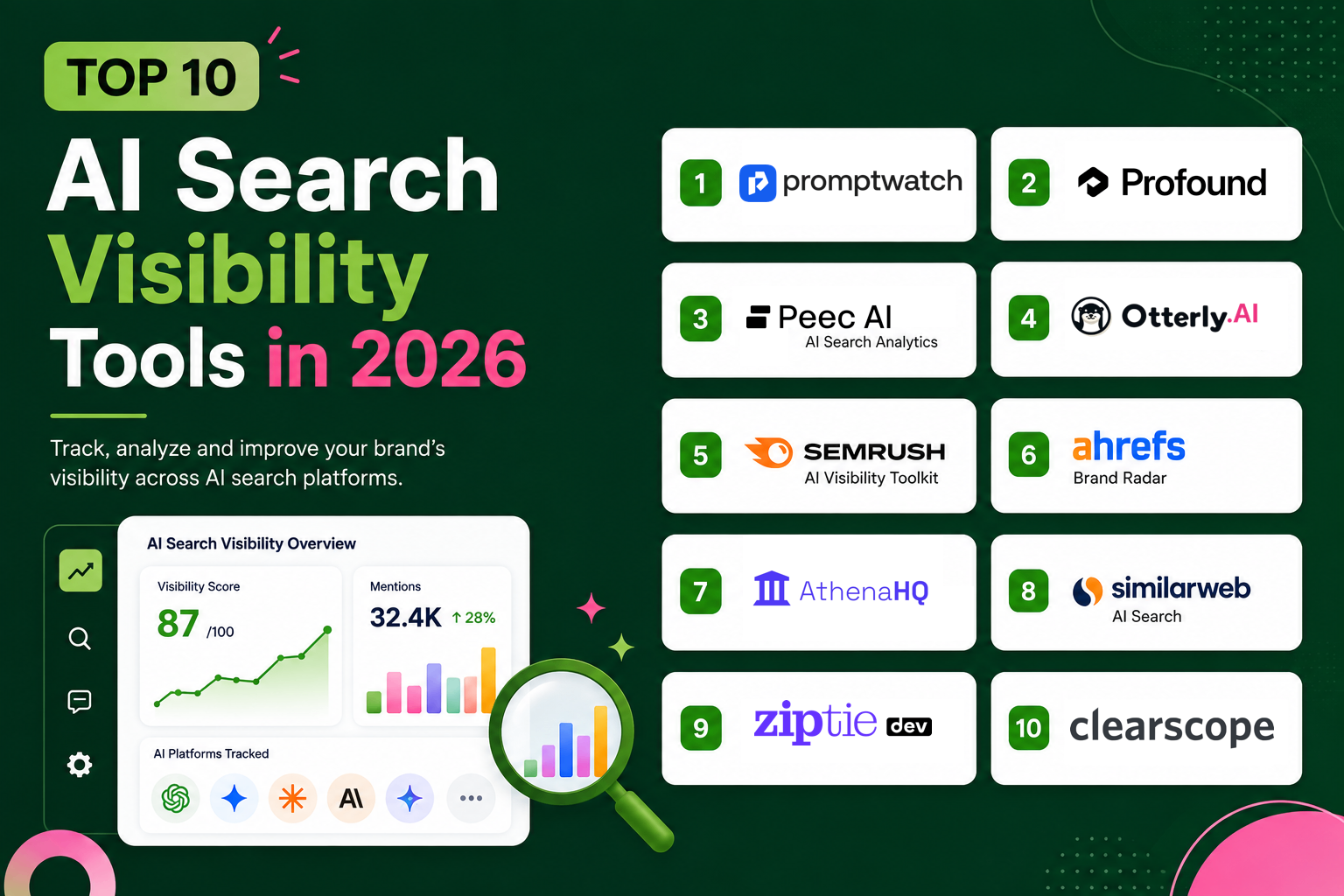
Top 10 AI Search Visibility Tools in 2026
AI-powered search is rapidly changing how people discover brands online. Instead of clicking through a list of blue links, users are increasingly asking ChatGPT, Google AI Overviews, Gemini, Perplexity, Claude, and other AI assistants for recommendations. These systems summarize information, cite trusted sources, and recommend products directly, making AI search visibility an important part of every modern SEO strategy. Traditional SEO metrics alone are no longer enough to measure online presence. Businesses now need to understand how often AI models mention their brand, which pages are being cited, how competitors appear in AI-generated answers, and where new opportunities exist. This has given rise to a new category of software known as AI search visibility or Generative Engine Optimization (GEO) tools. These platforms monitor brand mentions across AI search engines, analyze citations, measure share of voice, identify content gaps, and help marketing teams improve their visibility in AI-generated responses. Some focus entirely on AI analytics, while others combine AI visibility with traditional SEO, content optimization, and competitive intelligence. In this guide, we'll compare the best AI search visibility tools available in 2026. Whether you're a startup, SaaS company, agency, ecommerce business, or enterprise marketing team, this guide will help you choose the right platform to monitor and improve your visibility across the next generation of search engines. > SUMMARY > > AI search visibility tools help businesses measure and improve how often their brand appears in AI-generated answers across platforms like ChatGPT, Google AI Mode, Perplexity, Claude, and Gemini. Most platforms monitor AI citations, track prompts, analyze competitors, and provide insights to strengthen visibility in AI search results. > > The best platform depends on your needs, whether you're looking for enterprise monitoring, agency reporting, SEO insights, or AI content optimization. > > * PromptWatch - Best for monitoring AI search visibility, tracking prompts, and measuring brand performance across leading AI search engines. > * Profound - Ideal for enterprise AI visibility with prompt tracking, citation monitoring, and brand sentiment analysis. > * Peec AI - Built for agencies with competitor tracking, prompt analytics, and multi-brand reporting. > * Otterly AI - Helps brands understand and improve their visibility across AI search platforms with actionable optimization insights. > * Semrush AI Visibility Toolkit - Best for SEO teams that want to combine traditional search analytics with AI visibility tracking. > > Other leading AI search visibility tools include Ahrefs Brand Radar, AthenaHQ, and Similarweb AI Brand Visibility, which offer capabilities such as AI citation tracking, competitive intelligence, brand monitoring, and visibility analytics. COMPARISON TABLE | Tool | Best For | Core Feature | Starting Price | Free Plan | Platform | | : | : | : | : | : | : | | Promptwatch | Enterprise AI search optimization | AI visibility monitoring, prompt tracking, citation analysis, AI crawler analytics, competitor tracking, AI content agents | From $95/month | 7-day free trial | Cloud SaaS | | Profound | Enterprise AI visibility | AI brand monitoring, citations & sentiment | From $99/mo | ✗ | Cloud SaaS | | Peec AI | Agencies | Prompt tracking & AI share of voice | From $95/mo | ✗ | Cloud SaaS | | Otterly AI | AI search optimization | AI visibility tracking, prompt monitoring, competitor analysis, GEO insights | Custom | ✗ | Cloud SaaS | | Ziptie | AI search monitoring | Prompt tracking & GEO analytics | Custom | ✗ | Cloud SaaS | | Ahrefs Brand Radar | Existing Ahrefs users | AI citations & brand mentions | Included in Ahrefs plans | ✗ | Cloud SaaS | | AthenaHQ | Ecommerce & growth teams | AI visibility tied to revenue | From $295/mo | Limited | Cloud SaaS | | Clearscope | AI search content optimization | AI prompt tracking, content optimization, topic research, AI content grading, AI visibility tracking, content briefs | From $129/month | 14-day free trial | Cloud SaaS | | Similarweb AI Brand Visibility | Competitive intelligence | AI traffic & brand visibility analytics | Custom | ✗ | Cloud SaaS | | Semrush AI Visibility Toolkit | Existing Semrush users | AI visibility + SEO insights | $99/mo | Limited | Cloud SaaS | | Scrunch | Enterprise brands | AI visibility & governance | Custom | ✗ | Cloud SaaS | | Writesonic AI Visibility Tracker | AI search visibility + content optimization | AI visibility tracking, GEO optimization, AI Bot Analytics, AI Article Writer, competitor monitoring, Action Center, site audits | From $79/mo | ✓ | Cloud SaaS | 1. PROMPTWATCH Unlike traditional SEO platforms that primarily measure rankings and traffic, Promptwatch is built specifically for AI search optimization. The platform helps brands understand how they appear across ChatGPT, Gemini, Claude, Perplexity, Google AI Overviews, and other AI search engines while providing actionable insights to improve visibility. It combines AI visibility monitoring, citation analysis, prompt tracking, and AI-powered content optimization in a single platform. Promptwatch tracks real user prompts to show when and how AI models mention a brand, which sources they cite, and how competitors perform for the same queries. Its citation analysis identifies the websites and content types influencing AI-generated answers, while Agent Analytics monitors AI crawler activity to reveal which pages are being discovered, indexed, and cited. This helps marketing teams understand not only where they are visible, but also why AI models recommend certain brands over others. Another standout capability is its AI-powered Content Agents. Instead of simply reporting visibility metrics, Promptwatch analyzes citation gaps, generates AI-optimized content briefs, performs competitor analysis, and recommends content that is more likely to be referenced by AI search engines. The platform also supports country, state, and city-level tracking, API and MCP access, and integrations with major CDNs, making it suitable for businesses and agencies managing AI search performance at scale. With its combination of prompt monitoring, citation intelligence, crawler analytics, and AI-driven content optimization, Promptwatch serves as an end-to-end AI Search Optimization (AISO) platform rather than a standalone monitoring tool. It is particularly well suited for enterprises, agencies, and SEO teams looking to measure, improve, and scale their visibility across the rapidly growing AI search ecosystem. PRICING | Plan | Pricing | | : | : | | 7-day Free Trial | Available | | Essential | From $95/month | | Professional | From $245/month | | Business | From $579/month | | Enterprise | Custom pricing | BEST FOR Enterprise SEO teams, agencies, SaaS companies, publishers, and brands that want to monitor AI visibility, analyze citations, track competitors, and create content optimized for AI search engines. 2. PROFOUND As AI-powered search becomes a primary discovery channel, businesses need more than traditional SEO reports to understand their online presence. Search engines like ChatGPT, Google AI Overviews, Perplexity, Claude, and Gemini generate answers instead of simply listing web pages, making it increasingly important to know when and why your brand is mentioned. Profound is one of the first enterprise platforms built specifically for this purpose, helping brands monitor, measure, and improve their visibility across leading AI search engines. Rather than tracking keyword rankings alone, Profound analyses how AI models respond to thousands of prompts related to your business. It identifies when your brand appears in AI-generated answers, which sources are being cited, how competitors compare, and where opportunities exist to improve visibility. This gives marketing teams a much clearer understanding of their AI search performance than traditional SEO metrics alone. One of Profound's strongest capabilities is its comprehensive analytics dashboard. Businesses can monitor AI citations, analyse brand sentiment, track changes in share of voice, and evaluate prompt performance across multiple large language models. The platform also provides recommendations that help marketers optimise content likely to be referenced by AI systems, making it useful for both SEO and content strategy. Profound is designed primarily for enterprise organisations managing multiple products, brands, or international markets. Its reporting features allow teams to monitor AI visibility over time, compare performance against competitors, and measure how content updates influence AI-generated answers. As AI search continues evolving, these insights help businesses understand where they are gaining visibility and where further optimisation is needed. Although Profound focuses more on enterprise customers than on smaller businesses, it remains one of the most comprehensive AI visibility platforms currently available. Companies investing heavily in AI search optimisation can use its analytics to make informed decisions instead of relying on assumptions about how AI models reference their content. PRICING Profound offers custom pricing based on business size, monitoring requirements, and the number of brands being tracked. BEST FOR Enterprise businesses, global brands, large marketing teams, and organisations looking for comprehensive AI search visibility analytics across multiple AI search platforms. 3. PEEC AI For agencies and SEO teams managing multiple clients, monitoring AI search manually can quickly become impossible. Peec AI is designed specifically for Generative Engine Optimization (GEO), giving businesses a centralized platform to track how brands appear across AI-powered search engines. It combines prompt monitoring, citation analysis, competitor benchmarking, and reporting into a workflow built for both agencies and in-house marketing teams. The platform continuously evaluates thousands of prompts related to your business and records how AI platforms respond. It identifies when your brand appears, which competitors receive more visibility, what sources are being cited, and how your share of voice changes over time. This helps marketers understand not only whether they are visible in AI search, but also why competitors may be outperforming them. Peec AI also provides detailed competitor analysis and historical reporting, allowing teams to measure the impact of content updates and optimization campaigns. Because AI search results evolve rapidly, ongoing monitoring makes it easier to identify new opportunities before they become highly competitive. Agencies can manage multiple client workspaces, generate branded reports, and monitor several industries from a single dashboard. Another advantage is its collaboration features. Multiple users can access projects, compare brands, and share insights across marketing, SEO, and content teams. This makes Peec AI particularly valuable for organizations managing AI visibility across several clients or business units. Although newer than some traditional SEO platforms, Peec AI has quickly established itself as one of the leading dedicated AI visibility solutions by focusing entirely on helping businesses succeed in conversational search. 4. OTTERLY AI For businesses taking their first steps into AI search optimization, Otterly AI offers one of the simplest ways to monitor brand visibility across leading AI platforms. Instead of focusing on traditional keyword rankings, the platform tracks how often your website, products, and content appear in AI-generated responses from search engines such as ChatGPT, Google AI Overviews, and Perplexity. Its straightforward interface makes it accessible for startups, content creators, and marketing teams that want actionable insights without the complexity of enterprise software. Otterly AI automatically monitors a collection of prompts related to your business and records how AI platforms respond over time. It highlights whether your brand is mentioned, which competitors appear instead, and which webpages are most frequently cited. By tracking these changes continuously, businesses can quickly identify opportunities to improve their AI search presence and measure whether new content is increasing visibility. The platform also provides historical reporting, allowing teams to compare AI visibility across weeks or months instead of relying on one-time manual checks. Because AI search results change frequently, this ongoing monitoring helps marketers understand long-term trends and evaluate the effectiveness of their content strategy. Although Otterly AI doesn't include the extensive competitive intelligence found in larger enterprise platforms, its affordability and ease of use make it one of the best entry points for businesses beginning their Generative Engine Optimization (GEO) journey. PRICING | Plan | Pricing | | : | : | | Starter | $29/month | | Pro | $189/month | | Enterprise | Custom pricing | BEST FOR Startups, bloggers, content creators, small businesses, and marketing teams looking for an affordable AI search visibility monitoring platform. 5. SEMRUSH AI VISIBILITY TOOLKIT For businesses already using Semrush as their primary SEO platform, Semrush AI Visibility Toolkit provides a natural extension into AI search monitoring. Instead of managing a separate platform for Generative Engine Optimization (GEO), users can analyse AI visibility alongside keyword rankings, backlink performance, competitor research, and technical SEO from the same dashboard. The toolkit measures how frequently your brand appears in AI-generated responses across supported AI search engines while also identifying which competitors receive more visibility for similar prompts. Rather than simply counting mentions, it analyses citations, prompt performance, market share, and AI-generated recommendations, allowing marketing teams to understand how AI systems interpret their content. One of the platform's biggest advantages is its integration with the wider Semrush ecosystem. Users can move from identifying an AI visibility gap to researching keywords, analysing backlinks, improving content, and monitoring organic rankings without switching between multiple applications. This unified workflow makes it particularly attractive for established SEO teams that already rely on Semrush for daily optimisation. The toolkit also highlights emerging opportunities where businesses can improve AI visibility through stronger topical authority, more authoritative citations, or better content coverage. As Google AI Overviews and conversational search continue expanding, these recommendations help businesses adapt their SEO strategy to new search behaviours instead of focusing only on traditional rankings. For companies already investing in Semrush, the AI Visibility Toolkit provides one of the easiest ways to begin measuring AI search performance without adding another specialised platform to their marketing stack. PRICING The AI Visibility Toolkit is available as part of Semrush AI Toolkit, with plans starting at approximately $99/month. BEST FOR SEO professionals, agencies, content marketers, and businesses already using Semrush that want to measure and improve their visibility across AI-powered search engines. 6. ZIPTIE As AI search platforms become a major source of product discovery, simply tracking keyword rankings is no longer enough. Businesses also need to understand how frequently AI models recommend their brand, which prompts trigger those mentions, and why competitors appear more often. Ziptie is built specifically to answer these questions by monitoring brand visibility across leading AI search engines and helping businesses improve their presence in AI-generated responses. Rather than focusing on traditional SEO metrics, Ziptie continuously tracks prompts related to your products, services, and industry. It analyses responses from AI platforms to determine whether your brand is mentioned, which sources are cited, and how your visibility changes over time. This provides marketers with a clearer understanding of their performance across conversational search engines without manually testing hundreds of prompts every week. One of Ziptie's biggest strengths is its developer-friendly approach. The platform provides detailed prompt analytics, citation tracking, competitor comparisons, and historical reporting that help teams identify opportunities to improve their AI search presence. Businesses can monitor how content updates influence AI-generated answers while discovering new topics that deserve additional coverage. Because AI search is evolving rapidly, continuous monitoring is becoming increasingly valuable. Ziptie helps businesses detect changes early so marketing teams can adapt their content strategy before competitors gain an advantage. Its streamlined interface and focused feature set make it particularly useful for companies that want dedicated AI visibility analytics without the complexity of a broader enterprise SEO suite. PRICING Ziptie offers custom pricing based on monitoring requirements and business size. BEST FOR Developers, SaaS companies, startups, and marketing teams looking for dedicated AI search visibility tracking and prompt analytics. 7. AHREFS BRAND RADAR Understanding whether your brand is being mentioned by AI search engines is becoming just as important as tracking backlinks or keyword rankings. Ahrefs Brand Radar extends Ahrefs' SEO platform by helping businesses measure how frequently their brand appears in AI-generated answers and how that visibility compares with competitors. For teams already using Ahrefs, it provides a natural way to monitor AI search performance alongside traditional SEO metrics. Brand Radar continuously analyses AI-generated responses across supported search platforms to identify brand mentions, citations, and overall share of voice. Rather than simply reporting how often a brand appears, it highlights the topics and prompts that generate visibility, making it easier for marketers to understand where additional content or authority may be needed. Because Brand Radar is integrated into the broader Ahrefs ecosystem, users can quickly move from identifying an AI visibility gap to researching keywords, analysing backlinks, or auditing content without leaving the platform. This unified workflow saves time while helping SEO teams connect AI visibility improvements with traditional organic search performance. For businesses already relying on Ahrefs, Brand Radar offers an efficient way to begin monitoring AI search without investing in a completely separate analytics platform. It complements existing SEO workflows while providing valuable insights into how AI search engines are reshaping online discovery. PRICING Brand Radar is available as part of selected Ahrefs subscription plans, with pricing starting from $129/month for the broader Ahrefs platform. BEST FOR SEO professionals, agencies, publishers, and businesses already using Ahrefs that want to measure brand visibility across AI-powered search engines. 8. SIMILARWEB AI BRAND VISIBILITY Understanding how people discover your brand through AI search requires more than monitoring mentions alone. Businesses also need to know how AI search contributes to website traffic, how competitors are performing, and which prompts drive the highest visibility. Similarweb AI Brand Visibility extends Similarweb's market intelligence platform by providing insights into brand performance across AI-powered search experiences. The platform analyses how frequently brands appear in AI-generated responses while measuring share of voice, citation trends, and competitive performance across multiple industries. Unlike traditional SEO platforms that primarily focus on rankings, Similarweb combines AI visibility data with broader digital market intelligence, allowing businesses to understand AI search within the context of their overall online presence. Another major advantage is competitor benchmarking. Marketing teams can compare their AI visibility against competing brands, identify content gaps, and discover emerging trends before they become highly competitive. Because Similarweb already collects extensive web traffic and market intelligence data, these AI insights can be connected directly with broader digital marketing performance, helping businesses make more informed strategic decisions. For larger organisations, this integrated approach provides valuable context that goes beyond simple mention tracking. Instead of asking whether a brand appears in AI responses, teams can understand how AI visibility relates to traffic growth, market share, and customer discovery across different digital channels. PRICING Similarweb AI Brand Visibility is available through custom enterprise pricing. BEST FOR Enterprise businesses, large marketing teams, competitive intelligence analysts, and brands looking to combine AI visibility with broader digital market insights. 9. ATHENAHQ As AI search becomes a growing source of website traffic, marketers need more than visibility reports. They also need to understand whether AI-generated mentions are driving business results. AthenaHQ is built around this idea by combining AI search visibility tracking with revenue-focused analytics. Instead of simply reporting how often a brand appears in AI-generated answers, the platform helps businesses understand how AI visibility influences customer acquisition, conversions, and overall marketing performance. AthenaHQ continuously monitors prompts across major AI search platforms, including ChatGPT, Google AI Overviews, Gemini, Claude, and Perplexity. It tracks brand mentions, citation sources, competitor visibility, and share of voice while identifying content opportunities that can improve AI search performance. The platform also measures changes over time, allowing marketing teams to evaluate whether new content and optimization efforts increase AI visibility. One of AthenaHQ's strongest features is its business-focused reporting. Rather than treating AI search as a standalone metric, it connects visibility data with marketing outcomes, helping businesses prioritize the content and topics that generate meaningful results. Teams can monitor competitors, discover emerging trends, and identify which AI prompts influence customer discovery the most. For growing SaaS companies and enterprise marketing teams, AthenaHQ provides a practical way to measure the impact of AI search while integrating those insights into broader SEO and growth strategies. As conversational search continues expanding, understanding the business value behind AI visibility is becoming just as important as tracking rankings. PRICING | Plan | Pricing | | : | : | | Growth | From $295/month | | Enterprise | Custom pricing | BEST FOR Growth-stage startups, SaaS companies, enterprise marketing teams, and businesses that want to connect AI search visibility with revenue and marketing performance. 10. CLEARSCOPE While many AI visibility platforms focus primarily on monitoring brand mentions, Clearscope takes a content-first approach by helping businesses create pages that perform well in both traditional search engines and AI-powered search experiences. The platform combines content optimization, topic research, AI prompt tracking, and AI visibility monitoring to help marketers improve the chances of being referenced in ChatGPT, Google AI Mode, Gemini, and future AI search platforms. Clearscope brings together semantic content analysis, AI-assisted drafting, and search intent recommendations into a single workflow. Its content editor provides real-time optimization scores, identifies important topics and entities to cover, and generates detailed content briefs based on top-performing pages. The platform also includes AI Drafts and Topic Exploration, enabling teams to research, write, and optimize content that aligns with both user intent and modern AI search systems. A major addition is its AI visibility suite, which allows users to track prompts across ChatGPT and Gemini, monitor brand mentions, analyze AI citations, and understand the web searches AI models perform before generating responses. Rather than only showing visibility metrics, Clearscope provides actionable recommendations that help improve topical authority, content quality, and the likelihood of appearing in AI-generated answers. Integrations with Google Docs, Microsoft Word, and WordPress also streamline collaboration for editorial teams. Although Clearscope is best known as an enterprise SEO content optimization platform, its growing focus on Answer Engine Optimization (AEO) and AI visibility makes it a valuable solution for organizations that want to create authoritative content while measuring how it performs across both search engines and AI assistants. PRICING | Plan | Pricing | | : | : | | 14-day Free Trial | Available | | Essentials | From $129/month | | Business | From $399/month | | Enterprise | Custom pricing | BEST FOR Content marketing teams, enterprise SEO teams, publishers, agencies, and businesses looking to optimize content for both search engines and AI-powered search while tracking AI visibility and brand citations. 11. SCRUNCH For enterprise organisations, monitoring AI visibility involves more than measuring brand mentions. Teams also need governance, reporting, collaboration, and clear insights into how AI models represent their products and messaging. Scrunch is designed to help businesses manage this growing challenge by providing enterprise-grade AI search monitoring and brand intelligence. Scrunch continuously evaluates how leading AI platforms describe your business, what sources they rely on, and how competitor visibility changes over time. Instead of manually testing prompts across multiple AI models, businesses receive centralised reporting that highlights brand mentions, citation sources, sentiment, and visibility trends. This helps marketing and communications teams maintain a consistent understanding of how AI systems present their brand. One of Scrunch's strengths is its focus on collaboration. Reports can be shared across SEO, PR, content, and executive teams, making AI visibility part of broader marketing and brand governance efforts. As organisations increasingly invest in AI optimisation, having a shared view of brand performance helps different departments align their strategies and respond more quickly to changes in AI-generated search results. While Scrunch is primarily aimed at larger organisations, its combination of AI monitoring, reporting, and enterprise collaboration makes it a valuable platform for businesses that view AI search as a strategic marketing channel rather than simply another SEO metric. PRICING Scrunch offers custom enterprise pricing based on business requirements and monitoring volume. BEST FOR Enterprise brands, corporate marketing teams, communications departments, and organisations managing AI search visibility across multiple products or markets. 12. WRITESONIC AI VISIBILITY TRACKER Unlike many AI visibility platforms that only monitor brand mentions, Writesonic AI Visibility Tracker combines AI search monitoring with content creation and optimization in a single platform. It enables businesses to track how their brand appears across ChatGPT, Gemini, and Google AI Overviews while providing actionable recommendations to improve visibility. Recent updates have expanded the platform beyond GEO, adding AI Bot Analytics, competitor monitoring, and an AI Visibility Action Center that helps prioritize content, technical SEO, and citation opportunities. Writesonic integrates AI writing, SEO research, AI visibility tracking, and website auditing into one workflow. Users can generate long-form articles, optimize existing content, run site audits, monitor AI search performance, and identify gaps where competitors are being cited instead. The platform also offers AI-powered content strategy recommendations and automated SEO improvements, making it easier to publish content designed for both traditional search engines and AI-powered answer engines. A notable addition is the Action Center, which turns AI visibility insights into prioritized recommendations. Instead of only showing where visibility is lacking, Writesonic suggests on-page improvements, technical fixes, and content opportunities that can help increase citations in AI-generated responses. Teams can also monitor prompt performance, track sentiment, and measure visibility trends without relying on multiple SEO and analytics tools. Although Writesonic remains a strong AI writing platform, its expanded AI Search Visibility suite makes it a practical option for startups, agencies, and marketing teams looking for an all-in-one solution that combines AI visibility tracking, GEO optimization, content creation, and SEO workflows. PRICING | Plan | Pricing | | : | : | | Free Trial | Available | | Starter | From $79/month | | Basic | From $199/month | | Growth | From $399/month | | Enterprise | Custom pricing | BEST FOR Businesses and content teams looking for an all in one platform for AI search visibility tracking, GEO optimization, and AI-powered content creation. CONCLUSION AI search is rapidly becoming an important channel for online discovery, making visibility in ChatGPT, Google AI Overviews, Gemini, Claude, Perplexity, and other AI assistants just as valuable as traditional search rankings. Instead of relying solely on keyword positions, businesses now need to understand how AI models reference their brand, which sources they cite, and where new opportunities exist to improve visibility. Each platform in this guide addresses a different aspect of AI search optimization. PromptWatch, Profound and Peec AI specialize in enterprise-grade AI visibility monitoring, while Semrush AI Visibility Toolkit and Ahrefs Brand Radar extend familiar SEO platforms with AI search insights. Otterly AI offers an accessible solution for smaller teams, Writesonic AI Visibility Tracker helps create AI-friendly content, and platforms such as Ziptie, Similarweb AI Brand Visibility, Scrunch, and AthenaHQ provide specialized analytics for competitive intelligence and brand monitoring. The right AI search visibility tool depends on your business goals, existing SEO workflow, and budget. Whether you're a founder, agency, marketer, or enterprise team, investing in AI visibility today can help your brand stay discoverable as search continues shifting toward conversational AI. Businesses that monitor, optimize, and adapt their content for AI-powered search will be better positioned to build authority, increase brand awareness, and capture organic traffic in the years ahead.