A SaaS buyer who once searched Google for “best project management software” can now ask ChatGPT, Gemini, Perplexity, Claude , or Google AI Mode the same question in natural language: “What’s the best project management tool for a 10-person remote team?”
Instead of returning a list of blue links, these systems can synthesize information from multiple sources and recommend a small set of products.
That changes how SaaS companies need to think about search visibility. Ranking on Google still matters, but it is no longer the only way a potential customer can discover a product.
AI search visibility is becoming an additional layer of SaaS SEO. It combines technical SEO, clear product positioning, useful content, third-party mentions, review platforms, community discussions, and consistent brand information across the web.
There is no single tactic that guarantees a product will be recommended by an AI search engine. However, research from Google, OpenAI, Anthropic, Perplexity, Microsoft, Ahrefs, Semrush, and independent researchers reveals several recurring patterns.
This guide explains what those patterns mean for SaaS companies and how to build a practical strategy for increasing visibility across ChatGPT, Google AI, Gemini, Perplexity, Claude, and Microsoft Copilot.
Quick Answer
For SaaS companies, AI search visibility comes down to six core areas:
- Technical accessibility: Make sure search engines and AI crawlers can discover, crawl, and understand important pages.
- Entity clarity: Clearly explain what the product does, who it is for, what problem it solves, and how it differs from alternatives.
- Answer-focused content: Create comparison, alternatives, use-case, pricing, integration, and problem-focused content that directly answers buyer questions.
- Third-party presence: Build genuine visibility across platforms such as G2, Capterra, Reddit, YouTube, GitHub, Product Watch, Product Hunt, and relevant industry publications.
- Brand consistency: Keep product descriptions, categories, audiences, features, and other important facts consistent across the web.
- Measurement: Track realistic buyer prompts across multiple AI platforms instead of assuming that visibility on one platform means visibility everywhere.
None of these guarantees a citation or recommendation. AI answers vary between platforms, queries, users, and model updates. The goal is to make the product easy for both people and AI systems to discover, understand, verify, and mention.
Traditional SEO optimizes for a ranked list of links. AI search systems, including ChatGPT Search, Google's AI Overviews and AI Mode, Gemini, Perplexity, Claude, and Microsoft Copilot, instead synthesize answers from multiple retrieved sources and often attach citations. Princeton, Georgia Tech, the Allen Institute for AI, and IIT Delhi introduced the concept of "generative engines" in their Generative Engine Optimization (GEO) research paper, later published at KDD 2024. In a 10,000-query benchmark, adding citations, statistics, and quotations to content improved visibility by roughly 30 to 40% in their test setup. This was a controlled benchmark, not a guarantee of visibility on today's AI search platforms.
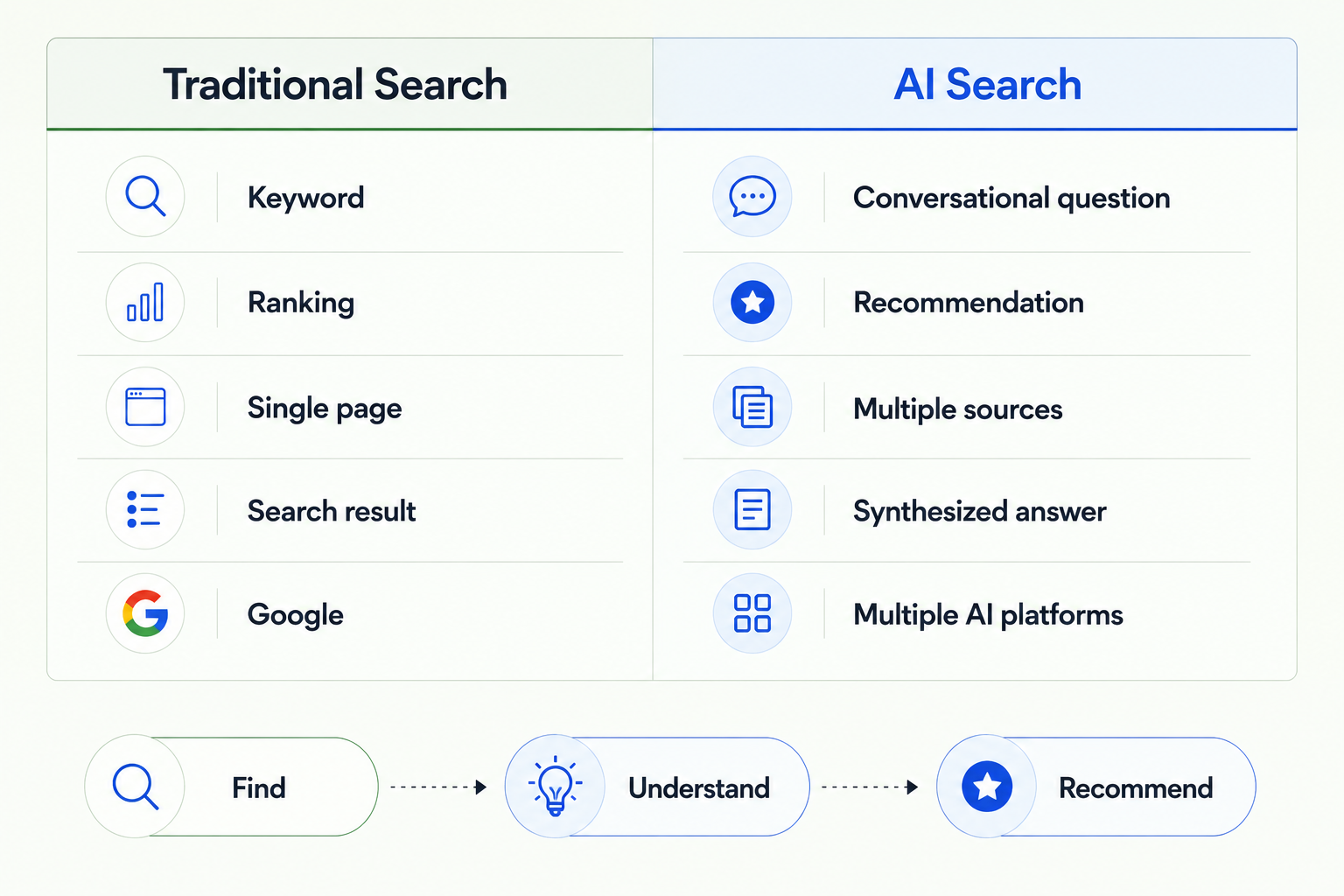
Three distinctions matter. First, being retrieved is not the same as being cited: AI systems can retrieve pages without ultimately using them in the answer. Second, visibility is platform-specific. A page cited by Perplexity may not appear in ChatGPT for the same query because platforms use different retrieval and ranking systems. Third, AI visibility is not deterministic. The same prompt can produce different sources, so visibility should be measured as an ongoing trend rather than a one-time ranking.
Each platform has published at least some documentation about how it handles web content, and independent research has filled in some of the gaps. None of the platforms discloses its full ranking logic, and none should be assumed to work identically to the others.
ChatGPT can rewrite a user's request into targeted search queries, retrieve web results, and generate answers with linked sources. OpenAI's OAI-SearchBot crawls sites for search visibility, while third-party research indicates ChatGPT may rely partly on Bing's index for live results. Bing indexing therefore matters alongside Google SEO.
Google says there are no special SEO requirements, schema, or AI-specific files needed for AI Overviews or AI Mode. Pages must be indexed and eligible for normal Google Search. Both features use Google's Search index and existing quality signals, making strong traditional SEO the foundation for visibility.
Gemini and Google AI Mode use Google's Search infrastructure and Knowledge Graph. Third-party citation research suggests Gemini frequently draws from sources such as YouTube, Wikipedia, and Reddit, depending on the query.
Perplexity uses its own crawler, PerplexityBot, to retrieve and cite web content. Its retrieval system evaluates multiple candidate pages before selecting sources based on factors such as relevance, freshness, and content structure. Fresh, recently updated content appears particularly important for fast-moving topics.
Claude's web search and Research features provide real-time results with citations. Third-party reporting identifies Brave Search as its underlying search provider. Independent analysis of Claude citations has also found a strong presence of practitioner and company blogs containing detailed primary-source information.
Microsoft Copilot uses Bing for current web information and applies Bing's ranking signals, including relevance, engagement, and freshness. For SaaS companies, Bing Webmaster Tools, sitemaps, and IndexNow can therefore help improve discoverability in Copilot.
Two caveats apply to the whole table. None of the platforms discloses its complete ranking algorithm, so the "considerations" column reflects a mix of official documentation and credible third-party research, not confirmed formulas. And overlap between platforms is smaller than intuition suggests. Ahrefs' analysis of citation data found only about 13.7 percent URL overlap between Google's own AI Overviews and AI Mode, and other research has found only around 2 percent of cited URLs appear consistently across AI Overviews, ChatGPT, and Perplexity together. Treating "AI search" as one monolithic channel is a measurable mistake.
Before any content or outreach tactic matters, AI systems first need to understand what the product is, who it serves, and what problem it solves. Generative engines rely heavily on entity recognition, connecting a brand to consistent facts across multiple sources.
A useful framework is:
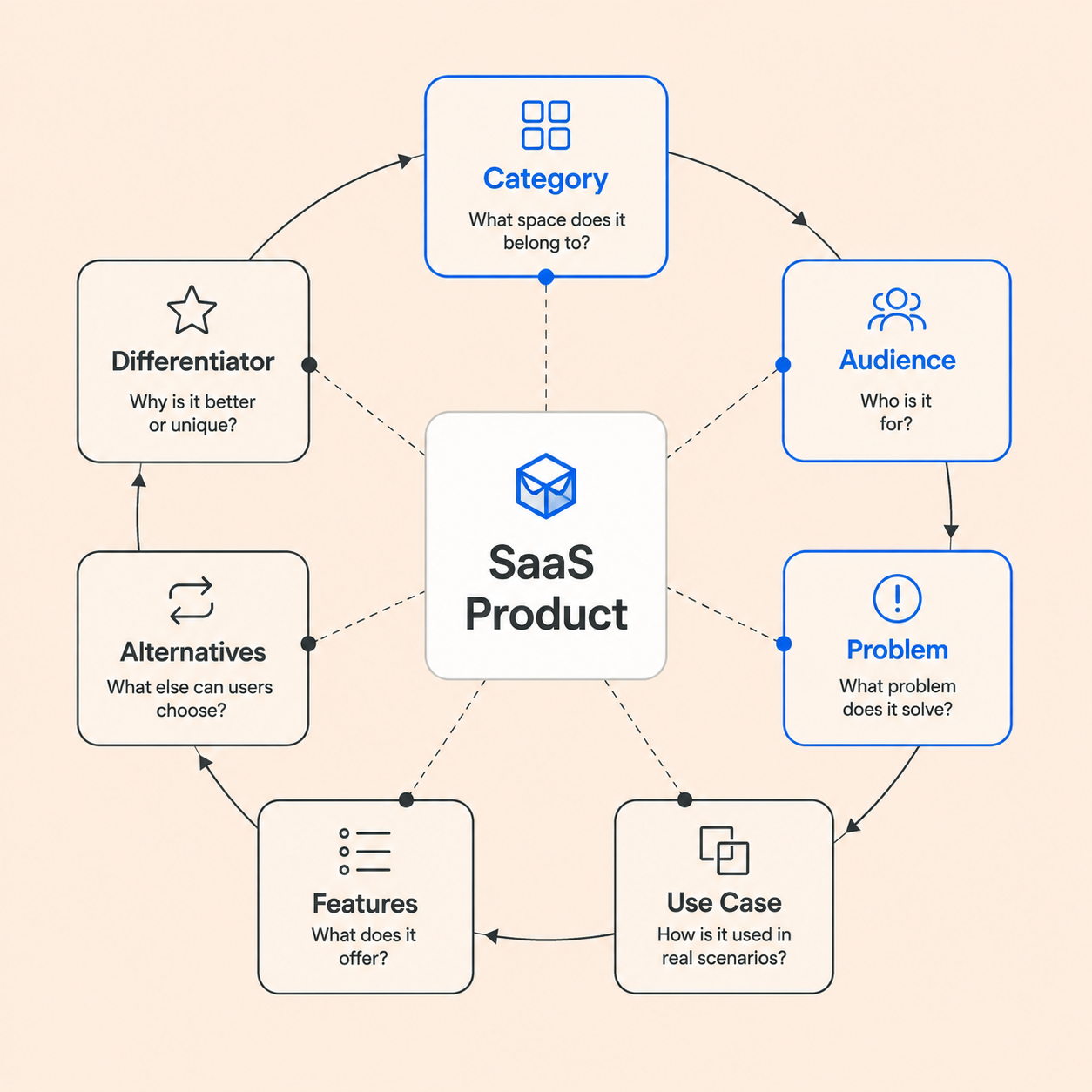
For SaaS, a simple entity statement can be:
[Product] is a [category] for [audience] that helps them [solve problem].
Instead of vague copy like “an all-in-one platform that helps teams work better,” clearly state something like “asynchronous status-update software for distributed engineering teams.” This gives AI systems concrete signals to match against relevant queries.
The same core facts should remain consistent across the official website, G2, Capterra, Product Watch, Product Hunt, LinkedIn, GitHub, founder profiles, and industry coverage. Wording can vary, but category, core function, and audience should not contradict each other. HubSpot's semantic-restructuring experiment also suggests that making key facts explicit and consistently associated with the brand can improve AI citation visibility, although it was only one part of a broader strategy.
Product association is the next layer. Category positioning answers “What is this?” while association answers “What tools, workflows, and platforms is it mentioned alongside?” Founder interviews, integration directories, tech-stack articles, comparison pages, and third-party coverage can expand these associations and help a product appear in adjacent AI-generated recommendations.
Generative engines are frequently used for genuinely comparative and evaluative questions, "what are the best expense management tools for startups," "what's the difference between Linear and Jira for a small engineering team," "what are good alternatives to Asana that are cheaper", and a SaaS company's content has the best chance of being useful to a retrieval system when it exists to answer exactly these questions, rather than existing primarily to announce product releases or promote features.
This points toward several content types with a demonstrated logical fit for AI-search queries, though the degree to which any one of them "works" varies by category and competitive density:
Comparison and alternatives pages directly match a large share of observed AI search queries in B2B SaaS ("X vs Y," "alternatives to X"), and Search Engine Land's analysis of cited content formats found articles, listicles, and comparison-style product pages among the most frequently cited formats across AI Mode, ChatGPT, and Perplexity. A comparison page written honestly, including where a competitor genuinely does something better, tends to be more citable than one written as thinly veiled marketing, because it more closely matches the kind of even-handed synthesis a language model is trying to produce.
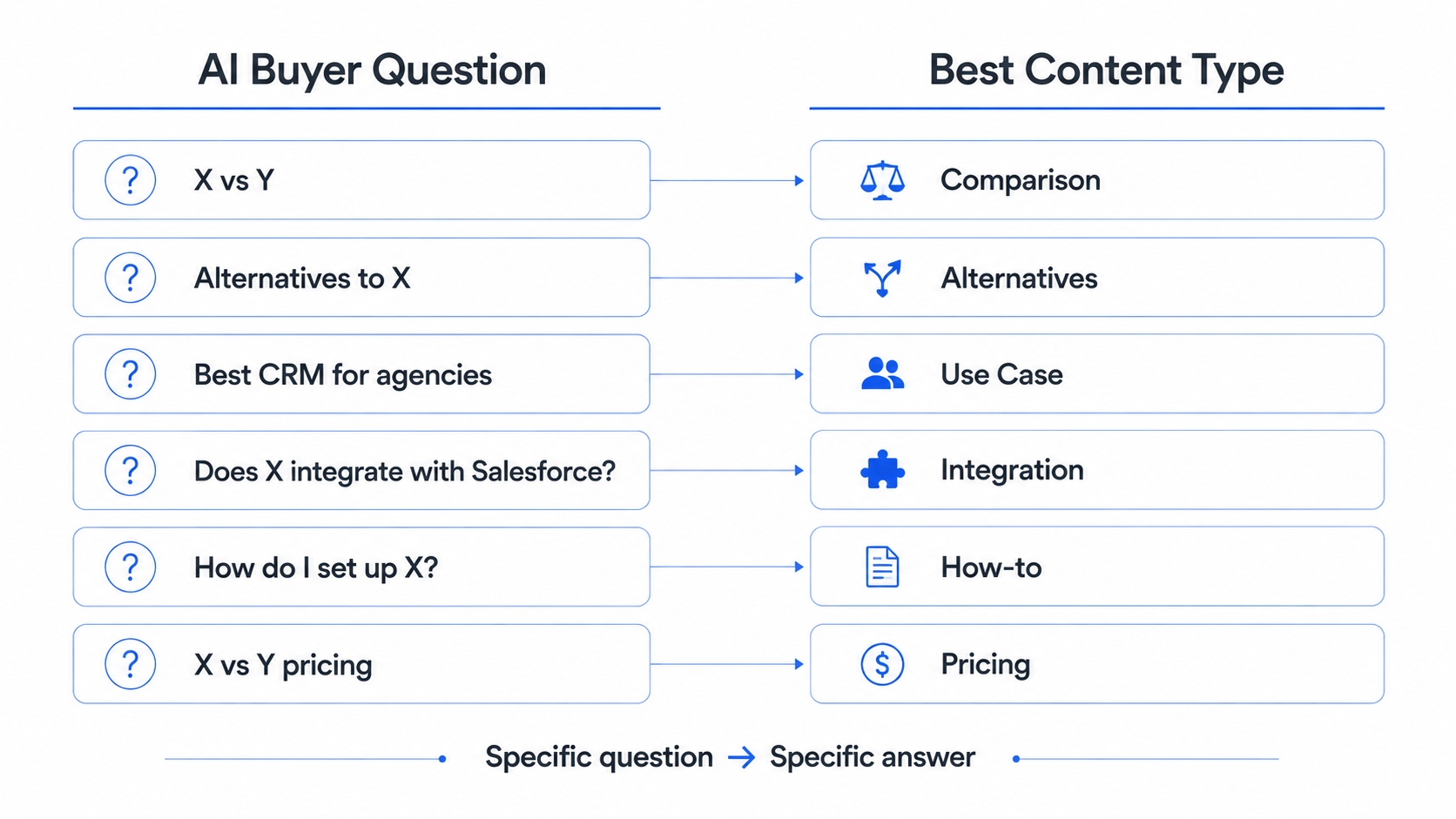
Use-case and audience-specific pages ("expense management for remote agencies," "CRM for solo consultants") map onto the highly specific, qualifier-heavy way people phrase conversational AI queries, which tend to be longer and more contextual than typed search queries.
Integration pages matter disproportionately for SaaS because buyers frequently ask about compatibility ("does X integrate with Salesforce") as a filtering question before evaluating the product itself.
Implementation and how-to guides serve two audiences simultaneously: the human reader deciding whether the product is usable for their situation, and a retrieval system looking for concrete, procedural, extractable answers rather than abstract claims.
Pricing-comparison content addresses one of the most common conversational AI queries in SaaS ("what does X cost compared to Y") and is a category where accuracy and freshness matter more than almost anywhere else, since pricing pages go stale quickly and AI systems have been shown to favor recently updated sources for this reason.
Problem-focused content, written around the buyer's actual pain point rather than the product's feature list, tends to match how people phrase questions to a conversational assistant more closely than product-centric copy does.
What should get comparatively less priority, based on the evidence above, is content whose primary purpose is announcing releases, company milestones, or internal news, not because such content is worthless, but because it rarely matches the kind of evaluative or comparative question that triggers an AI-generated answer with citations in the first place. Product update content still has value for existing users and for direct-traffic engagement; it is simply not where AI-search visibility is most likely to be won.
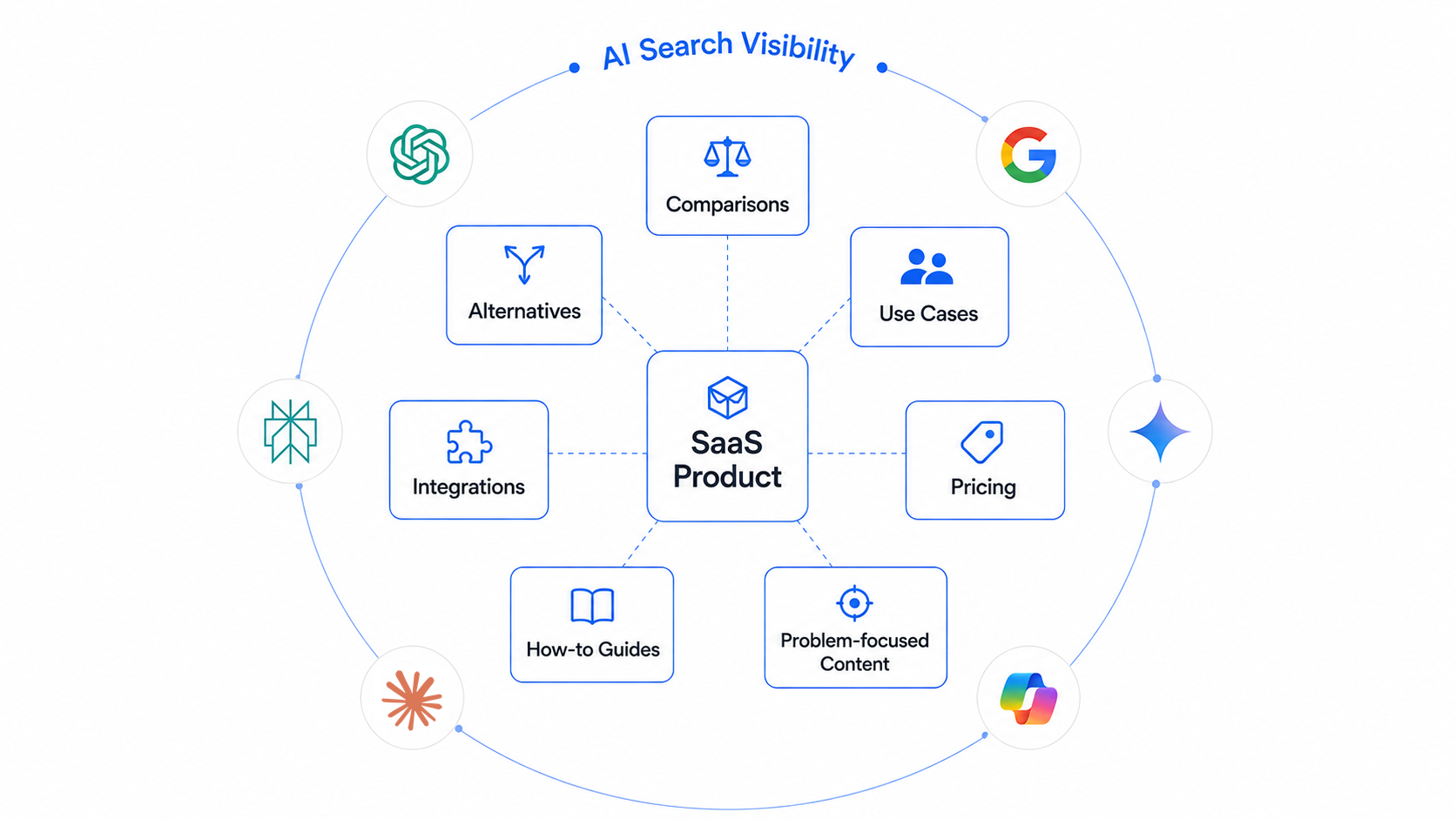
It helps to think concretely about how these queries actually sound in a conversational assistant, since phrasing shapes what gets retrieved. A typed Google query like "expense management software" becomes, in ChatGPT or Gemini, something closer to "what's a good expense management tool for a 15-person agency that already uses Xero, and does it handle multi-currency reimbursements." The qualifiers, team size, existing stack, a specific feature requirement- are exactly the kind of detail a generic homepage rarely addresses but a well-built use-case or integration page does. Content built around these longer, more specific phrasings has a structural advantage: it more closely mirrors both the query itself and the kind of self-contained, directly answerable passage a retrieval system is built to extract. This is also why FAQ-style sections embedded within longer pages, not necessarily marked up with the now-retired FAQPage rich result, but written as clear question-and-answer pairs, continue to have practical value for extraction even where the visual search-result benefit has gone away.
Depth matters more than volume here. Search Engine Land's format analysis found listicles, standalone articles, and product pages among the most-cited content types, but none of the underlying research suggests that publishing a higher number of thin pages outperforms fewer, more thorough ones. A single comparison page that accurately covers pricing, feature parity, ideal-customer fit, and honest limitations for both products is more likely to be extracted cleanly than five shorter posts that each cover part of the same ground with less rigor.
Yes, with real caveats. G2's own account of third-party data, corroborated independently by Semrush and by the AI-visibility platform Profound, indicates G2 is disproportionately dominant among software review platforms as a citation source, accounting for roughly one-third to three-quarters of review-site citations across ChatGPT, Google AI Overviews, and Perplexity, depending on the study and platform measured. Separate research from AirOps and from SE Ranking found that review platforms collectively appear in roughly a third of commercial AI Overview answers, with the top five review platforms, Gartner Peer Insights, G2, Capterra, Product Watch, Software Advice, and TrustRadius, accounting for the large majority of review-site citations. In a notable consolidation, G2 completed a $110 million acquisition of Capterra, Software Advice, and GetApp from Gartner in early 2026, meaning a single company now operates several of the most-cited software review destinations.
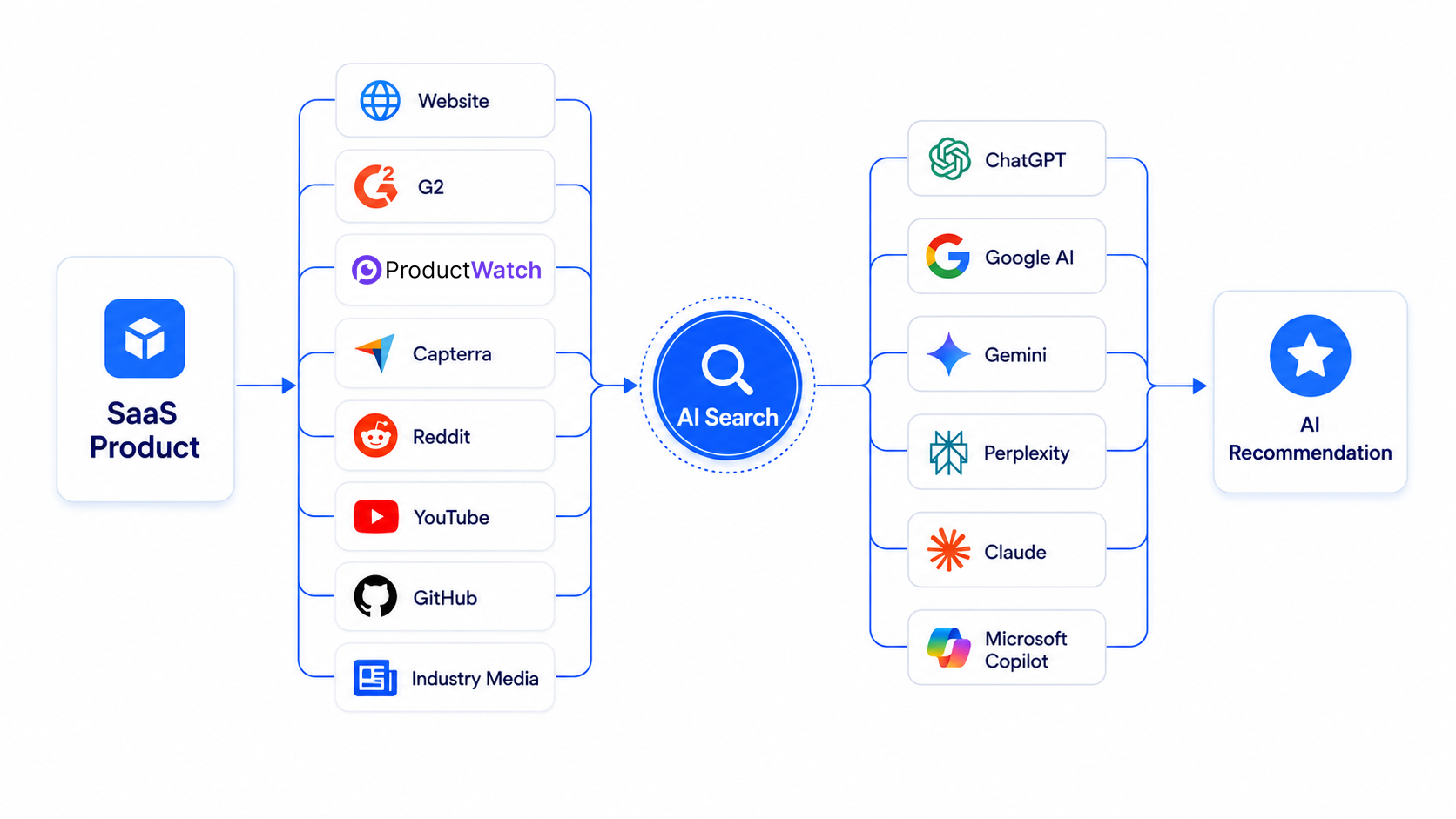
The practical implication is that a G2 and Capterra listing, populated with a meaningful number of genuine, detailed reviews, functions less like a marketing nicety and more like a prerequisite for being included in AI-generated software recommendations for many B2B categories; several independent analyses describe the absence of any review-platform presence as something close to a de facto exclusion from AI recommendation sets for competitive SaaS categories. Product Hunt operates differently: a launch can generate a short-term spike in mentions, backlinks, and community discussion, and Product Hunt pages themselves are occasionally cited directly, but the evidence for Product Hunt as an ongoing citation source is thinner and more anecdotal than the evidence for G2 or Capterra. Smaller or niche directories (SaaSHub, Product Watch, BetaList, category-specific lists) can support discoverability and backlink profiles in a modest way, but no available research shows they function as meaningful AI citation sources in their own right.
This is also where a clear line needs to be drawn between legitimate directory presence and low-quality directory spam. Submitting a SaaS product to dozens of low-authority, auto-approval directories primarily built to sell backlinks does not have documented evidence of improving AI visibility, and several of the same studies that show backlink volume correlating only weakly with AI citation (discussed below) suggest this kind of mass submission is largely wasted effort. A small number of relevant, actively used, review-based platforms, where real customers leave real reviews that get periodically refreshed, appear to matter considerably more than a large number of generic listings.
SaaS directories can contribute to discoverability, but not all directories provide the same value.
A listing on a well-established platform can give AI systems another independent source that confirms what a product is, which category it belongs to, who uses it, and how it compares with other products.
Review platforms such as G2 and Capterra are particularly relevant because they contain structured product information, customer reviews, category classifications, comparisons, and other signals that can help establish a product's presence in the software ecosystem.
Product discovery platforms and niche SaaS directories can also help create additional references to a product, particularly when their pages are indexed, maintained, and genuinely useful to users.
However, submitting a product to hundreds of low-quality directories purely to obtain backlinks should not be confused with building AI search visibility. A large number of duplicate or low-value listings is not a substitute for genuine reviews, community discussion, editorial coverage, useful comparisons, and strong product information.
The goal is not to collect the largest possible number of directory links. The goal is to build a consistent and credible web presence around the product.
Independent research consistently finds that the large majority of what AI systems cite about a brand originates from sources the brand does not own or directly control. Muck Rack's analysis of AI citations across ChatGPT, Claude, and Gemini found that the substantial majority of citations traced back to earned media rather than brand-owned domains, with paid or advertorial content accounting for a negligible fraction. Separate analysis attributes only a small single-digit-to-low-double-digit percentage of AI-cited sources to a brand's own website. This reframes the practical objective: a SaaS company's own blog and documentation matter, but the majority of the visibility work happens in coverage, mentions, and discussion the company does not directly author.
Reddit and Hacker News discussions occupy an unusual position here. On one hand, several platforms, Gemini and, to a lesser extent, ChatGPT and Perplexity, have been documented drawing on Reddit as a grounding source, and HubSpot's own case study reported Reddit-driven citations of its content growing from roughly 178 in May 2025 to around 146,000 by December 2025, a scale shift the company attributes partly to deliberate community engagement. On the other hand, Reddit's own CEO, Steve Huffman, stated on the company's Q3 2025 earnings call that AI chatbots were not, at that point, a meaningful source of referral traffic back to Reddit, a reminder that a platform can be an important input to AI answers while sending little direct traffic in return, and that community visibility should be evaluated as a citation-source strategy, not primarily as a traffic-generation one.
Indie Hackers, relevant subreddits, and product-specific Slack or Discord communities function best as venues for genuine participation rather than promotion: answering real questions, being named organically by other founders and users in threads about tooling choices, and letting a product accumulate the kind of independent, third-party corroboration that both traditional SEO and AI retrieval systems treat as a trust signal. GitHub carries particular weight for developer-facing SaaS products specifically: an active, well-documented repository, responsive issue handling, and genuine community contribution function as both a technical credibility signal and a discovery surface, since developer questions about tooling are disproportionately likely to surface GitHub activity, README content, and developer blog posts in both traditional search and AI-assisted coding tools.
The distinction between being present and being mentioned is important.
Creating a Reddit account and repeatedly posting links to a product does not create the same signal as a product being discussed by independent users. Similarly, having a GitHub repository is different from having developers reference, contribute to, or discuss that repository.
For AI search, the stronger objective is not simply to publish more links. It is to become part of the existing conversations around a category, problem, workflow, or use case.
The core limitation to keep in mind: none of this research supports treating a single viral Reddit thread, one well-performing Hacker News post, or one favorable YouTube review as proof of a repeatable strategy. These are individual data points in a large and shifting system, useful for identifying directional patterns rather than as standalone case studies.
Google's own documentation is explicit that AI Overviews and AI Mode rely on the same underlying index and ranking systems as regular Search, and that a page ineligible for a normal Search snippet is not going to appear in either AI feature. That single fact does most of the work in explaining why technical SEO fundamentals have not become obsolete: crawlability (robots.txt not blocking relevant bots, no accidental noindex tags), clean XML sitemaps, sensible internal linking, server-side or properly hydrated rendering for JavaScript-heavy sites, reasonable page performance, and a healthy Search Console account remain foundational, not because they are new AI-search tactics, but because AI features are downstream of the same indexing pipeline as everything else.
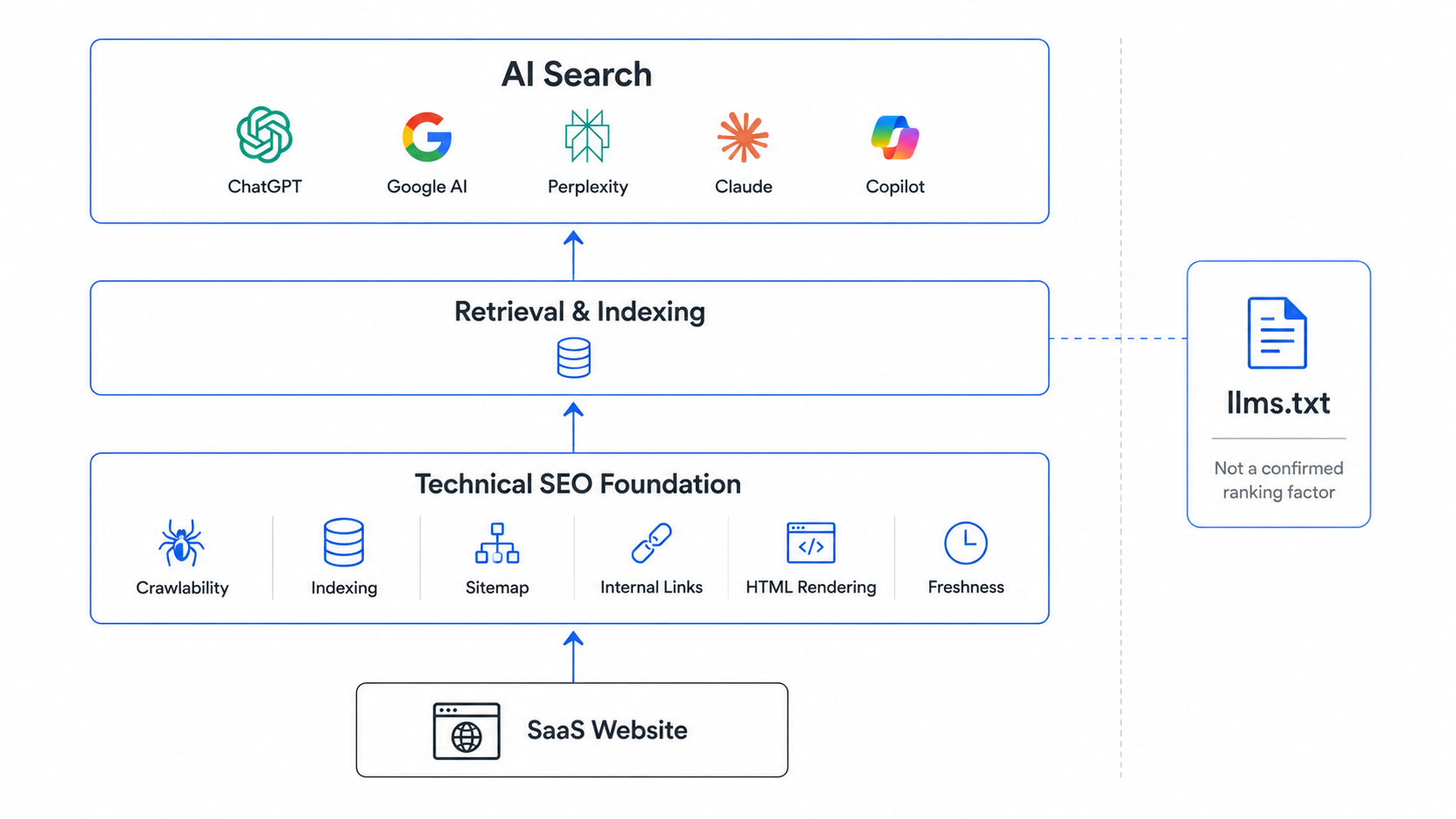
For crawler access specifically, each AI platform operates named bots that a SaaS site can allow or block through robots.txt: OpenAI's GPTBot and OAI-SearchBot, Google's crawlers (including the Google-Extended designation relevant to AI training and features), Anthropic's ClaudeBot, PerplexityBot, and Bingbot for Microsoft's ecosystem. Blocking a platform's crawler is a legitimate choice some publishers make for data-use reasons, but it comes with a direct visibility trade-off for that specific platform, and several analyses note that blocking AI training crawlers (distinct from AI search/retrieval crawlers, which are frequently separate bots with separate directives) has been shown to have negligible measurable effect on Google ranking specifically, the two access decisions are not the same lever.
On structured data, the evidence is more mixed than much of the SEO industry content on this topic suggests. Google's documentation states directly that no special or new schema is required to appear in AI Overviews or AI Mode. That does not make schema markup pointless; Organization, Product, SoftwareApplication, Article, and BreadcrumbList markup remain useful for classic rich-result eligibility and for giving any parsing system (human-built or AI-built) an unambiguous, structured description of entities like pricing, ratings, and authorship. FAQPage markup is a partial exception worth flagging precisely: Google discontinued the FAQ rich-result search feature in mid-2026, along with related Search Console reporting, though FAQPage itself remains a valid schema.org type and well-structured question-and-answer content can still support extraction by AI systems even without the now-retired rich-result treatment. Review schema, applied honestly to genuine customer reviews rather than manufactured ones, supports the same trust signals that third-party review platforms provide, though it does not substitute for an actual G2 or Capterra presence.
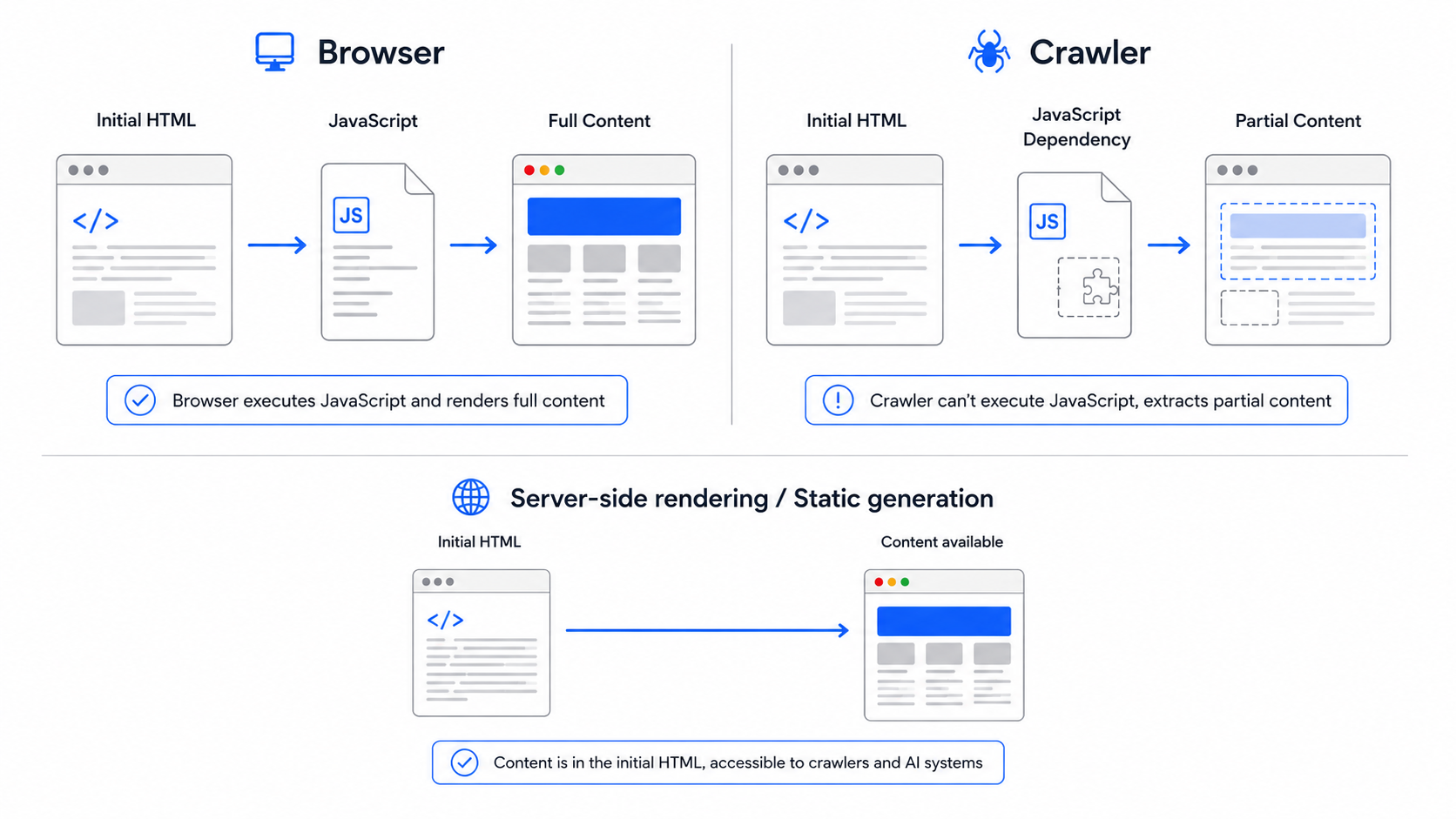
JavaScript rendering deserves a specific note because SaaS marketing sites, often built on modern frontend frameworks, are more exposed to this issue than many other website categories. Several independent crawler analyses have found that AI retrieval bots are less consistent than Googlebot at executing client-side JavaScript before extracting content, meaning a page that renders correctly in a browser can still return largely empty or partial content to a crawler that only reads the initial HTML response. Server-side rendering, static generation, or dynamic rendering specifically for known bot user agents reduces this risk. This is a case where a technical SEO best practice that predates AI search, ensuring content is present in the initial HTML rather than requiring script execution, has become more, not less, important, because the cost of failure (a blank or truncated page fed to a retrieval system) is more consequential when the page might otherwise have been quoted directly in an answer.
Freshness signals also merit a more precise treatment than "keep content updated." Visible, accurate "last updated" dates, genuinely refreshed statistics and screenshots (not just a changed timestamp on unchanged text), and updated comparison data as competitors change pricing or features all appear to matter, particularly for Perplexity and for any AI Overview query with a time-sensitive dimension. Several industry analyses report a measurable citation gap between recently updated and stale content, though exact figures vary by study and should be read as directional rather than as a precise, universal multiplier.
The llms.txt file deserves a direct, evidence-based answer, because it has generated disproportionate attention relative to what has actually been confirmed. llms.txt is a community-proposed convention, not a standard endorsed by any standards body, and not something any major AI company has publicly confirmed using in production retrieval or citation systems. Google's Search Advocate Gary Illyes has stated on the record that Google does not support it, and John Mueller has compared it to the long-discredited keywords meta tag. Independent research reinforces this: SE Ranking's analysis of roughly 300,000 domains found no statistically significant correlation between having an llms.txt file and AI citation frequency, and removing the variable from a predictive citation model reportedly improved the model's accuracy. Separate crawler-log analysis covering hundreds of millions of AI bot visits found that llms.txt files were fetched only a negligible number of times relative to total AI crawler traffic. The honest, evidence-based conclusion is that llms.txt is low-cost to implement, occasionally useful for developer-documentation sites and for the emerging category of AI coding agents that may consume it directly, but it is not a confirmed AI-search ranking or citation factor, and content teams should not treat it as a substitute for the fundamentals above.
The sections above explain what the evidence supports. This playbook turns that evidence into an order of operations, sequenced by dependency and effect rather than by calendar time. Each step builds on the one before it. Skipping ahead, for example, chasing press coverage before the product's own category positioning is settled, tends to waste the later effort, because journalists, reviewers, and community members have nothing consistent to repeat back. The steps below are not a schedule. They are a priority order: work through them in sequence, and revisit earlier steps whenever a later one exposes a gap.
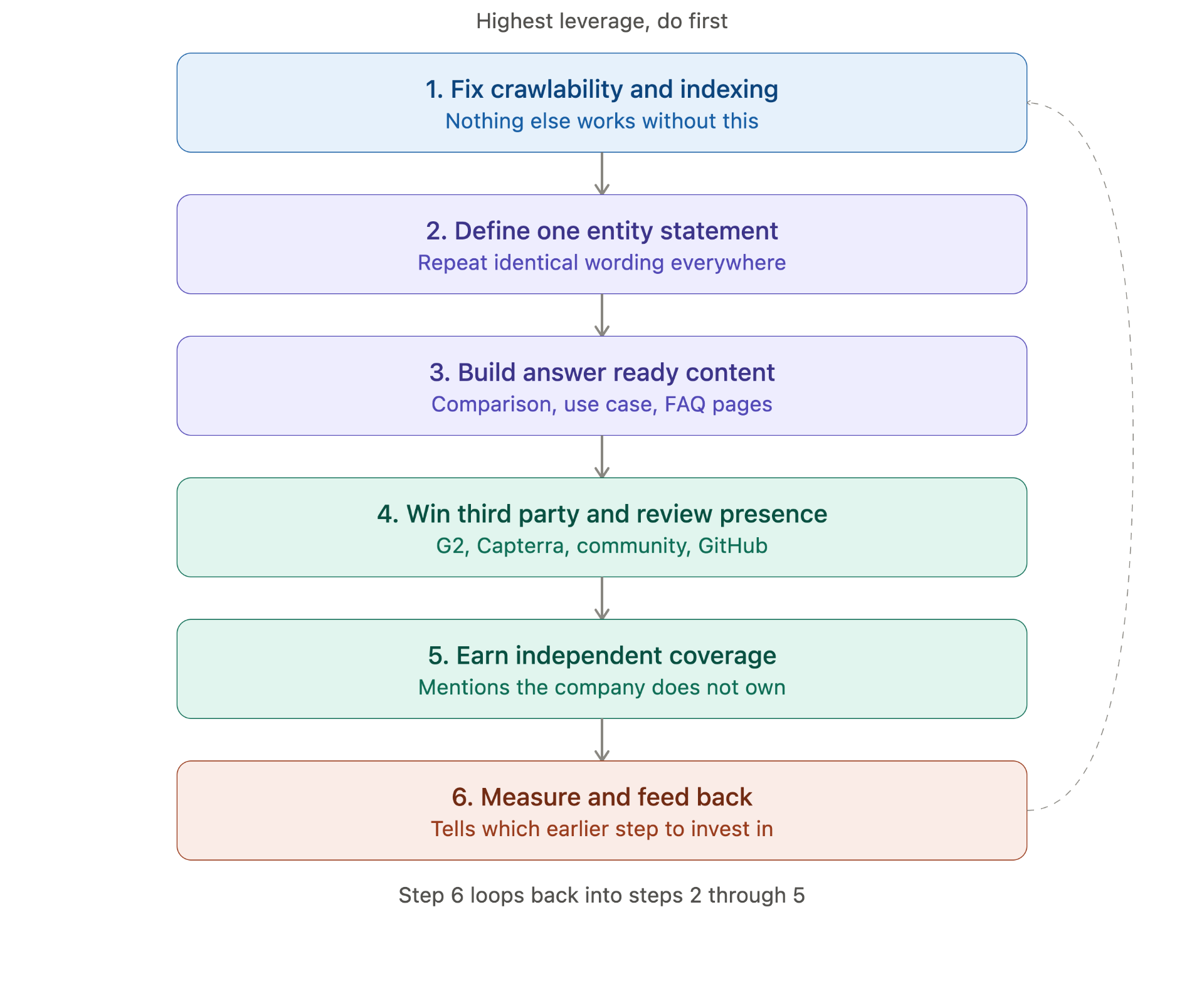
Step 1: Make the site fully crawlable.
Ensure important pages are crawlable, indexable, and rendered correctly without relying entirely on JavaScript. Check robots.txt, Search Console, XML sitemaps, Bing Webmaster Tools, and key pages such as the homepage, pricing, comparison, and use-case pages. Keep AI search crawlers and training crawlers as separate access decisions.
Step 2: Define the product clearly and consistently. Create one clear statement covering the category, audience, problem, use cases, and differentiator. Use the same core description across the website, G2, Capterra, Product Hunt, LinkedIn, and other relevant profiles. Consistency makes the product easier to identify and distinguish.
Step 3: Create content around real buyer questions. Prioritize comparison, alternatives, use-case, integration, pricing, and problem-focused content. Write for specific queries such as "expense software for a 15-person agency using Xero," rather than relying only on broad category pages. Keep comparisons balanced and information accurate.
Step 4: Build genuine third-party presence. Maintain relevant G2 and Capterra profiles, encourage genuine customer reviews, and participate naturally in Reddit, Indie Hackers, Slack, and Discord communities. For developer-focused SaaS, GitHub activity, documentation, and issue responsiveness can also strengthen the product's wider web presence.
Step 5: Earn independent coverage. Build relationships with industry publications, independent bloggers, reviewers, and relevant media. Since AI systems frequently use third-party sources, independent mentions can provide additional evidence about what the product is and where it fits.
Step 6: Measure and iterate. Track a fixed set of buyer-focused prompts across major AI platforms. Record mentions, recommendation position, accuracy, competitors, and cited sources. Treat the first results as a baseline and use subsequent changes to decide where to invest more in content, technical SEO, community, and third-party coverage.
The framework below is an editorial tool for structuring internal audits and prioritization; it is not an official scoring system from Google, OpenAI, Anthropic, or Perplexity, none of which publish a visibility score of this kind. It organizes the areas covered in this article into eight dimensions a SaaS team can walk through, roughly in order of foundational dependency: later dimensions matter less if earlier ones are unresolved.
A team scoring itself honestly against these eight dimensions, even informally, without a numeric system, will generally find gaps concentrated in dimensions five through seven, since most SaaS marketing organizations are structurally built to manage dimensions one through four (owned content and technical SEO) and much less equipped to manage earned, third-party, and community presence.
Because AI platforms do not offer a universal equivalent of Google Search Console, most SaaS teams combine manual prompt testing with AI-visibility monitoring tools. Bing Webmaster Tools and Google Search Console are also adding limited AI-search reporting.
Start with realistic buyer queries rather than brand searches:
Run these prompts across ChatGPT, Gemini, Perplexity, Claude and Copilot and record whether the product appears, its position, whether the description is accurate, and which sources are cited. Repeat the same prompts regularly because AI answers can change over time.
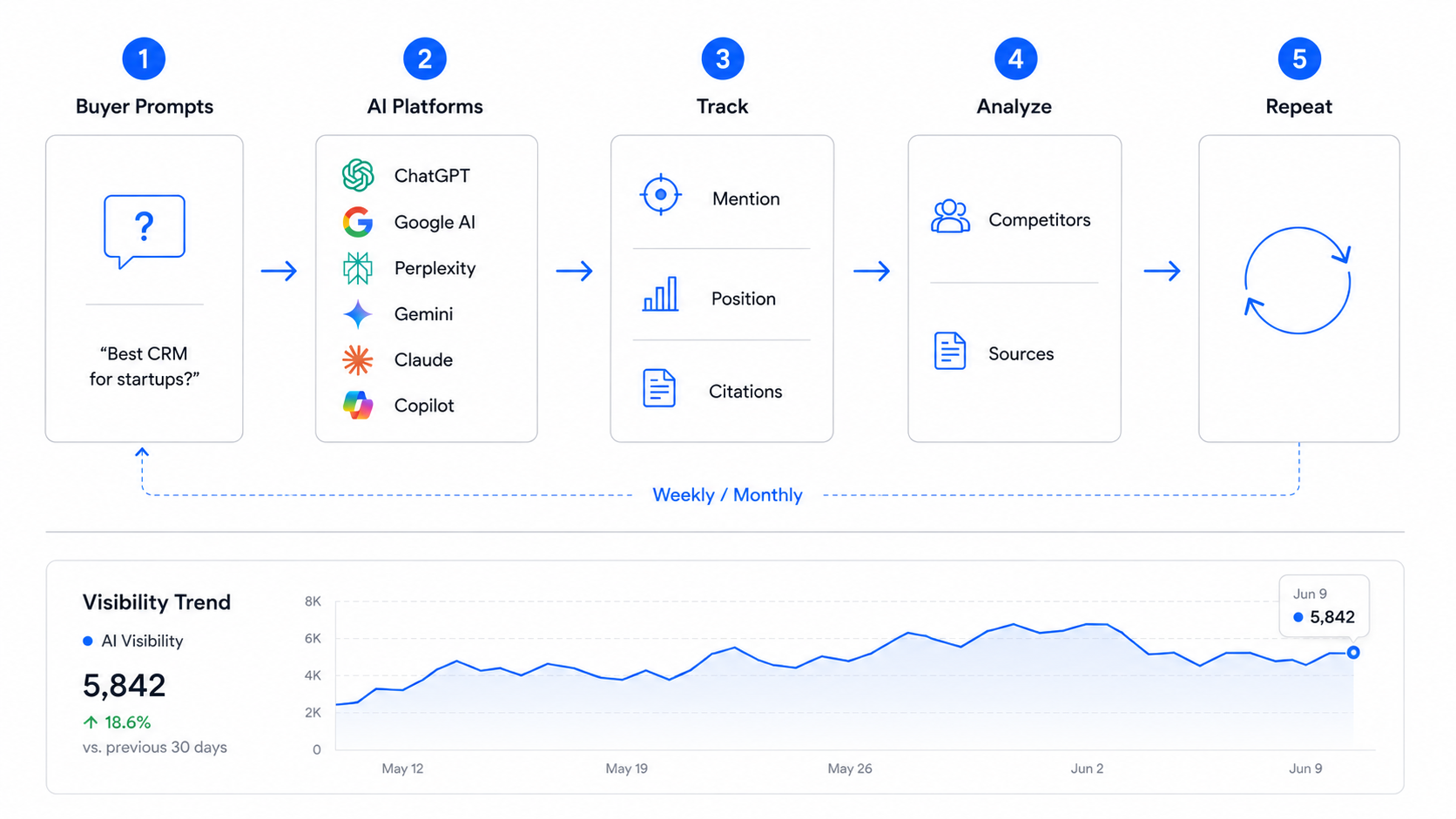
For larger-scale tracking, tools such as PromptWatch, Profound, Peec AI, Otterly.AI, Semrush, and Ahrefs can automate prompt monitoring, competitor comparisons, and citation analysis.
The goal is not a single visibility score. Look for sustained patterns across realistic buyer queries, especially which competitors appear consistently and which third-party sources are behind their recommendations.
AI search visibility is not a replacement for SEO. For SaaS companies, it is becoming an additional layer of search visibility built on many of the same foundations.
A product still needs a crawlable website, useful content, strong technical SEO, and clear information. But that is only part of the picture. AI systems also need enough independent evidence to understand what the product does, who it serves, how it compares with alternatives, and whether other people and organizations recognize it as a credible solution.
That makes AI search visibility a broader ecosystem problem rather than a single-page optimization exercise.
The strongest approach is therefore straightforward: make the product technically accessible, define the product clearly, answer the questions buyers actually ask, build genuine third-party presence, keep information consistent, and measure visibility across multiple AI platforms.
There is no guaranteed formula for appearing in ChatGPT, Gemini, Perplexity, Google AI, Claude, or Copilot. But SaaS companies that consistently make their products easier to discover, understand, verify, and discuss are better positioned for the way software discovery is changing.
