Launching a SaaS product is easy. Getting the right people to notice it is the difficult part.
For indie hackers, solo-founders, and SaaS developers, launch platforms such as Product Hunt, Hacker News, Indie Hackers, Reddit, LinkedIn, and X can create a powerful burst of visibility. But simply publishing a product page does not guarantee users, customers, or even meaningful attention.
A successful launch starts well before launch day. The product needs a clear demo, the launch page needs to communicate its value quickly, the team needs to choose an appropriate launch time, and the founder needs a plan for distributing the launch across existing networks.
This guide focuses on the practical launch process, particularly preparing a demo, building a genuine Product Hunt presence, choosing launch timing, generating legitimate launch-day momentum, distributing the launch through social and personal networks, and understanding why buying or manipulating votes is not a sustainable strategy.
Quick Summary
- Product Hunt: Record a short demo before launch, complete the launch page, prepare your screenshots and description, schedule the launch when your team can be available, and ask your real network for feedback and sharing rather than creating fake accounts or buying votes.
- Hacker News: Launch when the product has something genuinely useful or technically interesting for developers. Write a clear post explaining what was built and why it matters, then stay available to answer technical questions.
- Indie Hackers: Share the actual building journey, including the problem, product decisions, launch experience, early users, mistakes, and results. Start participating in discussions before promoting the product.
- Reddit: Find subreddits where your target users already discuss the problem your product solves. Check each community's rules, contribute useful information, and share the launch only where self-promotion is allowed.
- Startup directories: Submit the product to relevant directories such as Product Watch to create additional discovery opportunities, referral traffic, and long-term SEO value. Do not expect every directory to generate immediate launch-day traffic.
- LinkedIn & X : Turn the launch into several posts instead of sharing the same announcement repeatedly. Publish the demo, explain the problem, show the product in action, share the founder story, and post early results
- WhatsApp and personal networks: Send the launch to friends, colleagues, existing users, and relevant professional contacts who may genuinely be interested. Ask them to try the product and share honest feedback rather than simply asking everyone to upvote.
- After launch: Do not stop when the Product Hunt ranking settles. Follow up with people who tried the product, collect feedback, fix the biggest problems, share the results, and continue promoting the product through content, communities, directories, and social media.
The first thing to prepare is a short product demo. A common mistake among SaaS founders is spending weeks preparing the product and then trying to record a demo a few hours before launch.
The demo should make the product understandable without requiring the visitor to read a long description. Ideally, someone should be able to watch it and understand what the product does, who it is for, and why it is useful within a minute or two.
For example, imagine an indie hacker launching an AI tool that converts GitHub commits into social media posts. Instead of explaining every feature, the demo could show a GitHub repository, select a commit, generate the post, make a small edit, and publish the result. The entire value proposition becomes visible through the workflow.
A simple structure works well: show the problem, introduce the product, demonstrate the core workflow, and finish with the result.*
For visual assets and lightweight video editing, Canva can be used to create product screenshots, launch graphics, thumbnails, captions, and short videos. For straightforward screen recording, Loom is particularly useful for SaaS and developer products because the founder can simply record the actual product in action.
The goal should not be to make the video look like a large company's advertisement. The goal is to make the product immediately understandable.
Product Hunt itself includes product media and launch preparation guidance for makers preparing their pages.
One of the most common Product Hunt launch tactics found in older growth guides is to create multiple accounts through friends and family and use them to generate a large number of votes immediately after launch.
That is not a strategy worth following.
Product Hunt explicitly says makers should not ask friends or family to upvote their products. It expects people to vote because they genuinely like or find the product interesting, and coordinated requests can result in ranking drops or removal from the homepage.
Product Hunt also works to detect fake accounts, voting rings, and other forms of vote manipulation, and suspicious votes can be removed.
The useful idea behind the old strategy is actually starting early. Instead of creating accounts solely for voting, founders and team members should create genuine Product Hunt profiles well before launch and participate in the community.
Product Hunt recommends joining the community before launching and says newly created accounts must wait at least one week before posting a product. It also recommends becoming familiar with the community considerably earlier than launch.
For an indie hacker, this means the founder can start following other makers, discovering products, leaving useful comments, and understanding how successful launches are presented.
If there is a team, genuine team members can also participate. The important distinction is that every account should represent a real person rather than an account created simply to manipulate launch rankings.
Launch timing matters, but there is no magical weekday that guarantees a Product Hunt win.
Product Hunt itself says there is no universal "golden-ticket" day because launch performance depends on several factors, including competing launches, events, audience behavior, and the maker's ability to participate during the launch.
Product Hunt currently recommends 12:01 a.m. Pacific Time as the default launch time when makers do not have another timing constraint. This gives the product a full 24-hour launch cycle.
Product Hunt also allows makers to schedule launches up to one month in advance.
For a SaaS founder, the practical question is therefore not simply "Which day gets the most votes?" It is "When can the team give the launch its full attention?"
If the founder launches at midnight but goes to sleep immediately, a theoretically perfect launch window becomes much less useful. Someone should be available to respond to comments, answer questions, monitor the application, investigate bugs, and talk to early users.
Before scheduling, the Product Hunt page, demo video, screenshots, launch description, first comment, website, analytics, social posts, and support process should all be ready.
This is where the traditional "get 10 accounts and upvote immediately" strategy should be replaced with something much more effective.
When the product goes live, activate the people who already know about the product.
That could include beta users, newsletter subscribers, existing customers, genuine community members, friends who are actually interested in the product, previous collaborators, and the founder's professional network.
The message should not be:
"Go upvote this Product Hunt launch."
Instead, it can be:
The launch is live 🚀 Would love to get your honest feedback on the product. If you have a few minutes, check it out and let us know what you think.
That small change matters. It invites genuine engagement rather than attempting to manufacture votes.
Product Hunt recommends asking people to visit, comment, provide feedback, and share rather than directly asking them for upvotes.
A person who genuinely likes the product can decide whether to upvote it themselves.
This approach also produces something more valuable than a vote. Someone may become a customer, report a bug, introduce another founder, write a review, share the product, or provide feedback that improves the product.
Product Hunt says its ranking system considers multiple signals, including votes, comments, time since submission, and other factors, while keeping the exact algorithm private to prevent manipulation.
The objective should therefore be real engagement, not a particular vote number.
Once the product is live, do not simply wait for Product Hunt's internal traffic.
Use the channels where the founder already has relationships.
LinkedIn can be particularly effective for B2B SaaS. Instead of publishing a generic "We are live on Product Hunt" announcement, explain the problem that led to the product.
For example:
After months of building, [Product Name] is finally live.
The problem was simple: developers were spending too much time switching between tools to debug API requests.
The new workflow puts the entire process into one place.
Here's a 45-second demo.
Feedback from developers and SaaS founders would be especially useful.
That type of post gives the audience a reason to care before asking them to visit the launch.
The same principle applies to X. A founder can turn the launch into a short story showing what was built, why it was built, what changed during development, and what the product does now.
For visual content, Canva can turn the same product screenshots into LinkedIn graphics, X images, carousels, thumbnails, and short videos.
WhatsApp can be useful for early-stage launches because founders often have personal and professional relationships there.
However, blasting dozens of groups with "Please upvote this" can quickly become spammy and can also produce low-quality engagement.
A better approach is to contact people who are actually relevant.
For example, if a founder has built a developer tool, a personal message to developer friends can say:
The product is finally live. Since you work with APIs, would love your honest opinion after trying it.
If the person likes the product, they can share it naturally.
The same principle applies to Slack groups, Discord communities, Telegram groups, email lists, and private communities. The launch should be relevant to the audience rather than simply distributed everywhere.
Product Hunt specifically recommends sharing launches through email, LinkedIn, in-app notifications, and communities where the maker has already established a presence. It also warns against suddenly spamming communities such as Reddit or Indie Hackers on launch day.
Launch day can become surprisingly chaotic.
A founder may need to answer Product Hunt comments, solve bugs, respond to customers, monitor infrastructure, speak with potential users, and track traffic at the same time.
Social content should therefore be prepared before launch.
Buffer can help schedule posts across social platforms so the founder does not have to manually publish every update during the launch.
Instead of publishing the same announcement repeatedly, create different angles around the same product.
The first post can announce the launch. A later post can show the product demo. Another can explain the problem that inspired the product. Another can highlight a feature. A later post can share what users discovered during launch day.
This makes the launch feel like an ongoing story rather than a single promotional message repeated five times.
The demo video created before launch should not be used only on Product Hunt.
A 60-second product demo can be transformed into several pieces of content.
The full version can appear on the Product Hunt page. A shorter version can be posted on LinkedIn and X. Individual scenes can become screenshots. A particularly interesting workflow can become a GIF. A technical section can become an X thread or developer-focused post.

Canva is useful for creating these variations, while Loom can be used when additional technical walkthroughs are needed.
For founders experimenting with different hooks, HeyGen can also create different AI-presenter or UGC-style versions.
For example, the same SaaS product can have one video starting with:
"Still doing this manually?"
Another can start with:
"This used to take 20 minutes. Now it takes 30 seconds."
Another can start with:
"Here's how this developer workflow works."
The product remains the same. The positioning changes according to the audience.
Reddit can be a strong launch channel for SaaS products, indie projects, and developer tools, but the approach should be different from Product Hunt. Instead of posting the same promotional message everywhere, find subreddits where potential users already discuss the problem the product solves.
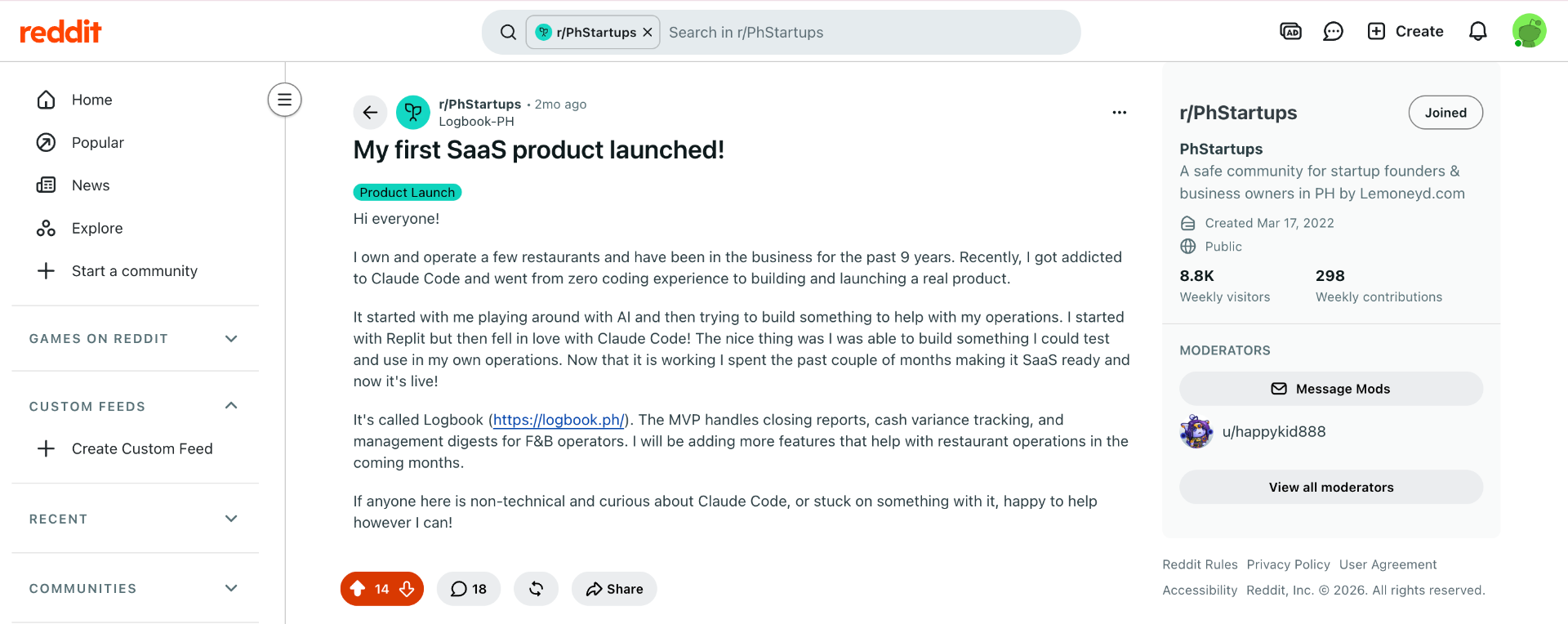
Some useful communities to research include r/SaaS, r/SideProject, r/indiehackers, r/buildinpublic, r/microsaas, r/startups, r/EntrepreneurRideAlong, and r/RoastMyStartup.
For example, rather than saying "Our SaaS is live, check it out," share the problem, development journey, results, or ask for genuine feedback. Always check the current subreddit rules before posting because many communities restrict self-promotion or provide dedicated launch threads.
The goal is not to post on the most subreddits. It is to find the communities where the product genuinely belongs.
Launching is not the end of the process.
The first few hours can generate questions that reveal exactly what potential customers do not understand.
If multiple people ask how pricing works, the pricing page may need improvement.
If people repeatedly ask whether a certain integration exists, that integration may be worth considering.
If visitors watch the demo but do not sign up, the onboarding or landing page may have friction.
If developers love the technical idea but struggle to install the product, the documentation may need work.
Product Hunt recommends being available and responding to comments as quickly as possible during launch day.
For a small SaaS team, this can be one of the most valuable parts of the launch because the founder is suddenly receiving concentrated feedback from people who discovered the product without being personally recruited.
It is tempting to refresh the Product Hunt ranking every few minutes.
But ranking is only one part of the outcome.
Suppose a launch receives 5,000 visitors but only two customers. Another source sends 500 visitors and produces ten paying customers.
The second channel may be much more valuable.
Product Hunt itself identifies goals such as website traffic, sales and leads, early adopters, feedback, networking, social buzz, and brand recognition as potential launch outcomes.
For an early-stage SaaS, track what happens after the click.
Website visitors matter.
Signups matter more.
Activated users matter more than signups.
Paying customers matter more than activated users.
Retention matters more than one-time purchases.
The launch should therefore be evaluated as a funnel rather than simply as a leaderboard position.
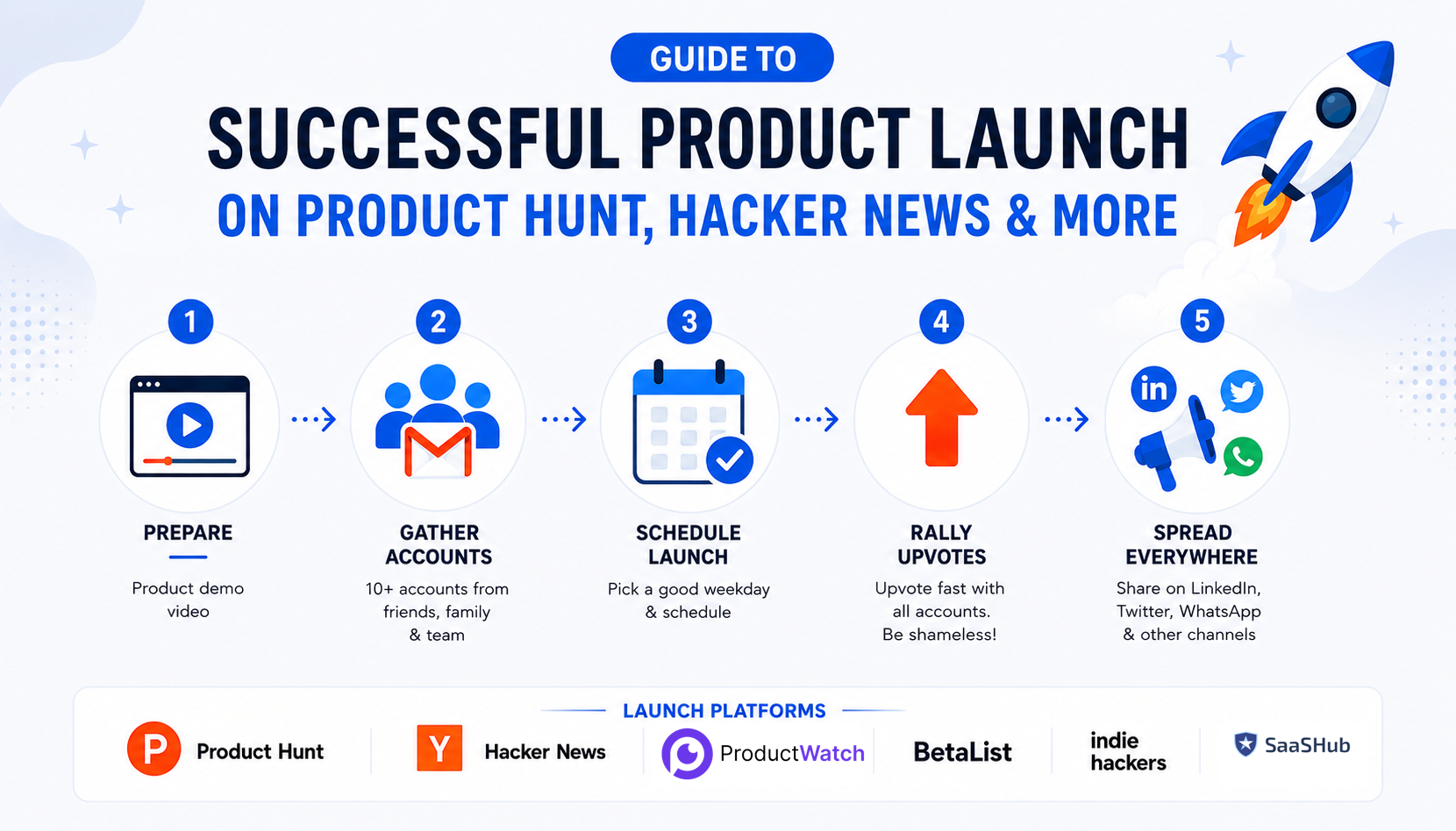
The original six-step strategy includes buying upvotes if there is enough budget.
That should not be part of a legitimate Product Hunt launch strategy.
Product Hunt explicitly warns against artificial engagement, vote manipulation, paid hunters, and incentivized voting. It states that products involved in rule-breaking can be unfeatured or removed and that makers may face permanent bans.
There is a major difference between paying for distribution and paying for votes.
A founder can legitimately spend money on a video, design, advertising, sponsorships, creator partnerships, or other marketing activities.
But paying people specifically to create artificial Product Hunt engagement can put the launch and account at risk.
For a limited SaaS marketing budget, money is generally better spent improving the assets that create genuine demand.
A better $100 can be spent on a better demo, landing-page improvements, customer interviews, or content that continues generating traffic after launch.
The entire process can be reduced to a straightforward workflow.
Before launch: Build the product, prepare the demo, create a genuine Product Hunt profile, participate in the community, prepare the launch page, and schedule the launch.
One week before: Prepare LinkedIn, X, email, and personal-network content. Make sure analytics and support are ready.
Launch day: Publish the product, notify the existing audience, share the demo, ask for feedback, respond to comments, and monitor the product.
During the first 24 hours: Continue genuine distribution instead of repeatedly asking for votes. Talk to users, answer questions, identify friction, and monitor signups.
After launch: Share what was learned, improve the product, follow up with interested users, and turn the launch into additional content.
A successful Product Hunt launch is not about creating ten accounts, asking everyone to upvote, or purchasing votes.
The real advantage comes from preparation and distribution.
Prepare a product demo that makes the SaaS immediately understandable. Build a genuine Product Hunt presence before launch instead of creating accounts solely for voting. Schedule the launch when the team can actually participate. On launch day, activate the people who genuinely care about the product and ask for feedback rather than manufactured engagement.
Then take the launch outside Product Hunt.
Share the story on LinkedIn. Turn the development journey into an X thread. Reach relevant people through personal networks and email. Use communities where the founder already participates. Repurpose the demo into multiple pieces of content.
Tools such as Canva, Loom, HeyGen, and Buffer can make this process significantly easier for a small team.
Most importantly, do not confuse votes with traction.
The strongest launch is not necessarily the one with the highest leaderboard position. It is the one that brings the right people into the product, creates meaningful conversations, generates customers, reveals product weaknesses, and gives the founder enough momentum to keep growing after launch day.
Launch day gets attention. What happens after launch determines whether that attention becomes a business.
