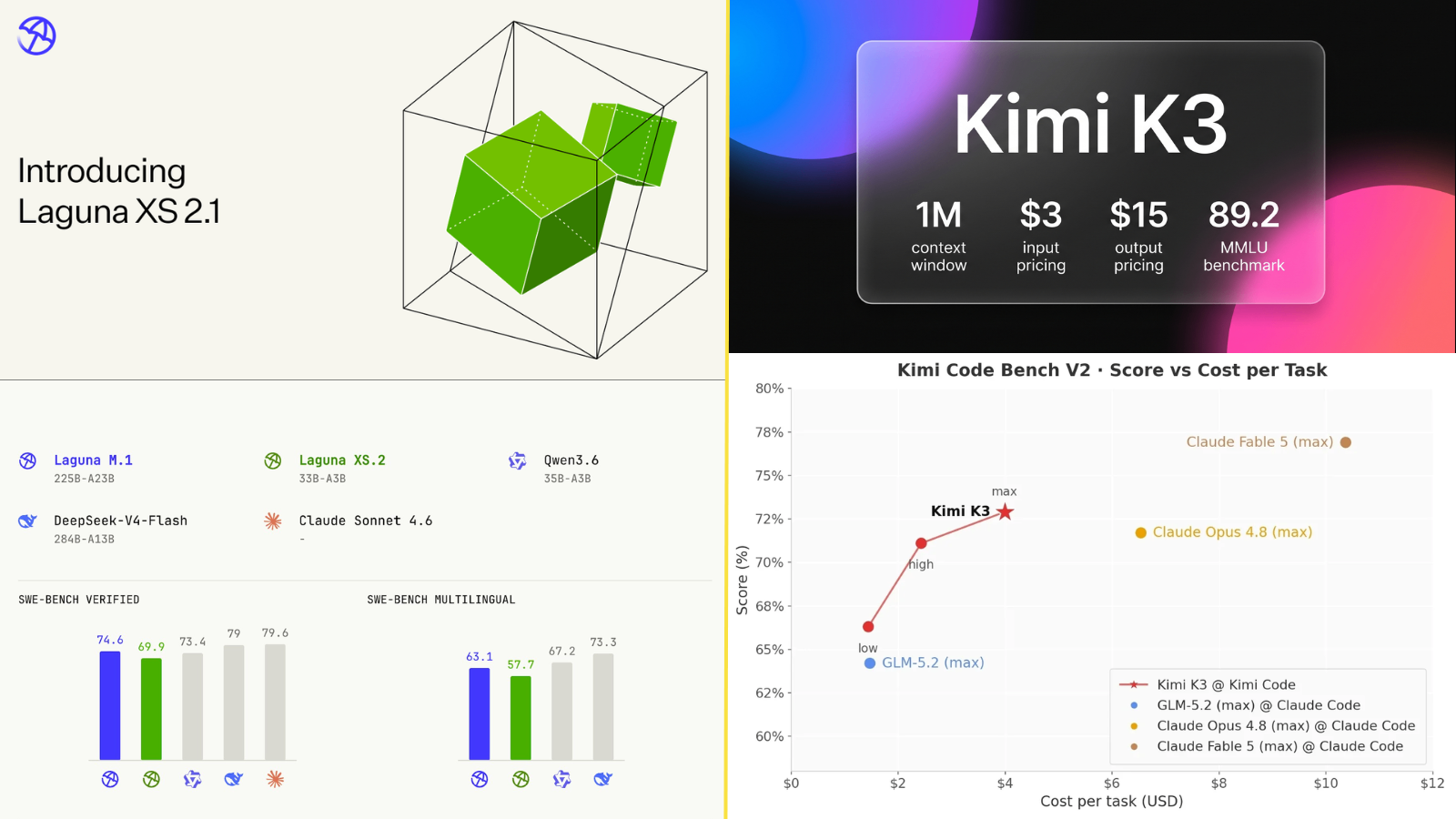
Open-weight AI models have transformed software development in just a few months. Until recently, developers looking for the best coding assistant were largely comparing proprietary models like Claude, GPT-5, or Gemini. While these models remain incredibly capable, they also come with trade-offs. API costs can become significant at scale, self-hosting is not an option, and organizations handling sensitive source code often prefer infrastructure they can control.
That shift has created a growing demand for open-weight coding models that combine strong programming performance with deployment flexibility. Rather than sending every request to a proprietary cloud service, engineering teams can now choose models that run inside their own infrastructure, integrate with existing development pipelines, and power autonomous coding agents without vendor lock-in.
Two models that have quickly become part of this conversation are Laguna XS 2.1 from Poolside and Kimi K3 from Moonshot AI. Although both are positioned as next-generation AI models for developers, they are built with very different objectives.
Laguna XS 2.1 focuses on efficiency. It uses a compact sparse Mixture-of-Experts (MoE) architecture that delivers competitive coding performance while keeping inference costs low. The model is designed for practical deployment, making it attractive for startups, developer tools, and teams that need thousands of AI-assisted coding requests every day.
Kimi K3 takes a different path. Instead of optimizing for affordability, it emphasizes reasoning, multimodal understanding, and exceptionally long context windows. With a trillion-scale sparse architecture and support for contexts up to one million tokens, it is designed for repository-scale software engineering, autonomous AI agents, and complex enterprise workflows.
Comparing these models isn't simply a matter of looking at parameter counts or benchmark scores. The better choice depends on how you plan to use them. A company building an internal code review assistant may value low latency and predictable costs, while an enterprise developing autonomous engineering agents might prioritize reasoning depth and large-context understanding.
This guide explores both models from a practical developer perspective. We'll examine their architecture, coding capabilities, deployment options, benchmark performance, pricing, and real-world use cases so you can decide which model fits your workflow.
Before diving into the technical details, here's a high-level comparison.
At first glance, Kimi K3 appears significantly larger and more capable, but larger models are not always the best choice for production systems. Infrastructure cost, latency, deployment flexibility, and software engineering performance often matter more than raw parameter counts.
Understanding why requires looking at how these models are built.
One of the biggest trends in modern AI development is the adoption of Mixture-of-Experts (MoE) architectures. Instead of activating every parameter for every prompt, MoE models contain many specialized "experts." A routing network decides which experts should handle each token, allowing only a small portion of the model to run during inference.
This approach improves efficiency without requiring every request to pass through the entire neural network.
The idea can be visualized as follows:
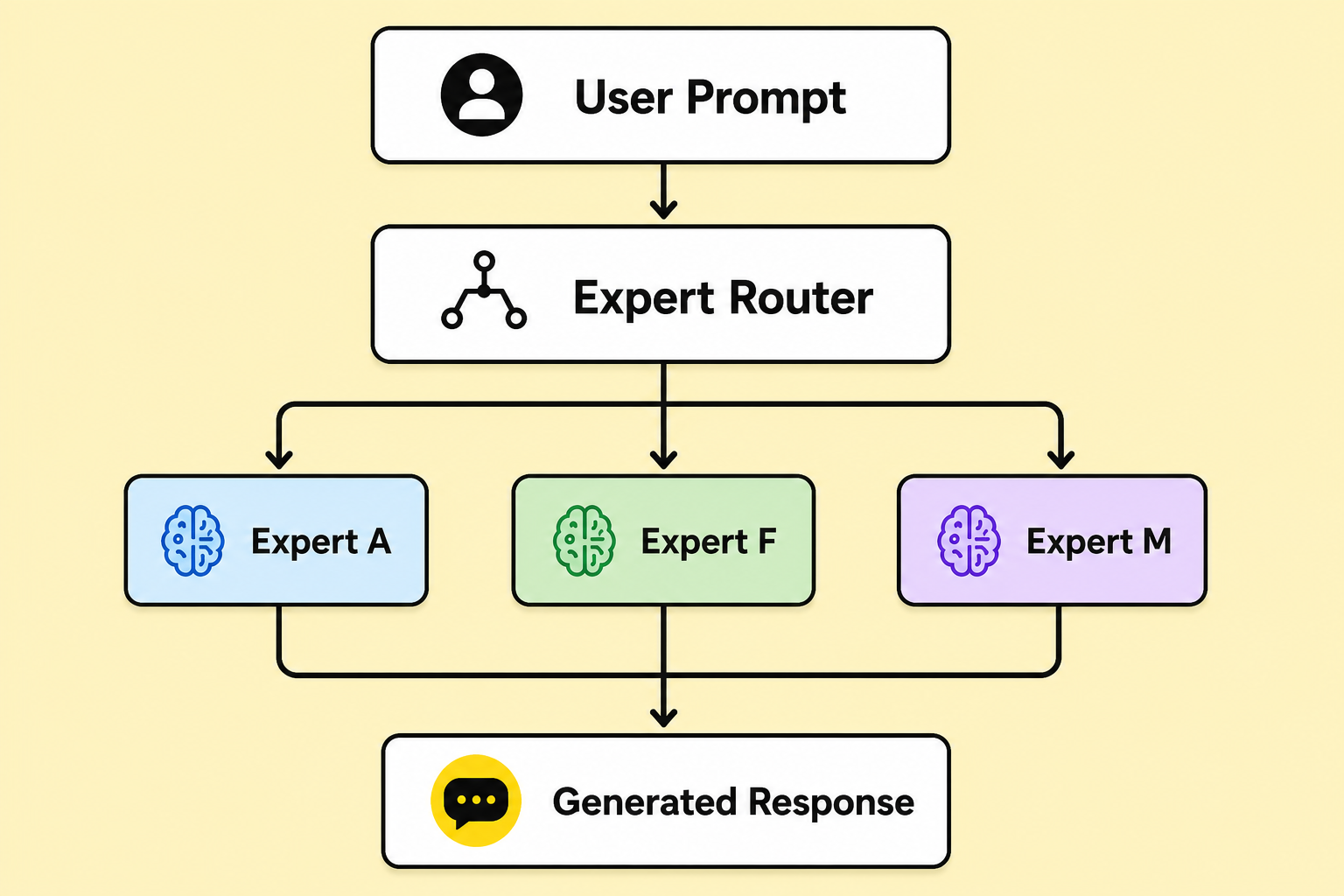
Unlike traditional dense models where every parameter participates in every computation, sparse architectures reduce unnecessary work. The result is lower computational requirements, faster inference, and improved scalability.
Although both Laguna XS 2.1 and Kimi K3 use this architecture, they apply it in different ways.
Poolside developed Laguna XS 2.1 with a clear objective: build an open coding model that delivers excellent software engineering performance without requiring enormous computational resources.
The model contains approximately 33 billion total parameters, but activates only around 3 billion for each token. This relatively small active parameter count allows the model to remain efficient while still handling demanding programming tasks such as repository analysis, bug fixing, code generation, refactoring, and tool-assisted development.
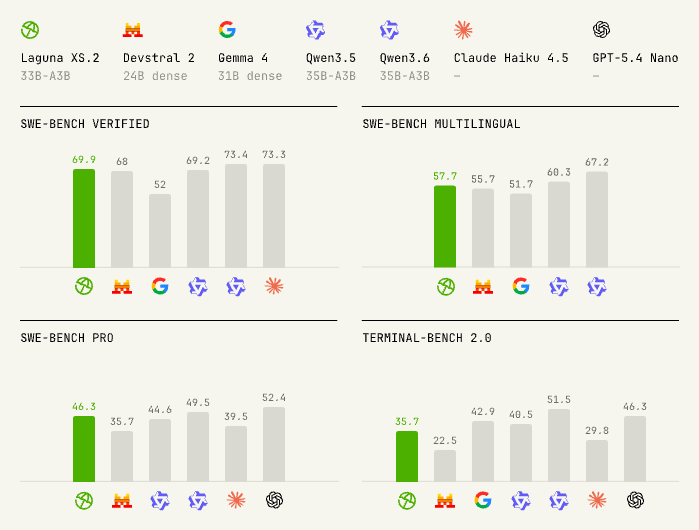
For developers, this architectural decision has practical implications. Lower active parameters generally translate into faster response times, reduced GPU memory requirements, and lower operating costs. Teams deploying coding assistants at scale can serve more requests with the same hardware than much larger models.
Rather than competing purely on model size, Laguna XS 2.1 focuses on maximizing useful work per unit of compute.
Kimi K3 follows a different philosophy.
Instead of minimizing computational requirements, Moonshot AI has built one of the largest publicly available open-weight language models released to date. Its architecture contains 2.8 trillion total parameters, with roughly 104 billion active parameters participating during inference.
While this significantly increases hardware requirements, it also expands the model's reasoning capacity. Kimi K3 is designed to manage complex planning tasks, analyze extremely large repositories, process lengthy technical documentation, and coordinate autonomous AI agents over long sessions.
Its support for a one million token context window further differentiates it from many competing models. Rather than breaking repositories into smaller chunks, developers can keep substantially more information available within a single prompt, reducing the need for external context management.
This architecture makes Kimi K3 particularly attractive for organizations building advanced AI systems where reasoning quality is more important than inference efficiency.
It's tempting to assume that a model with more parameters is automatically better, but modern AI development is more nuanced.
Large parameter counts often improve reasoning ability, yet they also increase inference cost, memory requirements, and deployment complexity. A model that performs slightly better on benchmarks may become impractical if serving millions of requests each month dramatically increases infrastructure expenses.
This is one reason sparse architectures have become so popular. Instead of asking, "Which model is larger?", engineering teams increasingly ask, "Which model delivers the best performance for the available compute budget?"
Laguna XS 2.1 and Kimi K3 represent two different answers to that question.
Poolside has prioritized efficiency without sacrificing coding quality, while Moonshot AI has pushed toward frontier-level reasoning and context capacity.
The remainder of this comparison explores how those architectural decisions influence coding performance, benchmarks, deployment, and overall developer experience.
When evaluating an AI coding model, benchmark numbers provide a useful starting point, but they rarely tell the complete story. A model that performs well on synthetic programming tasks may still struggle with real software engineering problems involving multiple files, debugging, dependency management, or long-running development sessions.
This is why modern evaluations increasingly focus on agentic software engineering rather than isolated code generation. Instead of asking a model to write a function from scratch, newer benchmarks measure whether it can understand an existing codebase, identify the root cause of a bug, edit the appropriate files, execute tests, and verify that the solution actually works.
Both Laguna XS 2.1 and Kimi K3 are designed for these more demanding engineering workflows, but they achieve their results in different ways. Laguna XS 2.1 focuses on maximizing coding performance per unit of compute, while Kimi K3 prioritizes reasoning depth and long-horizon execution for complex engineering tasks.
Before comparing benchmark scores, it helps to understand what these evaluations actually measure.
SWE-Bench has become one of the most widely referenced benchmarks for AI software engineering. Instead of asking standalone programming questions, it evaluates whether a model can resolve real GitHub issues collected from popular open-source repositories.
To succeed, a model must understand the reported bug, inspect the existing codebase, modify the correct files, and produce a patch that passes the project's automated tests. Because it mirrors real development workflows, many researchers consider SWE-Bench a stronger indicator of practical coding ability than traditional algorithmic programming tests.
Terminal Bench evaluates AI agents in a command-line environment rather than a conversational interface. Models interact with terminals much like a developer would, executing shell commands, managing dependencies, editing files, running build systems, configuring servers, and debugging projects.
Unlike code completion benchmarks, Terminal Bench measures whether a model can complete realistic engineering tasks that often require multiple reasoning steps and tool interactions.
Traditional coding benchmarks often reward memorization or the generation of short code. Modern software engineering is very different.
Developers spend much more time understanding unfamiliar repositories, debugging existing code, reviewing pull requests, fixing integration issues, and coordinating multiple tools than writing new algorithms from scratch. Benchmarks like SWE-Bench and Terminal Bench attempt to reflect these everyday engineering challenges more accurately.
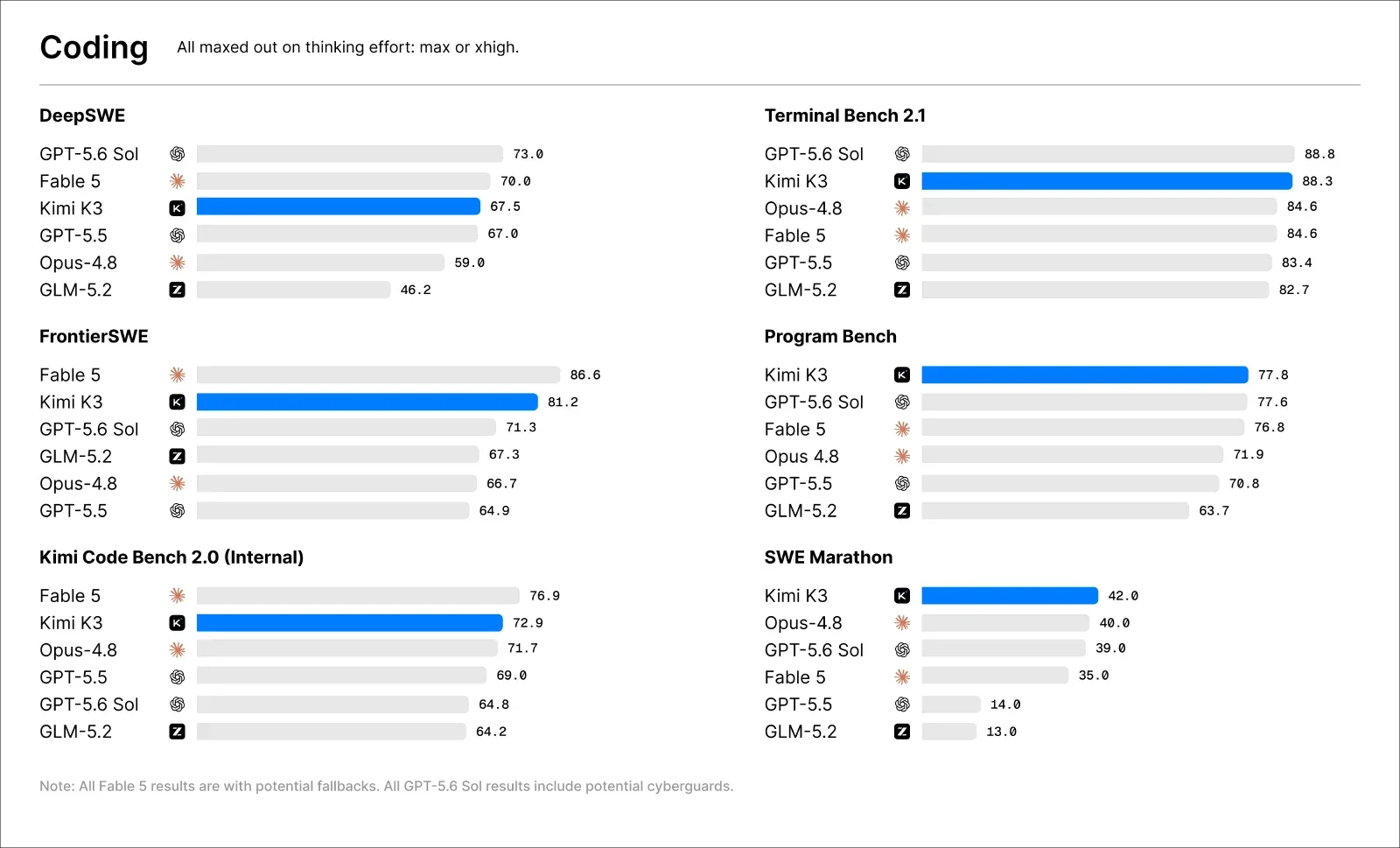
Although benchmark methodologies continue to evolve, publicly available results provide useful insight into how both models compare.
*Moonshot highlights Kimi K3's strong performance across long-horizon coding and agentic evaluations, although not every benchmark has directly comparable public results. :contentReference[oaicite:2]{index=2}
Rather than focusing on a single number, it's more useful to interpret what these results mean in practice.
Laguna XS 2.1 performs remarkably well considering its relatively compact architecture. Its published SWE-Bench Verified score places it among the strongest models in its parameter class, demonstrating that efficient model design can compete with substantially larger systems on real software engineering tasks. :contentReference[oaicite:3]{index=3}
Kimi K3, meanwhile, is designed to compete closer to frontier proprietary models. Its reported Terminal Bench 2.1 performance reflects particularly strong capabilities in long-running command-line workflows, where reasoning, planning, and tool orchestration become increasingly important.
Writing correct syntax is only a small part of software engineering.
Modern AI coding assistants are expected to understand architectural patterns, follow project conventions, generate tests, review pull requests, explain unfamiliar code, and help developers navigate large repositories.
Laguna XS 2.1 performs particularly well when these tasks remain centered around software engineering itself. Repository navigation, debugging, function generation, code refactoring, and API implementation are all areas where its architecture has been specifically optimized. Because only a small number of experts are activated during inference, response times remain fast even during extended development sessions.
Kimi K3 extends these capabilities further by combining software engineering with stronger reasoning. Rather than simply editing code, it can maintain significantly larger planning contexts, making it well suited for autonomous development agents that execute many interconnected tasks before producing a final solution.
This distinction becomes increasingly important as AI moves from code completion toward autonomous software engineering.
One of the biggest challenges for coding assistants is context management.
A modern enterprise repository can contain thousands of files, architectural documentation, infrastructure configuration, API specifications, test suites, and design discussions. No developer expects an AI model to understand every file perfectly, but the more context it can retain, the fewer compromises need to be made.
Laguna XS 2.1 already supports an impressive long context for its size, allowing developers to analyze large sections of a repository without repeatedly trimming prompts.
Kimi K3 pushes this concept much further.
Its one million token context window enables developers to work with substantially larger repositories, long technical documents, meeting transcripts, and design specifications within a single session. According to the Kimi K3 technical report, this capability is supported by architectural improvements including Kimi Delta Attention and optimized expert routing, allowing the model to maintain stronger information flow across extremely long sequences. :contentReference[oaicite:5]{index=5}
That additional context is particularly valuable for enterprise engineering teams, where understanding relationships across hundreds of files often matters more than generating another code snippet.
The conversation around AI coding has gradually shifted from "Can the model write code?" to "Can the model complete software engineering tasks with minimal supervision?"
Autonomous agents increasingly perform activities such as cloning repositories, inspecting issues, searching documentation, executing shell commands, modifying files, running tests, and preparing pull requests.
Laguna XS 2.1 is clearly optimized for this emerging workflow. Poolside has focused heavily on agentic software engineering, with thinking modes that allocate additional reasoning when solving difficult engineering problems. Published evaluations show substantial improvements on Terminal Bench and DeepSWE when these reasoning modes are enabled, illustrating the growing importance of adaptive inference rather than static code generation.
Kimi K3 approaches autonomous development from a broader perspective. Beyond coding, it incorporates multimodal understanding, long-horizon reinforcement learning, and reasoning strategies intended for complex AI systems. Its technical report emphasizes compositional reasoning, persistent agent states, and long-duration execution across coding, research, and general intelligence tasks.
These design decisions make Kimi K3 especially appealing for organizations building AI engineers rather than traditional code assistants.
Perhaps the most interesting comparison between these models is not capability, but efficiency.
Historically, achieving better AI performance required dramatically larger models and higher computational costs. Laguna XS 2.1 demonstrates that thoughtful architecture can narrow that gap considerably.
Instead of competing purely through scale, it focuses on maximizing useful coding performance while minimizing infrastructure requirements. This allows startups and developer tool companies to deploy advanced coding assistants without the hardware investment typically associated with frontier-scale language models.
Kimi K3 represents the opposite end of the spectrum. It assumes that some engineering problems justify significantly larger computational budgets in exchange for stronger reasoning, larger context windows, and more capable autonomous behavior.
Neither philosophy is inherently superior. The better choice depends entirely on the workload being optimized.
Benchmark scores often dominate discussions around AI models, but deploying a model in production involves a very different set of considerations. Engineering teams need to evaluate infrastructure requirements, API costs, latency, deployment flexibility, framework compatibility, and operational complexity before deciding which model fits their stack.
This is where Laguna XS 2.1 and Kimi K3 begin to diverge significantly. While both are designed for modern software engineering, their deployment philosophies reflect two very different approaches to AI infrastructure.
One of the biggest advantages of open-weight models is deployment flexibility. Organizations handling proprietary code, regulated data, or internal development workflows often prefer running models within their own infrastructure rather than relying entirely on external APIs.
Laguna XS 2.1 was designed with this use case in mind. With a 33B sparse Mixture-of-Experts architecture and only about 3 billion active parameters during inference, the model has a relatively compact serving footprint compared with frontier-scale systems. Poolside also provides compatibility with widely adopted inference stacks, making the model practical for organizations that want to build self-hosted coding assistants or integrate AI directly into internal development environments. Its FP8 quantization further reduces inference costs without sacrificing coding performance.
Kimi K3 takes a different path. Although Moonshot AI has released the model weights, the model itself is significantly larger, with 2.8 trillion total parameters and approximately 104 billion activated parameters through its sparse MoE architecture. This scale enables stronger reasoning and larger context windows, but it also introduces considerable infrastructure requirements. According to Moonshot's technical documentation, production deployments are intended for distributed GPU clusters rather than individual workstations.
For many development teams, this distinction matters more than benchmark rankings. A model that requires dozens of high-end accelerators may be ideal for enterprise AI platforms, while a compact coding model can often deliver better return on investment for everyday software engineering.
Running a modern coding model locally depends not only on parameter count but also on active parameters, quantization strategy, memory optimization, and inference software.
Laguna XS 2.1 benefits from activating only a small subset of experts during inference. This design reduces memory bandwidth requirements and makes the model suitable for a wider range of enterprise GPU configurations. Teams already operating inference servers with frameworks such as vLLM or TensorRT-LLM can integrate Laguna into existing workflows without requiring specialized hardware.
Kimi K3, on the other hand, targets an entirely different deployment class. Its sparse architecture activates 16 of 896 experts for each request, but the overall model still requires distributed inference because of its enormous parameter count. Moonshot recommends large multi-GPU deployments for production environments, particularly when serving long-context or agentic workloads.
The contrast can be summarized visually:
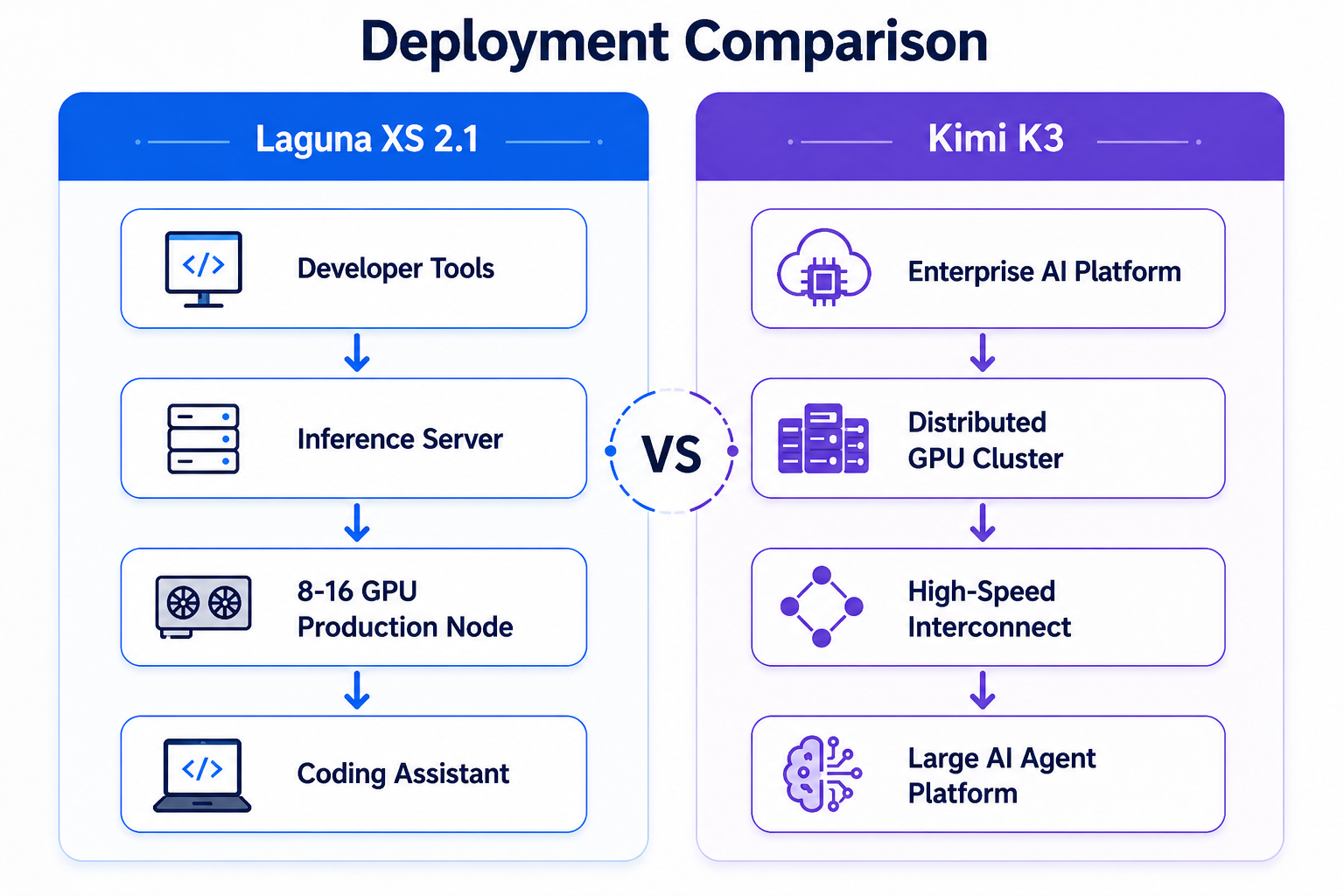
Rather than indicating that one model is superior, this comparison illustrates that each targets a different deployment environment.
Infrastructure planning is closely tied to operating cost, especially for organizations serving millions of AI requests each month.
Public API pricing highlights one of the largest practical differences between these models.
The numbers alone are striking, but their real impact becomes clearer when translated into production scenarios.
Imagine an AI-powered code review platform processing one billion input tokens and two hundred million output tokens each month. Using Laguna XS 2.1 would result in infrastructure costs that are dramatically lower than those associated with Kimi K3. For startups or developer tool companies operating on fixed infrastructure budgets, that difference can directly influence profitability.
Conversely, organizations building autonomous engineering systems may decide that Kimi K3's additional reasoning capability justifies the higher operating cost.
These models occupy very different positions on the cost-performance curve.
Another factor influencing adoption is the surrounding ecosystem.
A capable language model becomes far more useful when it integrates smoothly with developer tools, inference frameworks, and existing workflows.
Laguna XS 2.1 has been designed primarily for software engineering. It supports tool calling, long-context reasoning, and integration with common inference stacks, making it relatively straightforward to incorporate into code assistants, pull request reviewers, IDE extensions, and autonomous development agents. Because of its smaller serving footprint, experimentation is also more accessible for independent developers and startups.
Kimi K3 extends beyond traditional coding assistants. In addition to software engineering, it supports multimodal inputs and advanced reasoning, allowing developers to build applications that combine code, documentation, diagrams, screenshots, and visual assets within a single workflow. Native vision support makes it possible to analyze UI mockups, debugging screenshots, architecture diagrams, and other visual artifacts alongside source code.
This broader capability makes Kimi K3 attractive for AI-native platforms where coding is only one component of a much larger reasoning pipeline.
One of the fastest-growing areas of AI development is autonomous software engineering. Rather than simply completing code snippets, AI agents increasingly clone repositories, inspect issues, execute shell commands, modify files, run automated tests, and iterate until a task is complete.
Both Laguna XS 2.1 and Kimi K3 are designed with this future in mind, but they approach it differently.
Laguna XS 2.1 emphasizes efficient execution. Its architecture is optimized for repetitive engineering workflows where response speed and operating cost matter. This makes it well suited for continuous integration pipelines, automated pull request generation, repository maintenance, and developer productivity tools that execute thousands of tasks each day.
Kimi K3 focuses on sustained reasoning across much longer sessions. Moonshot's technical report highlights reinforcement learning for agentic behavior, improved attention mechanisms, and persistent long-horizon execution, enabling AI systems to coordinate multiple tools while maintaining context over extended interactions.
As AI agents continue to evolve, this difference is likely to become increasingly important.
The choice between Laguna XS 2.1 and Kimi K3 ultimately depends less on benchmark scores than on operational priorities.
Teams building developer tools, internal coding assistants, or high-volume engineering platforms will often benefit from Laguna XS 2.1's efficient architecture and lower operating costs. It delivers strong coding performance while remaining practical to deploy at scale.
Organizations building frontier AI systems, enterprise engineering agents, or multimodal reasoning platforms may find Kimi K3's larger architecture, million-token context window, and advanced reasoning capabilities better aligned with their long-term goals, even if those capabilities require substantially greater computational resources.
Understanding these trade-offs is far more valuable than simply asking which model is "better." Each has been engineered for a different class of software engineering problems, and selecting the right one depends on the complexity, scale, and economics of the applications you plan to build.
