
Blogs in llm
stay updated with the latest news, insights, and guides on llm from ProductWatch.
Laguna XS 2.1 vs Kimi K3: Which Open AI Coding Model Is Better for Developers in 2026?
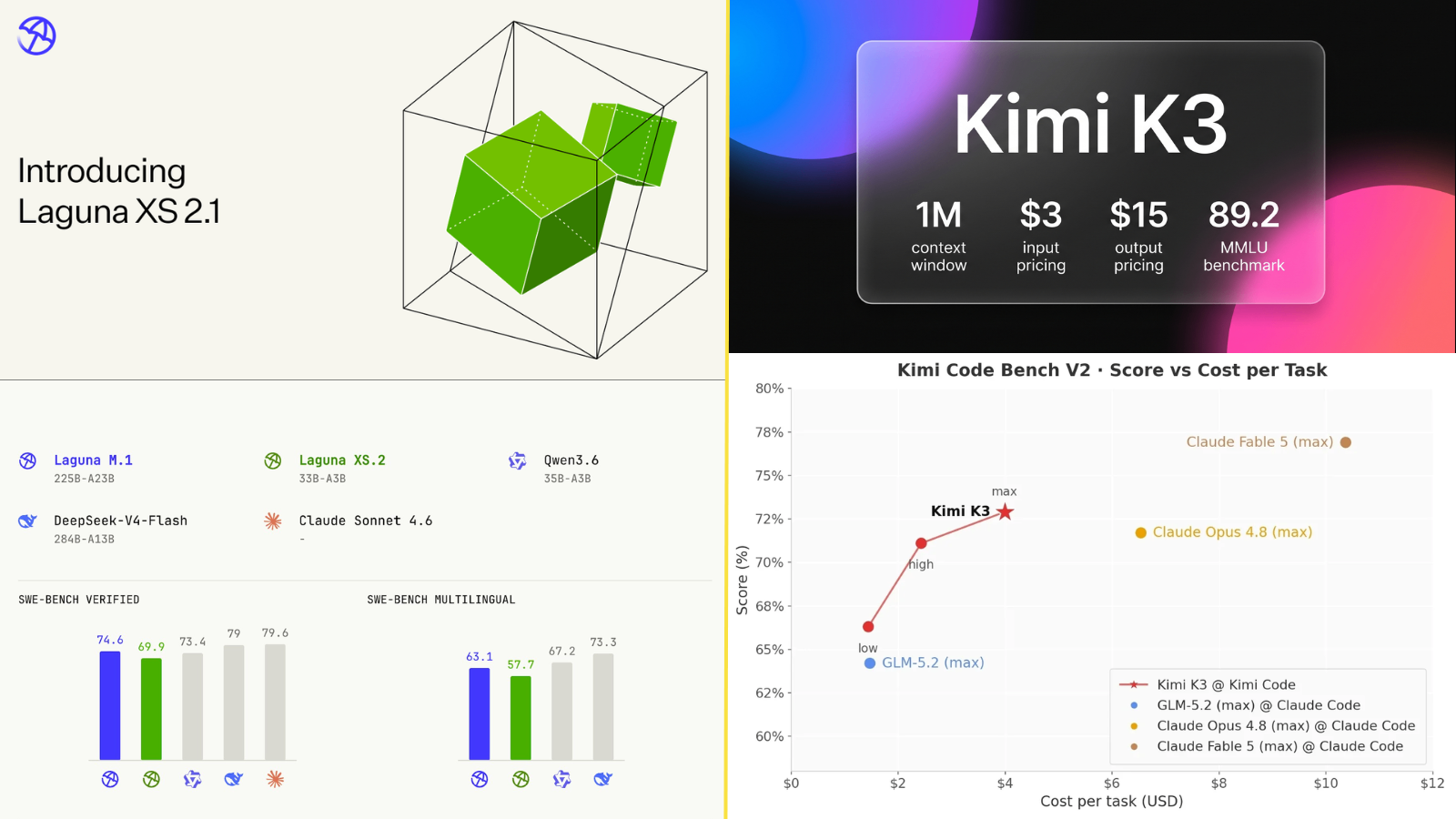
Open-weight AI models have transformed software development in just a few months. Until recently, developers looking for the best coding assistant were largely comparing proprietary models like Claude, GPT-5, or Gemini. While these models remain incredibly capable, they also come with trade-offs. API costs can become significant at scale, self-hosting is not an option, and organizations handling sensitive source code often prefer infrastructure they can control. That shift has created a growing demand for open-weight coding models that combine strong programming performance with deployment flexibility. Rather than sending every request to a proprietary cloud service, engineering teams can now choose models that run inside their own infrastructure, integrate with existing development pipelines, and power autonomous coding agents without vendor lock-in. Two models that have quickly become part of this conversation are Laguna XS 2.1 from Poolside and Kimi K3 from Moonshot AI. Although both are positioned as next-generation AI models for developers, they are built with very different objectives. Laguna XS 2.1 focuses on efficiency. It uses a compact sparse Mixture-of-Experts (MoE) architecture that delivers competitive coding performance while keeping inference costs low. The model is designed for practical deployment, making it attractive for startups, developer tools, and teams that need thousands of AI-assisted coding requests every day. Kimi K3 takes a different path. Instead of optimizing for affordability, it emphasizes reasoning, multimodal understanding, and exceptionally long context windows. With a trillion-scale sparse architecture and support for contexts up to one million tokens, it is designed for repository-scale software engineering, autonomous AI agents, and complex enterprise workflows. Comparing these models isn't simply a matter of looking at parameter counts or benchmark scores. The better choice depends on how you plan to use them. A company building an internal code review assistant may value low latency and predictable costs, while an enterprise developing autonomous engineering agents might prioritize reasoning depth and large-context understanding. This guide explores both models from a practical developer perspective. We'll examine their architecture, coding capabilities, deployment options, benchmark performance, pricing, and real-world use cases so you can decide which model fits your workflow. QUICK OVERVIEW Before diving into the technical details, here's a high-level comparison. | Feature | Laguna XS 2.1 | Kimi K3 | | | | | | Developer | Poolside | Moonshot AI | | Model Type | Sparse MoE | Sparse MoE | | Total Parameters | 33B | 2.8T | | Active Parameters | ~3B | ~104B | | Maximum Context | 262K tokens | 1M tokens | | Multimodal | No | Yes | | Open Weights | Yes | Yes | | Self Hosting | Yes | Yes (high hardware requirements) | | Primary Strength | Efficient autonomous coding | Long-context reasoning & AI agents | At first glance, Kimi K3 appears significantly larger and more capable, but larger models are not always the best choice for production systems. Infrastructure cost, latency, deployment flexibility, and software engineering performance often matter more than raw parameter counts. Understanding why requires looking at how these models are built. UNDERSTANDING SPARSE MIXTURE-OF-EXPERTS MODELS One of the biggest trends in modern AI development is the adoption of Mixture-of-Experts (MoE) architectures. Instead of activating every parameter for every prompt, MoE models contain many specialized "experts." A routing network decides which experts should handle each token, allowing only a small portion of the model to run during inference. This approach improves efficiency without requiring every request to pass through the entire neural network. The idea can be visualized as follows: Unlike traditional dense models where every parameter participates in every computation, sparse architectures reduce unnecessary work. The result is lower computational requirements, faster inference, and improved scalability. Although both Laguna XS 2.1 and Kimi K3 use this architecture, they apply it in different ways. LAGUNA XS 2.1: DESIGNED FOR EFFICIENT SOFTWARE ENGINEERING Poolside developed Laguna XS 2.1 with a clear objective: build an open coding model that delivers excellent software engineering performance without requiring enormous computational resources. The model contains approximately 33 billion total parameters, but activates only around 3 billion for each token. This relatively small active parameter count allows the model to remain efficient while still handling demanding programming tasks such as repository analysis, bug fixing, code generation, refactoring, and tool-assisted development. For developers, this architectural decision has practical implications. Lower active parameters generally translate into faster response times, reduced GPU memory requirements, and lower operating costs. Teams deploying coding assistants at scale can serve more requests with the same hardware than much larger models. Rather than competing purely on model size, Laguna XS 2.1 focuses on maximizing useful work per unit of compute. KIMI K3: OPTIMIZED FOR LONG-HORIZON REASONING Kimi K3 follows a different philosophy. Instead of minimizing computational requirements, Moonshot AI has built one of the largest publicly available open-weight language models released to date. Its architecture contains 2.8 trillion total parameters, with roughly 104 billion active parameters participating during inference. While this significantly increases hardware requirements, it also expands the model's reasoning capacity. Kimi K3 is designed to manage complex planning tasks, analyze extremely large repositories, process lengthy technical documentation, and coordinate autonomous AI agents over long sessions. Its support for a one million token context window further differentiates it from many competing models. Rather than breaking repositories into smaller chunks, developers can keep substantially more information available within a single prompt, reducing the need for external context management. This architecture makes Kimi K3 particularly attractive for organizations building advanced AI systems where reasoning quality is more important than inference efficiency. WHY PARAMETER COUNT DOESN'T TELL THE WHOLE STORY It's tempting to assume that a model with more parameters is automatically better, but modern AI development is more nuanced. Large parameter counts often improve reasoning ability, yet they also increase inference cost, memory requirements, and deployment complexity. A model that performs slightly better on benchmarks may become impractical if serving millions of requests each month dramatically increases infrastructure expenses. This is one reason sparse architectures have become so popular. Instead of asking, "Which model is larger?", engineering teams increasingly ask, "Which model delivers the best performance for the available compute budget?" Laguna XS 2.1 and Kimi K3 represent two different answers to that question. Poolside has prioritized efficiency without sacrificing coding quality, while Moonshot AI has pushed toward frontier-level reasoning and context capacity. The remainder of this comparison explores how those architectural decisions influence coding performance, benchmarks, deployment, and overall developer experience. CODING PERFORMANCE: LOOKING BEYOND BENCHMARK SCORES When evaluating an AI coding model, benchmark numbers provide a useful starting point, but they rarely tell the complete story. A model that performs well on synthetic programming tasks may still struggle with real software engineering problems involving multiple files, debugging, dependency management, or long-running development sessions. This is why modern evaluations increasingly focus on agentic software engineering rather than isolated code generation. Instead of asking a model to write a function from scratch, newer benchmarks measure whether it can understand an existing codebase, identify the root cause of a bug, edit the appropriate files, execute tests, and verify that the solution actually works. Both Laguna XS 2.1 and Kimi K3 are designed for these more demanding engineering workflows, but they achieve their results in different ways. Laguna XS 2.1 focuses on maximizing coding performance per unit of compute, while Kimi K3 prioritizes reasoning depth and long-horizon execution for complex engineering tasks. UNDERSTANDING MODERN CODING BENCHMARKS Before comparing benchmark scores, it helps to understand what these evaluations actually measure. SWE-BENCH SWE-Bench has become one of the most widely referenced benchmarks for AI software engineering. Instead of asking standalone programming questions, it evaluates whether a model can resolve real GitHub issues collected from popular open-source repositories. To succeed, a model must understand the reported bug, inspect the existing codebase, modify the correct files, and produce a patch that passes the project's automated tests. Because it mirrors real development workflows, many researchers consider SWE-Bench a stronger indicator of practical coding ability than traditional algorithmic programming tests. TERMINAL BENCH Terminal Bench evaluates AI agents in a command-line environment rather than a conversational interface. Models interact with terminals much like a developer would, executing shell commands, managing dependencies, editing files, running build systems, configuring servers, and debugging projects. Unlike code completion benchmarks, Terminal Bench measures whether a model can complete realistic engineering tasks that often require multiple reasoning steps and tool interactions. WHY THESE BENCHMARKS MATTER Traditional coding benchmarks often reward memorization or the generation of short code. Modern software engineering is very different. Developers spend much more time understanding unfamiliar repositories, debugging existing code, reviewing pull requests, fixing integration issues, and coordinating multiple tools than writing new algorithms from scratch. Benchmarks like SWE-Bench and Terminal Bench attempt to reflect these everyday engineering challenges more accurately. BENCHMARK COMPARISON Although benchmark methodologies continue to evolve, publicly available results provide useful insight into how both models compare. | Benchmark | Laguna XS 2.1 | Kimi K3 | | | :| :| | SWE-Bench Verified | 70.9% | Frontier-level (vendor reports) | | SWE-Bench Multilingual | 63.1% | Higher on larger Kimi family evaluations* | | Terminal Bench 2.0 | 37.5% | Higher | | Terminal Bench 2.1 | Laguna S 2.1 family: 70.2% | 88.3% | | Long Context | 1M (Laguna S family) / 262K (XS) | 1M | *Moonshot highlights Kimi K3's strong performance across long-horizon coding and agentic evaluations, although not every benchmark has directly comparable public results. :contentReference[oaicite:2]{index=2} Rather than focusing on a single number, it's more useful to interpret what these results mean in practice. Laguna XS 2.1 performs remarkably well considering its relatively compact architecture. Its published SWE-Bench Verified score places it among the strongest models in its parameter class, demonstrating that efficient model design can compete with substantially larger systems on real software engineering tasks. :contentReference[oaicite:3]{index=3} Kimi K3, meanwhile, is designed to compete closer to frontier proprietary models. Its reported Terminal Bench 2.1 performance reflects particularly strong capabilities in long-running command-line workflows, where reasoning, planning, and tool orchestration become increasingly important. CODING QUALITY IN REAL PROJECTS Writing correct syntax is only a small part of software engineering. Modern AI coding assistants are expected to understand architectural patterns, follow project conventions, generate tests, review pull requests, explain unfamiliar code, and help developers navigate large repositories. Laguna XS 2.1 performs particularly well when these tasks remain centered around software engineering itself. Repository navigation, debugging, function generation, code refactoring, and API implementation are all areas where its architecture has been specifically optimized. Because only a small number of experts are activated during inference, response times remain fast even during extended development sessions. Kimi K3 extends these capabilities further by combining software engineering with stronger reasoning. Rather than simply editing code, it can maintain significantly larger planning contexts, making it well suited for autonomous development agents that execute many interconnected tasks before producing a final solution. This distinction becomes increasingly important as AI moves from code completion toward autonomous software engineering. LONG-CONTEXT DEVELOPMENT One of the biggest challenges for coding assistants is context management. A modern enterprise repository can contain thousands of files, architectural documentation, infrastructure configuration, API specifications, test suites, and design discussions. No developer expects an AI model to understand every file perfectly, but the more context it can retain, the fewer compromises need to be made. Laguna XS 2.1 already supports an impressive long context for its size, allowing developers to analyze large sections of a repository without repeatedly trimming prompts. Kimi K3 pushes this concept much further. Its one million token context window enables developers to work with substantially larger repositories, long technical documents, meeting transcripts, and design specifications within a single session. According to the Kimi K3 technical report, this capability is supported by architectural improvements including Kimi Delta Attention and optimized expert routing, allowing the model to maintain stronger information flow across extremely long sequences. :contentReference[oaicite:5]{index=5} That additional context is particularly valuable for enterprise engineering teams, where understanding relationships across hundreds of files often matters more than generating another code snippet. AUTONOMOUS SOFTWARE ENGINEERING The conversation around AI coding has gradually shifted from "Can the model write code?" to "Can the model complete software engineering tasks with minimal supervision?" Autonomous agents increasingly perform activities such as cloning repositories, inspecting issues, searching documentation, executing shell commands, modifying files, running tests, and preparing pull requests. Laguna XS 2.1 is clearly optimized for this emerging workflow. Poolside has focused heavily on agentic software engineering, with thinking modes that allocate additional reasoning when solving difficult engineering problems. Published evaluations show substantial improvements on Terminal Bench and DeepSWE when these reasoning modes are enabled, illustrating the growing importance of adaptive inference rather than static code generation. Kimi K3 approaches autonomous development from a broader perspective. Beyond coding, it incorporates multimodal understanding, long-horizon reinforcement learning, and reasoning strategies intended for complex AI systems. Its technical report emphasizes compositional reasoning, persistent agent states, and long-duration execution across coding, research, and general intelligence tasks. These design decisions make Kimi K3 especially appealing for organizations building AI engineers rather than traditional code assistants. PERFORMANCE VERSUS EFFICIENCY Perhaps the most interesting comparison between these models is not capability, but efficiency. Historically, achieving better AI performance required dramatically larger models and higher computational costs. Laguna XS 2.1 demonstrates that thoughtful architecture can narrow that gap considerably. Instead of competing purely through scale, it focuses on maximizing useful coding performance while minimizing infrastructure requirements. This allows startups and developer tool companies to deploy advanced coding assistants without the hardware investment typically associated with frontier-scale language models. Kimi K3 represents the opposite end of the spectrum. It assumes that some engineering problems justify significantly larger computational budgets in exchange for stronger reasoning, larger context windows, and more capable autonomous behavior. Neither philosophy is inherently superior. The better choice depends entirely on the workload being optimized. DEPLOYMENT, INFRASTRUCTURE, AND DEVELOPER EXPERIENCE Benchmark scores often dominate discussions around AI models, but deploying a model in production involves a very different set of considerations. Engineering teams need to evaluate infrastructure requirements, API costs, latency, deployment flexibility, framework compatibility, and operational complexity before deciding which model fits their stack. This is where Laguna XS 2.1 and Kimi K3 begin to diverge significantly. While both are designed for modern software engineering, their deployment philosophies reflect two very different approaches to AI infrastructure. LOCAL DEPLOYMENT VS MANAGED APIS One of the biggest advantages of open-weight models is deployment flexibility. Organizations handling proprietary code, regulated data, or internal development workflows often prefer running models within their own infrastructure rather than relying entirely on external APIs. Laguna XS 2.1 was designed with this use case in mind. With a 33B sparse Mixture-of-Experts architecture and only about 3 billion active parameters during inference, the model has a relatively compact serving footprint compared with frontier-scale systems. Poolside also provides compatibility with widely adopted inference stacks, making the model practical for organizations that want to build self-hosted coding assistants or integrate AI directly into internal development environments. Its FP8 quantization further reduces inference costs without sacrificing coding performance. Kimi K3 takes a different path. Although Moonshot AI has released the model weights, the model itself is significantly larger, with 2.8 trillion total parameters and approximately 104 billion activated parameters through its sparse MoE architecture. This scale enables stronger reasoning and larger context windows, but it also introduces considerable infrastructure requirements. According to Moonshot's technical documentation, production deployments are intended for distributed GPU clusters rather than individual workstations. For many development teams, this distinction matters more than benchmark rankings. A model that requires dozens of high-end accelerators may be ideal for enterprise AI platforms, while a compact coding model can often deliver better return on investment for everyday software engineering. HARDWARE REQUIREMENTS Running a modern coding model locally depends not only on parameter count but also on active parameters, quantization strategy, memory optimization, and inference software. Laguna XS 2.1 benefits from activating only a small subset of experts during inference. This design reduces memory bandwidth requirements and makes the model suitable for a wider range of enterprise GPU configurations. Teams already operating inference servers with frameworks such as vLLM or TensorRT-LLM can integrate Laguna into existing workflows without requiring specialized hardware. Kimi K3, on the other hand, targets an entirely different deployment class. Its sparse architecture activates 16 of 896 experts for each request, but the overall model still requires distributed inference because of its enormous parameter count. Moonshot recommends large multi-GPU deployments for production environments, particularly when serving long-context or agentic workloads. The contrast can be summarized visually: Rather than indicating that one model is superior, this comparison illustrates that each targets a different deployment environment. API PRICING AND OPERATING COST Infrastructure planning is closely tied to operating cost, especially for organizations serving millions of AI requests each month. Public API pricing highlights one of the largest practical differences between these models. | Pricing (per million tokens) | Laguna XS 2.1 | Kimi K3 | | | :| :| | Input | $0.06 | $2.90-$3.00 | | Cached Input | $0.03 | $0.30 | | Output | $0.12 | $15.00 | The numbers alone are striking, but their real impact becomes clearer when translated into production scenarios. Imagine an AI-powered code review platform processing one billion input tokens and two hundred million output tokens each month. Using Laguna XS 2.1 would result in infrastructure costs that are dramatically lower than those associated with Kimi K3. For startups or developer tool companies operating on fixed infrastructure budgets, that difference can directly influence profitability. Conversely, organizations building autonomous engineering systems may decide that Kimi K3's additional reasoning capability justifies the higher operating cost. COST COMPARISON Approximate API Cost (per million tokens) Input Tokens Laguna XS 2.1 █ Kimi K3 ███████████████████████████████ Output Tokens Laguna XS 2.1 █ Kimi K3 ███████████████████████████████████████████████████ These models occupy very different positions on the cost-performance curve. DEVELOPER ECOSYSTEM Another factor influencing adoption is the surrounding ecosystem. A capable language model becomes far more useful when it integrates smoothly with developer tools, inference frameworks, and existing workflows. Laguna XS 2.1 has been designed primarily for software engineering. It supports tool calling, long-context reasoning, and integration with common inference stacks, making it relatively straightforward to incorporate into code assistants, pull request reviewers, IDE extensions, and autonomous development agents. Because of its smaller serving footprint, experimentation is also more accessible for independent developers and startups. Kimi K3 extends beyond traditional coding assistants. In addition to software engineering, it supports multimodal inputs and advanced reasoning, allowing developers to build applications that combine code, documentation, diagrams, screenshots, and visual assets within a single workflow. Native vision support makes it possible to analyze UI mockups, debugging screenshots, architecture diagrams, and other visual artifacts alongside source code. This broader capability makes Kimi K3 attractive for AI-native platforms where coding is only one component of a much larger reasoning pipeline. LONG-RUNNING AI AGENTS One of the fastest-growing areas of AI development is autonomous software engineering. Rather than simply completing code snippets, AI agents increasingly clone repositories, inspect issues, execute shell commands, modify files, run automated tests, and iterate until a task is complete. Both Laguna XS 2.1 and Kimi K3 are designed with this future in mind, but they approach it differently. Laguna XS 2.1 emphasizes efficient execution. Its architecture is optimized for repetitive engineering workflows where response speed and operating cost matter. This makes it well suited for continuous integration pipelines, automated pull request generation, repository maintenance, and developer productivity tools that execute thousands of tasks each day. Kimi K3 focuses on sustained reasoning across much longer sessions. Moonshot's technical report highlights reinforcement learning for agentic behavior, improved attention mechanisms, and persistent long-horizon execution, enabling AI systems to coordinate multiple tools while maintaining context over extended interactions. As AI agents continue to evolve, this difference is likely to become increasingly important. WHICH DEPLOYMENT STRATEGY FITS YOUR TEAM? The choice between Laguna XS 2.1 and Kimi K3 ultimately depends less on benchmark scores than on operational priorities. Teams building developer tools, internal coding assistants, or high-volume engineering platforms will often benefit from Laguna XS 2.1's efficient architecture and lower operating costs. It delivers strong coding performance while remaining practical to deploy at scale. Organizations building frontier AI systems, enterprise engineering agents, or multimodal reasoning platforms may find Kimi K3's larger architecture, million-token context window, and advanced reasoning capabilities better aligned with their long-term goals, even if those capabilities require substantially greater computational resources. Understanding these trade-offs is far more valuable than simply asking which model is "better." Each has been engineered for a different class of software engineering problems, and selecting the right one depends on the complexity, scale, and economics of the applications you plan to build.
Top 10 Model Context Protocol (MCP) Servers to Supercharge Your AI Agents in 2026
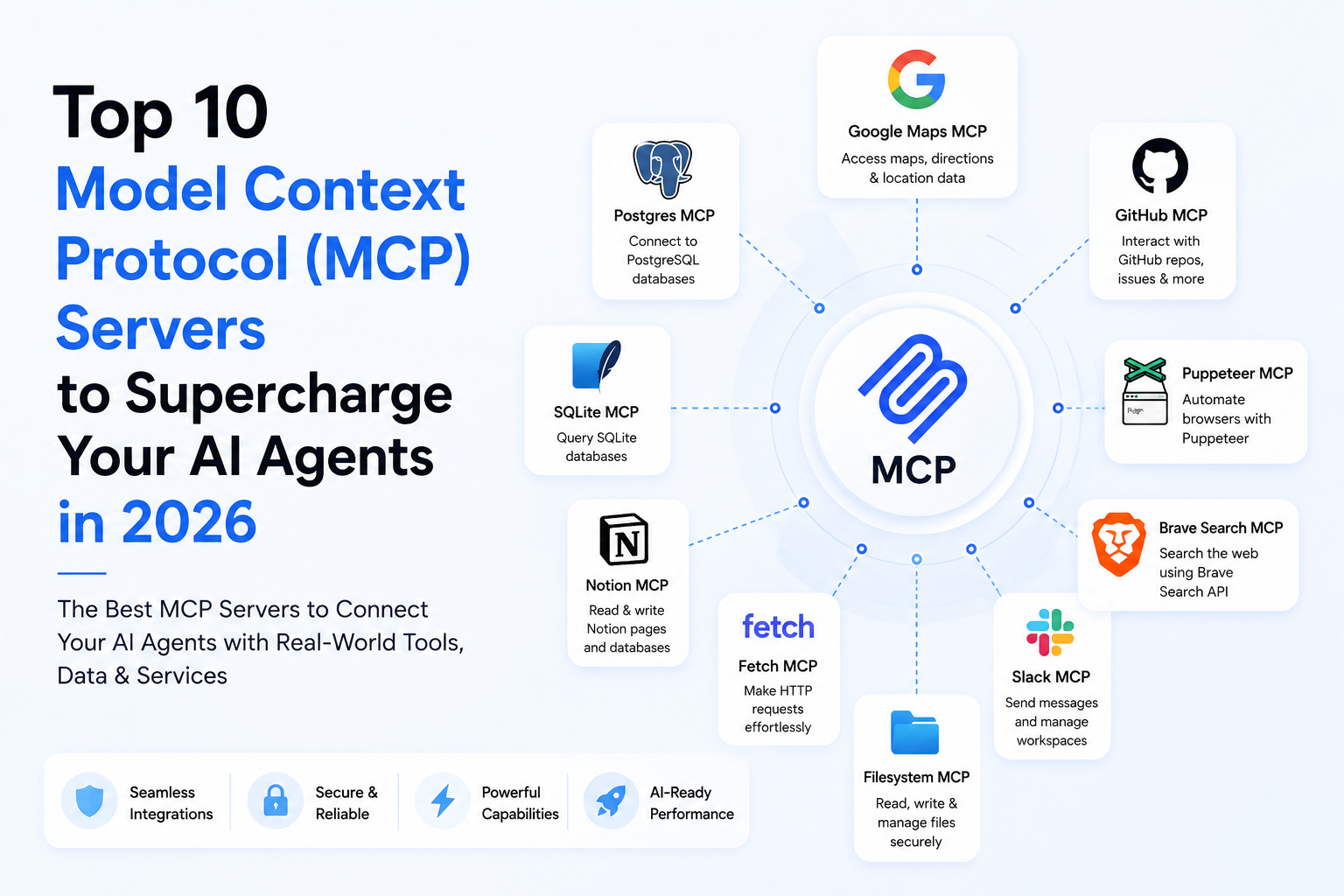
The Model Context Protocol (MCP) has quickly become the open standard for connecting large language models (LLMs) and AI agents directly to local and cloud-based data sources. Developed to resolve the limitations of closed, proprietary API connectors, MCP allows developer agents to read files, run terminal tests, search databases, inspect version repositories, and automate web operations through standardized server instances. By running these modular servers, developer clients like Claude Code, Cursor, and custom agent platforms can instantly extend their context windows with live, system-level capabilities. This guide evaluates the top ten Model Context Protocol (MCP) servers in 2026, outlining their target workflows, pros, cons, and pricing to help you build connected AI systems. > QUICK SUMMARY > > * SQLite MCP Server: Best overall local database server for reading, querying, and updating SQLite database files inside workspace agents. > * Postgres MCP Server: Best for enterprise-grade SQL execution and transactional data lookups. > * GitHub MCP Server: Best for automated repository navigation, file inspection, and PR/issue creation. > * Brave Search MCP Server: Best for real-time web searches and retrieving context-aware web summaries. > * Puppeteer MCP Server: Best for automated web scraping and UI interaction tests. > > Other excellent tools include Memory MCP Server, Slack MCP Server, Jira MCP Server, Google Drive MCP Server, and Fetch MCP Server. Each extends the contextual limits of agents, making them suitable for different developer workflows. COMPARISON MATRIX | Server | Best For | Core Access Target / Key Feature | Pricing | Free Plan | Platform / Type | | : | : | : | : | : | : | | SQLite MCP Server | Querying local SQLite tables | Local filesystem .db files read-write | Free (MIT License) | ✓ (Fully Free) | Local Node Server | | Postgres MCP Server | Enterprise SQL database analytics | Remote database read-write execution | Free (MIT License) | ✓ (Fully Free) | Local/Hosted Server | | GitHub MCP Server | Automated repository coding loops | GitHub public & private repositories API | Free (MIT License) | ✓ (Requires Git token) | API Server | | Brave Search MCP Server | Real-time web retrieval | Brave Search Index lookup API | Free (MIT License) | ✓ (Free key tiers) | API Server | | Puppeteer MCP Server | Headless web automation and audits | Chromium browser control automation | Free (MIT License) | ✓ (Fully Free) | Local node container | | Memory MCP Server | Stateful graph-based agent memory | Graph-based persistence local storage | Free (MIT License) | ✓ (Fully Free) | Local Node Server | | Slack MCP Server | Collaborative workspace communication | Slack workspace channels messaging API | Free (MIT License) | ✓ (Requires Slack token) | API Server | | Jira MCP Server | Project management and issue sync | Atlassian Jira issue boards sync API | Free (MIT License) | ✓ (Requires Jira token) | API Server | | Google Drive MCP Server | Reading shared corporate files | Google Drive folders text parsing API | Free (MIT License) | ✓ (Requires OAuth keys) | API Server | | Fetch MCP Server | Page downloading and plain text parsing | Raw web URL HTML markdown extractor | Free (MIT License) | ✓ (Fully Free) | Local Node Server | 1. SQLITE MCP SERVER The SQLite MCP Server is the standard database adapter for local agent files. It is the best choice for developers building terminal agents that need to inspect, query, create tables, and update records inside local SQLite databases during software loops. PROS & CONS It allows agents to execute complex raw SQL statements and retrieve structured database schemas natively, making local data analysis fast and zero-latency. On the downside, it is strictly configured for local file paths, meaning it cannot coordinate remote access, high-volume transactions, or real-time write operations on distributed production networks. PRICING The server is completely free and open-source under the MIT license. 2. POSTGRES MCP SERVER The Postgres MCP Server is an enterprise-grade database connector. It is the best choice for remote systems where agents need to run SQL reports, query metrics, or verify transactional entries inside distributed PostgreSQL database clusters. PROS & CONS The server provides secure SSL connections, support for complex relational schemas, and direct execution parameters, allowing agents to pull operational stats directly. However, exposing remote databases to LLM agents carries high security risks, requiring strict read-only parameters and custom SQL injection guardrails to prevent accidental data wipes. PRICING The Postgres adapter is free and open-source under the MIT license. 3. GITHUB MCP SERVER The GitHub MCP Server enables agents to navigate version-control repositories. It is the best option for autonomous coding tools that need to inspect file diffs, search code history, create branches, write pull requests, and manage issue tickets. PROS & CONS By integrating repository actions natively, developer agents can automate entire pull request workflows and issue-resolution tests without requiring manual terminal steps. However, hitting GitHub's API rate limits is common for large active repositories, which can cause model errors during multi-file reviews. PRICING It is free and open-source, but requires a personal access token matching the target repository's GitHub plan. 4. BRAVE SEARCH MCP SERVER The Brave Search MCP Server connects agents to real-time search engine results. It is the best choice for research agents that need to query the active web to gather facts, check documentation updates, and retrieve recent news events. PROS & CONS The Brave Search API returns highly optimized plain-text summaries and URL citations, allowing models to bypass heavy HTML scraping and parse search index results efficiently. The main limitation is that it requires an active Brave developer account and is subject to search query limits. PRICING The server adapter code is free and open-source. API usage starts with a free key tier, with paid packages scaling based on query volumes. 5. PUPPETEER MCP SERVER The Puppeteer MCP Server provides headless browser control to agents. It is the best choice for visual QA agents, automated web tests, and scraping tasks that require crawling complex single-page apps (SPAs) or taking screenshots of live interfaces. PROS & CONS It allows models to open Chromium windows, type inputs, click buttons, and capture page views natively, making it a powerful tool for web automation. On the other hand, executing Puppeteer instances consumes significant local memory and CPU resources, causing slow run times on lightweight servers. PRICING Puppeteer adapter libraries are free and open-source under the MIT license. 6. MEMORY MCP SERVER The Memory MCP Server implements persistent, graph-based memory nodes for agents. It is the best option for personalization apps where agents need to save facts, user preferences, and cross-session contexts over time. PROS & CONS By mapping relations as nodes in a graph database, the server allows agents to recall contextual connections across different chat sessions. However, managing memory consolidation (cleaning old or conflicting facts) requires substantial system prompts, or the memory index can become cluttered. PRICING The server is free and open-source under the MIT license. 7. SLACK MCP SERVER The Slack MCP Server is a team communication tool. It is the best choice for administrative agents that need to monitor specific Slack channels, post operational updates, search chat history, or alert developer teams when errors occur. PROS & CONS It allows developer agents to participate directly inside team chats, creating simple, conversational command centers for dev loops. The downside is the potential for message noise and prompt injection risks if agents respond indiscriminately to untrusted inputs inside public channels. PRICING It is open-source and free, requiring standard Slack developer app credentials and scopes. 8. JIRA MCP SERVER The Jira MCP Server connects agents to Atlassian's project management suite. It is the best option for product management assistants that need to create project tickets, transition epic boards, and assign tasks based on developer logs. PROS & CONS By integrating task states natively, agents can automatically verify when pull requests are merged and update the matching Jira issues. The limitation is the complex API configurations required to match Jira's custom field workflows, requiring manual setup. PRICING The adapter is free and open-source, scaling based on your team's Atlassian subscription plans. 9. GOOGLE DRIVE MCP SERVER The Google Drive MCP Server allows agents to search and parse files inside shared corporate cloud storage. It is the best choice for internal knowledge base assistants that need to read Google Docs, search folders, and extract content from spreadsheet files. PROS & CONS It provides a secure, direct link to search corporate drive folders without copying files to local folders, saving time and indexing storage space. However, it requires OAuth access setup, and processing giant files can cause token context overflows for agents. PRICING The server is free and open-source under the MIT license, subject to Google Cloud console project quotas. 10. FETCH MCP SERVER The Fetch MCP Server is a web document extraction tool. It is the best choice for web assistants that need to quickly fetch the raw contents of external web pages and convert them to clean, token-efficient plain text markdown. PROS & CONS It bypasses heavy advertising scripts and returns readable text formats, keeping LLM prompt costs low and query execution speeds high. The limitation is that it cannot execute JavaScript, meaning it will return blank pages for sites that rely on client-side React or Vue rendering. PRICING The Fetch server is free and open-source under the MIT license. CONCLUSION Deploying Model Context Protocol (MCP) servers allows teams to bypass custom API connectors and build connected agent ecosystems. If you are building a local coding assistant that needs file navigation and database queries, pairing the GitHub MCP Server with the SQLite MCP Server is the most robust setup. For real-time web search and automated page audits, choose the Brave Search MCP Server paired with Puppeteer MCP Server. Choose the servers that match your security rules to build safe, context-aware AI tools.