
Blogs in business development
stay updated with the latest news, insights, and guides on business development from ProductWatch.
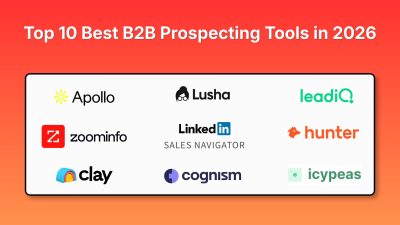
Top 10 Best B2B Prospecting Tools in 2026
A predictable B2B sales pipeline starts with knowing who to target and when to reach them. A SaaS founder may know exactly which companies are a good fit, but turning that ideal customer profile into qualified prospects takes work. Identifying the right decision-maker, verifying work emails, checking technology stacks, spotting buying signals, and keeping contact data updated can quickly consume hours. That’s where B2B prospecting tools come in. Modern sales platforms help teams discover target companies, identify decision-makers, verify contact details, enrich lead data, uncover buying signals, and move qualified prospects into CRM or outreach workflows. > QUICK SUMMARY > > * Apollo.io: An all-in-one B2B prospecting platform combining a large contact database, advanced filters, buying intent, lead scoring, enrichment, and outbound sequences, making it useful for teams that want prospecting and outreach in one place. > > * ZoomInfo SalesOS: An enterprise sales intelligence platform built around company and contact data, intent signals, organizational information, and account intelligence for larger sales and marketing teams. > > * LinkedIn Sales Navigator: Uses LinkedIn's professional network for advanced lead and account search, saved lists, alerts, InMail, account maps, and relationship-based prospecting. > > * Clay: A flexible prospecting and enrichment platform that connects 150+ data providers with waterfall enrichment, AI research through Claygent, job-change signals, web intent, and CRM automation. > > * Cognism: A B2B sales intelligence platform focused on verified contact and company data, mobile numbers, intent signals, job changes, AI research, and compliance-focused prospecting, with particularly strong relevance for European sales teams. > > Other useful tools include Lusha, UpLead, Hunter, LeadIQ, and Icypeas, which support contact discovery, verification, enrichment, and prospect research. B2B PROSPECTING TOOLS COMPARISON | # | Tool | Key prospecting features | Minimum price | Best for | Free plan | | -- | | | | | | | 1 | Apollo.io | 240M+ contacts, 65+ filters, buying intent, lead scoring, enrichment, sequences, AI research | $49/user/month, billed annually | SaaS founders, startups, sales teams wanting data + outreach | Yes | | 2 | ZoomInfo SalesOS | Contact/company intelligence, intent data, org charts, buyer signals, account intelligence | Custom quote | Enterprise sales and ABM teams | Trial | | 3 | LinkedIn Sales Navigator | Advanced search, lead/account lists, alerts, InMail, account maps, buyer interest | $119.99/user/month | Founder-led sales, B2B sales, relationship prospecting | Trial | | 4 | Clay | 150+ data providers, waterfall enrichment, Claygent AI research, job changes, intent, CRM enrichment | $185/month for Launch | RevOps, developers, growth teams, custom prospecting workflows | Yes | | 5 | Cognism | Verified emails and mobiles, firmographics, technographics, intent, job changes, AI research | Custom quote | EMEA prospecting and enterprise sales teams | No | | 6 | Lusha | Verified contact data, phone numbers, firmographics, buying signals, Chrome extension, CRM enrichment | $37/month, billed annually | SMB and mid-market sales teams | Yes | | 7 | UpLead | Verified emails, mobile numbers, company data, Chrome extension, LinkedIn prospecting | $99/month | Small sales teams and founders needing verified contacts | 5-credit trial | | 8 | Hunter | Domain search, email finder, email verification, lead discovery, AI assistant, outreach | $34/month | Email-first prospecting and lean teams | Yes | | 9 | LeadIQ | Contact discovery, job changes, CRM enrichment, AI messaging, sales signals, Chrome extension | Free, paid plans available | SDR teams and LinkedIn-based prospecting | Yes | | 10 | Icypeas | Email finding, verification, profile scraping, company search, API, MCP, no-code integrations | $19/month | Developers, agencies, and lean outbound workflows | Yes | 1. APOLLO.IO Apollo.io is one of the most complete options for teams that want to combine B2B contact discovery with outbound sales workflows. Its prospecting database currently covers more than 240 million contacts, and users can filter prospects using more than 65 data attributes. Filters can be used to narrow prospects by company, role, seniority, location, industry, technology, and other characteristics. Apollo also supports personas, buying intent, saved searches, alerts, and lookalike prospecting. For a SaaS founder, this can simplify the process of defining an ICP and turning it into an actual lead list. For example, a developer selling an API monitoring platform could search for engineering leaders at SaaS companies using a specific technology stack and then enrich those contacts before starting outreach. Apollo also goes beyond database search. Its platform includes CRM enrichment, CSV enrichment, API enrichment, lead scoring, AI research, and outbound sequences. That means a small sales team does not necessarily need separate tools for finding prospects and starting email outreach. PRICING Minimum paid price: $49/user/month, billed annually. A free plan is available, while higher tiers add more credits, intent topics, filters, automation, and other capabilities. Best for: SaaS founders, startups, agencies, and sales teams that want prospecting data and outbound execution in one platform. 2. ZOOMINFO SALESOS ZoomInfo SalesOS is designed for organizations that need detailed B2B sales intelligence across companies, contacts, accounts, and buying signals. The platform is particularly relevant for enterprise sales teams because prospecting is not limited to finding someone's email address. Teams can investigate company structures, identify decision-makers, monitor intent, and build account-level intelligence around target organizations. ZoomInfo's wider data platform includes company and professional profiles, organizational information, intent data, and signals that can help sales teams prioritize accounts. Current industry comparisons continue to position it as an enterprise-focused B2B intelligence platform with deep North American coverage. For an enterprise SaaS company selling into large organizations, this account-level approach can be more useful than simply downloading a large contact list. Sales teams can identify the company first, map the buying group, and then build an outreach strategy around multiple stakeholders. The tradeoff is that ZoomInfo is designed for a much larger sales operation than a solo founder who needs 50 verified emails. It makes more sense when account intelligence, intent data, organizational structures, and sales workflows justify an enterprise platform. PRICING Minimum price: Custom quote. Current market comparisons report enterprise contracts rather than a standard public self-serve price. Best for: Enterprise sales organizations, ABM teams, and businesses selling complex products into large companies. 3. LINKEDIN SALES NAVIGATOR LinkedIn Sales Navigator is different from traditional contact databases because its biggest advantage is direct access to LinkedIn's professional network. Its advanced search lets salespeople identify leads and companies using criteria such as job title, company, geography, seniority, industry, and other professional attributes. Users can save leads and accounts, receive alerts, use InMail, and organize prospects into custom lists. For founders, this is especially useful when selling requires understanding the person before sending an email. A founder selling developer infrastructure, for example, can identify CTOs, engineering managers, or founders at target companies, follow their activity, and use relevant information to make the first message more specific. Sales Navigator also has account maps and buyer-interest features. Advanced and Advanced Plus plans add collaboration and CRM-related functionality, with Advanced Plus supporting CRM synchronization and activity writeback. It is therefore particularly useful when LinkedIn is already part of the sales process. The platform is less about exporting a giant database and more about helping salespeople identify and work with professional relationships. PRICING Minimum paid price: $119.99/user/month for Sales Navigator Core. LinkedIn also offers Advanced and Advanced Plus plans with additional capabilities. Annual billing lowers the effective monthly cost. Best for: Founders, B2B salespeople, recruiters, consultants, and teams that rely heavily on LinkedIn for prospect research and relationship building. 4. CLAY Clay is particularly interesting for developers, RevOps teams, growth engineers, and founders who want to build custom prospecting workflows instead of relying on a single database. The platform connects more than 150 data providers and can run multi-provider waterfalls. This means a team can search one source, then use another provider when the first source does not return the required information. Clay also includes Claygent, its AI research agent, which can use web research to generate custom data points. A founder could use this to identify whether a company uses a particular technology, determine whether it recently launched a product, classify companies according to an ICP, or research information that is not available as a standard database field. The platform also supports job-change signals, company news, hiring signals, CRM enrichment, web intent, APIs, webhooks, and automated workflows. This makes it particularly useful when prospecting becomes a data-engineering problem rather than a simple lead-search task. For example, a SaaS developer could build a workflow that finds companies hiring backend engineers, enriches them with technology information, checks company size, researches recent funding, and sends the resulting records to a CRM. PRICING Minimum paid plan: $185/month for Launch. Clay also has a free plan with limited actions and data credits. Best for: Developers, RevOps teams, growth engineers, agencies, and technical founders building custom prospecting and enrichment workflows. 5. COGNISM Cognism focuses on verified B2B data and is particularly relevant for companies prospecting in Europe. The platform provides company and contact information, including emails, mobile numbers, job titles, work history, technology usage, and company information. Its prospecting workflows also include firmographic, technographic, and signal-based filters. One of Cognism's differentiators is its focus on mobile verification. Its Pro package includes on-demand mobile verification, while the platform also supports intent data, job changes, funding, hiring, and M&A signals. Cognism also includes AI company research, AI persona building, AI search, CSV enrichment, CRM enrichment, and API or bulk data delivery. This makes it suitable for teams that need more than a browser extension for finding individual contacts. For companies selling into the UK and European markets, compliance and data quality can be important factors when selecting a prospecting database. Cognism explicitly positions its platform around compliance-first data and offers GDPR-related controls and documentation. PRICING Minimum price: Custom quote. Cognism's current pricing is based on the package, team setup, data requirements, and usage. Best for: EMEA-focused sales teams, larger B2B companies, and businesses that need verified mobile data and compliance-focused prospecting. 6. LUSHA Lusha is designed for sales and marketing teams that need verified contact and company information without adopting a large enterprise sales intelligence platform. Its prospecting workflow provides contact information, company details, buying signals, and enrichment. Lusha also offers a Chrome extension that can be used while browsing LinkedIn and other websites. Current 2026 materials from Lusha state that the platform has more than 290 million contacts and supports signals such as hiring, funding, technology changes, and intent. For a founder, this can be useful when building a focused list rather than downloading thousands of contacts. For example, a SaaS founder can search for a specific job role at companies within a particular size range, verify contact details, and then move the selected prospects into a CRM. Lusha also supports CRM enrichment and integrations, allowing teams to keep contact information updated instead of repeatedly rebuilding lists. The platform is therefore a good middle ground between lightweight email finders and expensive enterprise intelligence systems. PRICING Minimum paid price: $37/month when billed annually. Lusha also provides a free plan with limited credits. Best for: SMB and mid-market sales teams, founders, agencies, and marketers that need verified contact data plus buying signals. 7. UPLEAD UpLead focuses on verified B2B contact data and gives users a relatively straightforward way to find emails and mobile numbers. Its database search supports company and contact filters, while its platform provides verified emails, mobile direct dials, and company information. The Chrome extension can also be used while browsing LinkedIn or other websites. One useful feature for smaller teams is the way UpLead handles credits. One credit unlocks one contact, including the available email and mobile direct dial. This makes it relatively easy to estimate how much a prospecting campaign will consume before building a list. UpLead also states that it verifies email addresses with a 95% accuracy rate. This is a vendor-reported figure, so teams should still test data quality against their own target market before building a large campaign. For founders who only need a few hundred targeted prospects rather than a large sales intelligence platform, this straightforward credit model can be easier to manage. PRICING Minimum paid plan: $99/month for Essentials. A seven-day free trial includes five credits. Best for: Small sales teams, agencies, founders, and marketers who want verified contact information with a simple credit-based model. 8. HUNTER Hunter is best known for email discovery and verification, but its current platform has expanded into broader prospecting and outreach. The platform can find professional emails using domain search and individual email lookup, verify email addresses, enrich leads, and identify potential opportunities. It also includes an AI Assistant inside its Discover database and supports cold email sequences. Hunter is particularly useful when the main prospecting requirement is finding a reliable business email rather than building a complete account-intelligence system. For example, a founder may already have a list of 200 target companies and only need to identify the correct email addresses for CEOs, marketing heads, CTOs, or sales leaders. Hunter can fit that workflow without requiring the team to adopt a large sales platform. Its API is also useful for developers who want to integrate email discovery and verification into an internal application or automated lead-generation workflow. PRICING Minimum paid price: $34/month. Hunter also has a free plan with 50 credits per month. Best for: Solo founders, marketers, agencies, developers, and small teams that mainly need email finding and verification. 9. LEADIQ LeadIQ combines contact discovery with sales signals, CRM enrichment, and AI-assisted outreach. The platform can find email addresses and phone numbers, track job changes, enrich CRM records, generate AI-assisted messages, and provide sales signals. Its Chrome extension makes it possible to prospect while browsing the web or LinkedIn. One useful aspect is its credit structure. Email discovery uses one credit, while phone numbers use more credits, allowing teams to decide whether they need only email data or both email and phone information. LeadIQ is also designed to fit into existing sales engagement workflows. This matters for teams that already use CRM and sales engagement software and want prospect data to flow into those systems instead of maintaining separate spreadsheets. The platform is therefore more relevant to SDR teams and sales organizations than to someone who only wants to find a handful of email addresses. PRICING Minimum price: Free plan available. Paid pricing depends on the number of credits and the selected plan. Best for: SDR teams, sales teams using LinkedIn for prospecting, and organizations that need contact discovery plus CRM and sales workflow integration. 10. ICYPEAS Icypeas is a more specialized prospecting and email enrichment platform that can be attractive to developers, agencies, and lean sales teams. Its core tools include email finding, email verification, domain scanning, profile scraping, company scraping, person and company discovery, reverse email lookup, API access, and no-code integrations with platforms such as Make, Zapier, and n8n. It also supports MCP, which makes it relevant to teams experimenting with AI agents and automated research workflows. One important difference is its focus on paying for verified or found data rather than purchasing a large all-in-one sales intelligence suite. The platform also supports credit rollover, meaning unused credits do not simply disappear at the end of the billing period. Its pricing structure can therefore work well for teams whose prospecting volume changes from month to month. For developers, the API and automation support are particularly useful. A team can connect Icypeas to an internal lead-generation workflow, automate email discovery, verify addresses, and send clean data into another system. PRICING Minimum paid plan: $19/month plus VAT. A free plan includes 50 credits, while paid plans provide larger monthly credit allocations. Best for: Developers, agencies, technical founders, and businesses that primarily need affordable email enrichment and API-based prospecting. HOW TO CHOOSE A B2B PROSPECTING TOOL The first question should not be "Which tool has the biggest database?" The better question is what exactly needs to happen between identifying a target company and contacting the right person? If the workflow starts with a list of companies and ends with a personalized outbound sequence, an all-in-one platform such as Apollo.io can reduce the number of tools involved. If the process starts with account research and relationship building, LinkedIn Sales Navigator may fit better because the prospect's professional activity and company relationships remain central to the workflow. If the team wants to combine several data providers, run custom enrichment, research websites with AI, or build automated workflows, Clay is more appropriate. Its multi-provider waterfalls and AI research capabilities are specifically designed for this type of workflow. For teams primarily looking for verified contact information, Lusha, UpLead, Hunter, and Icypeas offer more focused workflows. For European prospecting, Cognism deserves particular consideration because its platform emphasizes verified mobile data, intent signals, and compliance-focused workflows. WHAT B2B PROSPECTING FEATURES MATTER MOST? ACCURATE CONTACT DATA A huge database means little if emails bounce or contacts have changed jobs. Look for email verification, phone data, job-change detection, regular updates, and replacement options for inaccurate records. ADVANCED FILTERS Good prospecting tools should turn your ICP into searchable criteria. Example: SaaS → 50–500 employees → US/UK/India → hiring engineers → AWS users → CTO or VP Engineering. Better filters mean less manual research. BUYING SIGNALS Firmographics show who fits your ICP. Buying signals help answer why contact them now. Funding, hiring, leadership changes, technology adoption, and expansion can provide useful outreach context. CRM ENRICHMENT Your prospecting system should keep CRM records fresh by filling missing information and updating outdated contact or company data. API & AUTOMATION For technical teams, API access can turn prospecting data into part of an automated lead-generation workflow. Clay and Icypeas are particularly useful for custom enrichment and automation. COMPLIANCE Before scaling outbound campaigns, check how a provider handles data sources, opt-outs, privacy requirements, processing, and retention, especially for European prospects. A PRACTICAL B2B PROSPECTING STACK You rarely need ten different tools. A simple workflow could look like: Sales Navigator → Find target accounts → Apollo/Lusha → Find contacts → Hunter/Icypeas → Verify emails → Clay → Enrich → CRM → Outreach Larger organizations may use ZoomInfo or Cognism as their central sales intelligence platform. The goal is not to collect more databases. It is to build a workflow that produces accurate contacts, useful context, timely outreach, and clean CRM data. CONCLUSION The right prospecting tool depends on your sales process. Apollo.io combines prospecting, contact data, enrichment, and outbound workflows. ZoomInfo focuses on broader sales intelligence for larger teams, while LinkedIn Sales Navigator is useful when LinkedIn plays a central role in prospect discovery. Clay is well suited to custom enrichment workflows, while Cognism focuses strongly on B2B data and EMEA prospecting. Lusha, UpLead, Hunter, LeadIQ, and Icypeas can handle more focused contact discovery, verification, and enrichment needs. For founders and small SaaS teams, start with one core prospecting platform. Add enrichment or verification tools only when a specific gap appears.