
Blogs in content-marketing
stay updated with the latest news, insights, and guides on content-marketing from ProductWatch.
How Career Hound Reached $25K+ a Month With a Simple Job Board
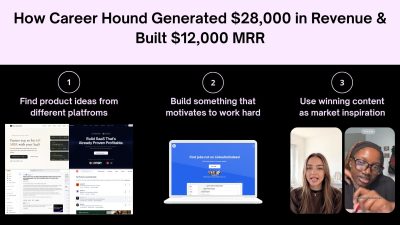
Can a simple job board really become a $25,000-plus-per-month business? Career Hound is an interesting example of how it can happen without building an unusually complicated product. The platform helps people find jobs posted directly on company websites, giving job seekers another way to discover opportunities beyond traditional job boards. In one recent month, Career Hound generated $28,000 in total revenue, while its reported MRR was around $12,000. The platform had more than 8,000 users and 779 active subscribers, with an average customer lifetime value of approximately $50. At the same time, its social content generated 11.7 million views in 30 days. The numbers are impressive, but the product itself is not particularly complicated. > KEY TAKEAWAYS > > * Career Hound solved a specific problem: finding jobs directly from company websites. > * During the Starter Story interview, Roman reported $28K monthly revenue, $12K MRR, 8,000+ users, and 779 active subscribers. > * Social content generated 11.7M views in 30 days. > * Roman researched Reddit, TikTok, Instagram, and other platforms to understand what job seekers repeatedly wanted. > * The strategy focused on evergreen topics and repeatable content formats instead of constantly chasing trends. > * Creators received clear formats and instructions, making content production easier to repeat. > * Marketing experiments were measured by clicks, signups, subscriptions, retention, and revenue, not views alone. > * The core system was research → test → measure → repeat. A QUICK LOOK AT CAREER HOUND Career Hound was launched around 2024 by Roman Lakhnyuk, a non-technical founder who built the platform after seeing how difficult it was to find relevant jobs through traditional job boards. The idea came from a simpler approach: find job openings directly on company websites and make those opportunities easier to discover. Today, Career Hound focuses on helping job seekers find jobs that may not appear on LinkedIn or Indeed. The platform has grown to more than 8,500 job seekers and says it has identified over 4.5 million hidden jobs. What started as a simple job-search solution eventually became a business generating around $25,000 per month, with the growth driven less by complex technology and more by content, audience research, and creator-led distribution. THE CAREER HOUND PLAYBOOK FOR BUILDING A SAAS BUSINESS Career Hound’s growth story is useful because the business was not built around a complicated product or a large marketing department. Roman started with a specific job-search problem, turned an existing scraping process into a product, and then built distribution around content and creators. The strategy was repeated for roughly two years, with marketing experiments used to identify which topics, formats, creators, and messages could consistently attract the target audience. For solo founders and SaaS builders, the important part is not copying Career Hound’s job-board model. A developer tool, analytics platform, recruiting SaaS, or AI product will need different content. What can be copied is the process: start with an existing problem, identify a specific audience, research what already gets their attention, find repeatable content formats, test them continuously, measure business results, and put more resources into the formats that produce customers. STEP 1: START WITH A PROBLEM THAT ALREADY EXISTS Career Hound did not begin with the assumption that people needed another general-purpose job board. The original idea came from a friend who had built a scraper that found job openings directly on company websites. Roman and his friend saw an existing process that solved a real problem and turned it into a product. That distinction matters for SaaS founders. Instead of starting with a feature and then searching for a market, start with a problem people are already spending time, money, or effort trying to solve. Look at how people currently handle the problem. Search Reddit discussions, communities, app reviews, YouTube comments, support forums, social posts, and competing products. Pay attention to repeated complaints and workarounds. Tools such as Reddit, YouTube, and G2 can help founders research existing conversations, reviews, and customer complaints. A good starting question is not, "What should be built?" It is, "What are people already trying to accomplish, and where is the current process failing them?" Career Hound's product came from an existing job-search workflow. That reduced the need to convince people that the problem existed. The marketing challenge became showing people that there was a better way to find opportunities. STEP 2: DEFINE ONE SPECIFIC CUSTOMER GROUP Career Hound initially focused on people in the United States who were looking for jobs, including both employed and unemployed job seekers. That gave Roman a defined audience to study. A SaaS product should be equally specific at the beginning. "Anyone who needs productivity software" is too broad to create a useful marketing system. A more useful target could be freelance developers managing multiple clients, small SaaS teams tracking product analytics, recruiters sourcing technical candidates, or solo founders trying to automate customer support. The narrower the initial audience, the easier it becomes to understand what that audience watches, reads, searches for, shares, and buys. This also makes content research more useful. When the audience is specific, a founder can identify recurring questions and desired outcomes instead of producing general educational content that could apply to everyone and therefore feels relevant to nobody. Tools such as SparkToro can help research where a specific audience spends time online, while Google Trends can help identify search interest around audience problems. STEP 3: RESEARCH THE AUDIENCE BEFORE CREATING CONTENT Roman's marketing process starts with research. He spends substantial time looking at content across platforms such as Instagram, Reddit, and TikTok. He looks at both video and text because the objective is not to study one platform. The objective is to understand what attracts attention from people in the niche. This is where Career Hound's "content thrifting" approach comes from. Instead of opening a blank document and trying to invent a topic, Roman collects examples that already made people stop, watch, read, comment, or share. A SaaS founder can use the same process. Suppose the product is a developer monitoring tool. Instead of immediately writing "10 Benefits of Application Monitoring," research what developers are already discussing. Look for posts about production incidents, debugging failures, unexpected cloud bills, database bottlenecks, uptime problems, and deployment mistakes. Save the posts that receive strong engagement and examine what made them work. The goal is not to copy the content. The goal is to identify recurring demand. After collecting enough examples, patterns begin to appear. Certain problems appear repeatedly. Certain hooks receive attention. Certain formats make complicated subjects easier to consume. Those patterns can become the foundation for the company's own content strategy. Tools such as Google Trends, AnswerThePublic, and BuzzSumo can help identify recurring questions, topics, and content patterns. STEP 4: SEPARATE TIMELY TOPICS FROM TIMELESS DEMAND Career Hound's marketing strategy distinguishes between timely content and timeless content. Timely content depends on something happening now. It can generate attention quickly, but its usefulness may disappear when the trend ends. A company can spend significant time chasing these topics without building a repeatable acquisition system. Timeless content is different. It is based on a problem or desired outcome that keeps returning. Roman gave remote and worldwide job opportunities as an example. People continue searching for companies that hire remotely. The exact companies can change, but the underlying demand remains. This distinction is important for SaaS marketing. A founder should not build the entire acquisition strategy around whatever happens to be trending that week. Look for subjects where the underlying demand is likely to remain. For an analytics product, a timeless topic might be "how to understand where users drop out of a signup funnel." For a recruiting product, it could be "how to find qualified technical candidates." For an AI writing product, it could be "how to create consistent product documentation." The topic can be updated, but the underlying problem remains. Tools such as Google Trends can help compare search interest over time and identify whether interest around a topic is recurring or heavily tied to a particular moment. STEP 5: FIND THE DESIRED OUTCOME Career Hound's content is built around outcomes rather than product features. Job seekers want a better job, remote work, access to more opportunities, or a faster way to discover relevant openings. That gives the content a clear reason to exist. SaaS founders should identify the outcome their audience already wants before deciding what content to publish. The product can then become part of the path toward that outcome. For example, an accounting SaaS may sell automated financial reporting, but customers may care more about knowing whether the business is actually profitable. A project management tool may sell task management, but customers may care more about completing projects without missing deadlines. The marketing message should begin with the outcome the customer recognizes, then show how the product helps achieve it. Tools such as Hotjar can help founders understand what visitors are trying to do on a website through behavioral insights and feedback. STEP 6: TURN ONE SUCCESSFUL IDEA INTO A REPEATABLE FORMAT One of Career Hound's key strategies is finding content formats that convert and repeating them. Roman's remote-job example follows a simple structure: introduce a desirable outcome, present a list of companies that provide that outcome, and direct viewers toward Career Hound for more opportunities. The strength of this approach is repeatability. The entire concept does not need to be reinvented for every post. A SaaS company can create the same type of system around its own audience. A cybersecurity company could repeatedly publish security mistakes found in real applications. An analytics product could repeatedly show examples of why users abandon a funnel. A developer tool could repeatedly demonstrate common production problems and how developers diagnose them. Once a format produces meaningful results, the founder can change the subject while keeping the underlying structure. This creates a content system instead of a collection of unrelated posts. Tools such as Notion or Airtable can help organize content ideas, formats, production briefs, and publishing workflows. STEP 7: TEST VARIATIONS INSTEAD OF GUESSING Career Hound's marketing process treats content as a series of experiments. A founder can change one variable at a time: the hook, topic, creator, opening line, format, presentation, CTA, or audience segment. The purpose is to discover which combination produces the desired business result. For example, suppose three videos all discuss the same SaaS feature. One uses a problem-based hook, one uses a list format, and one uses a product demonstration. If one consistently generates more qualified website visitors, that provides evidence about the format. The process should continue after the first successful post. One successful video is not necessarily a repeatable acquisition channel. The next step is to reproduce the structure with different topics and creators and see whether the result happens again. This is why failed experiments are useful. A post that receives little attention eliminates one possible approach. A post that generates views but no signups reveals a different problem. A post that generates signups but few paid customers provides another piece of information. Every experiment should reduce uncertainty. Tools such as PostHog can help track product behavior and experiments, while Google Analytics can help measure website traffic and conversions. STEP 8: BUILD A CREATOR DISTRIBUTION SYSTEM Career Hound does not rely only on Roman's personal content output. He works with creators who already produce content for the target audience. The important part is audience fit, not simply follower count. Roman specifically described working with older creators for job-search content because he believed their appearance could communicate experience and credibility to the audience. That is a Career Hound-specific choice, not a universal rule. Another SaaS category may require a completely different creator profile. The general principle is to identify the type of person the audience already listens to. Creators can be found through creator marketplaces or by directly contacting people who are already making relevant content. The best candidates do not necessarily have enormous audiences. Someone with a smaller but highly relevant audience can be more useful than a large account whose followers have no connection to the product. Tools such as TikTok Creator Marketplace and Instagram Creator Marketplace can help brands discover creators and evaluate potential audience matches. STEP 9: MAKE THE CREATOR'S JOB EXTREMELY SIMPLE Roman's creator workflow removes research from the creator's responsibilities. He maintains a sheet containing content formats and precise instructions. The creator does not need to research the subject, determine the structure, or figure out what the company wants to communicate. The instructions explain what needs to be created. This is an important operational lesson. If a company hires ten creators and gives each person a vague instruction such as "make a video about our product," every creator will interpret the assignment differently. Quality becomes inconsistent, revisions increase, and the founder spends more time managing content. A better system defines the format, topic, hook, key information, CTA, and any important restrictions before the creator starts. Roman described trying to make the instructions simple enough that there is little room for confusion. That makes the system easier to scale and reduces the amount of management required from the founder. Tools such as Google Sheets, Notion, and Trello can help maintain creator briefs, instructions, deadlines, and content status. STEP 10: KEEP CREATOR COSTS CONTROLLED During the Starter Story interview, Roman said he generally aimed to pay no more than around $20 per video in most situations. The exact number should not be copied blindly. Creator pricing depends on the platform, niche, audience, quality, geography, and deliverables. The useful lesson is to control the cost of experimentation. If a company spends hundreds of dollars testing every new content idea, it becomes difficult to run enough experiments to identify a winning format. If the cost of testing is controlled, the company can run more experiments and learn faster. The objective is not to pay creators as little as possible. The objective is to establish a repeatable cost structure where enough experiments can be run to determine what works. Tools such as SideShift, Upwork and Fiverr can help founders compare creator and freelance production options. STEP 11: MEASURE THE ENTIRE FUNNEL Views alone do not tell a SaaS founder whether content is producing a business. Career Hound reported 11.7 million social views in the 30 days before the Starter Story interview. During the same interview, Roman reported 779 active subscribers, approximately $12,000 in MRR, $28,000 in total revenue for the previous month, an average lifetime value of around $50, and approximately 31% churn. These figures are from the interview period and should not be treated as current financial results. The important lesson is how to connect marketing activity to business results. A useful funnel is: If a video receives 100,000 views but produces almost no website traffic, the problem may be the CTA or audience fit. If it produces traffic but few signups, the landing page or offer may need work. If it produces signups but few paid users, the product or pricing may not match the promise made by the content. Without this funnel, a founder can mistake attention for growth. Tools such as PostHog and Google Analytics can help connect traffic, user behavior, conversions, and product activity across the funnel. STEP 12: USE THE PRODUCT TO SUPPORT THE MARKETING PROMISE Career Hound's product solves a clear problem: finding job openings directly from company websites. The marketing works because the content and product are connected. A video about finding companies that hire remotely naturally leads to a service designed to help users discover more job opportunities. SaaS founders should create the same connection. If the content promises faster customer research, the product should help users perform that research. If the content promises easier analytics, the product should make the analysis easier. If the content promises a list of opportunities, the product should provide access to more opportunities. The CTA should feel like the next step rather than an unrelated advertisement. Tools such as Framer or Webflow can help founders create and test landing pages that connect the content promise with the product experience. STEP 13: KEEP THE TECHNOLOGY FOCUSED ON OPERATIONS Career Hound does not rely on a large collection of specialized software. Roman reported using a relatively lightweight stack, with each tool supporting a specific operational requirement across marketing, creator management, analytics, email, hosting, and infrastructure. | Tool | Purpose | How Career Hound Uses It | | | | | | Shorttimize | Social tracking | Tracks clicks and connects social content with website traffic | | PostHog | Experiments and analytics | Supports product and marketing experiments and measures user behavior | | WhatsApp | Creator communication | Keeps communication with content creators simple and direct | | Microsoft Clarity | Visitor behavior | Shows how visitors interact with the website after arriving from content | | Hetzner | Server infrastructure | Provides the server infrastructure used to run the application | | Postmark | Email | Handles transactional and product-related email delivery | | Google Workspace | Business communication | Manages business email and day-to-day communication | | Cloudflare | Infrastructure and security | Supports website infrastructure, traffic management, and security | The important point is not to copy this exact stack. Career Hound uses each tool for a specific operational need. Short URL connects social activity with traffic, PostHog supports experiments, Clarity helps understand visitor behavior, and WhatsApp makes creator coordination easier. For a solo founder, the useful lesson is to add technology when a specific operational problem appears. If it is difficult to track which content sends visitors to the website, improve attribution. If visitor behavior is unclear, add analytics. If managing creators becomes difficult, improve the communication and production workflow. The technology should support the growth process rather than become the growth process. Career Hound's reported results came from audience research, repeatable content formats, creator distribution, marketing experiments, and measurement. The technology helped operate that system in the background. STEP 14: TURN EXPERIMENTS INTO A REPEATABLE OPERATING SYSTEM The real Career Hound playbook is not one viral video or one creator campaign. It is the repeated cycle behind them. Research what the audience already cares about. Identify recurring problems and desired outcomes. Find content formats that attract attention. Turn those formats into clear creator instructions. Publish multiple variations. Track traffic, signups, subscriptions, and revenue. Remove formats that repeatedly fail. Produce more versions of formats that generate customers. This creates a feedback loop. Research produces ideas. Experiments produce data. Data identifies useful formats. Useful formats become repeatable processes. Repetition creates more data. The process then starts again. That is much more useful than trying to find a single "perfect" marketing strategy. Tools such as Notion, Airtable, and PostHog can help document experiments, organize processes, and track results. STEP 15: BUILD A SIMPLE WEEKLY GROWTH ROUTINE A solo founder can turn this process into a weekly operating routine. At the beginning of the week, research the audience and collect new examples from the platforms where customers spend time. Identify recurring questions, problems, formats, and hooks. Next, select several content concepts based on those patterns. Turn each concept into a simple production brief containing the hook, topic, structure, key information, CTA, and target audience. Then publish or send the briefs to creators. Keep the experiments small enough that multiple variations can be tested without consuming the entire marketing budget. At the end of the week, review the numbers. Separate views from actual business outcomes. Identify which topics generated traffic, which generated signups, and which produced paying customers. The following week should not start from zero. Carry the strongest formats forward and test new variations against them. This is how a founder gradually builds a marketing system from repeated evidence rather than intuition. Tools such as Notion or Google Sheets can be used to manage the weekly research, content pipeline, experiments, and results. STEP 16: USE FAILURE TO NARROW THE STRATEGY Roman compares marketing experiments with his previous door-to-door sales experience. Every unsuccessful door eliminated one possibility, while each successful interaction moved him closer to a sale. The same logic applies to SaaS marketing. A failed topic tells you something about demand. A weak creator tells you something about audience fit. A high-view video with no signups tells you something about the connection between attention and product intent. A strong signup rate but poor paid conversion tells you something about the offer. The mistake is treating every failed experiment as wasted money. A failed experiment becomes useful when the result changes what the company does next. The objective is not to make every campaign successful. The objective is to learn quickly enough that unsuccessful approaches are removed and successful approaches receive more resources. Tools such as PostHog can help founders record experiment results and compare changes in user behavior. STEP 17: DO NOT CONFUSE CONTENT REACH WITH PRODUCT-MARKET FIT Career Hound's social reach is a major part of its distribution strategy, but content reach alone does not prove that a product has product-market fit. A SaaS business needs customers who continue using and paying for the product. Career Hound's interview data provides a useful example. Roman reported 779 active subscribers and approximately 31% churn at the time. For a job-search product, churn has to be interpreted in the context of the customer's situation because a user may stop needing a job-search service after finding employment. This is why founders should track retention alongside acquisition. A marketing campaign that produces thousands of new signups but very little continued usage can create a large audience without creating a durable business. Tools such as PostHog and Mixpanel can help founders analyze retention, cohorts, conversion, and user behavior. The product category changes. The research and testing process stays similar. Tools such as GitHub, Hacker News, Reddit, and YouTube can support research across different SaaS audiences. THE COMPLETE CAREER HOUND GROWTH LOOP Career Hound's strategy can be reduced to one operating loop: The strength of this approach is that it does not depend on guessing which marketing channel will suddenly work. It creates a process for discovering what works. For a solo founder, that distinction matters. The goal is not to become a full-time content creator or copy Career Hound's exact videos. The goal is to build a repeatable system where every week produces new information about the audience, the content, the creators, and the product. Career Hound's reported growth shows what can happen when that process is maintained for a long period. Roman started with a specific job-search problem, built a focused product, researched what the audience wanted to see, worked with creators who matched that audience, and repeated content experiments for roughly two years. For other SaaS founders, the practical playbook is straightforward: solve a problem people already have, study the audience before creating content, build around recurring demand, test many small ideas, measure customers rather than views, and keep repeating the formats that produce measurable business results. That is the part of the Career Hound story worth copying. CONCLUSION Career Hound's journey to more than $25,000 a month is not really a story about building a revolutionary product. It is a story about distribution. The product is simple, the market is proven, and the technology stack is lean. The growth comes from understanding the audience, finding evergreen content opportunities, identifying repeatable formats, and building a creator system around them. For solo founders and SaaS builders, that is the bigger takeaway. The next successful product does not necessarily need to be complicated or completely original. A simple product solving a proven problem can become a substantial business when the distribution system is strong enough. Build something people understand. Research what they care about. Find what content works. Then repeat and improve it.