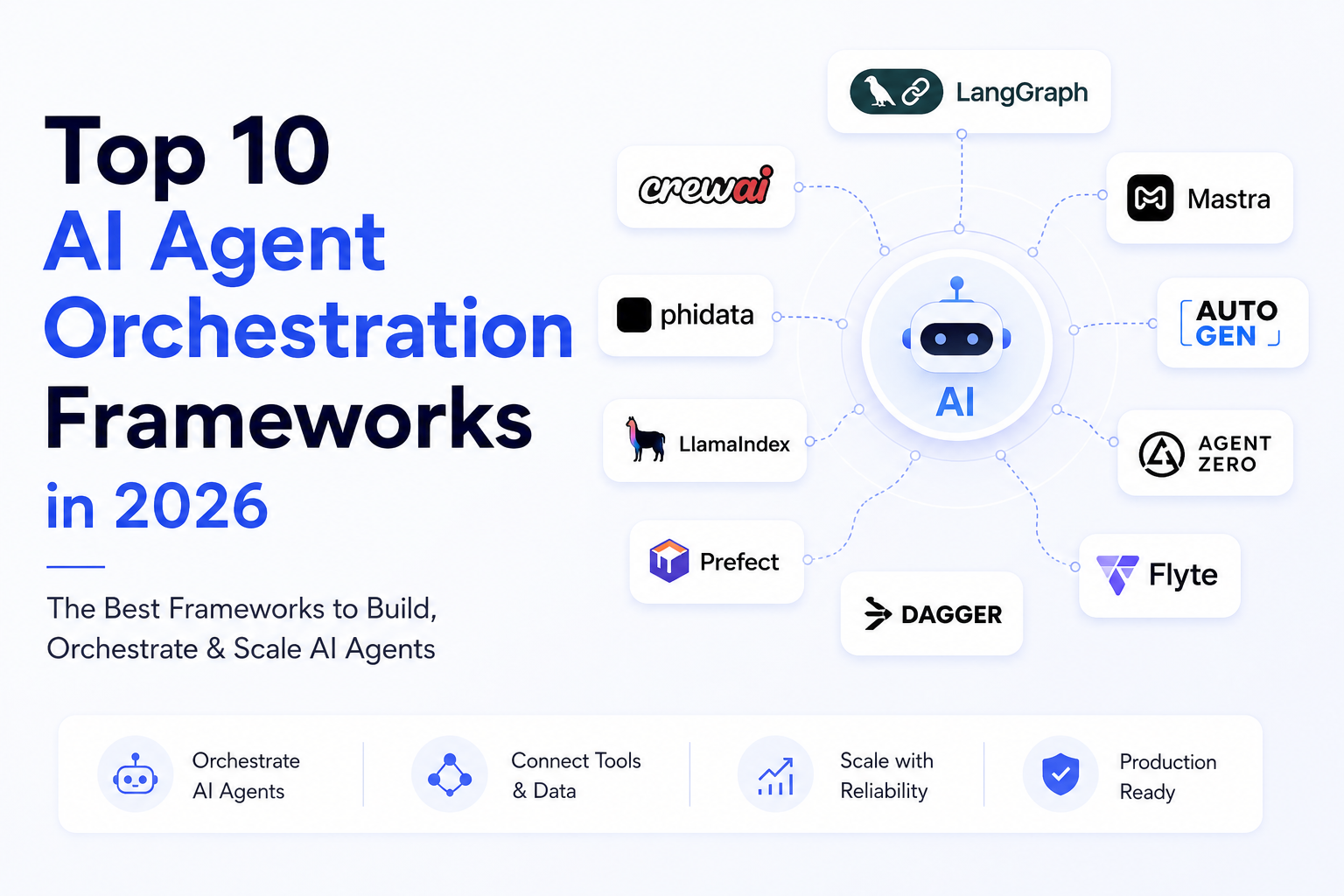
The software engineering ecosystem in 2026 has witnessed a massive transition from simple prompt templates and single-step chains to autonomous multi-agent systems. Rather than reacting to user messages one-by-one, today's AI agents reason, plan, use tools, collaborate with other agents, and execute long-running tasks in the background. Building these complex systems from scratch is highly difficult, requiring developers to manage state, handle errors, support human-in-the-loop validation, and structure long-term memory. To solve these challenges, software teams rely on specialized agent orchestration frameworks. This guide reviews the top ten AI agent frameworks available in 2026, comparing their architectures, key capabilities, target developers, and limitations to help you select the best library for your next project.
Quick Summary
- LangGraph: Best overall stateful framework for production-grade enterprise agents requiring complex loops and human-in-the-loop validation.
- Mastra: Best choice for modern, lightweight, TypeScript-first web applications running in serverless Node.js environments.
- CrewAI: Best for configuring multi-role collaborative agent workforces using clean, human-readable abstractions.
- Agno: Best for structured outputs, database integration, and active SQL queries.
- PydanticAI: Best for type-safe agent schemas and integration with fast, modern Python backends.
Other excellent tools include OpenAI Agents SDK, Google Agent Development Kit, Claude Agent SDK, Microsoft Agent Framework, and Strands Agents (AWS). Each approaches agentic workflows differently, making them suitable for different use cases and developer stacks.
LangGraph is the industry-standard stateful agent orchestration framework, designed for developers building complex, cyclic workflows that require absolute control over state transitions. It treats agent workflows as state machines where nodes execute logic and edges determine transition rules. It is the best choice for enterprise applications that need persistent execution memory and human authorization before running critical processes.
Implementing LangGraph gives developers access to a powerful state machine model with native support for time-travel debugging and human-in-the-loop pauses, making it highly reliable for mission-critical operations. However, this structure comes at the cost of a steep learning curve and substantial boilerplate code, which can slow down early-stage prototyping and feels unnecessarily heavy for simple chatbots.
The core library is open-source and free under the MIT license, while the commercial LangGraph Cloud deployment service starts at a paid seat price of $20 per seat per month plus execution fees based on query volumes.
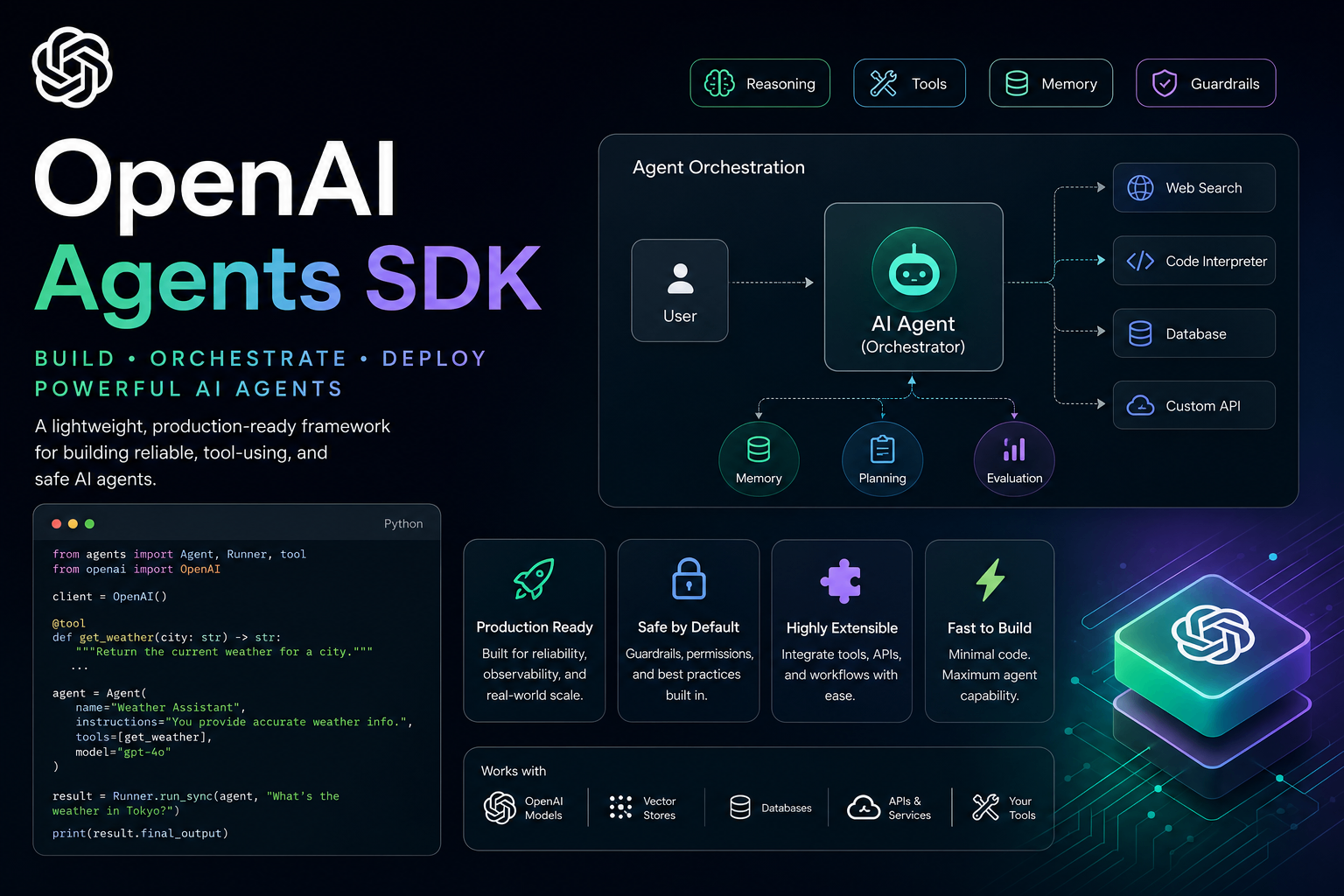
The OpenAI Agents SDK provides a simplified interface for building conversational agents backed by the Assistants API. It is the best option for solo founders and customer support teams who want to build high-performance chatbots without managing local databases for conversation threads, file indices, and user session context.
The framework takes care of database syncs, indexing, and session management automatically, which significantly reduces development time and lets founders launch client-facing assistants in minutes. On the other hand, the closed-source backend offers very limited customizability over vector storage algorithms and memory retrieval pipelines, locking developers into OpenAI's API fees.
The SDK itself is free, but developer usage is billed directly based on Assistants API usage, which includes GPT model token costs and file storage rates of $0.20 per GB of search index per assistant per day.
The Google ADK is a cloud-native development kit designed for enterprise teams deploying multimodal agent pipelines on Google Cloud Platform. It is optimized for Gemini models, making it the premier option for projects that need to ingest and process native video, audio, and large datasets directly within Google Cloud databases.
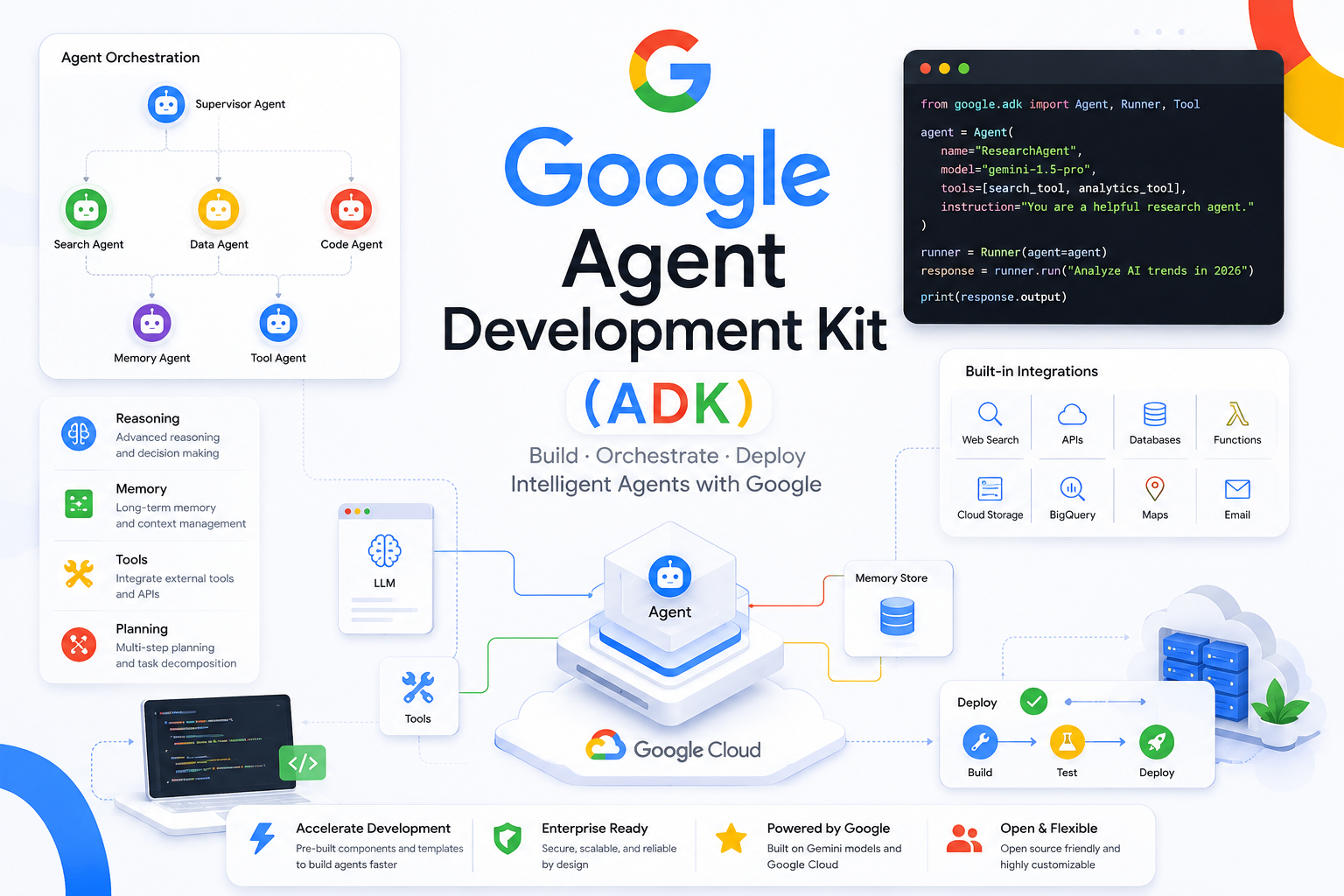
It integrates seamlessly with Vertex AI Search and BigQuery data warehouses, providing enterprises with high standards of data security, compliance, and multi-modal handling. However, the library is heavily tied to GCP services, making it inappropriate for developers looking to build platform-agnostic, open-source projects that can run locally.
Billing is calculated monthly based on Vertex AI API compute time, Gemini model tokens, and storage costs inside GCP.
The Claude Agent SDK is Anthropic’s first-party toolkit, built specifically to optimize application execution speeds when using the Claude model family. It is the best choice for teams building Anthropic-native agents that leverage prompt caching and visual UI automation tasks.
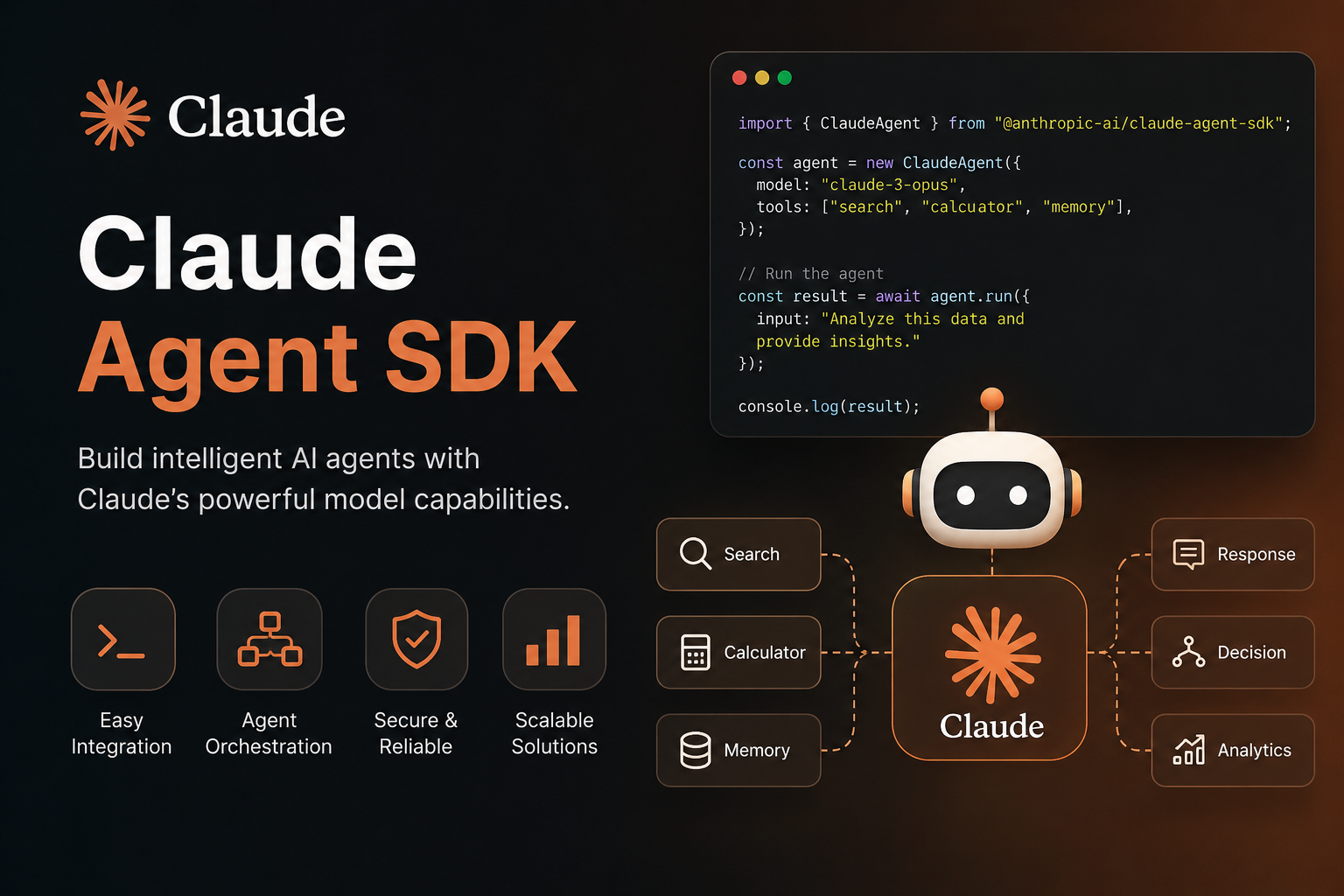
The SDK provides native support for Claude's prompt caching, which drastically cuts down input latency and API costs for applications with long system descriptions. However, it creates complete vendor lock-in to Anthropic's model catalog, requiring a full rewrite if the team ever needs to swap providers.
The SDK is free and open-source, with usage costs tied directly to Anthropic API model token consumption.
Mastra is a lightweight, TypeScript-first framework built for web developers deploying agents inside serverless JavaScript ecosystems like Next.js, Node.js, and Vercel. It is the best option for developers who want to avoid Python dependencies and run high-speed agent loops in JavaScript.

Being written in native TypeScript, Mastra provides fast boot times, low memory footprints, and simple deployments to serverless platforms. Its main limitation is its maturity, as the library lacks the massive integration catalog that older Python-centric frameworks have developed over several years.
Mastra is fully open-source and free under the MIT license, with no paid hosting seats or commercial licensing required.
CrewAI coordinates agent groups by matching tasks to virtual roles. It is the best option for automation tasks like content creation, market research, and automated lead generation where multiple agents must share info and critique each other's outputs.
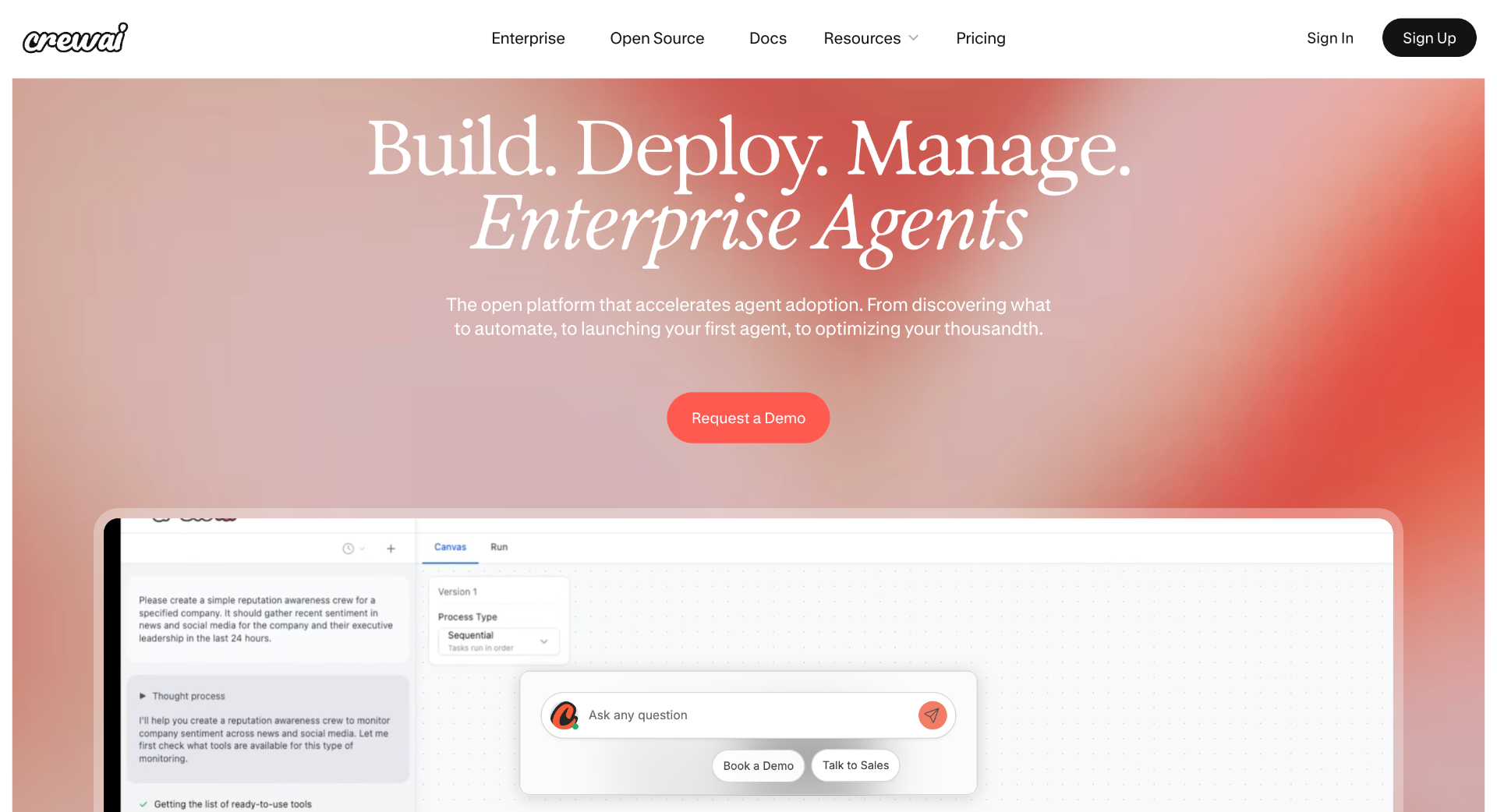
Its intuitive role-playing abstractions make it incredibly fast to configure collaborative agent teams without writing low-level graph logic. However, coordinating these chats generates high API token overhead, and agents can easily get stuck in conversational loops if goals are not configured precisely.
The base framework is free and open-source under the MIT license, while enterprise management dashboards and hosting are available via custom enterprise tiers.
The Microsoft Agent Framework is a robust, event-driven framework built for enterprise-grade agent orchestration across large C# and Python systems. It is the direct successor to the legacy AutoGen library, optimized for scalable microservice integrations.
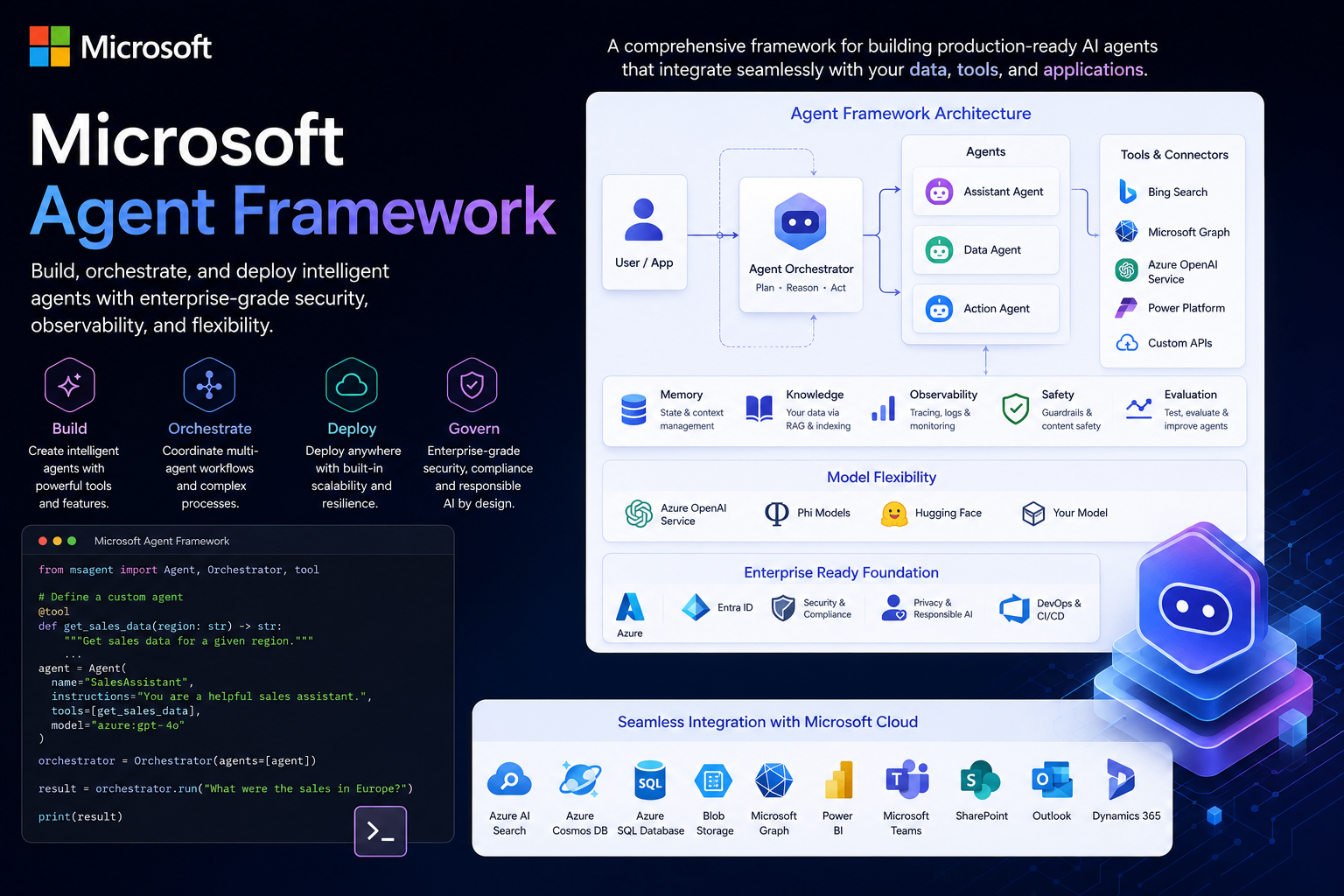
The framework provides highly secure state management, event-driven execution loops, and enterprise-grade messaging queues, making it excellent for large corporate infrastructure. Its drawback is its high structural complexity, which makes it slow and over-engineered for small startups and solo developers.
The framework is fully open-source and free to deploy under the MIT license.
Agno is a lightweight Python framework designed to turn standard LLMs into structured assistants with active database memory. It is the best choice for developer workloads that require writing direct database queries, managing SQLite/Postgres backends, and enforcing reliable JSON schemas.
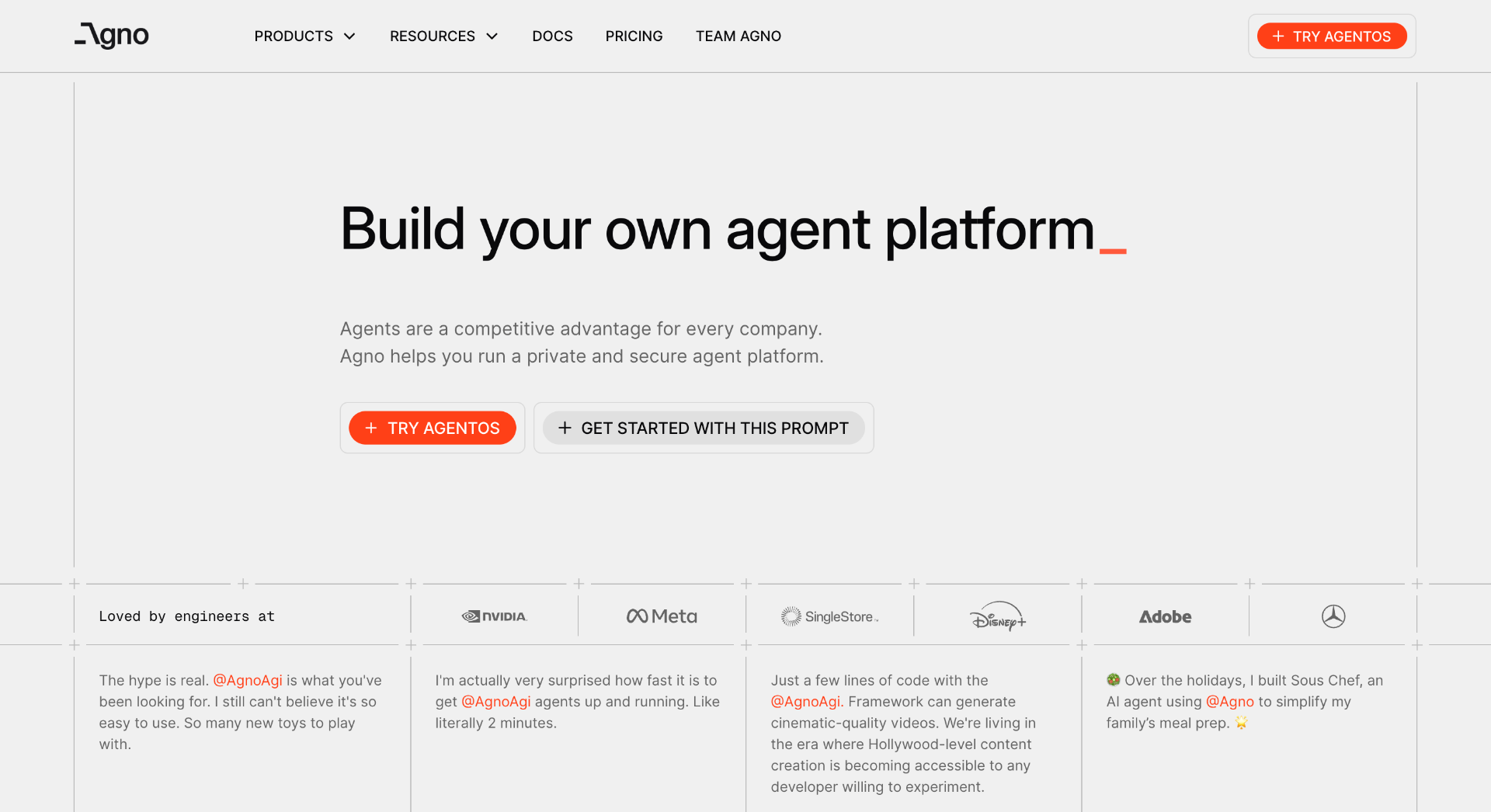
Agno makes it easy to integrate PostgreSQL, SQLite, and custom SQL databases in a few lines of code, offering developers clean structured outputs and low boilerplate overhead. However, it is not designed to support complex, non-linear multi-agent negotiations or cycle-heavy state graphs.
The library is open-source and free, while the Agno Cloud monitoring and trace tracking platform offers seat tiers starting at $10 per month.
PydanticAI is a type-safe agent framework built by the creators of Pydantic. It is the best choice for Python developers building fast APIs (e.g. with FastAPI) that require strict type safety, schema validation, and structured output formatting.
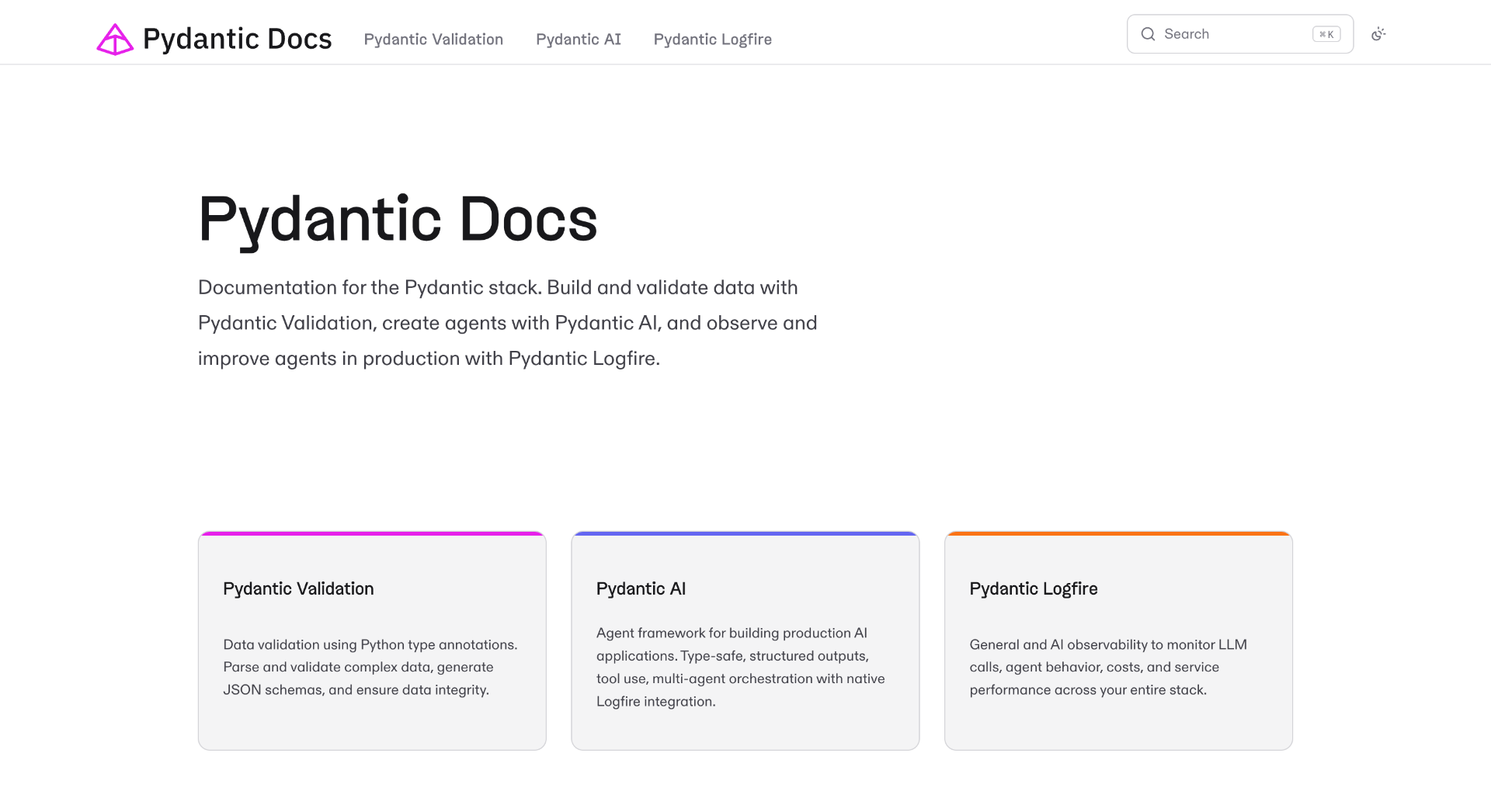
It integrates Pydantic’s validation directly into LLM prompts and outputs, offering developers reliable type safety and simple integration with existing Python schemas. However, it is not designed for complex conversational group chats or event-driven multi-agent microservices.
PydanticAI is fully open-source and free under the MIT license.
Strands Agents (AWS) is a cloud-native agent framework designed for AWS environments utilizing Amazon Bedrock models. It is the best choice for developers building serverless cloud agents that need to trigger AWS Step Functions and connect securely to AWS databases.
It offers native integration with Bedrock, AWS security layers, and serverless compute scaling, enabling enterprises to deploy secure agents at scale. Its main limitation is that it requires deep familiarity with AWS cloud tools and is not suitable for local development or multi-cloud stacks.
Billing is managed directly through AWS, calculated based on Amazon Bedrock API usage and AWS serverless compute fees.
Under this section, we evaluate other active frameworks in the 2026 landscape:
A data-oriented routing framework designed specifically to scale advanced RAG and vector database lookups. Available for free as an open source framework, with paid LlamaCloud plans for managed deployments.
A unified UI integration library built to stream agent model generations directly to frontend React and Svelte apps. Free and open source.
A lightweight Hugging Face library designed to let models execute arbitrary Python code directly within secure sandboxes. Free and open source.
An agentic framework optimized for Alibaba's Qwen open-weights models, offering strong performance on localized multilingual tasks. Free and open source.
Microsoft's enterprise integration library, designed to bridge LLMs with traditional C# and Java software dependencies. Free and open source.
A declarative programming framework that replaces traditional manual prompting with automated, compiler-like prompt optimization. Free and open source.
A modular pipeline library designed by deepset for building production-grade semantic search and retrieval workflows. Free and open source, with paid enterprise offerings available.
The original open-source multi-agent conversation framework, now largely superseded by the Microsoft Agent Framework. Free and open source.
A multi-agent framework designed to model a software company structure, allowing agents to generate PRDs, designs, and code. Free and open source.
A highly customizable command-line agent framework built to execute system-level operations and bash tasks directly.
Orchestrating autonomous agents in production requires balancing developer speed, language preference, and execution safety.
If you are a web developer or solo founder building within JavaScript or Next.js, Mastra is the most efficient choice, allowing you to deploy lightweight TypeScript agents on serverless architectures. For enterprise engineering teams building complex Python workflows that require human-in-the-loop validation, LangGraph remains the most robust, battle-tested framework. If your workflow is based on multi-role team execution, CrewAI provides the fastest prototyping speed. Always select the framework that aligns with your stack and data layout to build sustainable, self-improving agent systems.