
X-energy Wins the NRC's First Pebble-Bed Permit in Nearly 60 Years
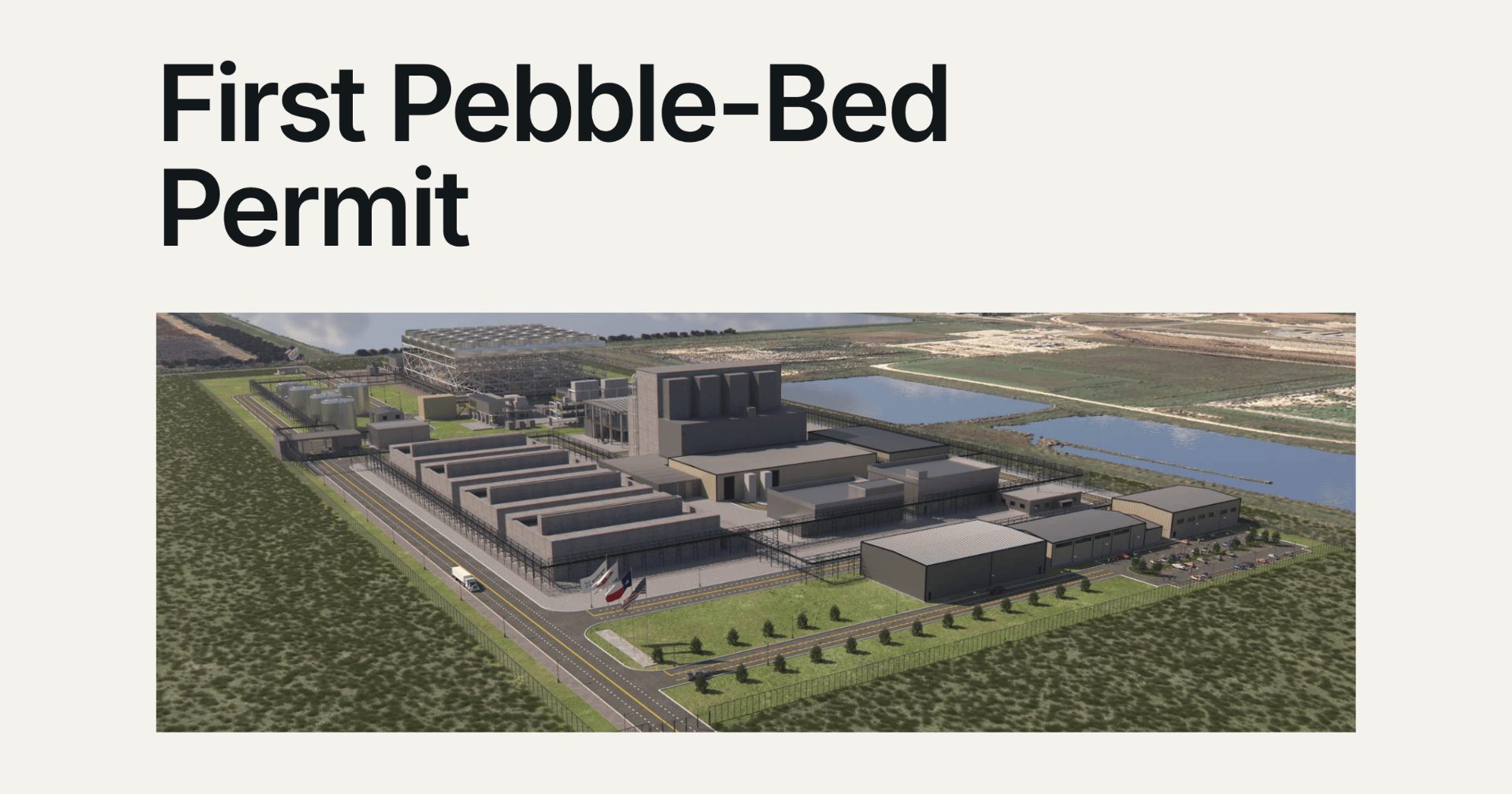
The Nuclear Regulatory Commission has issued a construction permit for four X-energy Xe-100 reactors at Dow's UCC Seadrift Operations on the Texas Gulf Coast, a project known as the Long Mott Generating Station. The approval, announced in the second week of November 2026, is the first construction permit for a high-temperature gas-cooled reactor in the United States in roughly six decades, and according to the Breakthrough Institute it is the third advanced reactor construction permit the agency has issued in 2026 alone.
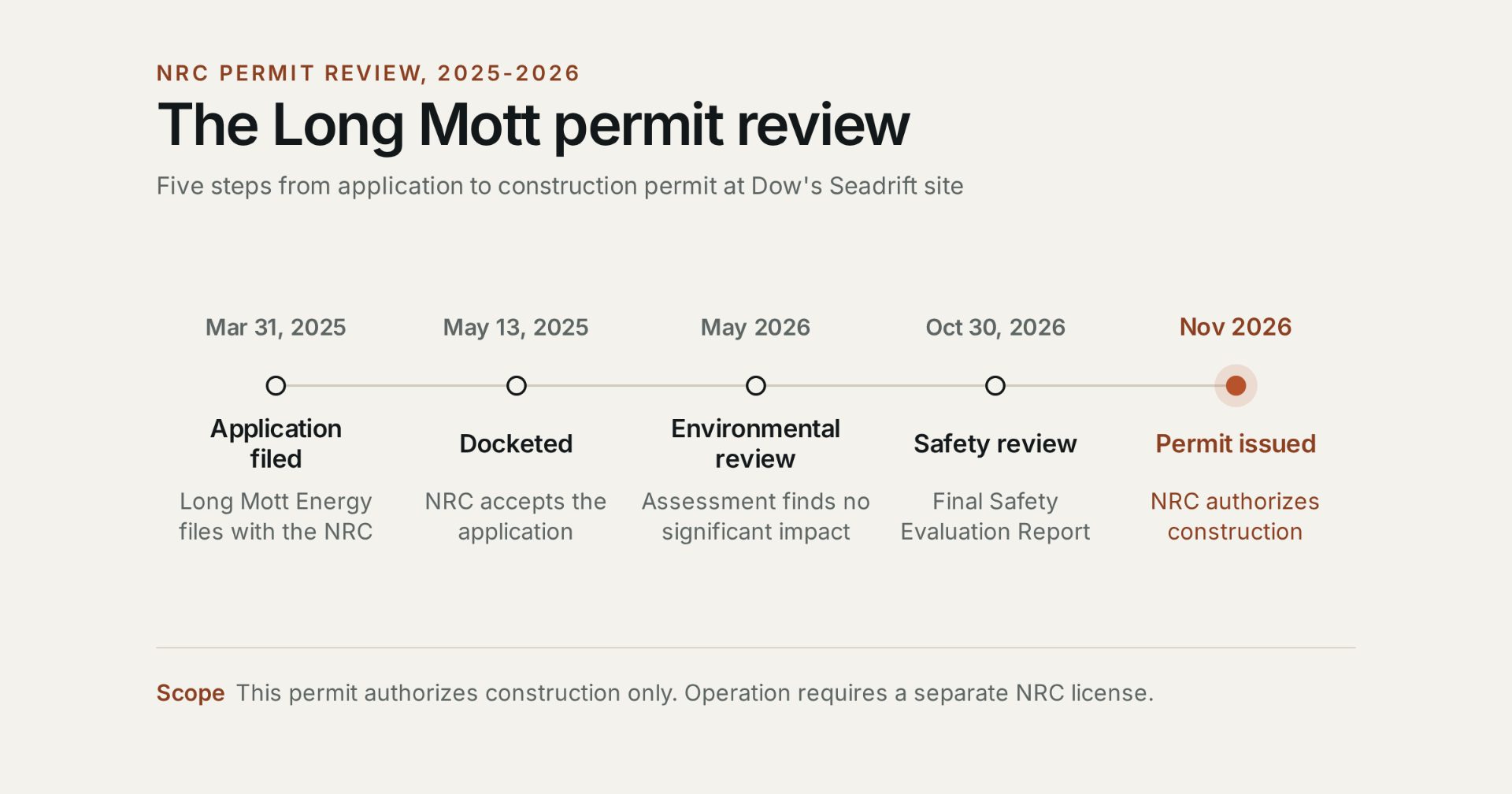
For an industry that has spent years promising that smaller reactors would be cheaper and faster to build, the milestone matters. It is also narrower than the headlines suggest. The permit authorizes construction. It does not authorize operation. Long Mott Energy, the Dow subsidiary that filed the application, would still need a separate operating license before any of the four units produces a megawatt or a kilogram of steam. X-energy itself has said the reactors will not be running until the early 2030s, and Dow has said it does not expect to make a final investment decision on the project before 2028.
That gap between regulatory permission and commercial reality is the real story here. The permit tells us something concrete about how the NRC now reviews novel reactor designs, how fast it can move, and what it is willing to leave unresolved. It tells us much less about whether X-energy can build a power plant on budget.
What the regulator actually approved
The application was submitted on March 31, 2025, and docketed on May 13, 2025. Under the 18-month review timeline set by executive order, the NRC completed its environmental review in May 2026 with an Environmental Assessment and a Finding of No Significant Impact, then closed out its safety review with a Final Safety Evaluation Report on October 30, 2026. The permit followed days later, ahead of the schedule X-energy had published to investors, which had pointed to a first-quarter 2027 issuance.
| Item | Detail |
|---|---|
| Applicant | Long Mott Energy LLC, a wholly owned Dow subsidiary |
| Site | Dow UCC Seadrift Operations, Calhoun County, Texas |
| Reactors | Four Xe-100 high-temperature gas-cooled units |
| Capacity | 80 MWe and 200 MWth per unit; 320 MWe and 800 MWth total |
| Environmental review | Environmental Assessment and Finding of No Significant Impact, May 2026 |
| Safety review | Final Safety Evaluation Report, October 30, 2026 |
| Permit scope | Authorizes construction only |
| Next regulatory step | Separate operating license application |
| Target operation | Early 2030s |
| Dow final investment decision | Not expected before 2028 |
The Seadrift site is not a greenfield experiment in an empty county. It covers about 4,700 acres, employs more than 1,200 people, has operated since 1954 under Union Carbide and then Dow, and ships more than 4 billion pounds of chemical products a year. Natural gas turbines on site currently supply both electricity and process steam. The reactors are intended to replace those assets as they approach the end of their operational lives, which is why the project can claim to be the first grid-scale advanced nuclear deployment serving an industrial facility in North America rather than a utility grid.
The machine: helium, pebbles, and a smaller safety footprint
The Xe-100 is a pebble-bed reactor. Its core holds roughly 220,000 graphite spheres, each studded with thousands of tiny fuel particles known as TRISO: a uranium kernel wrapped in layers of porous carbon, pyrolytic carbon, and silicon carbide. Helium, an inert gas, is pushed through the bed and exits the core at over 750 degrees Celsius, hot enough to raise steam at about 565 degrees Celsius on the secondary side without the higher pressures that a boiling water reactor requires.
The fuel is enriched to 20 percent uranium-235, the ceiling for high-assay low-enriched uranium, which lets each pebble stay in the core longer and burn more of its fissile content. Because the ceramic coatings are designed to retain fission products at temperatures well beyond any credible accident scenario, the design leans on intrinsic material properties rather than engineered backup systems. That claim is the commercial heart of the pitch: fewer mechanical safety systems, less concrete and steel containment, and a plant that can theoretically be sited closer to the people and processes it serves.
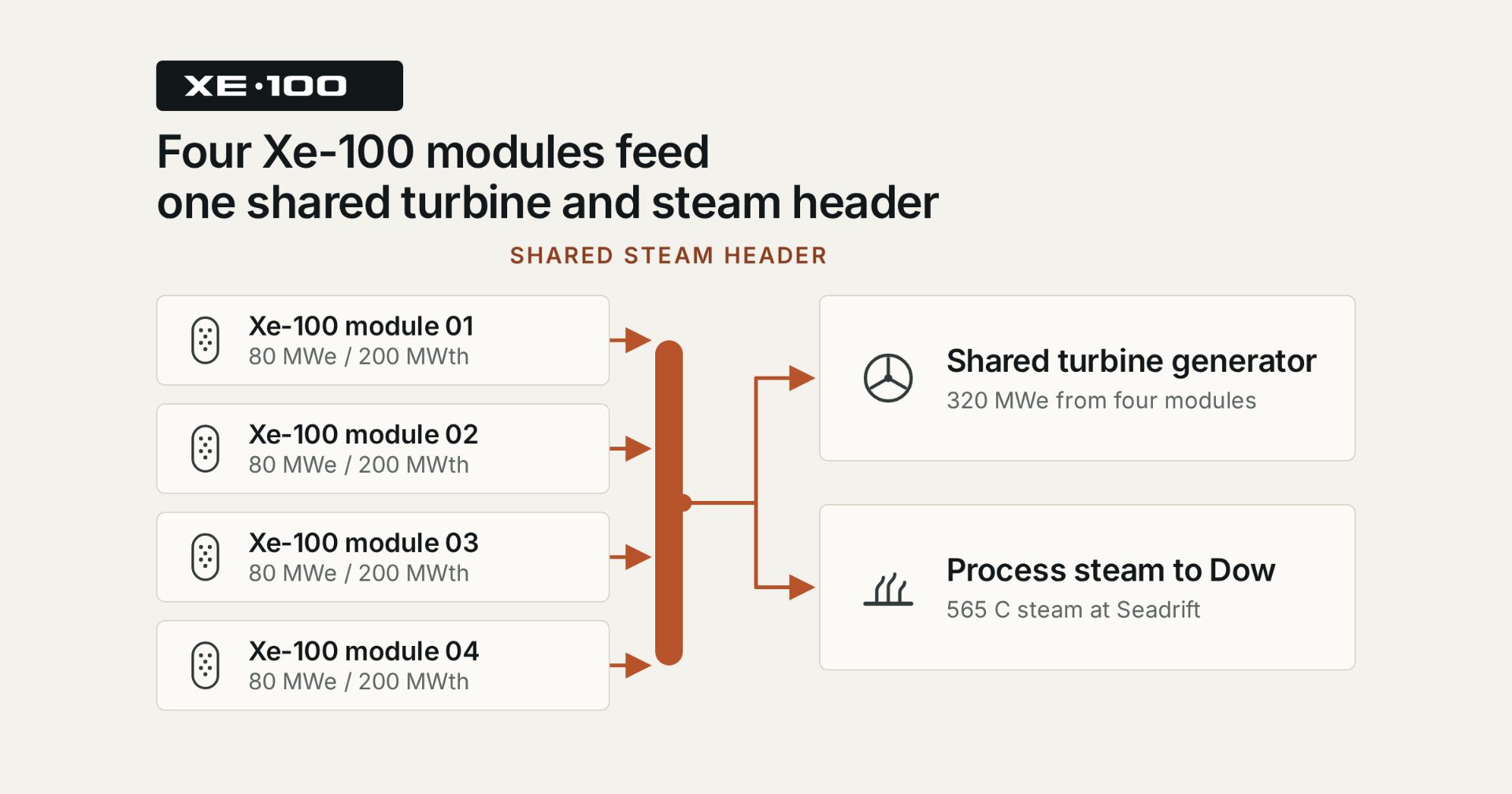
Each unit is rated at 80 MWe and 200 MWth, and a four-pack is designed to feed a common steam source so that one reactor can be taken offline for maintenance while the others keep the chemical plant running. X-energy projects plant availability above 95 percent on that basis and a 60-year operating life, with load-following down to 40 percent of full power within minutes. Those numbers are design targets, not demonstrated performance. No Xe-100 has ever operated.
Why an industrial host is a different bet from a utility
Selling electricity to a grid is a commodity business decided by wholesale prices and capacity markets. Selling high-temperature steam to a chemical plant is a process business decided by whether the steam arrives at the right pressure, temperature, and reliability for a facility that cannot afford unplanned shutdowns.
That difference is why Dow is the anchor customer. At Seadrift, the reactors would displace natural gas combustion that produces both Scope 1 emissions from the site's own equipment and Scope 2 emissions from purchased energy. Removing most of those emissions from a large, continuous industrial process is difficult with intermittent renewables alone, because the plant needs heat around the clock and does not have a grid-scale battery equivalent for steam.
X-energy also plans to export surplus power. Under the deployment concept described for the site, two reactors supply electricity to the facility, one supplies process heat, and the fourth sells power to the grid. That mix is a hedge: it gives the owner flexibility as the relative value of electricity and steam shifts, and it gives the project a second revenue stream if industrial demand softens.
The regulatory story is the more transferable achievement
The single most important sentence in the NRC's treatment of this project is not about the reactor at all. It is that the agency used an Environmental Assessment rather than the longer, costlier Environmental Impact Statement that has historically been the default for commercial reactor applications.
An EA asks whether a project's environmental impacts exist and whether they are significant. An EIS is a full stand-alone review. For a large light-water plant on a greenfield site, the heavier path made sense. For four small units inside an existing 4,700-acre industrial footprint that already has power infrastructure, roads, and a permitted operator, it was arguably disproportionate. The NRC concluded that an EA better addressed the project's limited footprint while maintaining its standards, and no significant impact was found.
Two other firsts are worth noting. The permit is the agency's first approval of a pebble-bed core with online refueling, a design feature in which spent spheres are drawn from the bottom of the bed and fresh ones added at the top while the reactor runs. And the agency approved an emergency planning zone of 400 meters, compared with the conventional 10-mile radius for a large light-water reactor, a direct consequence of the smaller source term and passive safety characteristics of the design.
The review also ran through a technology-inclusive, risk-informed, and performance-based licensing framework rather than the light-water conventions that dominate the agency's rulebook. Much of that framework traces back to years of pre-application engagement between X-energy and the NRC beginning in 2018, plus the licensing modernization work supported by the Department of Energy and carried out with industry. Predictability is the product here. A developer planning eleven gigawatts of projects across multiple customers needs to know how long a review will take, not just that it will eventually end.
The objection that will not go away
The Union of Concerned Scientists did not treat the approval as a triumph. Edwin Lyman, the group's director of nuclear power safety, argued that the NRC reached the milestone by deferring critical safety questions to a later date, issues he said should have been resolved before construction was authorized.
That criticism deserves to be stated plainly rather than dismissed. It also reflects a structural feature of construction permits under the older Part 50 pathway rather than a shortcut unique to this project. A construction permit is built around a preliminary design. Some analysis, particularly research and development items and details that do not affect whether a site can safely host a reactor, are resolved later in the Final Safety Analysis Report and the operating license review. TerraPower's permit for its Natrium plant in Wyoming drew a similar note from NRC staff, which acknowledged remaining areas of uncertainty in the design and analysis as acceptable under regulations written for exactly that situation.
The fair question is not whether anything was deferred, but whether the deferred items are bounded and whether the operating license review has real teeth. X-energy's argument is that the fuel itself does much of the safety work. The Department of Energy has described TRISO particles as unable to melt at temperatures beyond the threshold of current nuclear fuels, a property that shifts the burden from redundant cooling systems to the physics and materials of the fuel. If that characterization holds up under irradiation and accident testing, the regulatory logic follows. If it does not, the deferral looks worse in hindsight.
Fuel is the constraint no permit can solve
A reactor is only as real as its fuel supply. TRISO pebbles at 20 percent enrichment are not available off the shelf in the United States at commercial scale, which is why X-energy has spent years building its own production capability rather than relying on the market.
Its TRISO-X subsidiary is constructing the TX-1 fabrication facility at Oak Ridge, Tennessee, with vertical construction reported about 56 percent complete in the company's first-quarter 2026 investor materials and operations targeted for 2028. In February 2026 the NRC issued the first Category II special nuclear material license of its kind for TX-1 and the planned TX-2 facility, clearing the way for commercial manufacture of high-assay low-enriched fuel pending a final inspection. TX-1 is designed for roughly 5 metric tons of uranium per year, enough for a handful of reactors; TX-2, still in development, is intended to reach 20 metric tons and support a much larger fleet.
The vertical integration is a genuine strategic advantage in a sector where several competitors are still shopping for fuel. It is also a single point of failure. Long Mott cannot start up if Oak Ridge is late.
The commercial question: Dow's checkbook and the share price
The permit removes a regulatory excuse. It does not remove an economic one. Dow has been consistent that it will not commit capital until it is satisfied the project can meet its financial return targets, and that decision is not expected before 2028. X-energy's own illustrative figures, disclosed in its registration statement, put the lifetime cost of a four-reactor plant somewhere between roughly $1.66 billion and $2.18 billion, with fuel accounting for the majority over six decades of operation. First-of-a-kind projects rarely land on the low end of such ranges.
The market has already registered its skepticism. X-energy went public in April 2026 at $23 per share, raising about $1 billion in the largest nuclear listing on record. By November, the stock was trading at less than half its offering price. The permit announcement produced only enough of a bounce to recover the prior week's losses, which is a sober verdict on how much investors think a construction approval is worth on its own.
That is not irrational. Nuclear plants are capital-intensive, schedule-sensitive, and prone to cost overruns on first builds. The only thing that reliably changes the economics is building the same design repeatedly and learning between units, which is precisely the argument for a fleet rather than a one-off.
Where X-energy sits in the field
The advanced reactor sector is no longer a set of paper designs, but it is not yet a set of operating power plants either. The differences between leaders are differences in which milestone they have passed.
| Developer | Design | Output | Position in late 2026 |
|---|---|---|---|
| X-energy | Xe-100 pebble-bed HTGR | 80 MWe / 200 MWth per unit | Construction permit for four units at Dow; operation early 2030s |
| TerraPower | Natrium sodium-cooled fast reactor with salt storage | 345 MWe, up to 500 MWe peak | Construction permit March 2026; target 2030 |
| NuScale | US460 light-water SMR | 77 MWe per module | Standard design approval May 2025; flagship US project cancelled over cost |
| Kairos Power | KP-FHR fluoride salt-cooled | 50 MWe at Hermes 2 | Permits secured; demonstration construction underway |
| GE Vernova Hitachi | BWRX-300 | About 300 MWe | Licensed construction progressing in Canada |
| China's HTR-PM | Twin-unit pebble-bed HTGR | Grid-connected | Commercial operation since December 2023 |
The Chinese entry deserves more attention than it usually gets in American coverage. A pebble-bed high-temperature gas-cooled plant has been running commercially since December 2023, which means the basic concept is not speculative. What remains unproven in the United States is the cost and schedule of building one here, under this regulator, with a domestic fuel supply chain.
NuScale's experience is the cautionary counterexample. The company holds the most mature regulatory position of any American SMR developer, with design approval for its 77-megawatt module, and still lost its flagship project when costs rose and customer commitments failed to materialize. A design certificate is not a power plant, and neither is a construction permit.
What to watch next
Four things will determine whether Long Mott becomes the template X-energy says it will be.
The first is the operating license application. A construction permit that leads to a slow, contentious operating review would erase much of the schedule advantage the 18-month construction review just created.
The second is Dow's 2028 investment decision. If a chemical company with its own balance sheet and its own emissions targets hesitates, the industrial-heat thesis behind a large share of X-energy's pipeline weakens.
The third is TX-1. Fuel fabrication is the least glamorous part of the story and the one most likely to set the actual start date.
The fourth is repetition. X-energy has signed development agreements tied to Amazon's five-gigawatt program, a nearly one-gigawatt project in Indiana with American Electric Power, and a UK pipeline with Centrica. None of that capacity is under construction. The value of the Long Mott permit is that it turns a novel licensing pathway into a repeatable one, and the sector will learn quickly whether the second and third applications go faster or merely go.
For now, the honest summary is this: the NRC has demonstrated it can review an unfamiliar reactor design and a novel site configuration inside a predictable window, which is a meaningful change from the recent past. X-energy has demonstrated that its paperwork and its fuel strategy can survive federal scrutiny. Neither of them has yet demonstrated a reactor that runs, and the early 2030s is a long way off in a business where the last decade of promises has been expensive.