
Starship Flight 15: Inside the First Attempt to Catch Both Stages
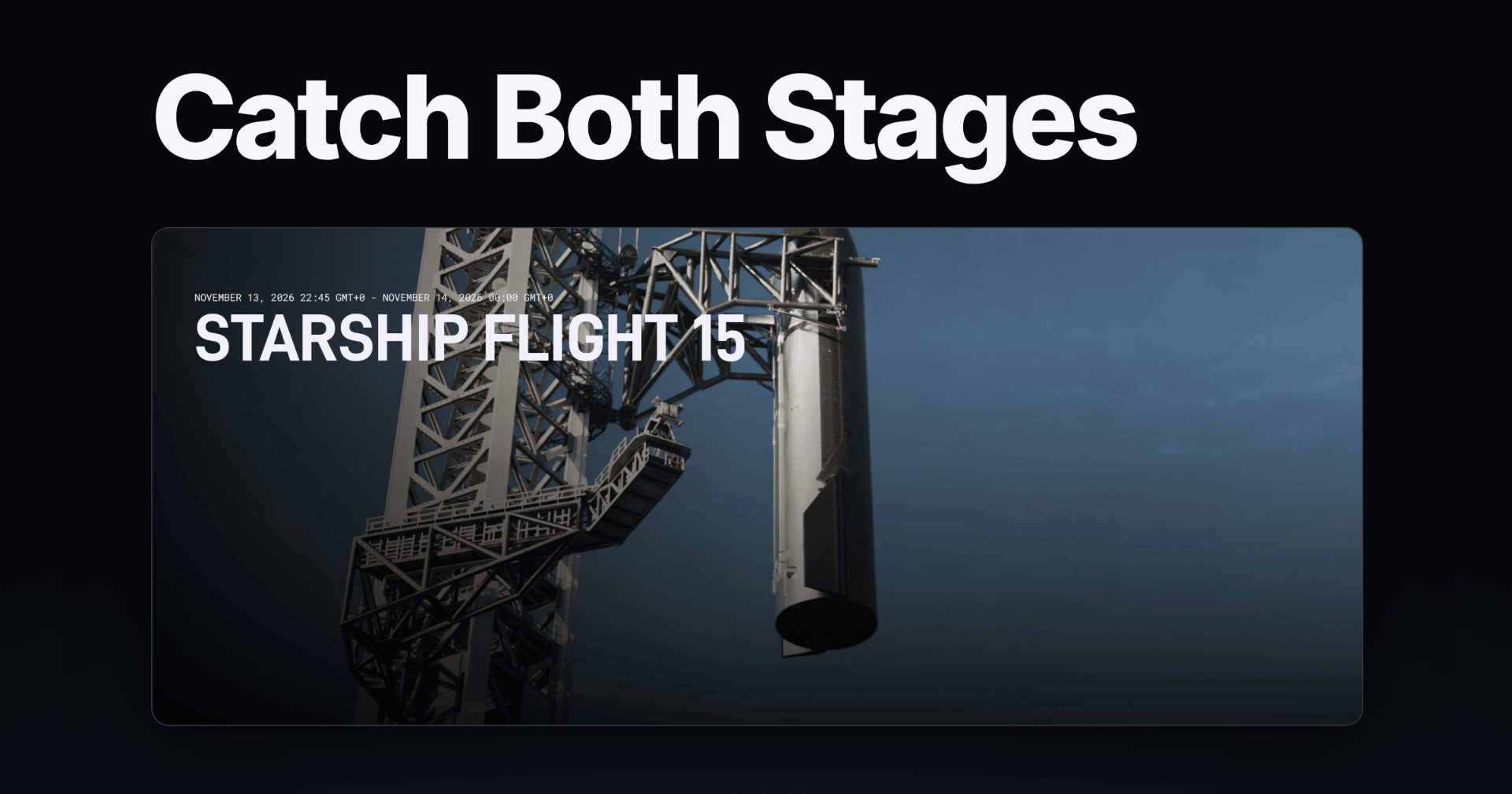
On Friday, November 13, 2026, SpaceX plans to launch the fifteenth integrated flight test of Starship from Starbase, Texas, pending regulatory approval. The 75-minute window opens at 4:45 p.m. Central time, and a webcast is scheduled to begin about half an hour before liftoff.
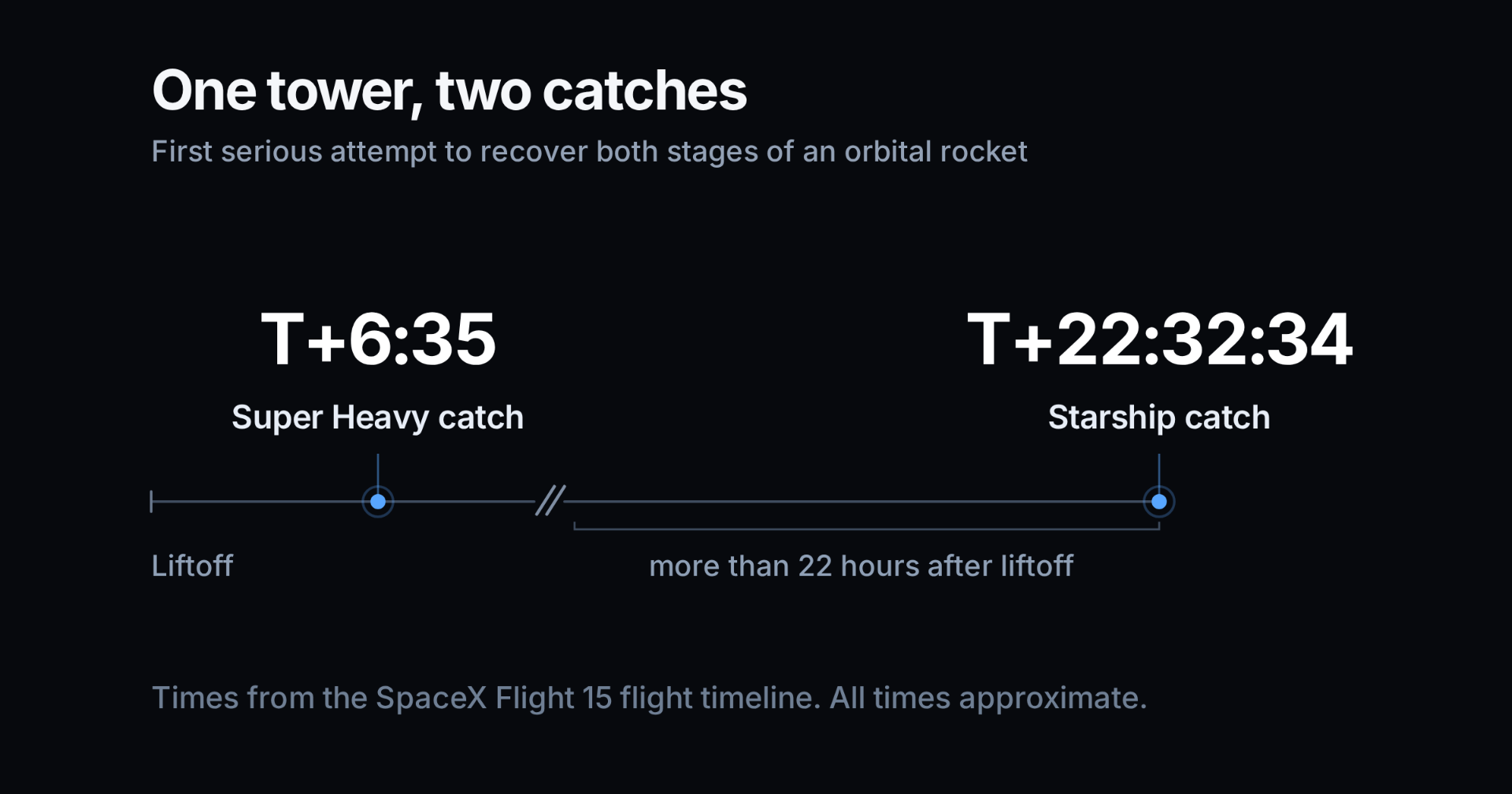
Most launches are judged by what they send uphill. This one will be judged by what comes back. If the mission goes as designed, the Super Heavy booster will be caught by the launch tower's mechanical arms roughly six and a half minutes after liftoff, and the Starship upper stage will return from orbit more than 22 hours later and be caught by the same tower. No orbital launch system has ever been recovered in full. Flight 15 is the first serious attempt to do it.
Why catching the ship is a different problem
SpaceX has been catching Super Heavy boosters since October 2024, when the first booster returned to the tower about seven minutes after launch and settled into the chopsticks on the first try. More catches followed, and two of the recovered boosters were later flown again. That track record makes the booster half of Flight 15 feel almost routine, even though this will be the first catch attempt for a Block 3 booster and the first at Orbital Launch Pad 2.
The ship is a fundamentally harder object to recover. A booster separates at roughly two and a half minutes, turns around on a short ballistic arc, and comes home within minutes. Its propellant tanks are still relatively full, its trajectory is well understood, and its reentry loads are modest compared with what an orbital vehicle faces.
Starship, by contrast, spends more than 22 hours in space, where its cryogenic propellants slowly boil off and its systems sit in a thermal environment very different from the one they were tested in. It then reenters the atmosphere at orbital velocity, with the underside of the vehicle facing a plasma flow hot enough to destroy the vehicle if the heat shield fails locally. It arrives at the tower as a 9-meter-diameter steel cylinder descending horizontally, and it must rotate to vertical and light its engines in the last few seconds before the arms close around it.
The booster catch is a demonstration of control. The ship catch is a demonstration of survival first, and control second.
The hardware: Booster 22 and Ship 42
Flight 15 is expected to use Booster 22 and Ship 42, the fourth pair of Block 3 vehicles to fly. Block 3 is the current generation of the vehicle, powered by Raptor 3 engines and standing roughly 124 meters tall when stacked, in the same 9-meter diameter that has defined the program from the beginning. Both stages burn liquid methane and liquid oxygen, and both are built from welded stainless steel rings, a design choice that trades the mass efficiency of composites for tolerance of reentry heating and cheap, fast manufacturing.
The Super Heavy booster carries 33 Raptor engines and produces tens of meganewtons of thrust at liftoff. The ship carries six: three optimized for sea level and three vacuum-optimized Raptors with much larger nozzles for operation outside the atmosphere. Neither stage has landing legs. That is the whole point of the tower: the vehicle carries less hardware, and it comes home to the same place it launched from, which removes the need to transport it back from a distant landing zone.
Booster 22 completed a full-duration static fire in late October, igniting all 33 engines while held down at the pad. Ship 42 went through cryogenic testing at the Massey's test site and, in September, was lifted by the launch tower's chopsticks in a rehearsal of the post-catch position, including a check against the ship quick-disconnect arm. That test was about the plumbing and procedures of recovering a ship at the pad, not just about the catch itself.
The booster's six minutes
The booster's job description is short: launch, ascend, separate, turn around, come back. The execution is anything but.
After liftoff, the vehicle passes maximum aerodynamic pressure at about 58 seconds. At roughly two minutes and 19 seconds, most of the booster's engines cut off, and two seconds later the ship ignites its own engines while still attached, a maneuver known as hot staging. The booster's remaining engines hold it steady for that instant, then the stages separate.
From there, Super Heavy flips and performs a boostback burn between about two minutes 26 seconds and three minutes two seconds, canceling most of its downrange velocity and aiming itself back at Starbase. During the unpowered coast that follows, grid fins near the top of the booster provide steering authority, working with cold gas thrusters. A landing burn starting around six minutes ten seconds slows the vehicle for the final approach, using only the inner ring of engines rather than the full complement.
The catch itself is scheduled for about six minutes 35 seconds after liftoff. The tower's two large arms close on hardpoints built into the booster's structure, hardware that also serves when the vehicle is lifted onto the launch mount. If conditions are not right, the booster can be diverted away from the tower rather than risking a collision with ground infrastructure.
The ship's 22 hours
Starship's flight is where the mission stops resembling anything SpaceX has done before.
The ship is expected to reach an orbit at roughly 275 kilometers altitude and complete about 14 revolutions of the Earth over a flight lasting more than 22 hours. That duration is not incidental. A return-to-launch-site trajectory requires the ground track to line up with Starbase again, and a long coast gives the vehicle time to come back around to the right reentry corridor.
That long stay in orbit is also a test in its own right. Propellant behavior over many hours, thermal performance in a slowly changing sun angle, and the health of systems that were designed to operate for minutes rather than a full day all matter for what comes next. SpaceX's future plans depend on keeping cryogenic propellant usable in orbit for long enough to transfer it between vehicles, and every hour of Flight 15 adds data to that problem.
The flight profile is built with off-ramps. As with Starship's first orbital mission, the trajectory allows the ship to be inserted into a passively safe suborbital path or to deorbit over pre-determined ocean areas at multiple points during the mission. If engineers are not confident in the ship's reentry systems, it does not have to come home.
26 satellites, and three inspectors
The payload bay is not empty on this flight. Starship will deploy 26 Starlink V3 satellites, the second batch of the next-generation satellites the vehicle has carried, following the first deployment on Flight 14 in September.
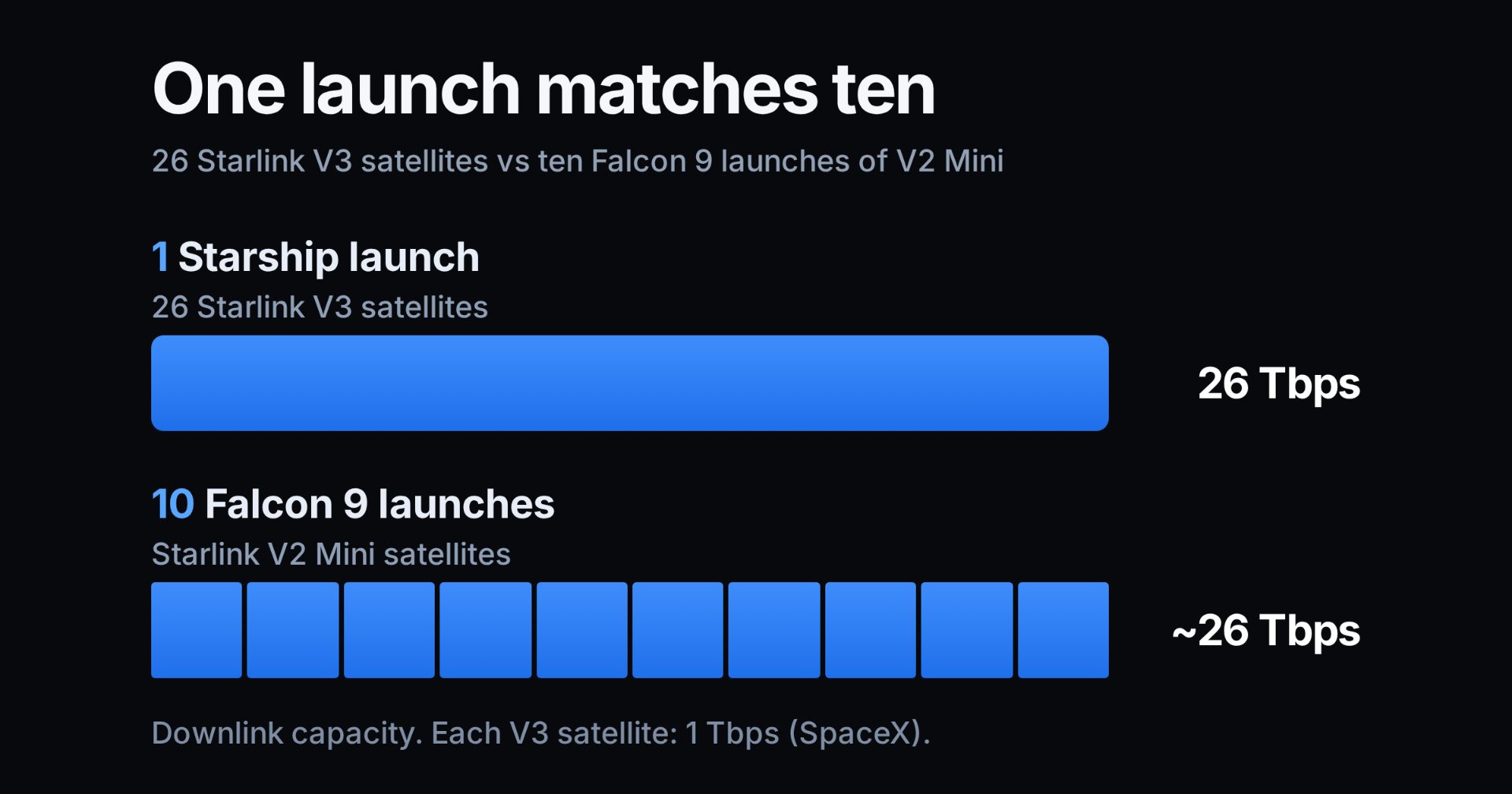
Each V3 satellite is designed to add roughly one terabit per second of capacity to the constellation. The full batch of 26 is equivalent, in capacity terms, to about ten Falcon 9 launches carrying Starlink V2 Mini satellites, which is the clearest illustration of why SpaceX wants Starship flying regularly. Starlink is the company's largest business, and the V3 satellites are too large to launch economically on anything but Starship.
After deployment, the satellites unfold their antennas, deploy solar arrays, establish contact with the ground and with the rest of the constellation through radio frequency and laser links, and begin raising their orbits with onboard thrusters. SpaceX expects them to start serving customers within a few weeks of launch, assuming on-orbit checkouts go well.
Three of the 26 satellites carry something extra: a suite of cameras pointed at the ship. These modified satellites scan Starship's heat shield and transmit imagery back to operators. The technique has been used on earlier flights, and it gives engineers a view of tile damage that no ground-based telescope or onboard sensor can match. On a flight where the ship's ability to survive reentry decides whether a catch is attempted at all, that inspection is not a nice-to-have.
The heat shield is the real gate
Everything about the ship's return depends on a thermal protection system made of thousands of hexagonal ceramic tiles, a silica-based design intended to withstand temperatures around 1,400 degrees Celsius and to be reused with limited maintenance between flights.
The tiles are also the least forgiving part of the vehicle. They are brittle, they are attached with pins, and they sit on a stainless steel structure that expands and contracts as the cryogenic tanks are filled and the vehicle heats during ascent. A tile that lifts off during ascent leaves a bare patch that plasma can attack during reentry.
Flight 15 carries the improvements introduced on Flight 14. Engineers added retention mechanisms in areas judged to be at highest risk of losing tiles during ascent, and they addressed areas where the geometry created a flow path for plasma to get behind the tiles. A large portion of the heat shield also uses a curved tile design that testing has shown reduces heating in the gaps between tiles, which is where the most damaging local hot spots tend to form.
The inspection satellites, the tile changes, and the option to wave off a return all serve the same decision: whether the flight control team is confident enough in the vehicle's condition to send it toward the tower rather than into the ocean.
The catch, step by step
The ship's return begins with a deorbit burn of about ten seconds, starting roughly 21 hours and 36 minutes after liftoff. Entry follows about 34 minutes later. The vehicle goes transonic near 22 hours 29 minutes and subsonic about 40 seconds after that, bleeding off the enormous energy of orbital velocity through aerodynamic drag while the flaps keep it oriented.
The final sequence is quick. At about 22 hours 32 minutes and 16 seconds, the landing burn starts. Two seconds later the ship performs a landing flip, rotating from a horizontal attitude to vertical. The burn steps down from three engines to two at 22 seconds past the minute, then to one at 33 seconds, and at 34 seconds the engines shut down and the tower arms make the catch.
That is a four-engine, eighteen-second choreography performed at the end of a day-long mission, with no second chance. The booster's catch has been practiced successfully several times. This one has not.
Odds, licensing, and honesty about risk
SpaceX has been careful to frame Flight 15 as an attempt rather than an expectation. Elon Musk said in October that a successful Flight 14 would clear the way for a ship catch attempt on Flight 15 and put the probability of success on the first try at "at least 50 or 60 percent." On the company's third-quarter earnings call he called full recovery a profound technology milestone while conceding that success was not guaranteed, adding that a steady stream of flights would follow regardless of the outcome.
The regulatory side matters as much as the hardware. The license granted for Flight 14 covered that mission; a return-to-launch-site profile with tower catches for both stages requires authorization covering those operations. SpaceX has said it expects its Flight 15 license to include them, but the launch date has always carried the phrase "pending regulatory approval," and schedules in this program have moved before.
SpaceX has also built in the ability to call off the ship's return late. The company states that Starship will only attempt a return to the launch site if the flight control team has confirmed that the systems critical for reentry maneuvers, the final landing burn, and the tower approach are healthy. In practice that means the ship may fly a perfect 22-hour mission, deploy its payload, and still end in the ocean, and that would count as a sensible decision rather than a failure.
What a double catch would and would not prove
A successful Flight 15 would be the first full recovery of an orbital launch system, and the implications go beyond symbolism. Recovering both stages at the launch site removes the recovery fleet, the towing, and the seawater exposure that have complicated earlier ship recoveries. A ship that returns to the pad rather than floating in the ocean for weeks arrives with engines and avionics that can be inspected and potentially tested, rather than corroded by salt water.
That matters for the next phase of the program. SpaceX intends to demonstrate in-orbit propellant transfer, using one ship to transfer oxygen and methane to another, and eventually dedicated depot vehicles. That capability is what makes lunar landings and Mars missions feasible, and it depends on vehicles that can be flown, recovered, and flown again on a meaningful cadence rather than on one-off test articles.
What a double catch would not prove is rapid reuse. Catching a vehicle is not the same as inspecting it, refurbishing it, refueling it, and launching it again in days. The booster catches already demonstrated the mechanics of recovery; what remains unproven is the turnaround. A successful Flight 15 would open that question rather than answer it.
What to watch
The launch window opens at 4:45 p.m. Central on Friday, November 13, and the flight is worth watching for at least two distinct moments, separated by more than 22 hours.
The first is the booster's return, roughly six and a half minutes in, which should look familiar to anyone who has followed the program since October 2024, with the difference that this is a Block 3 booster at a newer pad. The second is far less familiar: a ship that has spent most of a day in orbit, survived reentry, flipped upright at the last moment, and descended into the arms of the same tower it left the day before.
Either moment could go wrong, and the mission has been designed so that failure at one does not prevent the other. That is what makes Flight 15 worth the attention: not a single dramatic event, but two recoveries of very different kinds, engineered so that the vehicle can come home from orbit and also decline to try.