
Blogs in mcp
stay updated with the latest news, insights, and guides on mcp from ProductWatch.
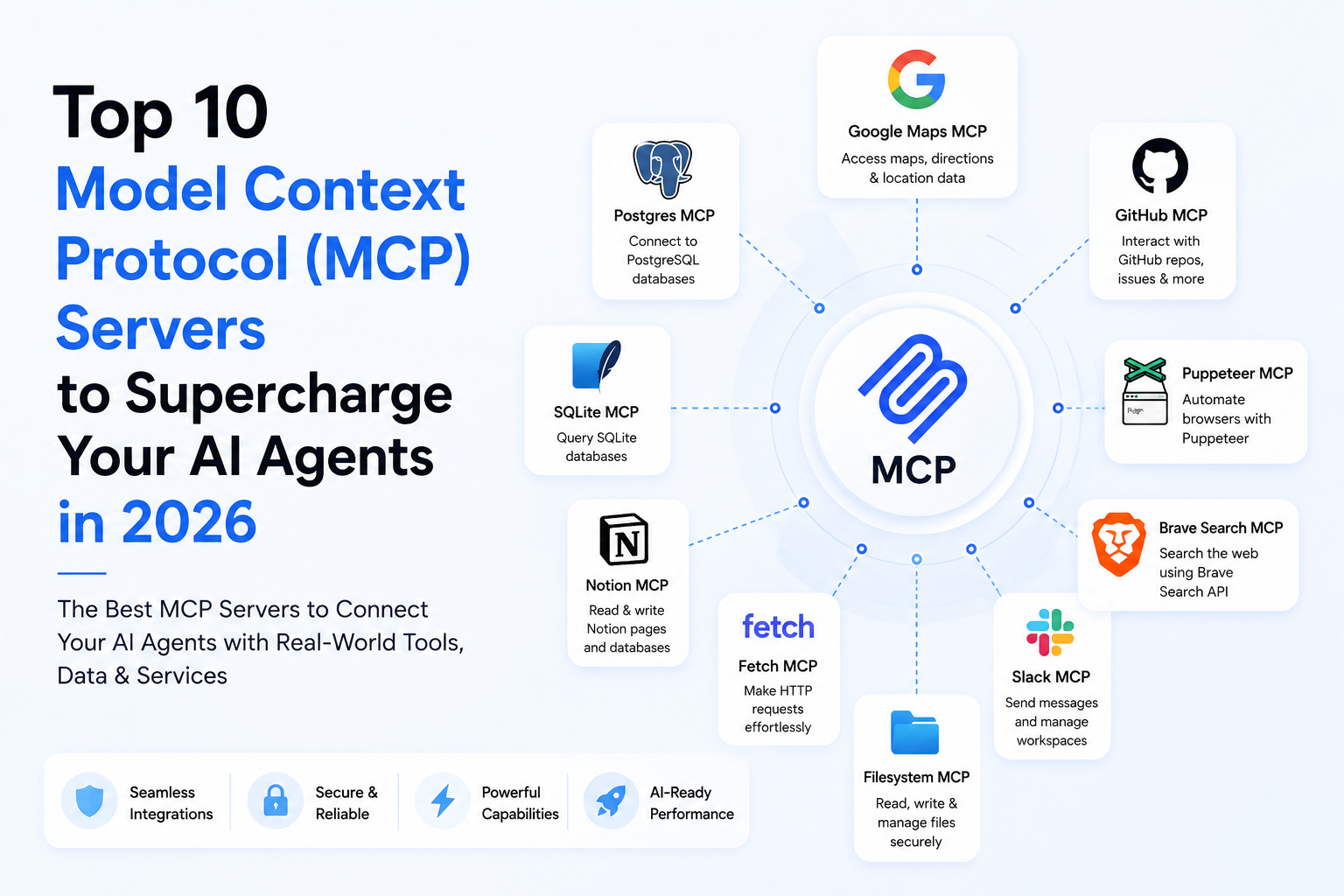
Top 10 Model Context Protocol (MCP) Servers to Supercharge Your AI Agents in 2026
The Model Context Protocol (MCP) has quickly become the open standard for connecting large language models (LLMs) and AI agents directly to local and cloud-based data sources. Developed to resolve the limitations of closed, proprietary API connectors, MCP allows developer agents to read files, run terminal tests, search databases, inspect version repositories, and automate web operations through standardized server instances. By running these modular servers, developer clients like Claude Code, Cursor, and custom agent platforms can instantly extend their context windows with live, system-level capabilities. This guide evaluates the top ten Model Context Protocol (MCP) servers in 2026, outlining their target workflows, pros, cons, and pricing to help you build connected AI systems. > QUICK SUMMARY > > * SQLite MCP Server: Best overall local database server for reading, querying, and updating SQLite database files inside workspace agents. > * Postgres MCP Server: Best for enterprise-grade SQL execution and transactional data lookups. > * GitHub MCP Server: Best for automated repository navigation, file inspection, and PR/issue creation. > * Brave Search MCP Server: Best for real-time web searches and retrieving context-aware web summaries. > * Puppeteer MCP Server: Best for automated web scraping and UI interaction tests. > > Other excellent tools include Memory MCP Server, Slack MCP Server, Jira MCP Server, Google Drive MCP Server, and Fetch MCP Server. Each extends the contextual limits of agents, making them suitable for different developer workflows. COMPARISON MATRIX | Server | Best For | Core Access Target / Key Feature | Pricing | Free Plan | Platform / Type | | : | : | : | : | : | : | | SQLite MCP Server | Querying local SQLite tables | Local filesystem .db files read-write | Free (MIT License) | ✓ (Fully Free) | Local Node Server | | Postgres MCP Server | Enterprise SQL database analytics | Remote database read-write execution | Free (MIT License) | ✓ (Fully Free) | Local/Hosted Server | | GitHub MCP Server | Automated repository coding loops | GitHub public & private repositories API | Free (MIT License) | ✓ (Requires Git token) | API Server | | Brave Search MCP Server | Real-time web retrieval | Brave Search Index lookup API | Free (MIT License) | ✓ (Free key tiers) | API Server | | Puppeteer MCP Server | Headless web automation and audits | Chromium browser control automation | Free (MIT License) | ✓ (Fully Free) | Local node container | | Memory MCP Server | Stateful graph-based agent memory | Graph-based persistence local storage | Free (MIT License) | ✓ (Fully Free) | Local Node Server | | Slack MCP Server | Collaborative workspace communication | Slack workspace channels messaging API | Free (MIT License) | ✓ (Requires Slack token) | API Server | | Jira MCP Server | Project management and issue sync | Atlassian Jira issue boards sync API | Free (MIT License) | ✓ (Requires Jira token) | API Server | | Google Drive MCP Server | Reading shared corporate files | Google Drive folders text parsing API | Free (MIT License) | ✓ (Requires OAuth keys) | API Server | | Fetch MCP Server | Page downloading and plain text parsing | Raw web URL HTML markdown extractor | Free (MIT License) | ✓ (Fully Free) | Local Node Server | 1. SQLITE MCP SERVER The SQLite MCP Server is the standard database adapter for local agent files. It is the best choice for developers building terminal agents that need to inspect, query, create tables, and update records inside local SQLite databases during software loops. PROS & CONS It allows agents to execute complex raw SQL statements and retrieve structured database schemas natively, making local data analysis fast and zero-latency. On the downside, it is strictly configured for local file paths, meaning it cannot coordinate remote access, high-volume transactions, or real-time write operations on distributed production networks. PRICING The server is completely free and open-source under the MIT license. 2. POSTGRES MCP SERVER The Postgres MCP Server is an enterprise-grade database connector. It is the best choice for remote systems where agents need to run SQL reports, query metrics, or verify transactional entries inside distributed PostgreSQL database clusters. PROS & CONS The server provides secure SSL connections, support for complex relational schemas, and direct execution parameters, allowing agents to pull operational stats directly. However, exposing remote databases to LLM agents carries high security risks, requiring strict read-only parameters and custom SQL injection guardrails to prevent accidental data wipes. PRICING The Postgres adapter is free and open-source under the MIT license. 3. GITHUB MCP SERVER The GitHub MCP Server enables agents to navigate version-control repositories. It is the best option for autonomous coding tools that need to inspect file diffs, search code history, create branches, write pull requests, and manage issue tickets. PROS & CONS By integrating repository actions natively, developer agents can automate entire pull request workflows and issue-resolution tests without requiring manual terminal steps. However, hitting GitHub's API rate limits is common for large active repositories, which can cause model errors during multi-file reviews. PRICING It is free and open-source, but requires a personal access token matching the target repository's GitHub plan. 4. BRAVE SEARCH MCP SERVER The Brave Search MCP Server connects agents to real-time search engine results. It is the best choice for research agents that need to query the active web to gather facts, check documentation updates, and retrieve recent news events. PROS & CONS The Brave Search API returns highly optimized plain-text summaries and URL citations, allowing models to bypass heavy HTML scraping and parse search index results efficiently. The main limitation is that it requires an active Brave developer account and is subject to search query limits. PRICING The server adapter code is free and open-source. API usage starts with a free key tier, with paid packages scaling based on query volumes. 5. PUPPETEER MCP SERVER The Puppeteer MCP Server provides headless browser control to agents. It is the best choice for visual QA agents, automated web tests, and scraping tasks that require crawling complex single-page apps (SPAs) or taking screenshots of live interfaces. PROS & CONS It allows models to open Chromium windows, type inputs, click buttons, and capture page views natively, making it a powerful tool for web automation. On the other hand, executing Puppeteer instances consumes significant local memory and CPU resources, causing slow run times on lightweight servers. PRICING Puppeteer adapter libraries are free and open-source under the MIT license. 6. MEMORY MCP SERVER The Memory MCP Server implements persistent, graph-based memory nodes for agents. It is the best option for personalization apps where agents need to save facts, user preferences, and cross-session contexts over time. PROS & CONS By mapping relations as nodes in a graph database, the server allows agents to recall contextual connections across different chat sessions. However, managing memory consolidation (cleaning old or conflicting facts) requires substantial system prompts, or the memory index can become cluttered. PRICING The server is free and open-source under the MIT license. 7. SLACK MCP SERVER The Slack MCP Server is a team communication tool. It is the best choice for administrative agents that need to monitor specific Slack channels, post operational updates, search chat history, or alert developer teams when errors occur. PROS & CONS It allows developer agents to participate directly inside team chats, creating simple, conversational command centers for dev loops. The downside is the potential for message noise and prompt injection risks if agents respond indiscriminately to untrusted inputs inside public channels. PRICING It is open-source and free, requiring standard Slack developer app credentials and scopes. 8. JIRA MCP SERVER The Jira MCP Server connects agents to Atlassian's project management suite. It is the best option for product management assistants that need to create project tickets, transition epic boards, and assign tasks based on developer logs. PROS & CONS By integrating task states natively, agents can automatically verify when pull requests are merged and update the matching Jira issues. The limitation is the complex API configurations required to match Jira's custom field workflows, requiring manual setup. PRICING The adapter is free and open-source, scaling based on your team's Atlassian subscription plans. 9. GOOGLE DRIVE MCP SERVER The Google Drive MCP Server allows agents to search and parse files inside shared corporate cloud storage. It is the best choice for internal knowledge base assistants that need to read Google Docs, search folders, and extract content from spreadsheet files. PROS & CONS It provides a secure, direct link to search corporate drive folders without copying files to local folders, saving time and indexing storage space. However, it requires OAuth access setup, and processing giant files can cause token context overflows for agents. PRICING The server is free and open-source under the MIT license, subject to Google Cloud console project quotas. 10. FETCH MCP SERVER The Fetch MCP Server is a web document extraction tool. It is the best choice for web assistants that need to quickly fetch the raw contents of external web pages and convert them to clean, token-efficient plain text markdown. PROS & CONS It bypasses heavy advertising scripts and returns readable text formats, keeping LLM prompt costs low and query execution speeds high. The limitation is that it cannot execute JavaScript, meaning it will return blank pages for sites that rely on client-side React or Vue rendering. PRICING The Fetch server is free and open-source under the MIT license. CONCLUSION Deploying Model Context Protocol (MCP) servers allows teams to bypass custom API connectors and build connected agent ecosystems. If you are building a local coding assistant that needs file navigation and database queries, pairing the GitHub MCP Server with the SQLite MCP Server is the most robust setup. For real-time web search and automated page audits, choose the Brave Search MCP Server paired with Puppeteer MCP Server. Choose the servers that match your security rules to build safe, context-aware AI tools.