AI sentiment analysis has moved far beyond simply checking whether a customer review is positive or negative.
In 2026, companies can monitor sentiment across social media, customer conversations, reviews, surveys, support tickets, and other text sources. A newer layer has also become important: AI search sentiment.
When someone asks ChatGPT, Gemini, Perplexity, Google AI Overviews, or another AI search system about a company, the answer may describe the brand as affordable, reliable, difficult to use, expensive, beginner-friendly, enterprise-focused, or better than a competitor. That perception can influence buying decisions even when the customer never visits a traditional search result.
Lumirank: Best for monitoring how ChatGPT, Gemini, Perplexity, Google AI Overviews, Google AI Mode, and Microsoft Copilot describe your brand, including AI visibility, competitor rankings, citations, and sentiment.
Semrush: Best for teams that want AI sentiment monitoring alongside SEO, AI visibility, competitor research, prompt tracking, and traditional search data in one platform.
Brandwatch: Best for enterprise brands that need large-scale social listening, consumer research, sentiment analysis, competitor comparison, and historical conversation data.
Sprinklr: Best for large organizations that want to combine social listening, customer feedback, sentiment, product insights, and AI-search monitoring across multiple teams.
Talkwalker: Best for global brands that need real-time social listening, sentiment tracking, visual listening, reputation monitoring, and large-scale digital coverage. For developers building their own sentiment workflows, APIs such as Google Cloud Natural Language and Amazon Comprehend offer programmable sentiment analysis instead of requiring a full consumer-intelligence platform
Lumirank is one of the strongest options for a newer category of sentiment monitoring: how AI search engines perceive and describe a brand.
Instead of analyzing only customer reviews or social posts, Lumirank sends tracked prompts to major AI platforms and measures how brands appear in the resulting answers. Its current platform tracks ChatGPT, Google AI Mode, Gemini, Perplexity, Microsoft Copilot, and Google AI Overviews.
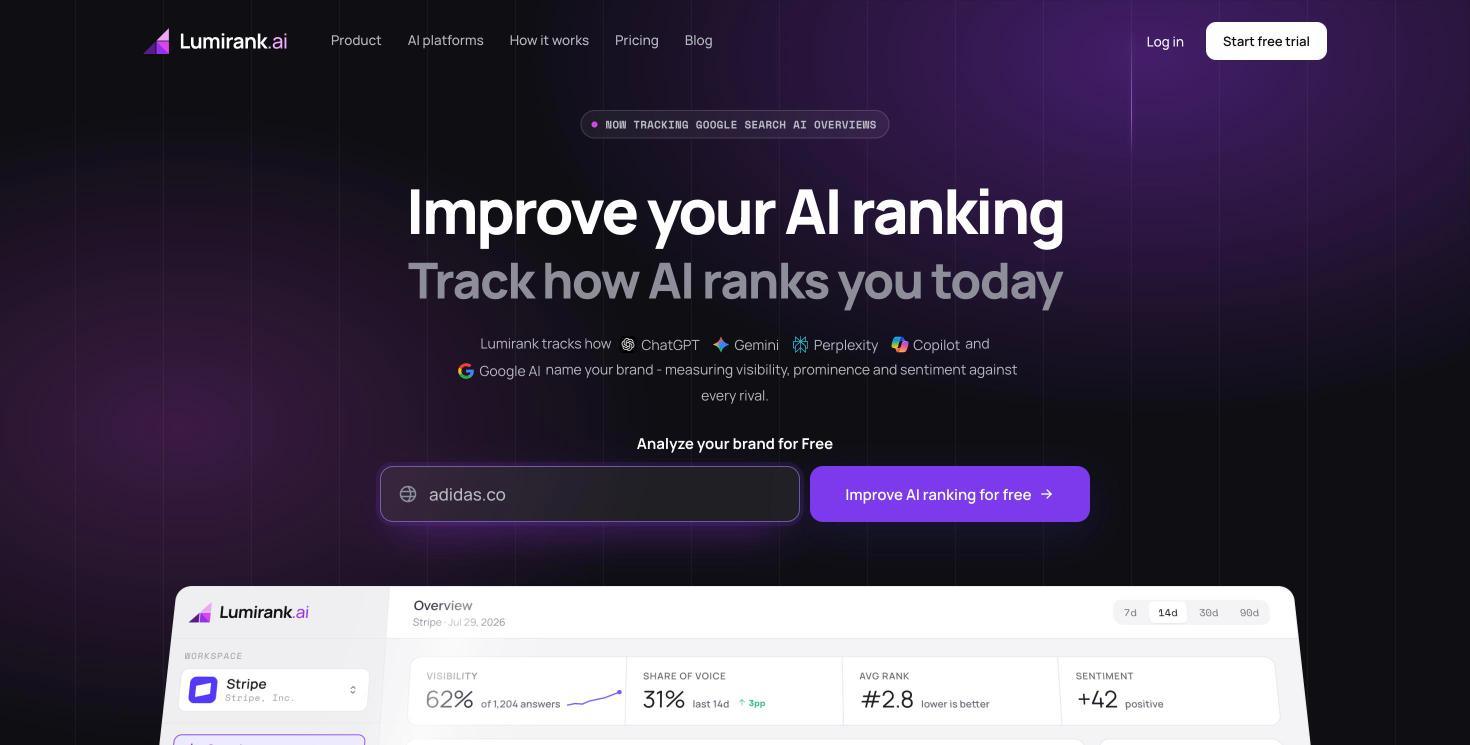
The platform measures several signals that are useful for SaaS companies. Visibility shows how frequently a brand is mentioned, while brand prominence measures where the brand appears in an AI-generated answer. Sentiment is reported on a -100 to +100 scale, and the platform also shows the sources and pages used by AI systems.
This is particularly useful for a SaaS founder asking questions such as: "What are the best alternatives to our product?" "Which tools are recommended for this use case?", or "What does AI say about our company compared with competitors?"
Lumirank also provides competitor tracking, movement alerts, multi-country monitoring, daily updates, and API access on paid plans. That makes it useful not only for marketers but also for developers who want to pull AI visibility and sentiment data into their own workflows.
Free plan available. Paid plans start at $29/month.
Best for: SaaS founders, marketers, SEO teams, agencies, and brands focused on AI search visibility and generative engine optimization.
Semrush is a strong choice for companies that do not want AI sentiment monitoring separated from their existing SEO and competitive research workflow.
Its AI visibility tools monitor how brands appear across ChatGPT, Gemini, Perplexity, Google AI, and other AI search experiences. The platform can track AI visibility, competitors, prompts, citations, and share of voice.
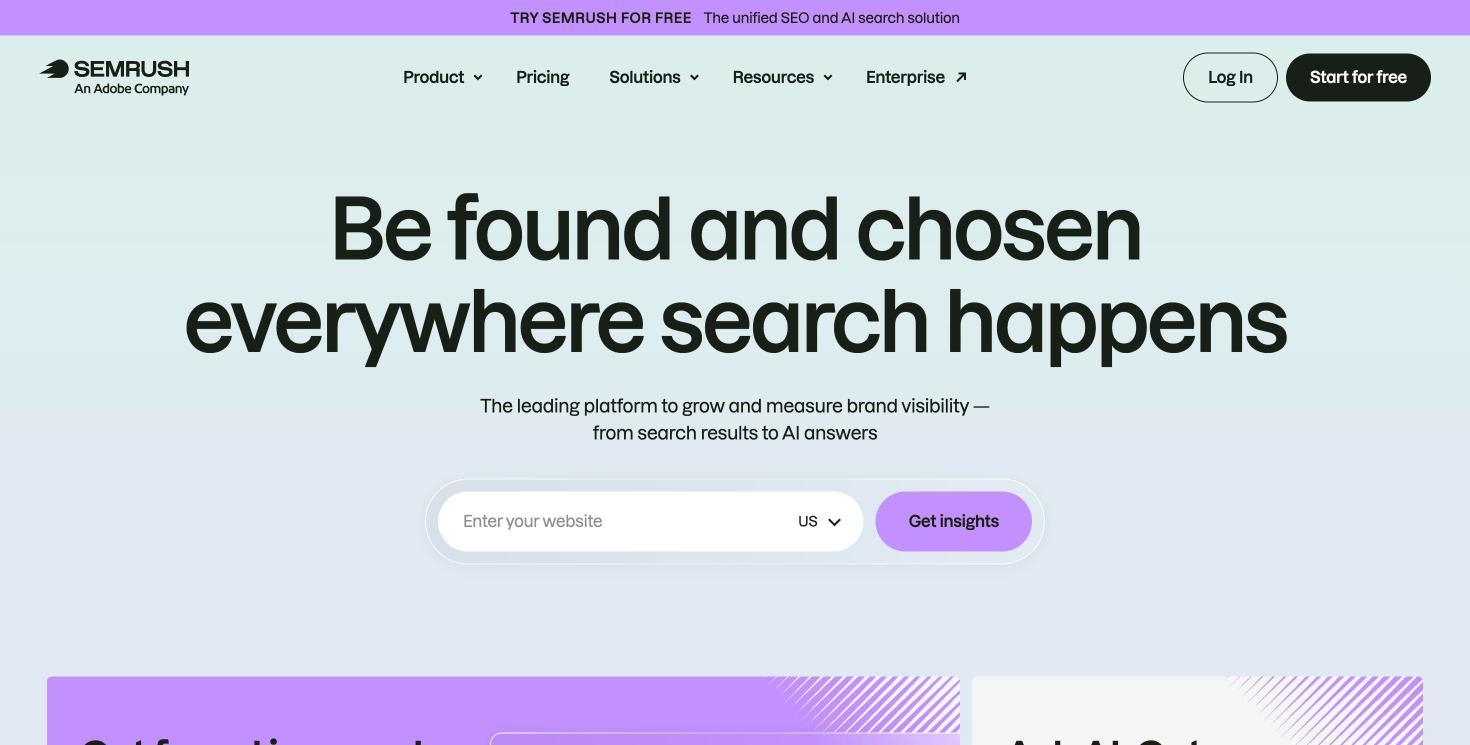
Its AI sentiment functionality goes one step further by showing how AI platforms describe a company, its products, and its positioning. This makes it possible to identify cases where a brand is being mentioned frequently but is being framed differently from how the company wants to be perceived.
For a SaaS marketing team, this creates an interesting connection between traditional SEO and AI search. A company can research which topics generate organic search demand, identify which prompts trigger competitor recommendations, and then monitor whether AI systems describe its brand positively.
Semrush is especially useful when the same marketing team already manages keyword research, technical SEO, competitor research, content optimization, and AI visibility. Instead of adding another standalone dashboard, the team can work from a broader search-marketing platform.
Free plan available. AI Visibility plans start at $99/month per domain when billed annually.
Best for: SaaS marketing teams, SEO professionals, agencies, content teams, and businesses combining Google SEO with AI search optimization.
Brandwatch is built for businesses that need to understand what people are saying about a brand across a very large amount of online conversation.
Its sentiment analysis separates conversations into positive, negative, and neutral categories and can help teams compare brand health, identify advocates and detractors, and understand topics surrounding a brand or competitor.
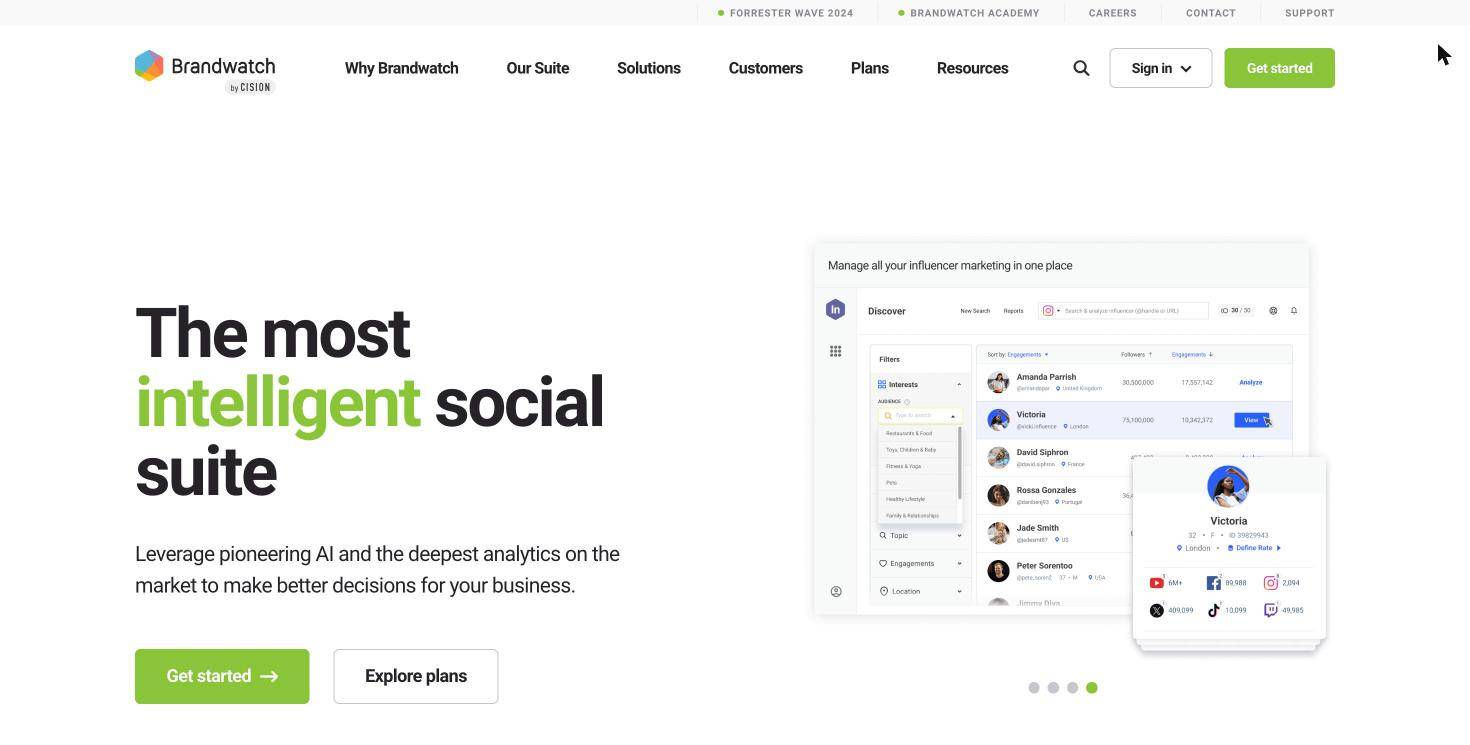
The scale is one of Brandwatch's biggest advantages. Its current Consumer Intelligence platform says it processes around half a billion posts from more than 100 million sources every day and provides access to social, news, and other consumer data.
This makes Brandwatch more appropriate for organizations that need broad market intelligence rather than simply checking sentiment around a few customer reviews.
For a product team, that data can reveal recurring complaints, emerging topics, competitor perception, and changes in public opinion. Marketing teams can use the same information to monitor campaigns and brand reputation.
Custom quote. Brandwatch does not publish a standard public subscription price for its enterprise Consumer Intelligence platform.
Best for: Enterprise brands, consumer companies, PR teams, market researchers, and organizations monitoring large volumes of public conversation.
Sprinklr combines social listening, customer feedback, analytics, and AI-powered insights in a broader customer-experience platform.
Its Insights platform can work with social channels, web sources, internal feedback, product data, and other customer information. Sentiment detection, emotion analysis, visual insights, competitive intelligence, and AI-powered conversation analysis are part of the platform.
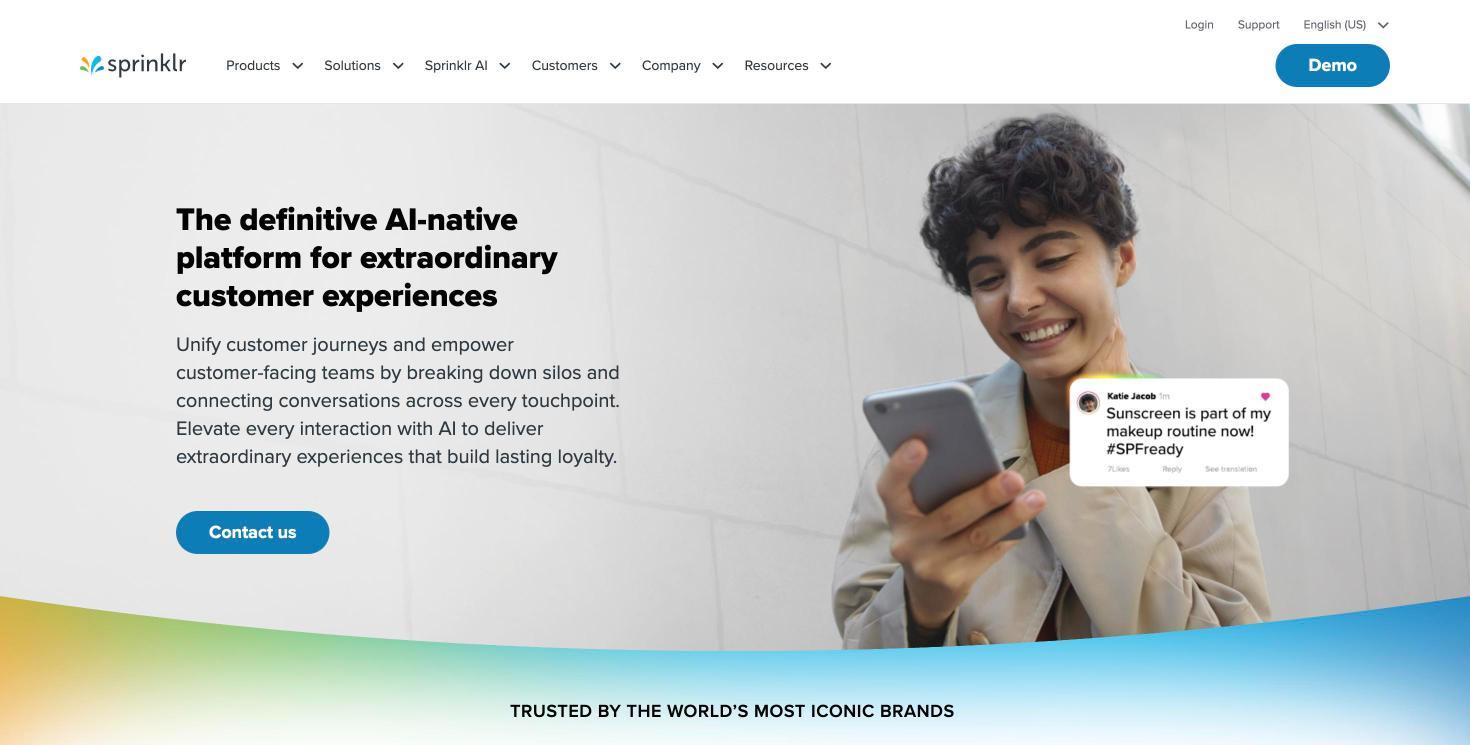
Sprinklr has also added LLM Insights for monitoring how brands are represented across AI platforms. Its LLM Insights supports ChatGPT, Gemini, Google AI Overview, Microsoft Copilot, and Perplexity and can track brand representation, perception, and the sources AI systems cite.
That combination is important for larger organizations because AI-search perception can be analyzed alongside traditional customer and social sentiment.
For example, a company might discover that social sentiment is positive while AI-generated answers repeatedly mention an outdated complaint. The two datasets tell different parts of the brand story and can help teams identify where the perception gap exists.
Custom enterprise quote. Sprinklr states that pricing depends on modules, users, channels, message volume, AI usage, and contract length.
Best for: Large companies managing social listening, customer experience, product feedback, and AI visibility across multiple departments.
Talkwalker is designed for organizations that need broad social and digital listening rather than sentiment analysis from a single data source.
Its current platform monitors 30+ social networks, 150 million websites, and 100 customer feedback sources across 239 countries and regions. It also supports visual listening, meaning brands can analyze mentions appearing in images, video, and audio rather than relying exclusively on written text.
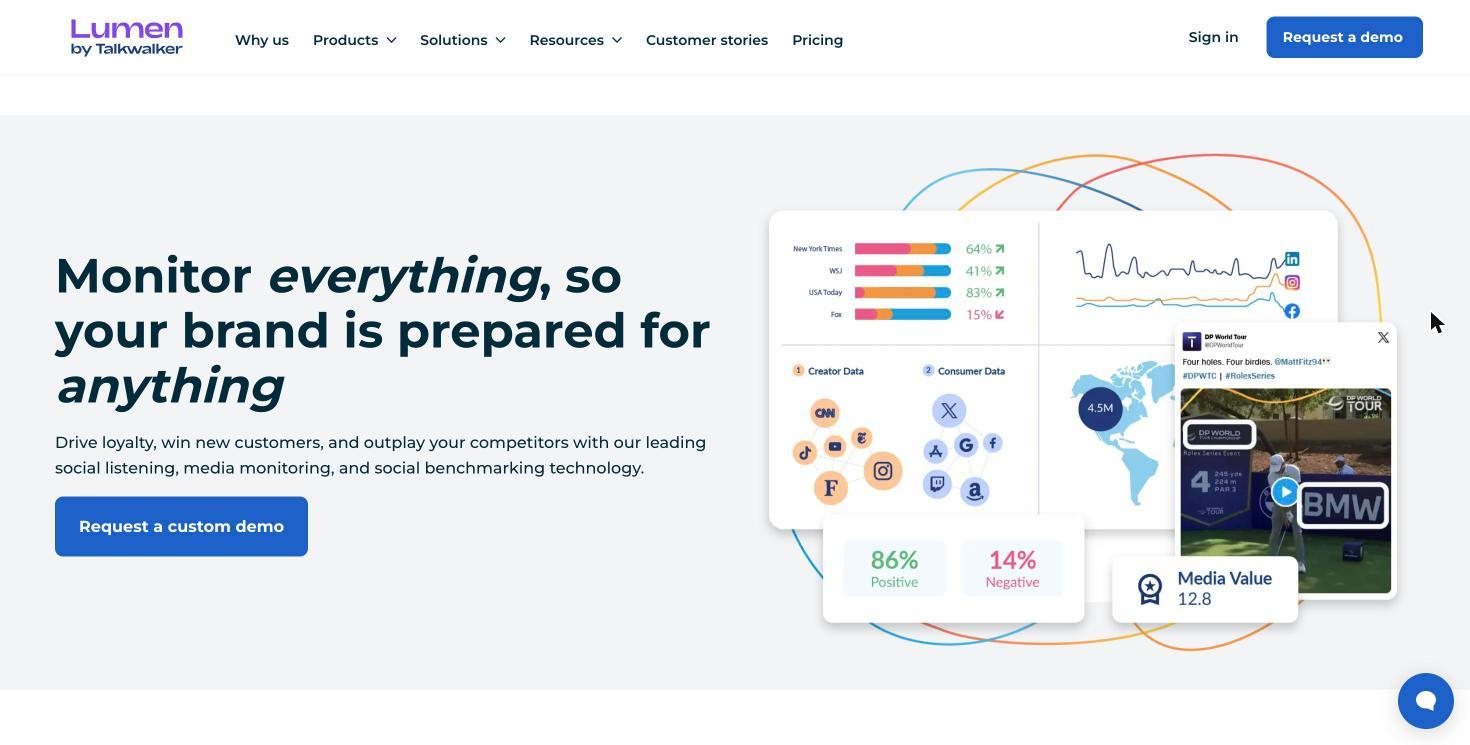
Sentiment analysis is connected to real-time alerts, conversation clusters, reputation monitoring, and audience feedback. This allows teams to detect changes in public opinion while a campaign, product launch, or potential crisis is developing.
Visual listening can be particularly useful for consumer brands because people may display or reference a product in an image without mentioning its brand name in the caption.
For marketing teams, Talkwalker can therefore answer broader questions than "Are people positive or negative?" It can help identify what people are talking about, where those conversations are happening, which topics are growing, and whether sentiment is changing.
Custom quote. Talkwalker's official site directs businesses toward a demo rather than publishing a standard public price.
Best for: Global brands, reputation teams, consumer companies, PR teams, and organizations monitoring large volumes of multimedia conversations.
Qualtrics XM Discover is focused heavily on understanding customer feedback and voice-of-customer data.
Its sentiment analysis works at sentence level and can classify feedback from very negative through very positive. The platform can use machine-learning sentiment as well as configurable rules and sentiment modifiers.
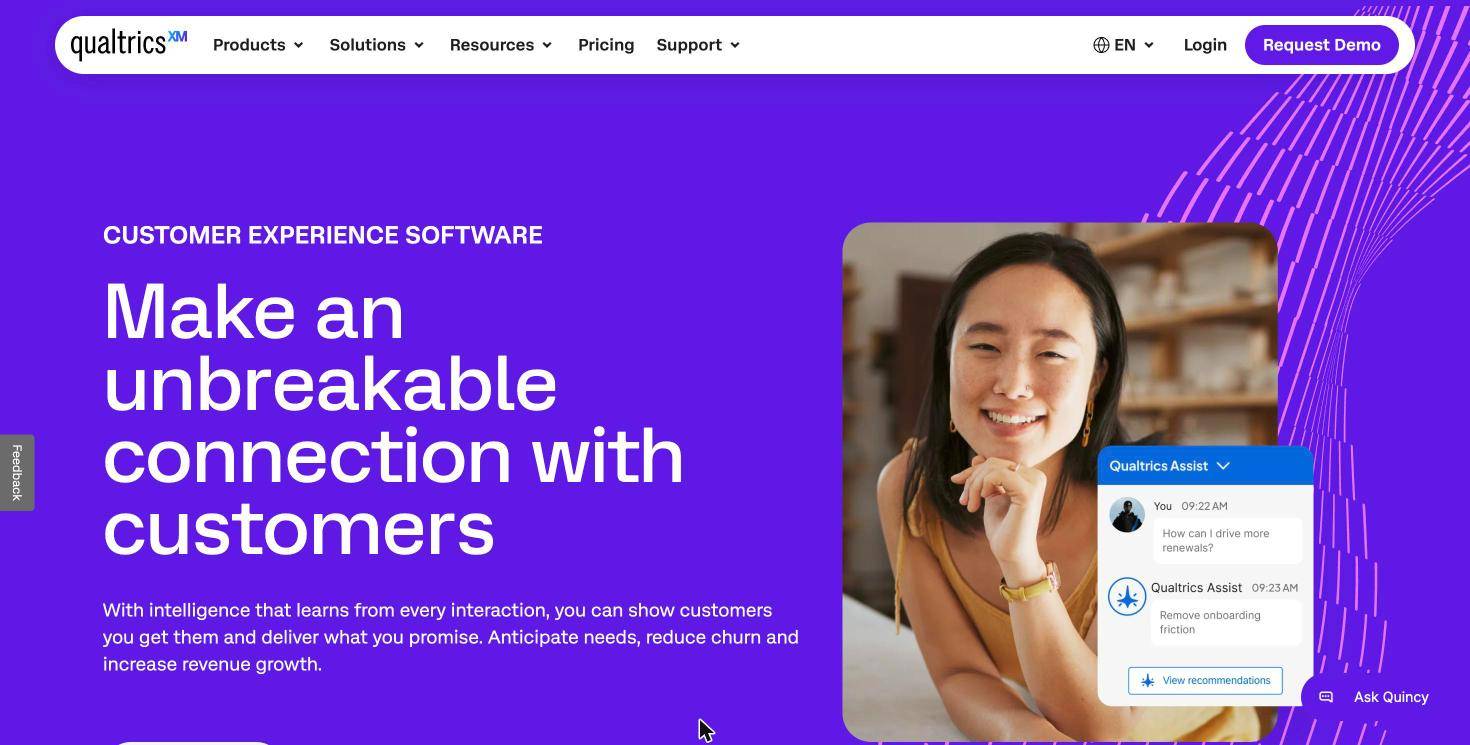
The important difference is the type of data it is designed to analyze. Qualtrics can work with feedback from websites, social media, contact centers, surveys, and other customer-data sources.
This makes it useful for product teams trying to move from raw feedback to structured product decisions. If thousands of customers complain about onboarding, pricing, documentation, or a particular feature, sentiment analysis can help identify where negative feedback is concentrated.
For larger organizations, sentiment can also be combined with other customer-experience measurements and dashboards, allowing product, customer support, and leadership teams to work from the same customer-feedback data.
Custom quote. Qualtrics does not publish a standard public price for XM Discover.
Best for: Enterprise customer-experience teams, product teams, contact centers, survey-heavy organizations, and voice-of-customer programs.
Yext Scout is particularly interesting for businesses that care about local AI search and brand discovery.
Scout brings together AI visibility, AI rankings, sentiment, citations, and competitor performance. It can analyze how a business appears in AI-generated answers across ChatGPT, Gemini, Google AI Overviews, Claude, and Perplexity.
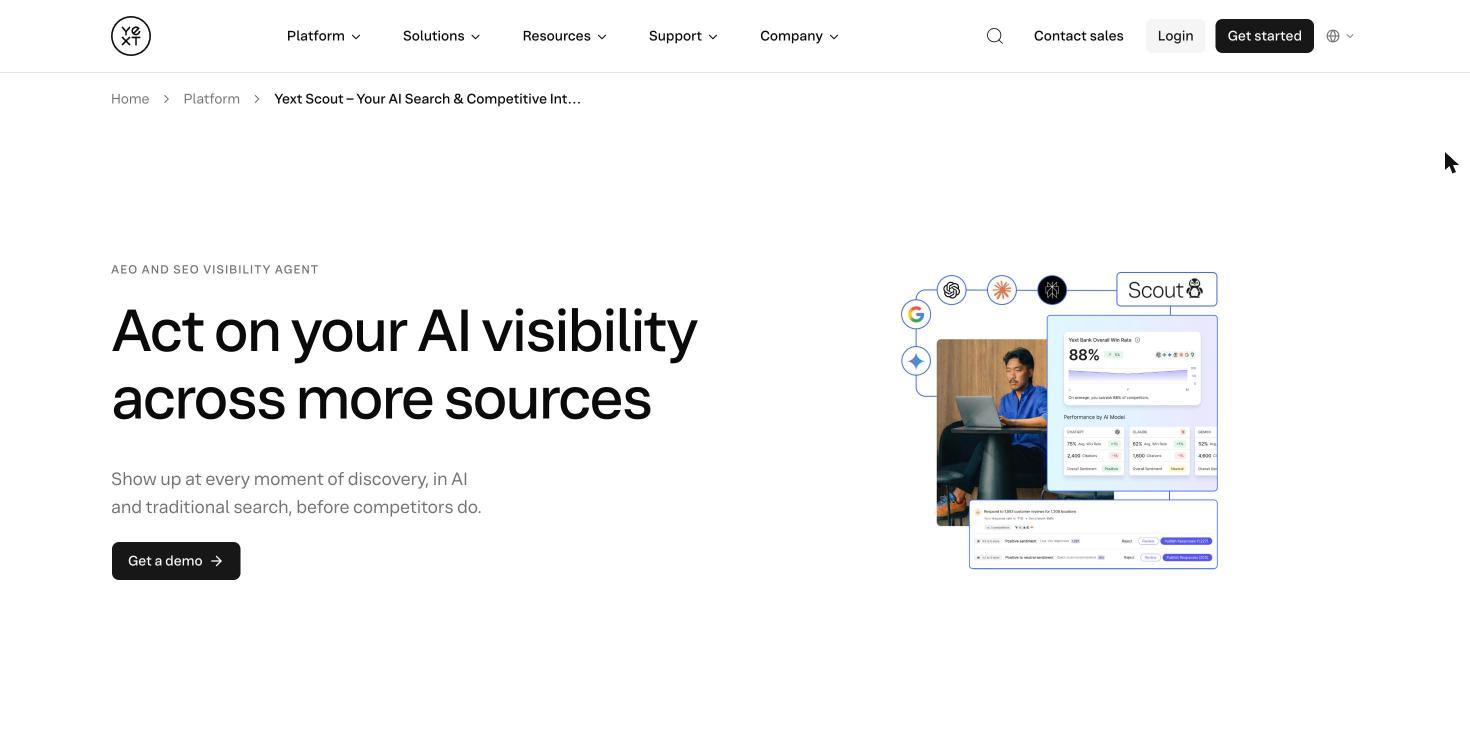
The sentiment section shows whether AI systems refer to a brand positively, neutrally, or negatively. It can also surface recurring themes that may explain why the AI-generated perception looks the way it does.
This becomes especially useful for businesses with multiple locations. A restaurant chain, healthcare company, retail business, hotel group, or local service provider may have a positive brand reputation overall but very different AI-generated perceptions from one location to another.
Yext can also connect visibility and sentiment data with citations. That means teams can investigate which websites, listings, reviews, social sources, and other content are influencing AI-generated answers.
Custom quote. Yext directs customers toward its sales and customer-success teams for Scout access and pricing.
Best for: Multi-location businesses, local brands, franchise networks, and companies managing both traditional and AI search visibility.
Google Cloud Natural Language is a different type of sentiment analysis tool.
Instead of buying a complete brand-monitoring platform, developers can use its API to build sentiment analysis directly into an application or internal workflow.
The API supports sentiment analysis, entity sentiment analysis, entity extraction, syntax analysis, content classification, and text moderation. Entity sentiment is particularly useful when a single piece of text discusses several products or companies and the developer needs to determine sentiment toward a specific entity.
For example, a SaaS company could process thousands of customer reviews and identify whether users are positive or negative about the product itself, the pricing, the support team, or a competitor.
The usage-based architecture also makes it suitable for developers who want to build custom dashboards instead of adopting an enterprise social-listening platform.
The main limitation is that Google Cloud Natural Language is an API, not a complete social listening or AI-search monitoring system. The engineering team needs to build the data collection, storage, dashboards, alerts, and business logic around it.
Free for the first 5,000 units per month, then sentiment analysis starts at $1 per 1,000-character unit.
Best for: Developers, SaaS teams, data engineers, and businesses building custom sentiment analysis pipelines.
Amazon Comprehend is another developer-focused option for teams that already operate heavily inside AWS.
It provides APIs for sentiment analysis, entity recognition, key phrase extraction, language detection, syntax analysis, custom classification, and other natural-language processing tasks.
For a SaaS product, this can be used to automatically classify customer feedback, support tickets, reviews, survey responses, chat messages, or other unstructured text.
The biggest advantage is flexibility. Rather than forcing a marketing team into a predefined dashboard, developers can integrate sentiment analysis into an existing AWS data pipeline and combine the results with databases, analytics systems, customer-support platforms, or internal applications.
Amazon Comprehend is therefore more appropriate for engineering teams than founders looking for a ready-made brand reputation dashboard.
Free tier available, followed by usage-based pricing calculated in 100-character units, with a 300-character minimum charge per request for the standard NLP APIs.
Best for: AWS developers, data teams, SaaS engineering teams, and companies building custom NLP workflows.
NICE Enlighten AI focuses on customer interactions rather than public social conversations.
Its AI sentiment analysis is embedded across NICE's customer-experience products and is designed to analyze customer interactions and identify satisfaction issues. NICE describes sentiment as a predictive indicator that can help organizations understand customer experience and improve operations.
This makes it particularly useful for contact centers where thousands of conversations are happening every day.
A support team could use sentiment analysis to identify conversations becoming increasingly negative, discover recurring service problems, and understand which parts of an interaction contribute to customer dissatisfaction.
For managers, this can also provide a way to evaluate customer-service performance at scale instead of manually reviewing a small sample of calls and conversations.
Custom quote. NICE does not publish a standard public price for enterprise Enlighten deployments.
Best for: Contact centers, customer-support organizations, enterprise CX teams, and companies analyzing large volumes of customer interactions.
Traditional sentiment analysis usually answers a relatively simple question:
Is this piece of text positive, negative, or neutral?
That remains useful. A SaaS company can analyze 50,000 reviews and determine whether customer sentiment is improving or declining.
But modern brand monitoring needs more context.
A company may have thousands of positive customer reviews but still be described negatively by AI search engines because older articles, comparison pages, forum discussions, or competitor content dominate the sources those systems retrieve.
That is why AI search sentiment monitoring is becoming a separate category.
Tools such as Lumirank measure sentiment directly inside AI-generated answers, while Semrush tracks how AI systems describe brands and products. Yext combines AI sentiment with local and traditional search performance.
The difference can be summarized simply:
Both are valuable, but they answer different questions.
For SaaS founders, sentiment analysis should not become another dashboard that gets checked once a month.
The useful question is what action the sentiment data enables.
If users repeatedly describe onboarding as confusing, product documentation and onboarding flows may need improvement.
If customers consistently praise one feature, that feature may deserve more attention in landing pages and marketing campaigns.
If negative sentiment increases after a pricing change, the company can investigate whether the issue is the price itself or poor communication around the change.
AI search monitoring adds another layer. A SaaS company can ask how AI platforms describe the product compared with competitors and whether the company is being recommended for the use cases it actually targets.
For example, an analytics SaaS might discover that ChatGPT frequently recommends it for small businesses but rarely for enterprise teams. That could reveal a positioning gap rather than a traditional SEO problem.
Not every company needs an enterprise platform.
A developer can build a basic sentiment pipeline using an API such as Google Cloud Natural Language or Amazon Comprehend.
A simple architecture could look like this:
Customer reviews → API → sentiment classification → database → dashboard → alerts → product or marketing action
The system can then add entity extraction to understand which feature or product a customer is discussing.
For example:
"The reporting dashboard is excellent, but the API documentation is confusing."
A basic positive/negative classifier may mark the entire review as mixed or positive. An entity-level system can separate the sentiment around the reporting dashboard from the sentiment around the API documentation.
That is much more useful for a product team.
A useful AI sentiment monitoring system should go beyond one overall sentiment percentage.
For a SaaS company, track:
The exact metrics depend on the business.
A B2B SaaS company may care more about product feedback and AI recommendations, while a retail company may care more about reviews, social conversations, local sentiment, and reputation.
The easiest way to choose is to start with where the sentiment data already exists.
If the biggest problem is understanding what ChatGPT and other AI search engines say about the company, start with Lumirank, Semrush, or Yext.
If the company needs large-scale social listening and consumer research, Brandwatch and Talkwalker are stronger candidates.
If customer feedback is spread across social media, surveys, service interactions, and internal systems, Sprinklr and Qualtrics provide broader customer-intelligence workflows.
If the requirement is to build a custom sentiment system, Google Cloud Natural Language and Amazon Comprehend are more appropriate because developers can integrate the APIs directly into their own applications.
For contact centers where the main source of sentiment is customer-agent interaction, NICE is a better fit than a pure social listening platform.
The right AI sentiment analysis tool depends on where your brand's reputation is being shaped. Lumirank and Semrush help track AI-driven brand perception, while Brandwatch, Sprinklr, and Talkwalker offer broader consumer intelligence. Qualtrics, Yext, NICE, and Google Cloud Natural Language address more specialized monitoring needs.
But tracking sentiment is only the starting point. In 2026, brands must understand not just what customers say, but also how AI platforms describe, compare, and recommend their products.
The real value of AI sentiment analysis comes from turning these insights into better product decisions, stronger customer experiences, and improved brand visibility across traditional search and AI-powered discovery.
| Amazon Comprehend | Sentiment, entities, key phrases, language detection, custom classification, AWS integration | Free tier; usage-based pricing | AWS developers and engineering teams | Free + Usage-based |
| NICE Enlighten AI | AI sentiment, customer interaction analysis, behavioral insights, CX optimization | Custom quote | Contact centers and enterprise CX teams | Paid |
