
Blogs in brand performance
stay updated with the latest news, insights, and guides on brand performance from ProductWatch.
Top AI Sentiment Analysis & Monitoring Tools for 2026
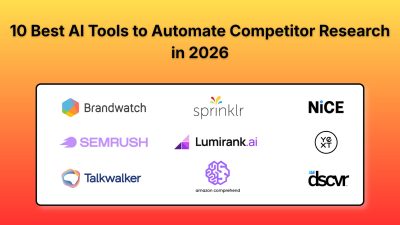
AI sentiment analysis has moved far beyond simply checking whether a customer review is positive or negative. In 2026, companies can monitor sentiment across social media, customer conversations, reviews, surveys, support tickets, and other text sources. A newer layer has also become important: AI search sentiment. When someone asks ChatGPT, Gemini, Perplexity, Google AI Overviews, or another AI search system about a company, the answer may describe the brand as affordable, reliable, difficult to use, expensive, beginner-friendly, enterprise-focused, or better than a competitor. That perception can influence buying decisions even when the customer never visits a traditional search result. > QUICK SUMMARY > > * Lumirank: Best for monitoring how ChatGPT, Gemini, Perplexity, Google AI Overviews, Google AI Mode, and Microsoft Copilot describe your brand, including AI visibility, competitor rankings, citations, and sentiment. > > * Semrush: Best for teams that want AI sentiment monitoring alongside SEO, AI visibility, competitor research, prompt tracking, and traditional search data in one platform. > > * Brandwatch: Best for enterprise brands that need large-scale social listening, consumer research, sentiment analysis, competitor comparison, and historical conversation data. > > * Sprinklr: Best for large organizations that want to combine social listening, customer feedback, sentiment, product insights, and AI-search monitoring across multiple teams. > > * Talkwalker: Best for global brands that need real-time social listening, sentiment tracking, visual listening, reputation monitoring, and large-scale digital coverage. For developers building their own sentiment workflows, APIs such as Google Cloud Natural Language and Amazon Comprehend offer programmable sentiment analysis instead of requiring a full consumer-intelligence platform AI SENTIMENT ANALYSIS TOOLS COMPARISON | Tool | Key features | Price | Best for | Free/Paid | | | | | | | | Lumirank | AI search sentiment, AI visibility, competitor ranking, citations, prompt tracking, multi-country monitoring, API | Free; paid from $29/month | SaaS founders, marketers, brands tracking AI search perception | Free + Paid | | Semrush | AI sentiment, AI visibility, competitor analysis, prompt research, SEO, AI search health, share of voice | Free; AI Visibility from $99/month/domain | SEO teams, SaaS marketers, agencies, founders | Free + Paid | | Brandwatch | Social listening, sentiment, consumer research, competitor analysis, historical data, dashboards | Custom quote | Enterprise brands and consumer intelligence teams | Paid | | Sprinklr | Social listening, sentiment, customer feedback, AI insights, LLM Insights, competitive intelligence | Custom quote | Large businesses with multiple customer-data channels | Paid | | Talkwalker | Social listening, sentiment, visual listening, alerts, conversation clusters, AI summaries | Custom quote | Global brands and reputation teams | Paid | | Qualtrics XM Discover | Text intelligence, sentiment, emotion, customer feedback, surveys, contact-center data | Custom quote | Voice-of-customer and CX teams | Paid | | Yext Scout | AI visibility, AI sentiment, AI rankings, citations, competitor comparison, local AI search | Custom quote | Multi-location brands and businesses managing local discovery | Paid | | Google Cloud Natural Language | Sentiment analysis API, entity sentiment, entity extraction, syntax analysis, content classification | Free up to 5,000 units/month, then from $1 per 1,000 characters | Developers building custom sentiment systems | Free + Usage-based | | Amazon Comprehend | Sentiment, entities, key phrases, language detection, custom classification, AWS integration | Free tier; usage-based pricing | AWS developers and engineering teams | Free + Usage-based | | NICE Enlighten AI | AI sentiment, customer interaction analysis, behavioral insights, CX optimization | Custom quote | Contact centers and enterprise CX teams | Paid | 1. LUMIRANK Lumirank is one of the strongest options for a newer category of sentiment monitoring: how AI search engines perceive and describe a brand. Instead of analyzing only customer reviews or social posts, Lumirank sends tracked prompts to major AI platforms and measures how brands appear in the resulting answers. Its current platform tracks ChatGPT, Google AI Mode, Gemini, Perplexity, Microsoft Copilot, and Google AI Overviews. The platform measures several signals that are useful for SaaS companies. Visibility shows how frequently a brand is mentioned, while brand prominence measures where the brand appears in an AI-generated answer. Sentiment is reported on a -100 to +100 scale, and the platform also shows the sources and pages used by AI systems. This is particularly useful for a SaaS founder asking questions such as: "What are the best alternatives to our product?" "Which tools are recommended for this use case?", or "What does AI say about our company compared with competitors?" Lumirank also provides competitor tracking, movement alerts, multi-country monitoring, daily updates, and API access on paid plans. That makes it useful not only for marketers but also for developers who want to pull AI visibility and sentiment data into their own workflows. PRICING Free plan available. Paid plans start at $29/month. Best for: SaaS founders, marketers, SEO teams, agencies, and brands focused on AI search visibility and generative engine optimization. 2. SEMRUSH Semrush is a strong choice for companies that do not want AI sentiment monitoring separated from their existing SEO and competitive research workflow. Its AI visibility tools monitor how brands appear across ChatGPT, Gemini, Perplexity, Google AI, and other AI search experiences. The platform can track AI visibility, competitors, prompts, citations, and share of voice. Its AI sentiment functionality goes one step further by showing how AI platforms describe a company, its products, and its positioning. This makes it possible to identify cases where a brand is being mentioned frequently but is being framed differently from how the company wants to be perceived. For a SaaS marketing team, this creates an interesting connection between traditional SEO and AI search. A company can research which topics generate organic search demand, identify which prompts trigger competitor recommendations, and then monitor whether AI systems describe its brand positively. Semrush is especially useful when the same marketing team already manages keyword research, technical SEO, competitor research, content optimization, and AI visibility. Instead of adding another standalone dashboard, the team can work from a broader search-marketing platform. PRICING Free plan available. AI Visibility plans start at $99/month per domain when billed annually. Best for: SaaS marketing teams, SEO professionals, agencies, content teams, and businesses combining Google SEO with AI search optimization. 3. BRANDWATCH Brandwatch is built for businesses that need to understand what people are saying about a brand across a very large amount of online conversation. Its sentiment analysis separates conversations into positive, negative, and neutral categories and can help teams compare brand health, identify advocates and detractors, and understand topics surrounding a brand or competitor. The scale is one of Brandwatch's biggest advantages. Its current Consumer Intelligence platform says it processes around half a billion posts from more than 100 million sources every day and provides access to social, news, and other consumer data. This makes Brandwatch more appropriate for organizations that need broad market intelligence rather than simply checking sentiment around a few customer reviews. For a product team, that data can reveal recurring complaints, emerging topics, competitor perception, and changes in public opinion. Marketing teams can use the same information to monitor campaigns and brand reputation. PRICING Custom quote. Brandwatch does not publish a standard public subscription price for its enterprise Consumer Intelligence platform. Best for: Enterprise brands, consumer companies, PR teams, market researchers, and organizations monitoring large volumes of public conversation. 4. SPRINKLR Sprinklr combines social listening, customer feedback, analytics, and AI-powered insights in a broader customer-experience platform. Its Insights platform can work with social channels, web sources, internal feedback, product data, and other customer information. Sentiment detection, emotion analysis, visual insights, competitive intelligence, and AI-powered conversation analysis are part of the platform. Sprinklr has also added LLM Insights for monitoring how brands are represented across AI platforms. Its LLM Insights supports ChatGPT, Gemini, Google AI Overview, Microsoft Copilot, and Perplexity and can track brand representation, perception, and the sources AI systems cite. That combination is important for larger organizations because AI-search perception can be analyzed alongside traditional customer and social sentiment. For example, a company might discover that social sentiment is positive while AI-generated answers repeatedly mention an outdated complaint. The two datasets tell different parts of the brand story and can help teams identify where the perception gap exists. PRICING Custom enterprise quote. Sprinklr states that pricing depends on modules, users, channels, message volume, AI usage, and contract length. Best for: Large companies managing social listening, customer experience, product feedback, and AI visibility across multiple departments. 5. TALKWALKER Talkwalker is designed for organizations that need broad social and digital listening rather than sentiment analysis from a single data source. Its current platform monitors 30+ social networks, 150 million websites, and 100 customer feedback sources across 239 countries and regions. It also supports visual listening, meaning brands can analyze mentions appearing in images, video, and audio rather than relying exclusively on written text. Sentiment analysis is connected to real-time alerts, conversation clusters, reputation monitoring, and audience feedback. This allows teams to detect changes in public opinion while a campaign, product launch, or potential crisis is developing. Visual listening can be particularly useful for consumer brands because people may display or reference a product in an image without mentioning its brand name in the caption. For marketing teams, Talkwalker can therefore answer broader questions than "Are people positive or negative?" It can help identify what people are talking about, where those conversations are happening, which topics are growing, and whether sentiment is changing. PRICING Custom quote. Talkwalker's official site directs businesses toward a demo rather than publishing a standard public price. Best for: Global brands, reputation teams, consumer companies, PR teams, and organizations monitoring large volumes of multimedia conversations. 6. QUALTRICS XM DISCOVER Qualtrics XM Discover is focused heavily on understanding customer feedback and voice-of-customer data. Its sentiment analysis works at sentence level and can classify feedback from very negative through very positive. The platform can use machine-learning sentiment as well as configurable rules and sentiment modifiers. The important difference is the type of data it is designed to analyze. Qualtrics can work with feedback from websites, social media, contact centers, surveys, and other customer-data sources. This makes it useful for product teams trying to move from raw feedback to structured product decisions. If thousands of customers complain about onboarding, pricing, documentation, or a particular feature, sentiment analysis can help identify where negative feedback is concentrated. For larger organizations, sentiment can also be combined with other customer-experience measurements and dashboards, allowing product, customer support, and leadership teams to work from the same customer-feedback data. PRICING Custom quote. Qualtrics does not publish a standard public price for XM Discover. Best for: Enterprise customer-experience teams, product teams, contact centers, survey-heavy organizations, and voice-of-customer programs. 7. YEXT SCOUT Yext Scout is particularly interesting for businesses that care about local AI search and brand discovery. Scout brings together AI visibility, AI rankings, sentiment, citations, and competitor performance. It can analyze how a business appears in AI-generated answers across ChatGPT, Gemini, Google AI Overviews, Claude, and Perplexity. The sentiment section shows whether AI systems refer to a brand positively, neutrally, or negatively. It can also surface recurring themes that may explain why the AI-generated perception looks the way it does. This becomes especially useful for businesses with multiple locations. A restaurant chain, healthcare company, retail business, hotel group, or local service provider may have a positive brand reputation overall but very different AI-generated perceptions from one location to another. Yext can also connect visibility and sentiment data with citations. That means teams can investigate which websites, listings, reviews, social sources, and other content are influencing AI-generated answers. PRICING Custom quote. Yext directs customers toward its sales and customer-success teams for Scout access and pricing. Best for: Multi-location businesses, local brands, franchise networks, and companies managing both traditional and AI search visibility. 8. GOOGLE CLOUD NATURAL LANGUAGE Google Cloud Natural Language is a different type of sentiment analysis tool. Instead of buying a complete brand-monitoring platform, developers can use its API to build sentiment analysis directly into an application or internal workflow. The API supports sentiment analysis, entity sentiment analysis, entity extraction, syntax analysis, content classification, and text moderation. Entity sentiment is particularly useful when a single piece of text discusses several products or companies and the developer needs to determine sentiment toward a specific entity. For example, a SaaS company could process thousands of customer reviews and identify whether users are positive or negative about the product itself, the pricing, the support team, or a competitor. The usage-based architecture also makes it suitable for developers who want to build custom dashboards instead of adopting an enterprise social-listening platform. The main limitation is that Google Cloud Natural Language is an API, not a complete social listening or AI-search monitoring system. The engineering team needs to build the data collection, storage, dashboards, alerts, and business logic around it. PRICING Free for the first 5,000 units per month, then sentiment analysis starts at $1 per 1,000-character unit. Best for: Developers, SaaS teams, data engineers, and businesses building custom sentiment analysis pipelines. 9. AMAZON COMPREHEND Amazon Comprehend is another developer-focused option for teams that already operate heavily inside AWS. It provides APIs for sentiment analysis, entity recognition, key phrase extraction, language detection, syntax analysis, custom classification, and other natural-language processing tasks. For a SaaS product, this can be used to automatically classify customer feedback, support tickets, reviews, survey responses, chat messages, or other unstructured text. The biggest advantage is flexibility. Rather than forcing a marketing team into a predefined dashboard, developers can integrate sentiment analysis into an existing AWS data pipeline and combine the results with databases, analytics systems, customer-support platforms, or internal applications. Amazon Comprehend is therefore more appropriate for engineering teams than founders looking for a ready-made brand reputation dashboard. PRICING Free tier available, followed by usage-based pricing calculated in 100-character units, with a 300-character minimum charge per request for the standard NLP APIs. Best for: AWS developers, data teams, SaaS engineering teams, and companies building custom NLP workflows. 10. NICE ENLIGHTEN AI NICE Enlighten AI focuses on customer interactions rather than public social conversations. Its AI sentiment analysis is embedded across NICE's customer-experience products and is designed to analyze customer interactions and identify satisfaction issues. NICE describes sentiment as a predictive indicator that can help organizations understand customer experience and improve operations. This makes it particularly useful for contact centers where thousands of conversations are happening every day. A support team could use sentiment analysis to identify conversations becoming increasingly negative, discover recurring service problems, and understand which parts of an interaction contribute to customer dissatisfaction. For managers, this can also provide a way to evaluate customer-service performance at scale instead of manually reviewing a small sample of calls and conversations. PRICING Custom quote. NICE does not publish a standard public price for enterprise Enlighten deployments. Best for: Contact centers, customer-support organizations, enterprise CX teams, and companies analyzing large volumes of customer interactions. AI SENTIMENT ANALYSIS VS TRADITIONAL SENTIMENT ANALYSIS Traditional sentiment analysis usually answers a relatively simple question: Is this piece of text positive, negative, or neutral? That remains useful. A SaaS company can analyze 50,000 reviews and determine whether customer sentiment is improving or declining. But modern brand monitoring needs more context. A company may have thousands of positive customer reviews but still be described negatively by AI search engines because older articles, comparison pages, forum discussions, or competitor content dominate the sources those systems retrieve. That is why AI search sentiment monitoring is becoming a separate category. Tools such as Lumirank measure sentiment directly inside AI-generated answers, while Semrush tracks how AI systems describe brands and products. Yext combines AI sentiment with local and traditional search performance. The difference can be summarized simply: | Traditional sentiment monitoring | AI search sentiment monitoring | | | | | Reviews | AI-generated answers | | Social posts | ChatGPT responses | | Customer tickets | Gemini responses | | Surveys | Perplexity responses | | Calls and chats | Google AI Overviews | | Public conversations | AI recommendations | | Customer emotion | AI-generated brand perception | Both are valuable, but they answer different questions. HOW AI SENTIMENT ANALYSIS HELPS SAAS COMPANIES For SaaS founders, sentiment analysis should not become another dashboard that gets checked once a month. The useful question is what action the sentiment data enables. If users repeatedly describe onboarding as confusing, product documentation and onboarding flows may need improvement. If customers consistently praise one feature, that feature may deserve more attention in landing pages and marketing campaigns. If negative sentiment increases after a pricing change, the company can investigate whether the issue is the price itself or poor communication around the change. AI search monitoring adds another layer. A SaaS company can ask how AI platforms describe the product compared with competitors and whether the company is being recommended for the use cases it actually targets. For example, an analytics SaaS might discover that ChatGPT frequently recommends it for small businesses but rarely for enterprise teams. That could reveal a positioning gap rather than a traditional SEO problem. HOW DEVELOPERS CAN BUILD A SENTIMENT MONITORING SYSTEM Not every company needs an enterprise platform. A developer can build a basic sentiment pipeline using an API such as Google Cloud Natural Language or Amazon Comprehend. A simple architecture could look like this: Customer reviews → API → sentiment classification → database → dashboard → alerts → product or marketing action The system can then add entity extraction to understand which feature or product a customer is discussing. For example: > "The reporting dashboard is excellent, but the API documentation is confusing." A basic positive/negative classifier may mark the entire review as mixed or positive. An entity-level system can separate the sentiment around the reporting dashboard from the sentiment around the API documentation. That is much more useful for a product team. WHAT SHOULD YOU TRACK? A useful AI sentiment monitoring system should go beyond one overall sentiment percentage. For a SaaS company, track: * Positive, neutral, and negative sentiment * Sentiment by product or feature * Sentiment by customer segment * Sentiment over time * Competitor sentiment * Recurring complaints * Recurring positive themes * Customer effort or frustration * AI-generated brand sentiment * AI visibility and share of voice * AI citations and source domains * Sentiment by AI platform * Sentiment by country or market The exact metrics depend on the business. A B2B SaaS company may care more about product feedback and AI recommendations, while a retail company may care more about reviews, social conversations, local sentiment, and reputation. HOW TO CHOOSE THE RIGHT AI SENTIMENT ANALYSIS TOOL The easiest way to choose is to start with where the sentiment data already exists. If the biggest problem is understanding what ChatGPT and other AI search engines say about the company, start with Lumirank, Semrush, or Yext. If the company needs large-scale social listening and consumer research, Brandwatch and Talkwalker are stronger candidates. If customer feedback is spread across social media, surveys, service interactions, and internal systems, Sprinklr and Qualtrics provide broader customer-intelligence workflows. If the requirement is to build a custom sentiment system, Google Cloud Natural Language and Amazon Comprehend are more appropriate because developers can integrate the APIs directly into their own applications. For contact centers where the main source of sentiment is customer-agent interaction, NICE is a better fit than a pure social listening platform. CONCLUSION The right AI sentiment analysis tool depends on where your brand's reputation is being shaped. Lumirank and Semrush help track AI-driven brand perception, while Brandwatch, Sprinklr, and Talkwalker offer broader consumer intelligence. Qualtrics, Yext, NICE, and Google Cloud Natural Language address more specialized monitoring needs. But tracking sentiment is only the starting point. In 2026, brands must understand not just what customers say, but also how AI platforms describe, compare, and recommend their products. The real value of AI sentiment analysis comes from turning these insights into better product decisions, stronger customer experiences, and improved brand visibility across traditional search and AI-powered discovery.
How to Track Brand Performance With AI Sentiment Analysis
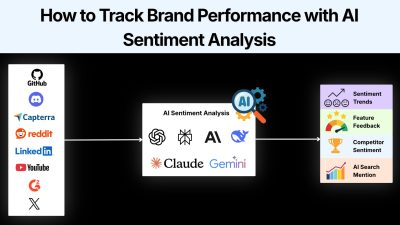
A SaaS company can get thousands of visits, new followers, and product signups while still having a brand perception problem. Customers may love the product but dislike its pricing. Developers may value the API but struggle with its documentation. Users may recommend it for small teams but avoid it for enterprise use. Traditional metrics rarely explain these differences. AI sentiment analysis fills that gap. It analyzes reviews, social media, support conversations, community discussions, and online mentions to reveal how people actually feel about a brand. It can also show how AI search platforms like ChatGPT, Gemini, and Perplexity describe a product in recommendations and comparisons. For SaaS teams, this turns scattered customer opinions into useful insights, helping identify product strengths, recurring complaints, competitor perception, and issues that could influence buying decisions. > QUICK SUMMARY > > * AI sentiment analysis identifies positive, negative, and neutral opinions about a brand across digital channels. > * It helps SaaS companies discover product issues that website analytics cannot explain. > * Sentiment trends reveal how customers respond to product launches, pricing changes, updates, and marketing campaigns. > * Aspect-based analysis identifies exactly which features, services, or product experiences customers appreciate or criticize. > * Competitor sentiment analysis helps businesses understand why customers prefer alternative products. > * AI search sentiment tracking reveals how platforms such as ChatGPT and Perplexity describe a brand. > * Sentiment data becomes more useful when combined with customer retention, conversion rates, reviews, and support metrics. WHAT IS AI SENTIMENT ANALYSIS? AI sentiment analysis is the process of using artificial intelligence, machine learning, and natural language processing (NLP) to identify opinions and emotional tone in written or spoken communication. It examines language to determine whether a person expresses a positive, negative, or neutral opinion about a particular subject. For example, consider three comments about a project management SaaS: Positive: "The interface is easy to understand, and the task automation saves our team several hours every week." Negative: "The pricing becomes too expensive when additional team members join." Neutral: "The platform supports task management, project tracking, and team collaboration." An AI sentiment analysis system can classify these comments and identify what each person is discussing. However, useful sentiment analysis goes beyond identifying positive or negative language. It can also recognize which product feature caused a particular reaction, identify recurring complaints, group similar customer opinions, and track changes in brand perception over time. For example, if hundreds of customers mention slow loading times, an analysis system can connect those comments to website performance rather than treating them as unrelated negative reviews. This distinction matters because a company needs to know what is affecting customer satisfaction before deciding what to improve. TRADITIONAL SENTIMENT ANALYSIS VS. AI BRAND SENTIMENT ANALYSIS The term AI sentiment analysis can describe two related but different activities. Traditional sentiment analysis uses AI to understand what people say about a brand. AI brand sentiment analysis can also examine how generative AI platforms describe that brand in their answers. Both perspectives matter, particularly for SaaS companies that depend on online discovery. | Area | Customer sentiment analysis | AI brand sentiment analysis | | | | | | Main focus | What customers say about a brand | How AI platforms describe a brand | | Data sources | Reviews, social media, forums, support tickets | ChatGPT, Gemini, Perplexity, AI search answers | | Main objective | Understand customer opinions | Understand AI-generated brand perception | | Useful insight | Product complaints and customer satisfaction | Brand positioning, inaccurate claims, recommendation gaps | | Business action | Improve product and customer experience | Improve brand information and online representation | For example, a customer might write that a particular SaaS product has excellent automation but poor customer support. Customer sentiment analysis identifies this feedback. A potential buyer might then ask ChatGPT to recommend automation tools. If ChatGPT describes that same product as difficult to use or unsuitable for growing teams, AI brand sentiment analysis helps identify how the platform is being positioned in AI-generated recommendations. These two perspectives should not be treated as interchangeable. Customer opinions and AI-generated descriptions are different data sources. Tracking both gives a business a more complete view of its reputation. WHY AI SENTIMENT ANALYSIS MATTERS FOR BRAND PERFORMANCE Brand performance is often measured through revenue, traffic, customer acquisition, engagement, and retention. These metrics explain what is happening, but they do not always explain why. Sentiment analysis adds customer perception to that measurement process. 1. UNDERSTAND WHAT CUSTOMERS ACTUALLY THINK ABOUT YOUR PRODUCT Customer feedback contains information that standard analytics cannot capture. A product dashboard might show that users spend an average of 20 minutes inside an application. However, it cannot tell whether users enjoy the experience, struggle with navigation, or spend that time trying to find a particular feature. AI sentiment analysis can examine reviews, feedback forms, support conversations, and public discussions to identify these opinions. Consider a developer-focused SaaS platform receiving the following feedback: * "API integration was straightforward." * "Documentation is missing examples for advanced use cases." * "Webhook delivery is reliable." * "The dashboard is difficult to navigate." Instead of treating these as four unrelated comments, an AI system can categorize them into API usability, documentation quality, reliability, and user interface experience. This gives product teams a clearer understanding of what customers appreciate and where development resources should be allocated. For founders, this is particularly useful when deciding whether to prioritize a new feature or fix an existing product issue. 2. IDENTIFY PRODUCT PROBLEMS BEFORE THEY AFFECT CUSTOMER RETENTION A declining retention rate does not always explain why customers are leaving. Users might cancel subscriptions because of pricing, missing integrations, technical errors, poor onboarding, or a feature that does not meet their expectations. AI sentiment analysis can identify repeated complaints across customer conversations and connect them to specific product experiences. For example, imagine a SaaS company notices an increase in negative comments about its onboarding process. Customers repeatedly mention: * Confusing account configuration. * Missing setup instructions. * Difficult third-party integrations. * Slow responses from customer support. These comments suggest that the problem might not be the core product. It could be the experience customers have before reaching its main features. The product team can investigate onboarding completion rates, improve setup documentation, introduce guided tutorials, and simplify integration steps. This approach helps businesses address customer dissatisfaction before it becomes a larger retention problem. 3. MEASURE BRAND REPUTATION ACROSS MULTIPLE CHANNELS Customers do not discuss products on a single platform. A SaaS brand might receive reviews on G2 and Capterra, technical discussions on Reddit, product feedback on GitHub, and customer complaints on X or LinkedIn. Checking each platform manually becomes difficult as brand mentions increase. AI sentiment analysis can collect and categorize feedback from supported sources, making it easier to identify recurring opinions. For example, a developer tool might receive positive reviews on software directories but repeated complaints about API limitations on developer forums. Looking at only one source could produce an incomplete picture of brand reputation. Cross-channel analysis helps businesses understand whether customer perception is consistent across different communities. It also helps identify where a company needs to improve its communication, documentation, support, or product experience. 4. UNDERSTAND WHICH PRODUCT FEATURES INFLUENCE CUSTOMER SATISFACTION A general sentiment score does not explain which parts of a product create positive or negative experiences. Aspect-based sentiment analysis addresses this problem by connecting opinions to specific product attributes. For example, a review might say: "The interface is clean, the reporting features are useful, but the monthly pricing is too high for a small agency." A basic sentiment system might classify this review as mixed or neutral. An aspect-based system can separate it into three findings: | Product aspect | Sentiment | Interpretation | | | | | | User interface | Positive | Customers appreciate the interface | | Reporting | Positive | Reporting features meet expectations | | Pricing | Negative | Cost creates purchasing resistance | This level of detail is useful for SaaS companies because different teams can act on different findings. Product designers can examine interface feedback. Developers can investigate feature-related complaints. Marketing teams can review how pricing is communicated. Rather than making decisions from a single overall score, teams can identify the exact product attributes influencing customer perception. 5. TRACK COMPETITOR SENTIMENT AND MARKET POSITION Brand performance is also relative to competitors. A company might have positive customer feedback but still lose potential customers because competing products offer better integrations, lower pricing, or more suitable features. AI sentiment analysis can examine public reviews and discussions about competing products to identify common strengths and weaknesses. For example, a project management platform might discover that: * Competitor A receives positive feedback for automation. * Competitor B is appreciated for its affordable pricing. * Competitor C is frequently recommended for enterprise collaboration. * Its own product receives positive feedback for ease of use but negative feedback about integrations. These findings help a company understand how customers compare products when making purchasing decisions. They can also inform product positioning. If competitors are known for advanced automation, a SaaS company might focus on its simpler setup process or better experience for smaller teams. The goal is not to copy competitor features. It is to understand what customers value and identify where a product can offer a better fit. 6. EVALUATE MARKETING CAMPAIGNS BEYOND CLICKS AND IMPRESSIONS A campaign can generate substantial engagement without improving brand perception. For example, a new product announcement might receive thousands of impressions and hundreds of comments. However, those comments could reveal confusion about the product's pricing, target audience, or actual functionality. AI sentiment analysis helps marketing teams understand the reactions behind campaign engagement. By comparing sentiment before, during, and after a campaign, marketers can identify whether a message attracted positive interest or created misunderstandings. This is useful when evaluating: * Product launch announcements. * Feature release campaigns. * Pricing announcements. * Influencer collaborations. * Brand repositioning campaigns. * Customer testimonial campaigns. Suppose a developer tool launches a new AI feature. Social engagement increases, but users repeatedly ask whether the feature is included in the free plan. That feedback suggests the campaign generated interest but did not communicate pricing clearly. The marketing team can update the announcement, landing page, and pricing documentation to answer the question directly. 7. DETECT BRAND REPUTATION PROBLEMS EARLIER A reputation problem can begin with a small number of customer complaints. A payment failure, security concern, service outage, or unexpected pricing change can quickly generate negative discussions across multiple platforms. AI sentiment analysis can monitor changes in negative mentions and highlight unusual increases. For example, a SaaS company might normally receive a small number of negative comments about customer support. After a major update, complaints about failed integrations suddenly increase. A sentiment monitoring system can identify this change and notify the relevant team. The company can then investigate the release, check support tickets, and communicate with affected customers. However, sentiment alerts should not automatically be treated as proof of a crisis. A sudden increase in negative mentions needs human verification, particularly when technical incidents or public discussions are involved. IMPORTANT SENTIMENT ANALYSIS METRICS EVERY BRAND SHOULD TRACK A sentiment dashboard becomes useful when its measurements connect to actual business questions. A single sentiment percentage is not enough. Companies should monitor multiple metrics to understand the volume, direction, and causes of customer opinions. | Metric | What it measures | Why it matters | | | | | | Positive mentions | Number of favorable brand discussions | Measures positive customer perception | | Negative mentions | Number of unfavorable discussions | Helps identify customer dissatisfaction | | Neutral mentions | Mentions without clear positive or negative sentiment | Shows general brand discussion volume | | Net sentiment score | Difference between positive and negative mentions relative to total mentions | Tracks overall sentiment direction | | Share of voice | Brand mentions compared with competitors | Measures visibility in market conversations | | Sentiment by topic | Opinions about individual product features or services | Identifies specific areas for improvement | | Sentiment trend | Changes in sentiment over time | Measures the effect of product and marketing changes | | Response time | Time taken to respond to negative customer feedback | Helps evaluate reputation management | HOW TO CALCULATE NET SENTIMENT SCORE One common method is to calculate net sentiment using positive and negative mentions. Formula: Net Sentiment Score = ((Positive Mentions − Negative Mentions) / Total Mentions) × 100 For example, suppose a SaaS company collects 1,000 brand mentions in one month: * Positive mentions: 650 * Negative mentions: 200 * Neutral mentions: 150 Net Sentiment Score: ((650 − 200) / 1,000) × 100 = 45% The resulting score is +45. This means positive mentions exceed negative mentions by 45% of the total mentions in the selected dataset. A company should track this score over time rather than treating one month's result as a complete measurement of brand health. It is also important to keep the calculation consistent. Some platforms exclude neutral mentions from their denominator or use different scoring scales. Always check how a sentiment tool calculates its score before comparing reports. HOW TO IMPLEMENT AI SENTIMENT ANALYSIS FOR A SAAS BRAND Sentiment analysis does not require an enterprise-level marketing department. Even a small SaaS team can build a basic monitoring process using customer feedback and publicly available discussions. STEP 1: IDENTIFY RELEVANT DATA SOURCES Start by identifying where customers discuss the product. For a SaaS company, useful sources include: * G2 and Capterra reviews. * Reddit discussions. * Product Hunt comments. * GitHub issues and discussions. * X and LinkedIn mentions. * Customer support tickets. * In-app feedback forms. * Customer surveys and cancellation responses. Not every source will be equally relevant. A developer tool should pay close attention to GitHub, technical forums, and developer communities. A B2B project management platform might prioritize software review websites, LinkedIn discussions, and customer support conversations. The objective is to collect feedback from sources that reflect actual product usage and purchasing decisions. STEP 2: ORGANIZE FEEDBACK INTO CATEGORIES Before measuring sentiment, divide feedback into meaningful categories. For example, a SaaS application could use: * Product usability. * Pricing and billing. * Performance and reliability. * Integrations and API. * Customer support. * Documentation. * Security and privacy. * Feature requests. This makes it easier to identify which areas contribute most to positive or negative opinions. A developer can also connect these categories to internal product modules, support ticket tags, or feature identifiers. STEP 3: USE AN AI MODEL TO CLASSIFY SENTIMENT An AI model can classify each feedback entry according to sentiment and topic. For example, a classification output could look like this: | Customer feedback | Sentiment | Category | | | | | | "Setup was completed in less than five minutes." | Positive | Onboarding | | "API documentation needs more examples." | Negative | Documentation | | "The platform supports Slack and GitHub integrations." | Neutral | Integrations | | "Customer support solved the issue quickly." | Positive | Customer support | For developers building their own sentiment pipeline, an LLM can return structured JSON containing sentiment, topic, confidence, and a short explanation. The output should be validated before it enters a reporting dashboard. A model should not be allowed to invent customer opinions or assign categories that are unsupported by the original text. STEP 4: COMPARE SENTIMENT WITH PRODUCT ANALYTICS Sentiment becomes more valuable when connected to actual user behavior. For example, if negative comments about onboarding increase, compare those findings with: * Signup-to-activation rate. * Onboarding completion rate. * Time to first successful action. * Trial-to-paid conversion. * Early subscription cancellations. If customers repeatedly complain about integration problems and integration-related support tickets also increase, the two data sources provide stronger evidence of a product issue. This connection helps teams distinguish isolated complaints from problems affecting a larger portion of their user base. STEP 5: BUILD A REGULAR MONITORING PROCESS Brand perception changes as products, pricing, competitors, and customer expectations change. A practical monitoring schedule for a growing SaaS company could include weekly checks for new negative feedback, monthly reviews of sentiment by product category, and quarterly competitor comparisons. Major releases, pricing changes, security incidents, and product launches should receive additional monitoring. The important part is maintaining consistent measurement periods so changes can be compared fairly. STEP 6: TURN FINDINGS INTO PRODUCT AND MARKETING DECISIONS Sentiment analysis should lead to specific actions. If users repeatedly criticize documentation, improve the technical guides. If customers appreciate a particular integration, make its use cases more visible on the website. If buyers misunderstand pricing, revise the pricing page and product messaging. Each major finding should have an owner and a measurable follow-up. For example, if negative onboarding feedback increases, the product team could target a reduction in onboarding-related complaints and compare activation rates over the following month. This creates a direct connection between customer perception and business improvement. AI BRAND SENTIMENT ANALYSIS: WHY AI SEARCH MATTERS NOW Customer conversations are only one part of brand perception. Potential customers increasingly use AI assistants to research software, compare competing tools, and shortlist products before visiting company websites. A buyer might ask: * Which CRM is best for a small SaaS startup? * What are the best alternatives to HubSpot? * Which API monitoring tools support real-time alerts? * Is Product X suitable for enterprise teams? * What are the disadvantages of using Product Y? AI platforms generate answers that can influence which brands buyers consider. This creates a new brand measurement question: What does AI say about your company when potential customers search for products in your category? A platform might mention a brand frequently but describe it with outdated features, incorrect pricing, or limitations that no longer apply. Another brand might receive fewer mentions but be described positively for its specific use cases. Tracking AI brand sentiment helps companies examine these differences. WHAT SHOULD SAAS COMPANIES MONITOR IN AI ANSWERS? Companies can test relevant prompts across AI search platforms and evaluate several aspects of their brand representation. Brand mentions: Does the platform mention the company when users ask category-related questions? Product positioning: Does it correctly explain what the product does and who should use it? Positive attributes: Does it associate the brand with features such as affordability, ease of use, integrations, performance, or customer support? Negative attributes: Does it repeatedly mention missing features, poor usability, high pricing, or other limitations? Competitor comparisons: Which competitors appear alongside the brand, and what differences does the platform highlight? Source accuracy: Does the platform rely on current product pages, documentation, reviews, and credible third-party discussions? For example, a developer tool might discover that AI assistants repeatedly describe it as suitable for individual developers but rarely mention its enterprise integrations. This could indicate a gap in how its enterprise capabilities are represented across its website and other online sources. The company can review its product pages, technical documentation, case studies, and third-party coverage to make those capabilities easier to verify. However, AI-generated answers vary with prompts, context, model versions, and retrieval sources. A single response should never be treated as a permanent representation of brand perception. HOW TO IMPROVE YOUR BRAND SENTIMENT USING AI INSIGHTS Collecting customer opinions is only the first part of sentiment analysis. Companies need a process for addressing recurring issues and improving how their products are represented. 1. FIX REPEATED PRODUCT COMPLAINTS Start with negative feedback that appears repeatedly across multiple customers. If users consistently mention slow dashboard loading, investigate performance rather than responding to every complaint individually. If complaints concern missing integrations, compare requested integrations with actual customer demand and product priorities. Prioritize issues based on frequency, severity, business impact, and the number of affected customers. 2. IMPROVE PRODUCT DOCUMENTATION AND WEBSITE MESSAGING Incomplete product information can create misunderstandings among customers and AI search platforms. Make sure important product pages clearly explain features, pricing, supported integrations, technical requirements, limitations, and target users. For developer-focused SaaS products, API references, setup instructions, code examples, changelogs, and troubleshooting documentation are particularly important. Accurate information helps customers evaluate the product and gives third-party sources better material to reference. 3. RESPOND TO NEGATIVE REVIEWS WITH SPECIFIC ANSWERS Generic responses rarely resolve customer concerns. If a customer complains about a billing problem, explain what happened and how it was addressed. If a review identifies a missing feature, clarify whether it is supported, planned, or unavailable. A useful response demonstrates that the company understands the complaint and is willing to investigate it. Customer responses should be honest. Asking customers to change negative reviews in exchange for compensation or pressuring them to remove criticism can damage trust. 4. STRENGTHEN POSITIVE BRAND ASSOCIATIONS Positive sentiment can reveal product features that deserve more attention. If customers repeatedly praise API reliability, onboarding speed, or a particular integration, use those findings to improve product messaging. These insights can inform landing pages, case studies, comparison pages, product announcements, and customer education materials. The goal is to communicate strengths that customers already recognize, supported by actual product capabilities and evidence. 5. IMPROVE THIRD-PARTY BRAND INFORMATION AI search platforms may encounter brand information across review websites, technical publications, community discussions, comparison articles, and company profiles. Check whether these sources contain outdated pricing, incorrect descriptions, unsupported claims, or missing product information. Where possible, update company profiles, request factual corrections, contribute useful technical information, and respond to genuine customer feedback. Companies cannot control independent discussions, but they can make accurate information easier to find. COMMON MISTAKES TO AVOID WHEN USING AI SENTIMENT ANALYSIS AI sentiment analysis can produce misleading conclusions when teams rely on automated scores without checking the underlying feedback. Treating every negative mention as a serious problem: A negative comment might come from an isolated incident, a misunderstanding, or an unrelated discussion. Check context before making business decisions. Ignoring neutral mentions: Neutral comments can contain important information about product features, competitor comparisons, and brand awareness. Relying on a single sentiment score: An overall score can hide serious problems in a particular feature, customer segment, or market. Ignoring sarcasm and technical language: A comment such as "Great, another update that broke the API" uses positive wording sarcastically. Technical communities also use terms differently from general consumers. Comparing different data sources without normalization: A review website and a social media platform attract different audiences. Their sentiment scores should not be compared as if they represent identical customer groups. Assuming AI classifications are always accurate: Models can misunderstand context, slang, mixed opinions, multilingual text, and industry-specific language. Human review remains important. Confusing correlation with causation: An increase in positive sentiment after a marketing campaign does not automatically prove that the campaign caused the improvement. Other product or market changes may have contributed. Ignoring privacy and data permissions: Customer support conversations and private feedback contain information that must be handled according to applicable privacy requirements and platform policies. BEST AI SENTIMENT ANALYSIS TOOLS FOR BRAND MONITORING Different tools serve different purposes. Some focus on social listening, while others analyze customer experience, online reviews, or AI-generated brand perception. The right choice depends on where a company receives feedback and what it needs to measure. | Tool | Main capability | Best for | | | | | | Brandwatch | Social listening, consumer research, and sentiment monitoring | Brands tracking conversations across social channels | | Sprout Social | Social media monitoring and sentiment analysis | Marketing and social media teams | | Mention | Online brand mention tracking and monitoring | Startups monitoring brand reputation | | Talkwalker | Social listening, media monitoring, and consumer intelligence | Companies tracking brand perception across markets | | Meltwater | Media intelligence and brand monitoring | PR and communications teams | | Qualtrics | Customer experience analytics and text analysis | Companies analyzing customer feedback | | Semrush | AI brand sentiment and AI visibility analysis | Brands monitoring how AI platforms describe them | These tools are not direct replacements for one another. A startup that mainly needs social media monitoring may not need an enterprise media intelligence platform. A company concerned about AI-generated product recommendations may need dedicated AI visibility reporting alongside traditional social listening. Evaluate each platform based on supported data sources, sentiment accuracy, language coverage, competitor tracking, reporting, integrations, and pricing. A PRACTICAL BRAND SENTIMENT FRAMEWORK FOR SAAS FOUNDERS A small SaaS team does not need to monitor every online conversation from day one. A focused framework can provide useful findings without requiring a large analytics budget. First month: Establish a baseline. Collect existing reviews, support feedback, social mentions, and community discussions. Categorize them by product area and calculate the initial positive, negative, and neutral mention counts. Second month: Identify recurring issues. Compare feedback across sources. Find the product features, pricing concerns, and customer experiences associated with repeated negative comments. Third month: Connect sentiment with product performance. Compare findings with activation, retention, conversion, support volume, and cancellation data. Prioritize issues with measurable business impact. Ongoing: Monitor competitors and AI search perception. Track competitor discussions and test a consistent set of prompts across relevant AI platforms. Record brand mentions, positioning, positive attributes, negative claims, and cited sources where available. After each major change: Measure the result. Compare sentiment before and after a product release, pricing update, documentation improvement, or campaign. Check whether the expected customer response actually occurred. This process turns sentiment analysis into a repeatable part of product development and brand management. CONCLUSION AI sentiment analysis helps SaaS companies understand brand performance beyond traffic and conversions. It reveals what customers like, where users struggle, how campaigns affect perception, and how AI search platforms describe the product. These insights can improve product roadmaps, support, pricing communication, competitor positioning, and content strategy. But sentiment scores are not perfect. The best results come from combining AI analysis with human review and real business data. Knowing what customers think, not just how many customers arrive, leads to better decisions.