
Blogs in competitor research
stay updated with the latest news, insights, and guides on competitor research from ProductWatch.
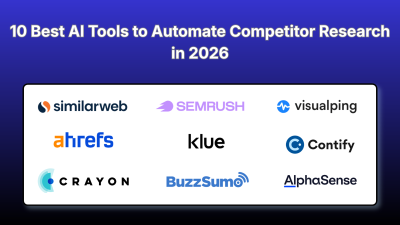
10 Best AI Tools to Automate Competitor Research in 2026
Competitor research can easily become a weekly task that never really ends. A SaaS founder may need to check competitor pricing, product updates, new features, customer reviews, website changes, traffic sources, SEO rankings, backlinks, paid campaigns, hiring activity, and new market moves. Doing all of that manually means opening dozens of tabs, copying information into spreadsheets, and repeating the same work every week. AI competitor analysis tools are changing that workflow. Instead of manually searching for every update, these platforms can monitor competitors, collect information from multiple sources, identify important changes, summarize what happened, and help teams decide what to investigate next. > QUICK SUMMARY > > * Similarweb: Best for understanding competitor traffic, audience, acquisition channels, market position, SEO, advertising, apps, and AI-search visibility from one digital intelligence platform. > > * Crayon: Best for automatically tracking competitor changes across websites, pricing, job postings, release notes, reviews, filings, and news, then turning those changes into summarized intelligence and sales battlecards. > > * Klue: Best for B2B SaaS companies that need competitor intelligence connected to sales calls, win-loss analysis, battlecards, CRM workflows, and deal-specific recommendations. > > * Semrush: Best for researching competitors' SEO, keywords, backlinks, paid search, traffic channels, content opportunities, and visibility in AI-generated search results. > > * Ahrefs: Best for SEO-focused competitor research, especially competitor keywords, backlinks, content gaps, organic pages, SERPs, and increasingly AI-search visibility. > > Use BuzzSumo to track viral content, SpyFu for budget-friendly SEO/PPC insights, and Contify or AlphaSense for heavy-hitting enterprise market intelligence. BEST AI COMPETITOR RESEARCH TOOLS COMPARED | Rank | Tool | Key features for competitor research | Starting price | Best for | Free/Paid | | | | | : | | | | 1 | Similarweb | Competitor traffic, audience, acquisition channels, market analysis, competitor alerts, SEO, ads, AI-search intelligence | $125/month billed annually | SaaS founders, marketers, business strategy, market research | Paid + limited free access | | 2 | Crayon | Website monitoring, pricing changes, product updates, news, reviews, job postings, AI summaries, battlecards | Custom quote | B2B SaaS, product marketing, sales teams | Paid | | 3 | Klue | AI competitor monitoring, win-loss analysis, battlecards, sales-call intelligence, deal tips, CRM/Slack integrations | Custom quote | B2B SaaS sales and competitive intelligence | Paid | | 4 | Semrush | Competitor SEO, keywords, backlinks, traffic, paid search, content gaps, AI-search visibility, competitor monitoring | $139.95/month | SaaS marketing, SEO, founders, growth teams | Paid + 7-day trial | | 5 | Ahrefs | Competitor keywords, backlinks, content gaps, organic pages, SERP analysis, AI visibility, competitor comparison | $129/month | SEO teams, SaaS founders, content teams | Paid + free tools | | 6 | Visualping | AI website change detection, pricing monitoring, product-page monitoring, text/visual changes, alerts, API/MCP | Free; paid from $14/month | Founders tracking competitor websites and pricing | Free + Paid | | 7 | Contify | AI competitive intelligence, competitor monitoring, market news, company developments, alerts, dashboards | Custom quote | Enterprise strategy, product, marketing, and intelligence teams | Paid + trial | | 8 | AlphaSense | AI search, company research, earnings calls, filings, expert insights, market intelligence, competitor research | Custom quote | Business strategy, finance, corporate research | Paid | | 9 | BuzzSumo | Competitor content research, trending content, media monitoring, engagement analysis, backlinks, influencers | From $119/month | Content marketers, SaaS marketers, publishers | Paid | | 10 | SpyFu | Competitor keywords, PPC research, SEO rankings, backlinks, domain comparison, historical data | Free; paid from $33/month annually | Founders and marketers researching SEO/PPC competitors | Free + Paid | 1. SIMILARWEB Similarweb ranks first because it gives founders a broad view of what is happening around a competitor's digital business rather than limiting research to one channel. A founder can use it to investigate competitor website traffic, traffic sources, audience characteristics, marketing channels, keyword performance, and market trends. This is useful when the question is not simply "What keywords does this competitor rank for?" but "Where is this competitor getting its audience from?" Its current platform also includes AI-powered competitive intelligence, market research analysis, competitor benchmarking, AI search intelligence, SEO analysis, advertising intelligence, and AI agents. This makes it particularly useful for teams that want to combine competitor research with market research instead of maintaining separate tools for every question. For a SaaS founder, one practical workflow is to compare several competitors, identify which channels consistently drive traffic to them, inspect the pages attracting visitors, and then investigate whether those channels or topics are worth pursuing. Similarweb's data is estimated, so it should be used for directional comparison and market analysis rather than treating every traffic number as an exact internal company figure. PRICING Starting price: $125/month billed annually, or $199/month. The Competitive Intelligence package includes one user, three months of historical data, traffic and engagement, customer demographics, marketing-channel data, and competitor alerts. Best for: SaaS founders, marketing teams, business strategists, and researchers who want a broad view of competitor digital performance. 2. CRAYON Crayon is designed specifically around competitive intelligence rather than general SEO or website analytics. Its platform continuously monitors competitor activity across sources such as websites, pricing pages, job postings, release notes, support documentation, customer reviews, SEC filings, and press releases. Instead of requiring a team member to repeatedly check those sources, Crayon collects the information and surfaces changes that deserve attention. AI then helps summarize the information and identify important competitive signals. Crayon's platform includes AI importance scoring, AI news summaries, competitor monitoring, battlecards, newsletters, and sales-enablement workflows. This is especially useful for B2B SaaS companies where competitor information needs to reach sales teams quickly. A product marketer can use the intelligence to update positioning, while sales representatives can use battlecards when a competitor appears in an active deal. That makes Crayon more useful for companies with an established sales process than for a solo founder who only wants to check competitor keywords. PRICING Custom quote. Crayon does not publish a standard price on its official website. Best for: B2B SaaS companies, product marketing teams, competitive intelligence teams, and sales organizations. 3. KLUE Klue combines competitor research with sales intelligence and win-loss analysis. Its AI platform can continuously collect information from competitor websites, reviews, news, sales calls, win-loss interviews, and internal documents. It then identifies patterns and generates competitor profiles, insights, and competitive content. The strongest use case is connecting research with active sales opportunities. Klue can detect competitor mentions in sales calls, identify competitive pressure, recommend sales tactics, and send deal tips to sellers. It also integrates with systems such as Salesforce and Slack, making competitive information easier to access inside the tools sales teams already use. For a SaaS business competing against several established vendors, this can answer questions such as why deals are being lost, which competitors appear most frequently, which objections sellers face, and what messaging is working in successful deals. That makes Klue more than a competitor-monitoring dashboard. PRICING Custom quote. Klue does not publish a standard public subscription price. Best for: B2B SaaS sales teams, product marketing teams, competitive intelligence professionals, and companies running structured win-loss programs. 4. SEMRUSH Semrush is one of the strongest choices when competitor research starts with search. Its competitor-analysis tools let teams examine competitor keywords, organic rankings, backlinks, paid strategies, traffic trends, and the channels contributing to competitor growth. It can also monitor competitor content and advertising activity instead of requiring manual checks. Semrush has also expanded competitor research into AI search. Its Competitor Research Report can compare your brand with competitor domains across AI-generated answers, identify prompts where competitors are mentioned but your brand is missing, and show AI-visibility differences. For SaaS founders, this creates a practical research workflow. Start with three competitors, identify the keywords bringing them organic visibility, inspect the pages ranking for those terms, compare backlinks, check paid-search activity, and then look for topics where competitors are visible but your product is not. PRICING Starting price: $139.95/month for the SEO Classic Pro plan. Semrush also lists AI Visibility and other toolkits separately, while its annual billing can reduce the effective monthly cost. Best for: SaaS marketers, SEO teams, founders, content teams, and businesses competing for search and AI-search visibility. 5. AHREFS Ahrefs is another strong option for search-focused competitor research, particularly when backlinks and content are central to the strategy. Its Site Explorer and Competitive Analysis features allow teams to investigate competitor organic performance, pages, backlinks, keywords, SERPs, and content opportunities. This makes it useful for finding the pages and topics that already work for competitors rather than guessing what content might attract traffic. Ahrefs has also added AI-focused features. Its current plans include Brand Radar, tracked AI prompts, AI visibility data, and competitor-related research capabilities. The platform's current pricing page also lists API and MCP access, which can be useful for developers and teams building automated research workflows. For a SaaS founder, one useful approach is to compare your domain with three to five competitors, identify keywords where competitors rank but your site does not, inspect the pages receiving backlinks, and then combine those findings with product positioning and customer research. PRICING Starting price: $129/month for the Lite plan. Ahrefs also has a $29/month Starter plan with a smaller feature set, while its full Lite plan includes broader competitive analysis, keyword tracking, crawl credits, and AI prompt tracking. Best for: SEO teams, SaaS founders, content marketers, developers building SEO workflows, and businesses focused on organic growth. 6. VISUALPING Visualping solves a different competitor-research problem: finding out when something changes. Instead of asking how much traffic a competitor receives, Visualping watches specific pages and alerts you when their content changes. A founder can monitor competitor pricing pages, product pages, feature pages, landing pages, documentation, terms, careers pages, or other important URLs. Its current plans include visual, text, and element change detection, AI-generated change summaries, and an important-or-not classification for detected changes. REST API and MCP access are available across plans, including the free plan. This can be especially useful for small SaaS teams. A founder does not need to remember to check five competitor pricing pages every Friday. Instead, the monitoring system can flag a change such as a new pricing tier, changed headline, new feature, altered guarantee, or product-page update. PRICING Free plan available with 150 checks/month. Paid plans start at $14/month, or $10/month when billed annually. Best for: Solo founders, SaaS teams, product managers, marketers, and businesses that need automatic competitor website monitoring. 7. CONTIFY Contify is built for continuous market and competitive intelligence rather than one-time competitor research. It can monitor competitor developments, industry news, company activity, and other external intelligence and organize the information for teams across strategy, product, marketing, and sales. Its positioning makes it more suitable for organizations where competitor intelligence is an ongoing business process. The advantage is the breadth of information. Instead of focusing only on competitor websites or SEO, Contify is designed to help teams follow developments across a wider competitive and market landscape. For larger SaaS companies, this can be useful when competitive research involves multiple departments. Product teams can monitor competitor releases, marketing teams can follow market messaging, and strategy teams can track broader industry developments from the same intelligence workflow. PRICING Custom quote. Contify currently offers a 7-day free trial according to its published product comparison. Best for: Enterprise strategy teams, product teams, marketing teams, and organizations running continuous competitive intelligence programs. 8. ALPHASENSE AlphaSense is particularly useful when competitor research involves business strategy, financial information, market research, and corporate documents. Instead of focusing primarily on website traffic or SEO, AlphaSense is designed around searching and analyzing large volumes of business information. This makes it useful for understanding competitors through earnings calls, company filings, research, expert insights, and other professional sources. For example, a strategy team researching a public competitor may want to know how management describes a new market, what risks executives are discussing, what products are becoming priorities, or how the company's positioning is changing. Those questions require different data from an SEO competitor analysis. AlphaSense is therefore better suited to strategic research than to a solo founder who simply wants to compare website keywords. For larger companies, however, it can become a central research layer for market and competitor intelligence. PRICING Custom quote. AlphaSense does not publish a standard public subscription price. Best for: Corporate strategy teams, investment research, finance teams, market researchers, and large businesses. 9. BUZZSUMO BuzzSumo focuses on a part of competitor research that many SaaS teams overlook: what content actually attracts attention. Its Content Analyzer can investigate content performance across topics, URLs, and domains, while Trending Feeds help identify recently popular content. The platform also provides media monitoring, alerts, influencer discovery, and engagement data. For a SaaS content team, this means competitor research can move beyond "What keywords does the competitor rank for?" You can investigate which competitor articles receive engagement, which topics repeatedly generate attention, which publishers cover the competitor, and which people amplify similar content. This is especially useful before launching a new content strategy. Instead of publishing dozens of articles based only on keyword volume, a team can analyze successful competitor content and identify patterns in topics, formats, publishers, and distribution. PRICING Starting price: $119/month for the Basic plan according to BuzzSumo's published pricing information. Higher plans add more users, alerts, searches, and advanced capabilities. Best for: SaaS content teams, marketers, publishers, PR teams, and founders researching competitor content strategies. 10. SPYFU SpyFu is a practical option for founders who want competitor SEO and PPC research without paying enterprise-level competitive-intelligence prices. Its core research includes competitor keywords, paid-search activity, organic rankings, backlinks, domain comparisons, keyword groups, historical data, and exports. The platform also provides data on competitor advertising and SEO rankings. One useful feature for SaaS marketers is domain comparison. A founder can compare a website against competitors and identify overlapping keywords, ranking opportunities, paid-search activity, and areas where competitors have built stronger search visibility. SpyFu is not a replacement for a full competitive-intelligence platform such as Crayon or Klue. Its strength is much more specific: search and advertising competitor research at a lower entry price. PRICING Free plan available. Paid plans start at $33/month when billed annually, or $39/month on monthly billing. Best for: SaaS founders, marketers, small businesses, SEO teams, and PPC teams that need affordable competitor search intelligence. HOW TO CHOOSE THE RIGHT AI COMPETITOR RESEARCH TOOL Choose tools based on your research goals: * Traffic analysis: Similarweb * Website monitoring: Visualping * SEO and backlinks: Semrush or Ahrefs * Sales intelligence: Crayon or Klue * Content research: BuzzSumo * Market intelligence: Contify or AlphaSense Solo founders can start with one SEO tool, website monitoring, and free resources like Google Alerts. Growing teams can add specialized platforms as needed. HOW AI CHANGES COMPETITOR RESEARCH AI automates data collection, monitors competitor changes, identifies patterns, and summarizes insights. Tools like Crayon and Klue support competitive intelligence, while Semrush and Ahrefs help track SEO and AI-search visibility. The best approach combines AI-driven research with human judgment to make better business decisions. A PRACTICAL COMPETITOR RESEARCH WORKFLOW FOR SAAS FOUNDERS Track three to five competitors and monitor relevant signals, including pricing, product updates, keywords, customer reviews, and backlinks. Automate repetitive tasks, then use the findings to guide product, marketing, and positioning decisions. CONCLUSION AI competitor research tools help SaaS businesses track competitors, uncover market opportunities, and improve decision-making. Start with the insights that matter most to your business rather than investing in every platform. For most SaaS founders, there is no reason to buy every tool on this list. Start with the competitor questions that affect revenue, product decisions, SEO, or customer acquisition, automate the repetitive research, and use the resulting information to make decisions your competitors are not making. That is where AI competitor research becomes useful: not when it produces another competitor report, but when it helps a business act on what competitors are doing before the opportunity disappears.